

Pour le retour d’une VF de qualité et sans IA dans World of Warcraft
Le problème
⬇️ ⬇️ ⬇️ Scroll down for the English version ⬇️ ⬇️ ⬇️
L’extension World of Warcraft : Midnight est sortie le 3 mars, à grand renfort d’une campagne de communication sans précédent. Les joueurs et la critique ont acclamé les nouveautés comme le housing, la race alliée des Haranir, la zone de Quel’Thalas revisitée, les nouvelles quêtes et donjons.
Mais il y a une ombre au tableau qui est loin de faire l’unanimité : le doublage en français.
La VF de Midnight a reçu de nombreuses critiques de la part des joueurs :
- Les voix des personnages emblématiques comme Xal’atath, Anduin, Alleria et Turalyon ont été remplacées. Certains d’entre eux changent même de voix au cours de l’extension.
- Le doublage est d’une qualité inférieure comparé aux précédentes extensions, le jeu d’acteur est moins expressif, voire plat.
- Il y a de nombreuses erreurs de traduction et de prononciation dans les noms propres.
- Les phrases de certains dialogues sont interrompues en plein milieu car la synchronisation avec la VO n'est pas respectée.
- Certains personnages ont un très fort accent québécois.
- Le rendu de certains dialogues ressemble à de l'audio généré avec de l’IA.
À l’heure actuelle, ce sujet a généré plus de 20 000 réactions et plus d’un million de vues.
Le nombre de comédiennes et comédiens de doublage dans les crédits de l’extension Midnight passe de 75 à The War Within à seulement 8 au moment de la sortie officielle.
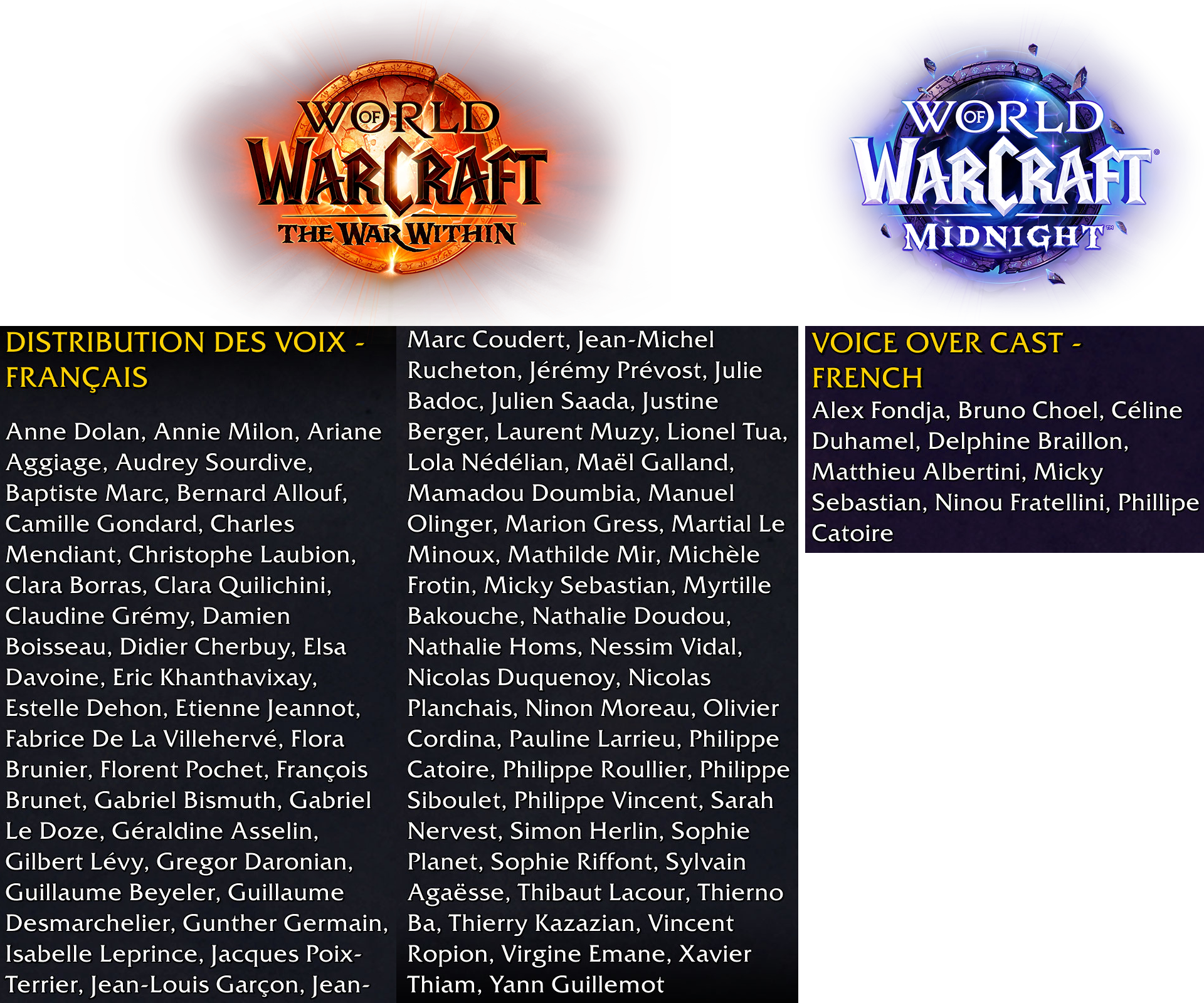
Le patch 11.2.7 précédent la sortie de Midnight n’a même reçu aucun doublage en français.
Ce doublage en français bâclé nuit à l’immersion des joueurs francophones et va totalement à l’encontre de la qualité exceptionnelle du reste de l’extension.
La source du problème
Alors que l’extension Midnight était en phase de développement, le Syndicat Français des Artistes interprètes (SFA) (l’équivalent du SAG-AFTRA américain) a repéré une clause à propos de l’usage de l’IA générative en relisant le contrat qui lie l’éditeur, Microsoft, et les comédiennes et comédiens de doublage.
La clause, imposée par Microsoft, est supposée engager Microsoft à ne pas utiliser les enregistrements de la voix des artistes pour entraîner les systèmes d’IA générative :
« Le Client s’engage à ne pas utiliser de nouveaux éléments dans la voix unique et reconnaissable de l’Artiste-interprète pour la Production et la génération par la technologie d’intelligence artificielle générative, à moins que l’Artiste-interprète n’y ait préalablement consenti en signant la Lettre d’accord ci-jointe. »
Pour le SFA, cette clause ne garantit par une protection suffisante et a par conséquent fortement déconseillé aux artistes de signer ce type de contrat.
Les comédiennes et comédiens de doublage historiques ont donc suivi ce conseil et décidé de ne pas renouveler leur contrat pour l’extension Midnight, ce qui a contraint Microsoft et Blizzard à faire appel en urgence à des prestataires étrangers qui parlent un français différent (Québec) ou bien moins expérimentés.
Conséquences de l’utilisation de l’IA pour le doublage
On peut comprendre que l’IA puisse se montrer pratique dans de nombreux cas, par exemple pour corriger un dialogue déjà enregistré ou combler un vide sans avoir besoin de solliciter de nouveau l’artiste. Cependant, l’économie faite en utilisant des voix synthétiques à la place d’un véritable enregistrement d’artiste reste insignifiante face à la qualité médiocre du résultat obtenu.
Les voix IA ne représentent que des inconvénients pour les joueurs et les artistes :
- La voix d’un(e) artiste, ce n’est pas que sa propriété intellectuelle, c’est son identité. Reproduire sa voix avec une IA, c’est s’approprier son identité. C’est également une donnée biométrique : en cas de fuite de données, les données de l’IA peuvent être exploitées pour usurper son identité, avec des conséquences catastrophiques.
- Remplacer les artistes par des IA représente un manque à gagner et menace la profession.
- Les IA sont incapables de reproduire toute l’émotion et l’engagement qu’un(e) comédien(ne) de doublage met dans son personnage. Les doublages artificiels sont plats, fades et sans âme.
- La qualité audio des sons générés par IA est très médiocre, présente de nombreux artefacts et reste bien en dessous d’un véritable enregistrement en studio.
- L’immersion des joueurs avec l’univers est rompue à cause des nombreux défauts des voix IA.
La communauté des joueurs de World of Warcraft fait part de son inquiétude quant à l’avenir de l’industrie du jeu vidéo face au slop IA de plus en plus omniprésent.
Pourquoi le doublage en français est important
Le doublage est une véritable institution culturelle en France et dans les pays francophones.
Les comédiennes et comédiens de doublage sont autant respectés et appréciés que les acteurs et les personnages à qui ils prêtent leur voix.
Blizzard a toujours habitué ses joueurs à des jeux d’une qualité exceptionnelle, bien au-delà de ce que proposent la plupart des éditeurs. Le doublage en français de World of Warcraft était jusqu’ici à la hauteur de cette qualité en faisant intervenir des artistes parmi les plus prestigieux :
- Micky Sebastian (Sharon Stone) : Xal’atath
- Martial Le Minoux (Professeur Layton) : Thrall
- Pierre Tessier (Ryan Reynolds) : Arthas Menethil
- Jérémy Prévost (Mackenzie Crook) : Anduin Wrynn
- Frédéric Cerdal (Michael Caine) : Genn Grisetête
- Philippe Peythieu (Homer Simpson) : Roi Mécagone, Terestian Malsabot et divers personnages
- Benoît Allemane (Morgan Freeman) : Sénégos, Sartharion et divers personnages
- Brigitte Lecordier (Son Goku enfant) : Joma et divers personnages
- Luc Boulad (Chris Griffin) : Lor’themar Theron
- Sylvie Jacob (Natalie Portman) : Calia Menethil
- Gilles Morvan (Benedict Cumberbatch) : Kilrogg
- Donald Reignoux (Jesse Eisenberg) : Durotan
- Dorothée Pousséo (Margot Robbie) : Luisaile et divers personnages
- Patrick Borg (Charlie Sheen), Emmanuel Karsen (Sean Penn) etc.
En l’état, le doublage en français de World of Warcraft : Midnight est donc perçu comme un véritable affront envers les joueurs francophones ainsi que la profession des artistes interprètes.
Revendications
En signant cette pétition, nous souhaitons :
- Intégrer une clause commune élaborée conjointement par le SFA et l’association Les Voix au contrat liant les artistes de doublage et Microsoft, visant à exclure explicitement toute utilisation de leurs prestations pour :
- L’entraînement ou l’apprentissage de systèmes d’IA,
- La génération de répliques numériques,
- La création de voix synthétiques, qu’elles imitent ou non la voix originale.
- Embaucher les comédiennes et comédiens de doublage historiques pour les futurs doublages de World of Warcraft sous ce nouveau contrat.
- Réenregistrer les doublages de World of Warcraft : Midnight avec les artistes historiques.
Si vous êtes d’accord et souhaitez vivre World of Warcraft avec un doublage français de qualité et préserver le métier de celles et ceux qui le rendent possible, signez cette pétition.
Ensemble, faisons entendre notre voix !
-=-=-=-=-=-=-=-=-=-=-
ENGLISH VERSION
-=-=-=-=-=-=-=-=-=-=-
Getting back the high standard Non-AI French voice acting in World of Warcraft
The Issue
The World of Warcraft: Midnight expansion launched on March 3rd, backed by an unprecedented marketing campaign. Players and critics praised new features, such as, housing, the Haranir allied race, the Quel’Thalas region makeover, the new quests and dungeons.
But there’s one glaring issue that has been met with widespread criticism: the French voice acting.
The French voice acting for Midnight, drew significant backlash from players:
- The voices of iconic characters such as Xal’atath, Anduin, Alleria, and Turalyon have been replaced. Some of them even change voices mid-expansion.
- The voice acting quality is a downgrade compared to previous expansions — performances are less impressive, or even, flatlining.
- There’s a dense amount of translation errors, and actual name mispronounciations.
- Some dialogue lines are interrupted mid-sentence because the synchronization with the original version is not respected.
- Some characters got a new noticeable Québec accent.
- Some dialogues sound like AI-generated audio.
At this time, this concern generated more than 20,000 reactions and more than one million views.
The number of voice actors credited in the Midnight expansion, dropped from 75 in The War Within, to just 8, at the official release.
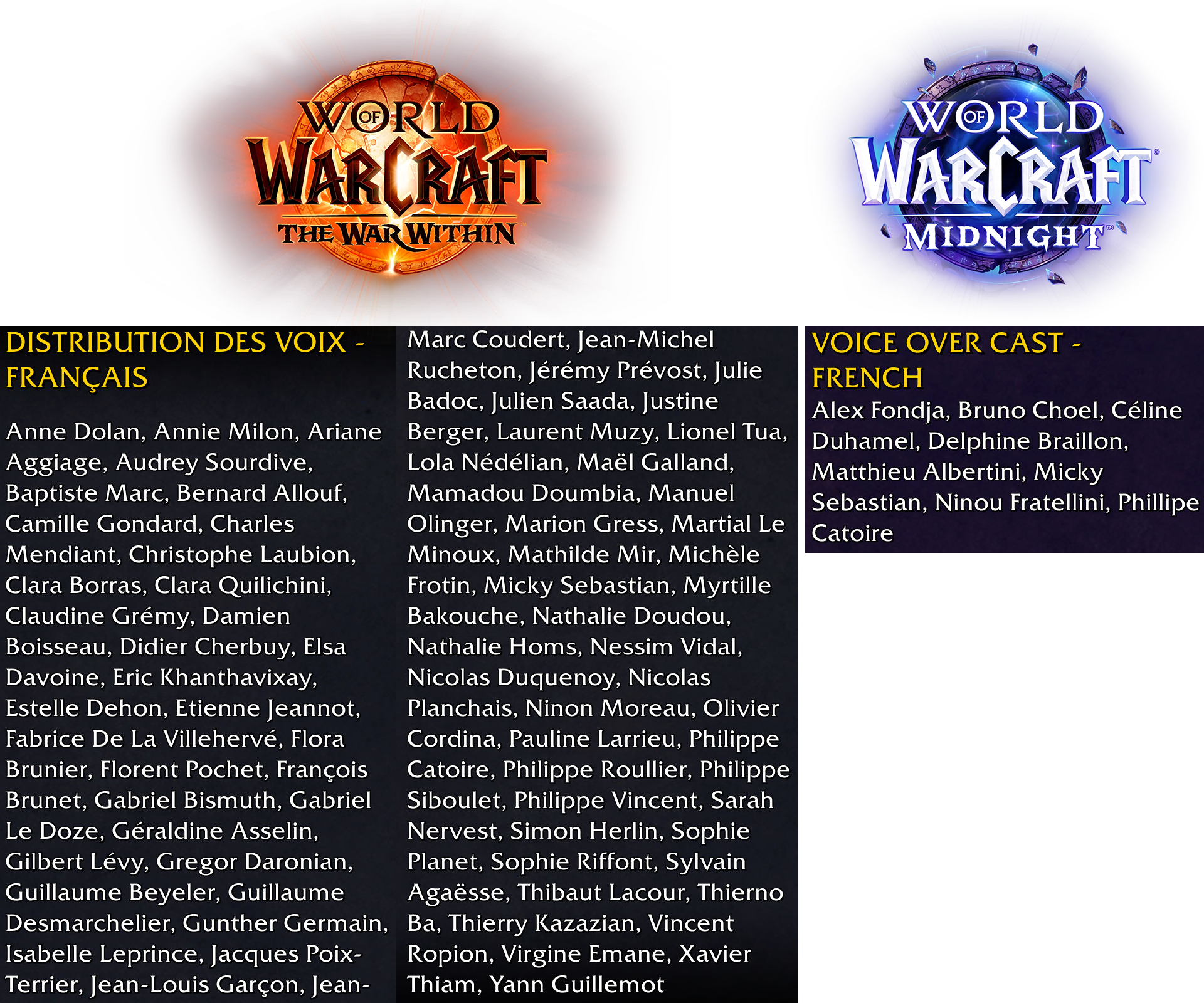
Patch 11.2.7, which preceded Midnight’s release, contained no French voice acting at all.
This rushed French voice acting ruins the immersion of French-speaking players, which completely opposes the otherwise, exceptional quality of this expansion.
Core of the issue
While the Midnight expansion was in development, the Syndicat Français des Artistes interprètes (SFA) which is the French equivalent of SAG-AFTRA, identified a clause regarding the use of generative AI while reviewing the contract binding the publisher, Microsoft, and the voice actors.
The clause, imposed by Microsoft, is intended to bind Microsoft to not using recordings of artists’ voices to train generative AI systems:
"The Client agrees not to use new elements in the unique and recognizable voice of the Performer for the Production and generation by generative artificial intelligence technology, unless the Performer has previously consented to this by signing the attached Letter of Agreement."
According to the SFA, this clause does not provide sufficient protection and they consequently strongly advised voice actors against signing this type of contract.
The long-standing French voice over cast followed this advice and chose not to renew their contracts for the Midnight expansion, forcing Microsoft and Blizzard to urgently turn to foreign contractors, who either speak a different variety of French (Québec), or have considerably less experience.
Consequences of Using AI for Voice Over
It’s understandable that AI can be convenient in certain cases — for instance, to fix a line of already-recorded dialogue or fill a gap without needing to bring an artist back in. However, the cost savings from using synthetic voices instead of real recorded performances are insignificant compared to the mediocre quality of the result.
AI voices are nothing but drawbacks for players and artists alike:
- A performer’s voice is not just their intellectual property — it is their identity. Reproducing it with AI is a form of identity theft. It also constitutes biometric data: in the event of a data breach, AI data could be exploited to impersonate the artist, with the potential of disastrous consequences.
- Replacing artists with AI represents shortfall and threatens the profession.
- AI is incapable of reproducing the full emotion and commitment a voice actor brings to a character. Artificial dubs are flatlining, lifeless, and soulless.
- The audio quality of AI-generated sounds is cheap, riddled with artifacts, and falls short of a genuine studio recording.
- Player’s immersion is shattered by the many inherent flaws of AI voices.
The World of Warcraft player’s community is expressing a growing concern about the future of the video game industry, in the face of increasing pervasive AI slop.
Why French voice acting matters
Voice acting and dubbing is a genuine cultural institution in France and across French-speaking countries.
Voice actors are as respected and beloved as the on-screen actors and the characters they bring to life.
Blizzard has always set an exceptionally high bar for their games, far beyond what most publishers offers. The French voice acting in World of Warcraft has historically lived up to that standard, featuring some of the most prestigious artists in the field:
- Micky Sebastian (Sharon Stone): Xal’atath
- Martial Le Minoux (Professor Layton): Thrall
- Pierre Tessier (Ryan Reynolds): Arthas Menethil
- Jérémy Prévost (Mackenzie Crook): Anduin Wrynn
- Frédéric Cerdal (Michael Caine): Genn Greymane
- Philippe Peythieu (Homer Simpson): Mekkatorque, Terestian Illhoof, and various characters
- Benoît Allemane (Morgan Freeman): Senegos, Sartharion, and various characters
- Brigitte Lecordier (young Son Goku): Joma and various characters
- Luc Boulad (Chris Griffin): Lor’themar Theron
- Sylvie Jacob (Natalie Portman): Calia Menethil
- Gilles Morvan (Benedict Cumberbatch): Kilrogg
- Donald Reignoux (Jesse Eisenberg): Durotan
- Dorothée Pousséo (Margot Robbie): Brightwing and various characters
- Patrick Borg (Charlie Sheen), Emmanuel Karsen (Sean Penn), etc.
As it stands, the French voice acting in World of Warcraft: Midnight is widely perceived as a direct insult to French-speaking players and to the voice acting profession as a whole.
Demands
By signing this petition, we call for:
- The inclusion of a common clause jointly developed by the SFA and the association Les Voix in the contract between voice actors and Microsoft, explicitly prohibiting the use of their performances for:
- The training or machine learning of AI systems,
- The generation of digital replicas,
- The creation of synthetic voices, whether or not they imitate the original voice.
- Rehiring the long-standing French voice over cast for future World of Warcraft voice overs under this new contract.
- Re-recording the World of Warcraft: Midnight dub with the original cast of artists.
If you agree and want to experience World of Warcraft with a top notch quality voice acting, in French or any langage, and to preserve the profession of those who make it happen, sign this petition.
Together, let’s make our voices heard!
-=-=-=-=-=-=-=-
PUBLICATIONS
-=-=-=-=-=-=-=-
- Restore French Voice Acting: Stop Cutting, Replacing, and Abandoning French Dubbing — XBOX Player Voice (500+ upvotes)
- Les voix françaises s’opposent à l’IA ! — @rtbf_ixpe x @manonnamaya (5.7K likes)
- Le PLUS GROS PROBLÈME de World Of Warcraft — @Celetik (35K views)
- 🚨 JOUEURS FRANÇAIS WoW EN RAGE TOTALE — @Lusty_Luxure (11K views)
- Corinne Wellong renonce au rôle de Talanji face aux clauses IA de Microsoft — @corinnewell (844 likes)
- Le gros problème de World of Warcraft... — @ArchivumAzeroth (1K views)
- Midnight : un changement de doublage qui fait réagir la communauté — Blizzspirit
- Défendre les voix françaises face à l’ère de l’intelligence artificielle — Mamytwink
- WoW : Les joueurs français sont en colère suite à la décision de Blizzard de changer les voix des personnages — Millenium
- World of Warcraft change ses voix et provoque la colère de ses joueurs — Frandroid
- Blizzard remplace la doubleuse française de Xal’atath sur fond d’IA, provoquant la colère des joueurs — Always For Keyboard
- IA et doublage chez Xbox : la nouvelle voix de Warcraft met les joueurs en colère — Xboxygen
- Voix off : les comédiens français en guerre contre l'IA de Microsoft et Amazon — La Tribune
- Doublage VF inexistant 11.2.7 — Forum officiel (594 messages)
- The situation with French voice acting in WoW — and why it might affect all localizations — r/wow (937 likes, 169 comments)
- Things are getting worse, when will we see the end (French dubbing)? — r/wow (216 likes, 110 comments)
- The french dub is infuriating — r/wow (392 likes, 223 comments)
- Lilaju "Allons travaille" — @Troma (369.5K views, 614 likes, 77 reposts)
- Je comprends pas qu'une société ayant des milliards puisse se permettre ce move... — @Sheshounet (242.7K views, 2K likes, 213 reposts)
- Microsoft is replacing the voices for the French versions of Blizzard titles... — @Arkentass (69.1 K views, 1K likes, 151 reposts)
- Midnight marque un tournant pour World of Warcraft sur le doublage français. — @Evanessor (99.3K views, 409 likes, 106 reposts)
- What’s up with the French voice acting situation for WoW? — @BellularGaming (58.8K views, 224 likes, 22 reposts)
- Vidéos de comparaison — @AzerothHub
#TouchepasàmaWoWVF Discord server: https://discord.gg/7TvZUvXnUZ

934
Le problème
⬇️ ⬇️ ⬇️ Scroll down for the English version ⬇️ ⬇️ ⬇️
L’extension World of Warcraft : Midnight est sortie le 3 mars, à grand renfort d’une campagne de communication sans précédent. Les joueurs et la critique ont acclamé les nouveautés comme le housing, la race alliée des Haranir, la zone de Quel’Thalas revisitée, les nouvelles quêtes et donjons.
Mais il y a une ombre au tableau qui est loin de faire l’unanimité : le doublage en français.
La VF de Midnight a reçu de nombreuses critiques de la part des joueurs :
- Les voix des personnages emblématiques comme Xal’atath, Anduin, Alleria et Turalyon ont été remplacées. Certains d’entre eux changent même de voix au cours de l’extension.
- Le doublage est d’une qualité inférieure comparé aux précédentes extensions, le jeu d’acteur est moins expressif, voire plat.
- Il y a de nombreuses erreurs de traduction et de prononciation dans les noms propres.
- Les phrases de certains dialogues sont interrompues en plein milieu car la synchronisation avec la VO n'est pas respectée.
- Certains personnages ont un très fort accent québécois.
- Le rendu de certains dialogues ressemble à de l'audio généré avec de l’IA.
À l’heure actuelle, ce sujet a généré plus de 20 000 réactions et plus d’un million de vues.
Le nombre de comédiennes et comédiens de doublage dans les crédits de l’extension Midnight passe de 75 à The War Within à seulement 8 au moment de la sortie officielle.
Le patch 11.2.7 précédent la sortie de Midnight n’a même reçu aucun doublage en français.
Ce doublage en français bâclé nuit à l’immersion des joueurs francophones et va totalement à l’encontre de la qualité exceptionnelle du reste de l’extension.
La source du problème
Alors que l’extension Midnight était en phase de développement, le Syndicat Français des Artistes interprètes (SFA) (l’équivalent du SAG-AFTRA américain) a repéré une clause à propos de l’usage de l’IA générative en relisant le contrat qui lie l’éditeur, Microsoft, et les comédiennes et comédiens de doublage.
La clause, imposée par Microsoft, est supposée engager Microsoft à ne pas utiliser les enregistrements de la voix des artistes pour entraîner les systèmes d’IA générative :
« Le Client s’engage à ne pas utiliser de nouveaux éléments dans la voix unique et reconnaissable de l’Artiste-interprète pour la Production et la génération par la technologie d’intelligence artificielle générative, à moins que l’Artiste-interprète n’y ait préalablement consenti en signant la Lettre d’accord ci-jointe. »
Pour le SFA, cette clause ne garantit par une protection suffisante et a par conséquent fortement déconseillé aux artistes de signer ce type de contrat.
Les comédiennes et comédiens de doublage historiques ont donc suivi ce conseil et décidé de ne pas renouveler leur contrat pour l’extension Midnight, ce qui a contraint Microsoft et Blizzard à faire appel en urgence à des prestataires étrangers qui parlent un français différent (Québec) ou bien moins expérimentés.
Conséquences de l’utilisation de l’IA pour le doublage
On peut comprendre que l’IA puisse se montrer pratique dans de nombreux cas, par exemple pour corriger un dialogue déjà enregistré ou combler un vide sans avoir besoin de solliciter de nouveau l’artiste. Cependant, l’économie faite en utilisant des voix synthétiques à la place d’un véritable enregistrement d’artiste reste insignifiante face à la qualité médiocre du résultat obtenu.
Les voix IA ne représentent que des inconvénients pour les joueurs et les artistes :
- La voix d’un(e) artiste, ce n’est pas que sa propriété intellectuelle, c’est son identité. Reproduire sa voix avec une IA, c’est s’approprier son identité. C’est également une donnée biométrique : en cas de fuite de données, les données de l’IA peuvent être exploitées pour usurper son identité, avec des conséquences catastrophiques.
- Remplacer les artistes par des IA représente un manque à gagner et menace la profession.
- Les IA sont incapables de reproduire toute l’émotion et l’engagement qu’un(e) comédien(ne) de doublage met dans son personnage. Les doublages artificiels sont plats, fades et sans âme.
- La qualité audio des sons générés par IA est très médiocre, présente de nombreux artefacts et reste bien en dessous d’un véritable enregistrement en studio.
- L’immersion des joueurs avec l’univers est rompue à cause des nombreux défauts des voix IA.
La communauté des joueurs de World of Warcraft fait part de son inquiétude quant à l’avenir de l’industrie du jeu vidéo face au slop IA de plus en plus omniprésent.
Pourquoi le doublage en français est important
Le doublage est une véritable institution culturelle en France et dans les pays francophones.
Les comédiennes et comédiens de doublage sont autant respectés et appréciés que les acteurs et les personnages à qui ils prêtent leur voix.
Blizzard a toujours habitué ses joueurs à des jeux d’une qualité exceptionnelle, bien au-delà de ce que proposent la plupart des éditeurs. Le doublage en français de World of Warcraft était jusqu’ici à la hauteur de cette qualité en faisant intervenir des artistes parmi les plus prestigieux :
- Micky Sebastian (Sharon Stone) : Xal’atath
- Martial Le Minoux (Professeur Layton) : Thrall
- Pierre Tessier (Ryan Reynolds) : Arthas Menethil
- Jérémy Prévost (Mackenzie Crook) : Anduin Wrynn
- Frédéric Cerdal (Michael Caine) : Genn Grisetête
- Philippe Peythieu (Homer Simpson) : Roi Mécagone, Terestian Malsabot et divers personnages
- Benoît Allemane (Morgan Freeman) : Sénégos, Sartharion et divers personnages
- Brigitte Lecordier (Son Goku enfant) : Joma et divers personnages
- Luc Boulad (Chris Griffin) : Lor’themar Theron
- Sylvie Jacob (Natalie Portman) : Calia Menethil
- Gilles Morvan (Benedict Cumberbatch) : Kilrogg
- Donald Reignoux (Jesse Eisenberg) : Durotan
- Dorothée Pousséo (Margot Robbie) : Luisaile et divers personnages
- Patrick Borg (Charlie Sheen), Emmanuel Karsen (Sean Penn) etc.
En l’état, le doublage en français de World of Warcraft : Midnight est donc perçu comme un véritable affront envers les joueurs francophones ainsi que la profession des artistes interprètes.
Revendications
En signant cette pétition, nous souhaitons :
- Intégrer une clause commune élaborée conjointement par le SFA et l’association Les Voix au contrat liant les artistes de doublage et Microsoft, visant à exclure explicitement toute utilisation de leurs prestations pour :
- L’entraînement ou l’apprentissage de systèmes d’IA,
- La génération de répliques numériques,
- La création de voix synthétiques, qu’elles imitent ou non la voix originale.
- Embaucher les comédiennes et comédiens de doublage historiques pour les futurs doublages de World of Warcraft sous ce nouveau contrat.
- Réenregistrer les doublages de World of Warcraft : Midnight avec les artistes historiques.
Si vous êtes d’accord et souhaitez vivre World of Warcraft avec un doublage français de qualité et préserver le métier de celles et ceux qui le rendent possible, signez cette pétition.
Ensemble, faisons entendre notre voix !
-=-=-=-=-=-=-=-=-=-=-
ENGLISH VERSION
-=-=-=-=-=-=-=-=-=-=-
Getting back the high standard Non-AI French voice acting in World of Warcraft
The Issue
The World of Warcraft: Midnight expansion launched on March 3rd, backed by an unprecedented marketing campaign. Players and critics praised new features, such as, housing, the Haranir allied race, the Quel’Thalas region makeover, the new quests and dungeons.
But there’s one glaring issue that has been met with widespread criticism: the French voice acting.
The French voice acting for Midnight, drew significant backlash from players:
- The voices of iconic characters such as Xal’atath, Anduin, Alleria, and Turalyon have been replaced. Some of them even change voices mid-expansion.
- The voice acting quality is a downgrade compared to previous expansions — performances are less impressive, or even, flatlining.
- There’s a dense amount of translation errors, and actual name mispronounciations.
- Some dialogue lines are interrupted mid-sentence because the synchronization with the original version is not respected.
- Some characters got a new noticeable Québec accent.
- Some dialogues sound like AI-generated audio.
At this time, this concern generated more than 20,000 reactions and more than one million views.
The number of voice actors credited in the Midnight expansion, dropped from 75 in The War Within, to just 8, at the official release.
Patch 11.2.7, which preceded Midnight’s release, contained no French voice acting at all.
This rushed French voice acting ruins the immersion of French-speaking players, which completely opposes the otherwise, exceptional quality of this expansion.
Core of the issue
While the Midnight expansion was in development, the Syndicat Français des Artistes interprètes (SFA) which is the French equivalent of SAG-AFTRA, identified a clause regarding the use of generative AI while reviewing the contract binding the publisher, Microsoft, and the voice actors.
The clause, imposed by Microsoft, is intended to bind Microsoft to not using recordings of artists’ voices to train generative AI systems:
"The Client agrees not to use new elements in the unique and recognizable voice of the Performer for the Production and generation by generative artificial intelligence technology, unless the Performer has previously consented to this by signing the attached Letter of Agreement."
According to the SFA, this clause does not provide sufficient protection and they consequently strongly advised voice actors against signing this type of contract.
The long-standing French voice over cast followed this advice and chose not to renew their contracts for the Midnight expansion, forcing Microsoft and Blizzard to urgently turn to foreign contractors, who either speak a different variety of French (Québec), or have considerably less experience.
Consequences of Using AI for Voice Over
It’s understandable that AI can be convenient in certain cases — for instance, to fix a line of already-recorded dialogue or fill a gap without needing to bring an artist back in. However, the cost savings from using synthetic voices instead of real recorded performances are insignificant compared to the mediocre quality of the result.
AI voices are nothing but drawbacks for players and artists alike:
- A performer’s voice is not just their intellectual property — it is their identity. Reproducing it with AI is a form of identity theft. It also constitutes biometric data: in the event of a data breach, AI data could be exploited to impersonate the artist, with the potential of disastrous consequences.
- Replacing artists with AI represents shortfall and threatens the profession.
- AI is incapable of reproducing the full emotion and commitment a voice actor brings to a character. Artificial dubs are flatlining, lifeless, and soulless.
- The audio quality of AI-generated sounds is cheap, riddled with artifacts, and falls short of a genuine studio recording.
- Player’s immersion is shattered by the many inherent flaws of AI voices.
The World of Warcraft player’s community is expressing a growing concern about the future of the video game industry, in the face of increasing pervasive AI slop.
Why French voice acting matters
Voice acting and dubbing is a genuine cultural institution in France and across French-speaking countries.
Voice actors are as respected and beloved as the on-screen actors and the characters they bring to life.
Blizzard has always set an exceptionally high bar for their games, far beyond what most publishers offers. The French voice acting in World of Warcraft has historically lived up to that standard, featuring some of the most prestigious artists in the field:
- Micky Sebastian (Sharon Stone): Xal’atath
- Martial Le Minoux (Professor Layton): Thrall
- Pierre Tessier (Ryan Reynolds): Arthas Menethil
- Jérémy Prévost (Mackenzie Crook): Anduin Wrynn
- Frédéric Cerdal (Michael Caine): Genn Greymane
- Philippe Peythieu (Homer Simpson): Mekkatorque, Terestian Illhoof, and various characters
- Benoît Allemane (Morgan Freeman): Senegos, Sartharion, and various characters
- Brigitte Lecordier (young Son Goku): Joma and various characters
- Luc Boulad (Chris Griffin): Lor’themar Theron
- Sylvie Jacob (Natalie Portman): Calia Menethil
- Gilles Morvan (Benedict Cumberbatch): Kilrogg
- Donald Reignoux (Jesse Eisenberg): Durotan
- Dorothée Pousséo (Margot Robbie): Brightwing and various characters
- Patrick Borg (Charlie Sheen), Emmanuel Karsen (Sean Penn), etc.
As it stands, the French voice acting in World of Warcraft: Midnight is widely perceived as a direct insult to French-speaking players and to the voice acting profession as a whole.
Demands
By signing this petition, we call for:
- The inclusion of a common clause jointly developed by the SFA and the association Les Voix in the contract between voice actors and Microsoft, explicitly prohibiting the use of their performances for:
- The training or machine learning of AI systems,
- The generation of digital replicas,
- The creation of synthetic voices, whether or not they imitate the original voice.
- Rehiring the long-standing French voice over cast for future World of Warcraft voice overs under this new contract.
- Re-recording the World of Warcraft: Midnight dub with the original cast of artists.
If you agree and want to experience World of Warcraft with a top notch quality voice acting, in French or any langage, and to preserve the profession of those who make it happen, sign this petition.
Together, let’s make our voices heard!
-=-=-=-=-=-=-=-
PUBLICATIONS
-=-=-=-=-=-=-=-
- Restore French Voice Acting: Stop Cutting, Replacing, and Abandoning French Dubbing — XBOX Player Voice (500+ upvotes)
- Les voix françaises s’opposent à l’IA ! — @rtbf_ixpe x @manonnamaya (5.7K likes)
- Le PLUS GROS PROBLÈME de World Of Warcraft — @Celetik (35K views)
- 🚨 JOUEURS FRANÇAIS WoW EN RAGE TOTALE — @Lusty_Luxure (11K views)
- Corinne Wellong renonce au rôle de Talanji face aux clauses IA de Microsoft — @corinnewell (844 likes)
- Le gros problème de World of Warcraft... — @ArchivumAzeroth (1K views)
- Midnight : un changement de doublage qui fait réagir la communauté — Blizzspirit
- Défendre les voix françaises face à l’ère de l’intelligence artificielle — Mamytwink
- WoW : Les joueurs français sont en colère suite à la décision de Blizzard de changer les voix des personnages — Millenium
- World of Warcraft change ses voix et provoque la colère de ses joueurs — Frandroid
- Blizzard remplace la doubleuse française de Xal’atath sur fond d’IA, provoquant la colère des joueurs — Always For Keyboard
- IA et doublage chez Xbox : la nouvelle voix de Warcraft met les joueurs en colère — Xboxygen
- Voix off : les comédiens français en guerre contre l'IA de Microsoft et Amazon — La Tribune
- Doublage VF inexistant 11.2.7 — Forum officiel (594 messages)
- The situation with French voice acting in WoW — and why it might affect all localizations — r/wow (937 likes, 169 comments)
- Things are getting worse, when will we see the end (French dubbing)? — r/wow (216 likes, 110 comments)
- The french dub is infuriating — r/wow (392 likes, 223 comments)
- Lilaju "Allons travaille" — @Troma (369.5K views, 614 likes, 77 reposts)
- Je comprends pas qu'une société ayant des milliards puisse se permettre ce move... — @Sheshounet (242.7K views, 2K likes, 213 reposts)
- Microsoft is replacing the voices for the French versions of Blizzard titles... — @Arkentass (69.1 K views, 1K likes, 151 reposts)
- Midnight marque un tournant pour World of Warcraft sur le doublage français. — @Evanessor (99.3K views, 409 likes, 106 reposts)
- What’s up with the French voice acting situation for WoW? — @BellularGaming (58.8K views, 224 likes, 22 reposts)
- Vidéos de comparaison — @AzerothHub
#TouchepasàmaWoWVF Discord server: https://discord.gg/7TvZUvXnUZ
Les décisionnaires

Voix de signataires
Message aux signataires
Partager la pétition
Pétition lancée le 18 mars 2026