

Petition to Support the Use of Multi-Message Signs (MMS) on NTG Roads
The Issue
We are advocating for crucial road safety improvements for all traffic management workers working on Northern Territory Government (NTG) managed roads.
Background:
Currently, the Department of Logistics and Infrastructure (DLI) severely restricts the use of MMS on all NTG roads. The NTG advises the use of MMS signs is being trialled. This trial has been going on for an extended period. The conditions on industry for the trialled use of MMS on NTG roads are within the following link: Temporary traffic management | NT.GOV.AU
The restrictions include MMS use only on:
- A posted speed limit of 80km/h or less
- No more than 2 lanes of traffic in one direction
In addition to this criterion, whilst it is not listed on the website, NTG mandates that all regulatory signs must be 1.5m high. To meet this requirement, the unsafe use of Oz Spikes (or similar) is required.
The Issue:
The AGTTM and AS1742.3 allow for the use of MMS. The AGTTM has been adopted throughout various jurisdictions in Australia and includes every other jurisdiction throughout the NT, except for NTG owned roads.
Over the years, temporary traffic management businesses have regularly campaigned the NTG to approve the use of MMS on NTG owned roads. Industry has informed the NTG that using MMS is the safest alternative for road workers and meets AS1742.3 and the AGTTM. NTGs mandate of driving oz spikes (or similar) into dry, compacted, and rocky shoulders puts all road workers and PCBUs at risk of injury/death and litigation.
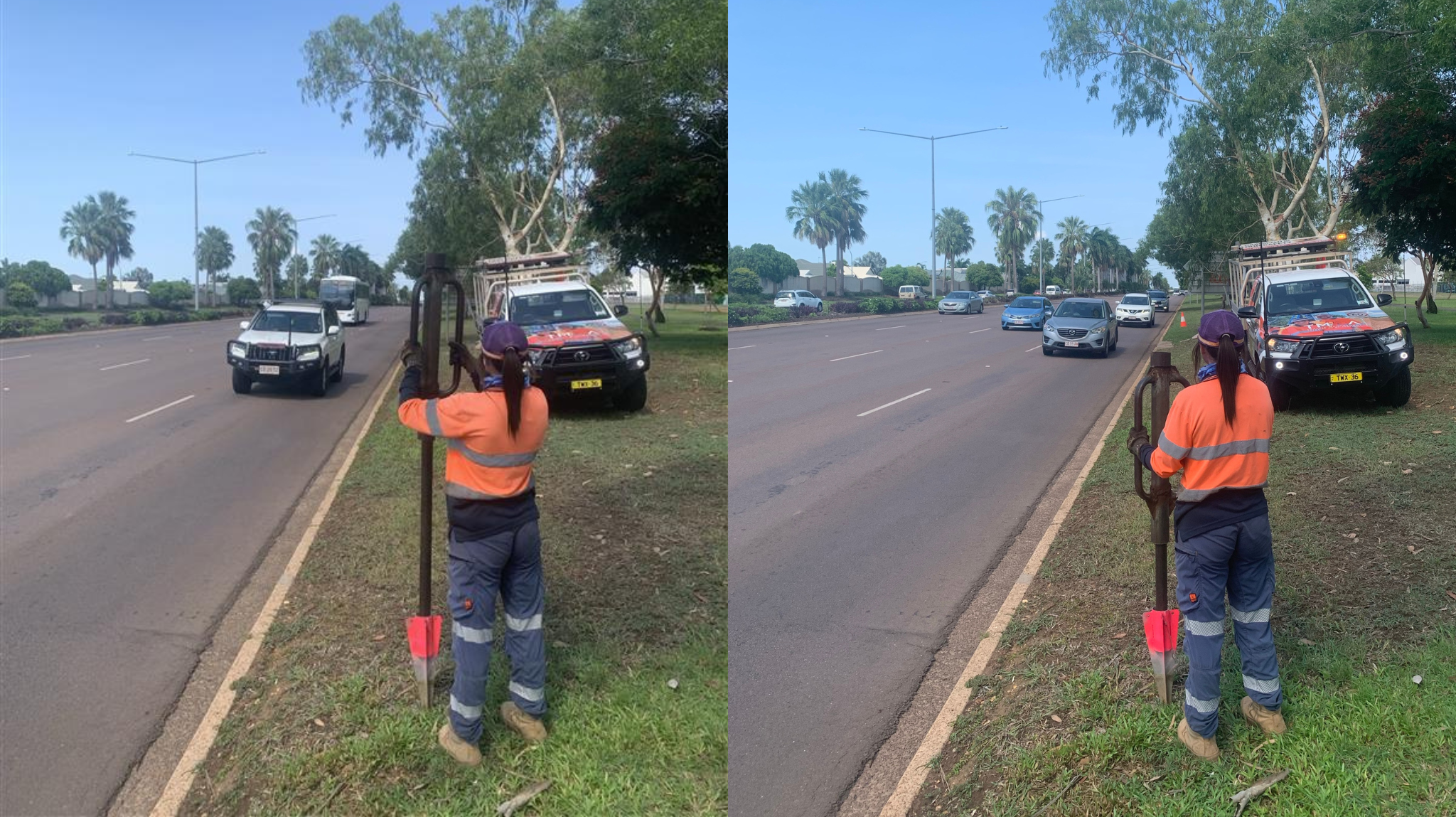
Image A: Traditional Setup with Oz Spikes
Photo Source: Trafficwerx NT and TMAA
In this image, a traffic controller is seen using a manual post rammer to hammer in Oz Spikes to hold speed signs. The time taken for this setup varies depending on the worker's ability and ground conditions, which affects how long the Traffic Controller is in a vulnerable position. During this process, the focus is on the equipment for safety reasons, leaving less attention on monitoring oncoming traffic. This creates a higher risk as heavy tools are involved, and the time spent setting up increases Traffic Controller exposure to potential hazards, making it harder to act quickly in case of an emergency.
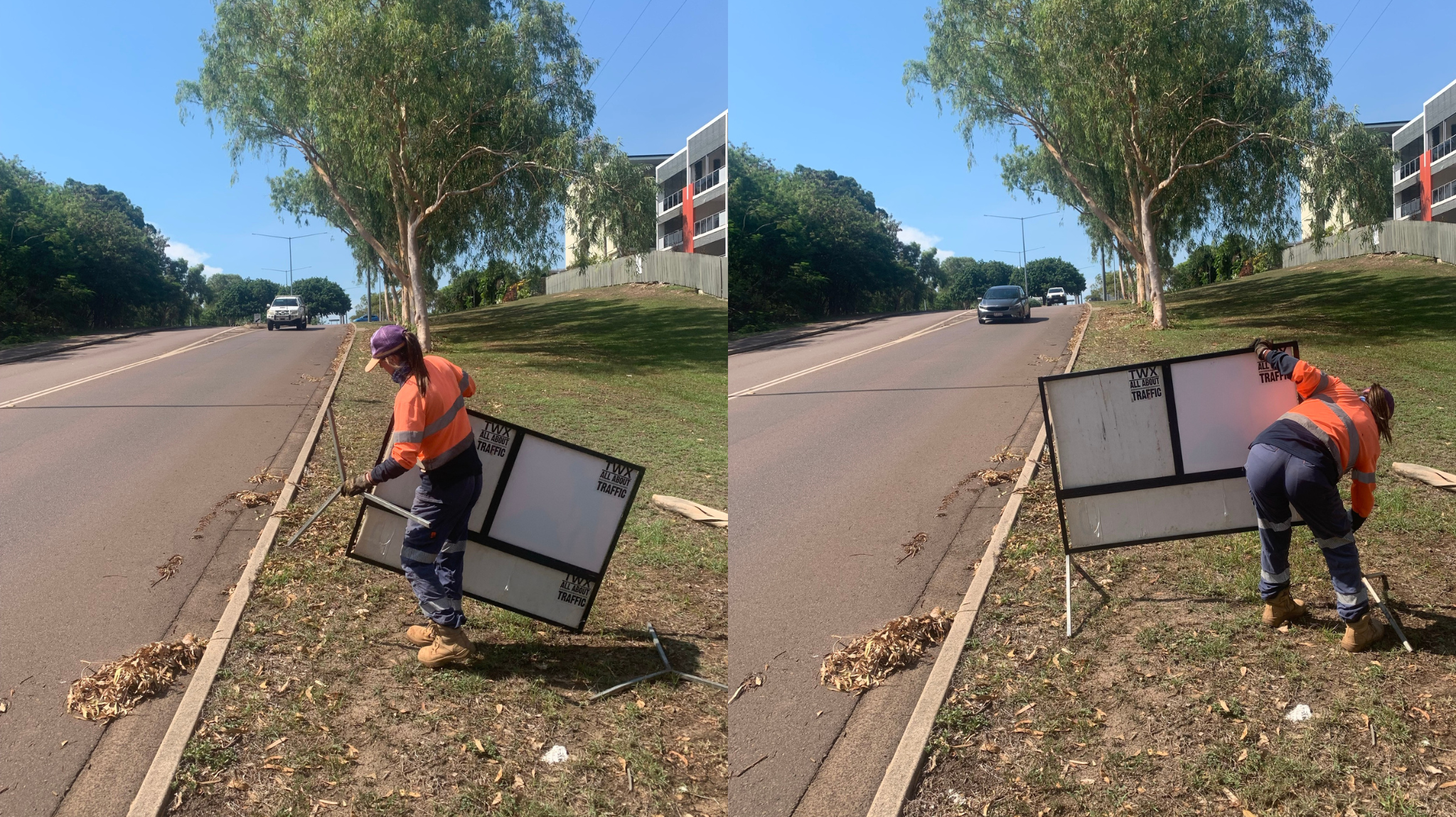
Image B: MMS Implementation for Safer Setup
Photo Source: Trafficwerx NT and TMAA
This image shows a traffic controller setting up a Multi-Message Sign (MMS) in a similar environment. Unlike the traditional method, MMS systems are lighter, quicker to install, and easier to handle. The ease of installation and reduced setup time allow the controller to direct more of their attention on monitoring oncoming traffic, lowering the risk of exposure. Additionally, the lighter equipment can be easily dropped if an emergency exit is needed, reducing danger and improving overall safety. MMS are used across Australia, except on the majority of NTG roads, despite their proven benefits.
Why We Need Change:
The safety of road crews is at the heart of effective traffic management. Allowing MMS to be used on all NT roads - regardless of speed limits or lane count - will significantly reduce the time workers spend in high-risk environments. By minimising their exposure to oncoming traffic, we can protect their well-being and save lives.
Why Support MMS?
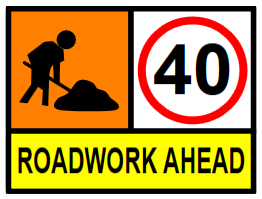
Example of Multi Message sign, as allowed by the Austroads Guide to Temporary Traffic Management
Benefits of Multi-Message Signs (MMS):
- Enhanced Safety: MMS improve communication by displaying clear, visible information to road users, which keeps both road crews and the public safer. Unlike traditional signage, MMS are easier to see, even from a distance, reducing confusion and risk.
- Reduced Risk for Workers: Traditional methods require manual setup, such as hammering spikes into the ground, which forces workers to repeatedly enter dangerous areas. MMS reduces this risk by allowing quick, straightforward setup, minimising the need for workers to be in harm's way.
- Improved Efficiency: MMS optimise traffic flow, reduce congestion, and streamline operations. They also lower costs associated with longer, more labour-intensive setups, leading to more efficient project management.
- Consistency with National Standards: Extending the use of MMS across NT aligns local practices with national standards, ensuring a consistent approach to safety and traffic management across Australia. By not adopting this standard, the NTG is creating unnecessary risks and discrepancies that could be avoided.
A Call for Action
We, the undersigned, urge the Department of Logistics and Infrastructure (DLI) to lift the current restrictions on MMS, allowing their use on all Northern Territory roads.
By supporting this petition, you are advocating for:
- Safer, more efficient traffic management practices
- Reduced risk for workers, ensuring their safety on the job
- Improved communication and safety for all road users
- Consistency with national standards, bringing NT in line with the rest of Australia
Together, we can push for a safer, more consistent approach that puts worker safety first. Please join us in urging the NT Government to make this vital change.

34
The Issue
We are advocating for crucial road safety improvements for all traffic management workers working on Northern Territory Government (NTG) managed roads.
Background:
Currently, the Department of Logistics and Infrastructure (DLI) severely restricts the use of MMS on all NTG roads. The NTG advises the use of MMS signs is being trialled. This trial has been going on for an extended period. The conditions on industry for the trialled use of MMS on NTG roads are within the following link: Temporary traffic management | NT.GOV.AU
The restrictions include MMS use only on:
- A posted speed limit of 80km/h or less
- No more than 2 lanes of traffic in one direction
In addition to this criterion, whilst it is not listed on the website, NTG mandates that all regulatory signs must be 1.5m high. To meet this requirement, the unsafe use of Oz Spikes (or similar) is required.
The Issue:
The AGTTM and AS1742.3 allow for the use of MMS. The AGTTM has been adopted throughout various jurisdictions in Australia and includes every other jurisdiction throughout the NT, except for NTG owned roads.
Over the years, temporary traffic management businesses have regularly campaigned the NTG to approve the use of MMS on NTG owned roads. Industry has informed the NTG that using MMS is the safest alternative for road workers and meets AS1742.3 and the AGTTM. NTGs mandate of driving oz spikes (or similar) into dry, compacted, and rocky shoulders puts all road workers and PCBUs at risk of injury/death and litigation.
Image A: Traditional Setup with Oz Spikes
Photo Source: Trafficwerx NT and TMAA
In this image, a traffic controller is seen using a manual post rammer to hammer in Oz Spikes to hold speed signs. The time taken for this setup varies depending on the worker's ability and ground conditions, which affects how long the Traffic Controller is in a vulnerable position. During this process, the focus is on the equipment for safety reasons, leaving less attention on monitoring oncoming traffic. This creates a higher risk as heavy tools are involved, and the time spent setting up increases Traffic Controller exposure to potential hazards, making it harder to act quickly in case of an emergency.
Image B: MMS Implementation for Safer Setup
Photo Source: Trafficwerx NT and TMAA
This image shows a traffic controller setting up a Multi-Message Sign (MMS) in a similar environment. Unlike the traditional method, MMS systems are lighter, quicker to install, and easier to handle. The ease of installation and reduced setup time allow the controller to direct more of their attention on monitoring oncoming traffic, lowering the risk of exposure. Additionally, the lighter equipment can be easily dropped if an emergency exit is needed, reducing danger and improving overall safety. MMS are used across Australia, except on the majority of NTG roads, despite their proven benefits.
Why We Need Change:
The safety of road crews is at the heart of effective traffic management. Allowing MMS to be used on all NT roads - regardless of speed limits or lane count - will significantly reduce the time workers spend in high-risk environments. By minimising their exposure to oncoming traffic, we can protect their well-being and save lives.
Why Support MMS?
Example of Multi Message sign, as allowed by the Austroads Guide to Temporary Traffic Management
Benefits of Multi-Message Signs (MMS):
- Enhanced Safety: MMS improve communication by displaying clear, visible information to road users, which keeps both road crews and the public safer. Unlike traditional signage, MMS are easier to see, even from a distance, reducing confusion and risk.
- Reduced Risk for Workers: Traditional methods require manual setup, such as hammering spikes into the ground, which forces workers to repeatedly enter dangerous areas. MMS reduces this risk by allowing quick, straightforward setup, minimising the need for workers to be in harm's way.
- Improved Efficiency: MMS optimise traffic flow, reduce congestion, and streamline operations. They also lower costs associated with longer, more labour-intensive setups, leading to more efficient project management.
- Consistency with National Standards: Extending the use of MMS across NT aligns local practices with national standards, ensuring a consistent approach to safety and traffic management across Australia. By not adopting this standard, the NTG is creating unnecessary risks and discrepancies that could be avoided.
A Call for Action
We, the undersigned, urge the Department of Logistics and Infrastructure (DLI) to lift the current restrictions on MMS, allowing their use on all Northern Territory roads.
By supporting this petition, you are advocating for:
- Safer, more efficient traffic management practices
- Reduced risk for workers, ensuring their safety on the job
- Improved communication and safety for all road users
- Consistency with national standards, bringing NT in line with the rest of Australia
Together, we can push for a safer, more consistent approach that puts worker safety first. Please join us in urging the NT Government to make this vital change.
Petition Updates
Share this petition
Petition created on 14 November 2023