
PETITION FOR SPOTSY BOARD ACTION AND ADOPTION OF A RESOLUTION OF THE PROPOSED KRAKEN LOOP
The Issue
PETITION FOR OFFICIAL BOARD ACTION AND ADOPTION OF A RESOLUTION
North Anna–Bristers 500-kV/230-kV Transmission Project (formerly “Kraken Loop”)
Virginia SCC Case No.: Not assigned as of this version date
TO: Each member of the Spotsylvania County Board of Supervisors; Clerk to the Board; County Administrator; and County Attorney
FROM: The undersigned Spotsylvania County residents and other identified supporters
Official action requested
We petition each Supervisor to request that the attached Proposed Resolution be placed on the next available Board agenda for public consideration and a recorded vote, and we petition at least two Supervisors to request a special meeting under Virginia Code § 15.2-1418 if timely action cannot occur at a regular meeting.
Why action is requested now
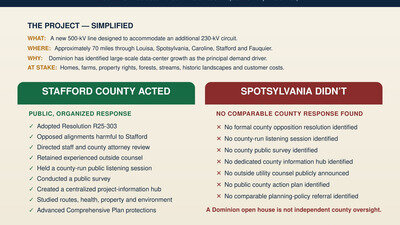
Dominion Energy’s proposed 70-mile North Anna–Bristers project would place a new 500-kV transmission corridor, with structures designed to carry an additional 230-kV circuit, through Louisa, Spotsylvania, Caroline, Stafford, and Fauquier Counties.
Dominion has publicly stated to PJM Interconnection that this corridor is experiencing significant growth “driven by large scale data center development.” Spotsylvania has approved or is considering numerous large data-center projects whose electrical demands may contribute to the asserted need. County officials must not remain passive while residents face the possible loss or impairment of homes, farms, forests, historic landscapes, water resources, property values, and quality of life. To date, Spotsylvania has done nothing, other than to host a Dominion community meeting, to independently investigate, question, or challenge the proposal. Spotsylvania’s duty is not limited to forwarding Dominion announcements. Our government must independently represent its citizens, test Dominion’s claims, preserve evidence, influence routing before positions harden, and ensure meaningful public participation.
Stafford County acted. Spotsylvania must do no less.
Stafford County appeared concerned enough about its citizens to take concrete, public action before the SCC filing. Its Board and staff:
- Adopted Resolution R25-303 opposing project alignments that would negatively affect Stafford and requested additional Dominion engagement;
- Directed staff and the county attorney to examine local authority and the SCC process;
- Retained outside counsel to advise the county and prepare for the SCC proceeding;
- Held a county-run public listening session separate from Dominion’s open houses;
- Conducted a public survey in which approximately 93% of respondents expressed an unfavorable view;
- Created a centralized county project-information hub;
- Examined legislative protections, undergrounding, schools, property impacts, health concerns, environmental effects, and alternative alignments;
- Sent letters, comments, questions, or requests concerning the Kraken Project to Dominion Energy or the Virginia State Corporation Commission, or authorized County staff, counsel, or consultants to do so on the County’s behalf; and
- Initiated Comprehensive Plan policies for transmission corridors and referred them to its Planning Commission.
We have found no comparable coordinated, public response by Spotsylvania County through July 16, 2026. A Dominion-sponsored open house at Berkeley Elementary School is NOT a substitute for independent county scrutiny, legal representation, public hearings, or a county position. The undersigned request an equally organized, independent, and public Spotsylvania response.
The requested procedural commitment
1. Each Supervisor is asked to instruct the Clerk, within the time required by the Board’s bylaws, to place the attached Proposed Resolution on the next available regular-meeting agenda.
2. If a regular meeting cannot provide timely consideration, at least two Supervisors are asked to submit a written request to the Clerk for a special meeting under Virginia Code § 15.2-1418, specifying consideration of the Proposed Resolution.
3. The Board is asked to allow public comment, deliberate in open session as required by law, and take a recorded vote on the Proposed Resolution.
4. The Clerk is asked to date-stamp this petition, distribute it and its attachments to all Supervisors, preserve it as a County record, and provide written confirmation of the agenda or special-meeting request.
Material risks requiring independent review
Homes, property rights, and financial effects
- Permanent easements, access routes, construction areas, vegetation restrictions, and possible condemnation; restrictions affecting homes, barns, wells, ponds, fences, trees, farming, and future construction.
- Possible market resistance, reduced value, impaired resale or refinancing, loss of privacy, uncompensated quality-of-life effects, parcel fragmentation, soil compaction, drainage disruption, crop loss, road wear, and continuing utility access.
- A planning cost reported at approximately $704 million, subject to escalation, financing, utility return, maintenance, and cost allocation; and possible ordinary-ratepayer exposure to speculative or customer-specific capacity.
Health, safety, noise, and quality of life
- Continuous 60-Hz electric and magnetic fields. The International Agency for Research on Cancer (IARC) classifies extremely low-frequency magnetic fields as possibly carcinogenic to humans; chiefly because of a statistical association with childhood leukemia at certain long-term residential exposure levels; Route- and load-specific modeling is necessary.
- Corona-related hissing, crackling, popping, or humming; substation transformer, fan, switching, and lighting effects; construction dust, diesel exhaust, vibration, noise, traffic, blasting, or drilling.
- Arcing, induced voltage, nuisance shock, fire, conductor failure, tall-equipment, farm-machinery, aviation, and emergency-access issues; chronic stress, sleep disruption, visual effects, uncertainty, and diminished enjoyment of homes and land.
Water, land, wildlife, farms, and cultural resources
- Streams, wetlands, floodplains, riparian buffers, springs, wells, drainage, and Chesapeake Bay watershed crossings; erosion, sediment, spills, concrete washout, and possible herbicide exposure.
- Permanent forest conversion, mature-tree loss, carbon-storage loss, edge effects, invasive species, habitat fragmentation, bird-collision risk, bat-roost and travel-corridor effects, and impacts to sensitive species.
- Agricultural productivity, irrigation, drainage, fencing, equipment movement, aerial application, conservation options, battlefields, historic viewsheds, archaeological sites, cemeteries, Indigenous resources, parks, trails, tourism, and scenic landscapes.
Cumulative and growth-related effects
- Additional substations, feeder lines, delivery points, generation, and transmission infrastructure; further conversion of rural land to industrial uses; indirect air, climate, water, and ratepayer effects; and cumulative effects with approved or proposed data-center and utility facilities.
Public necessity and property rights
Citizens reasonably question whether private homes and farms could be condemned principally to enable privately owned data centers. Data-center developers and the County do not automatically have authority to condemn residents’ property for this project. Dominion may seek to exercise eminent-domain authority only as a regulated public-service company and must establish that any proposed taking is for a legally authorized public use and is genuinely necessary—not merely convenient, less expensive, or principally beneficial to particular private customers.
Questions the County should require Dominion and the record to answer
- How much forecast need is attributable to approved, proposed, speculative, or confidential data-center loads? Which delivery points and forecasts were included?
- What reliability violations remain under no-new-data-center and reduced-load scenarios? Would the 500-kV project, substations, or 230-kV capability be needed at the same scale, route, and date?
- Are existing corridors, non-wires alternatives, enforceable load management, phasing, underground segments, customer-funded facilities, or less harmful routes feasible?
- What costs are attributable to the large-load customers causing the need, and what protections prevent ordinary customers from subsidizing speculative or customer-specific capacity?
- Is each proposed property interest necessary to the certified utility project rather than merely convenient for a preferred or lower-cost route?
Records and analyses to assemble
- Dominion, PJM, cooperative, data-center, and County maps, notices, correspondence, load assumptions, studies, schedules, and route alternatives, subject to lawful exemptions and privileges.
- An inventory of affected parcels and sensitive resources: homes, schools, daycares, parks, farms, wells, streams, wetlands, floodplains, forests, historic sites, conservation lands, and vulnerable populations.
- Independent maximum- and average-loading EMF modeling, noise analysis, construction air-quality estimates, safety review, cumulative-impact assessment, environmental review, and property-impact evidence.
- A dated public-process log identifying requests, responses, meetings, Board actions, SCC notices, case number, and all intervention, comment, and hearing deadlines.
PROPOSED RESOLUTION
A RESOLUTION DIRECTING IMMEDIATE COUNTY REVIEW, PUBLIC ENGAGEMENT, AND REGULATORY PARTICIPATION CONCERNING THE NORTH ANNA–BRISTERS TRANSMISSION PROJECT
WHEREAS, Dominion Energy has proposed the North Anna–Bristers 500-kV/230-kV Transmission Project, formerly called the Kraken Loop, potentially affecting Spotsylvania County residents, property, natural resources, historic resources, and public finances; and
WHEREAS, significant projected electric-load growth has been attributed to large-scale data-center development, making transparent review of need, alternatives, timing, cost responsibility, and cumulative effects necessary; and
WHEREAS, construction of transmission facilities above 115 kV ordinarily requires approval by the Virginia State Corporation Commission, and timely local participation may be necessary to protect County and resident interests; and
WHEREAS, the Board desires reliable electric service, lawful process, meaningful public participation, accurate risk communication, and avoidance or mitigation of unnecessary harm;
NOW, THEREFORE, BE IT RESOLVED by the Spotsylvania County Board of Supervisors that the Board directs the following official actions:
1. COUNTY REPORT. Direct the County Administrator, County Attorney, and appropriate staff to prepare a written report identifying the project’s status, conceptual and proposed routes, asserted need, data-center load contribution, foreseeable health, environmental, land-use, fiscal, historic, property, and quality-of-life effects, and county regulatory, legislative, and litigation options.
2. PUBLIC AGENDA AND MEETINGS. Maintain the project as a publicly noticed Board agenda matter; request a substantive public presentation from Dominion; and hold at least one county-run listening session or public meeting independent of Dominion’s open houses.
3. PUBLIC INFORMATION. Create and maintain a county webpage containing maps, notices, studies, correspondence, meeting dates, staff reports, SCC deadlines, the case number when assigned, and clear participation instructions; conduct a public survey capable of parcel- and route-segment-specific responses.
4. LEGAL AND TECHNICAL CAPACITY. Authorize the county attorney to analyze SCC procedure, respondent deadlines, discovery, confidentiality, eminent domain, route alternatives, cost allocation, and judicial review; return promptly with recommendations concerning outside utility counsel and independent experts.
5. SCC PARTICIPATION. Authorize preparation for formal county participation in the SCC proceeding and direct the county attorney to recommend, before any deadline, whether the county should become a respondent or otherwise participate. Direct preparation of a county resolution, comments, testimony, and evidence addressing need, routing, alternatives, costs, and impacts; request a local SCC public hearing.
6. PROJECT-SPECIFIC DISCLOSURE. Request from Dominion and other appropriate entities publicly reviewable data regarding average, peak, emergency, and reasonably foreseeable loading; conductor height, sag, phasing, and configuration; electric-and magnetic-field estimates; noise; construction effects; safety; environmental impacts; route alternatives; mitigation; and future load growth.
7. LOAD AND ALTERNATIVES AUDIT. Request a transparent data-center load audit and no-new-data-center and reduced-load counterfactuals; determine whether the proposed facilities would be required at the same scale, route, and date; evaluate existing corridors, phasing, non-wires alternatives, underground segments, co-location, and less harmful routes.
8. PROPERTY AND RESOURCE INVENTORY. Direct staff to map homes, schools, daycares, parks, farms, wells, streams, wetlands, floodplains, forests, historic and archaeological resources, cemeteries, conservation lands, and vulnerable populations potentially affected by each route under consideration.
9. COST RESPONSIBILITY. Request detailed project and incremental 230-kV cost information and analyze measures that assign customer-specific or speculative capacity costs to the large-load customers causing them rather than ordinary residents, to the extent allowed by law.
10. PLANNING POLICIES. Refer to the Planning Commission proposed Comprehensive Plan policies addressing high voltage transmission corridors, co-location, undergrounding where feasible, sensitive receptors, historic landscapes, environmental justice, and cumulative infrastructure effects.
11. LOAD AND ALTERNATIVES AUDIT. Request a transparent data-center load audit and no-new-data-center and reduced-load counterfactuals; determine whether the proposed facilities would be required at the same scale, route, and date; evaluate existing corridors, phasing, non-wires alternatives, underground segments, co-location, and less harmful routes.
12. PROPERTY AND RESOURCE INVENTORY. Direct staff to map homes, schools, daycares, parks, farms, wells, streams, wetlands, floodplains, forests, historic and archaeological resources, cemeteries, conservation lands, and vulnerable populations potentially affected by each route under consideration.
13. COST RESPONSIBILITY. Request detailed project and incremental 230-kV cost information and analyze measures that assign customer-specific or speculative capacity costs to the large-load customers causing them, rather than ordinary residents, to the extent allowed by law.
14. PLANNING POLICIES. Refer to the Planning Commission proposed Comprehensive Plan policies addressing high-voltage transmission corridors, co-location, undergrounding where feasible, sensitive receptors, historic landscapes, environmental justice, and cumulative infrastructure effects.
15. REGIONAL COORDINATION. Coordinate with affected localities, schools, public agencies, conservation organizations, and resident groups while preserving an independent Spotsylvania position.
16. NOTICE AND STATUS. Provide timely notice of the SCC case number, route changes, deadlines, hearings, surveys, and county actions; publish an initial action plan within 30 days after adoption and regular status updates thereafter.
17. RECORDS. Preserve county records concerning the project and related load growth in accordance with applicable retention law, including public-business communications on county or personal devices and accounts, while protecting privileged, confidential, and legally exempt information.
18. BOARD POSITION. Oppose any alignment that would unnecessarily harm residents, schools, farms, water resources, historic assets, conservation lands, or rural communities where a feasible, less harmful alternative exists, and present that position with supporting evidence to Dominion and the SCC.
Requested written response and submission record
The petitioners request written confirmation from the Board Chair, Clerk, and County Administrator identifying: (1) the Supervisor or Supervisors requesting the agenda item; (2) the meeting date; (3) whether two Supervisors have requested a special meeting if necessary; (4) the responsible officials; and (5) any action the Board declines to consider and the stated reason.
Sources and legal-accuracy notice
- Dominion Energy project materials; PJM RTEP and transmission-planning materials; Stafford County project materials and Resolution R25-303.
- Virginia Constitution, Article I, § 11; Virginia Code §§ 15.2-1418, 56-46.1, and 56-265.1 et seq.; Spotsylvania County Board of Supervisors 2026 Bylaws.
- WHO/IARC review of extremely low-frequency fields and applicable governmental environmental and transmission-corridor materials.
This is a citizen advocacy document, not individualized legal advice. It requests investigation and proof rather than asserting that condemnation is automatically unlawful or that disputed health effects are established. Counsel should review the final SCC application, docket order, current law, and the facts of each affected property.
Signer certification and public-record warning
CERTIFICATION: By signing as a county resident, I certify that I reside in Spotsylvania County at the address shown and that the information provided is accurate to the best of my knowledge. I support the requested action and attached Proposed Resolution.
PUBLIC-RECORD WARNING: Information submitted to the County may be publicly disclosed under Virginia law. Do not include sensitive identifiers. Optional contact information belongs on the separate organizer contact sheet.

16
The Issue
PETITION FOR OFFICIAL BOARD ACTION AND ADOPTION OF A RESOLUTION
North Anna–Bristers 500-kV/230-kV Transmission Project (formerly “Kraken Loop”)
Virginia SCC Case No.: Not assigned as of this version date
TO: Each member of the Spotsylvania County Board of Supervisors; Clerk to the Board; County Administrator; and County Attorney
FROM: The undersigned Spotsylvania County residents and other identified supporters
Official action requested
We petition each Supervisor to request that the attached Proposed Resolution be placed on the next available Board agenda for public consideration and a recorded vote, and we petition at least two Supervisors to request a special meeting under Virginia Code § 15.2-1418 if timely action cannot occur at a regular meeting.
Why action is requested now
Dominion Energy’s proposed 70-mile North Anna–Bristers project would place a new 500-kV transmission corridor, with structures designed to carry an additional 230-kV circuit, through Louisa, Spotsylvania, Caroline, Stafford, and Fauquier Counties.
Dominion has publicly stated to PJM Interconnection that this corridor is experiencing significant growth “driven by large scale data center development.” Spotsylvania has approved or is considering numerous large data-center projects whose electrical demands may contribute to the asserted need. County officials must not remain passive while residents face the possible loss or impairment of homes, farms, forests, historic landscapes, water resources, property values, and quality of life. To date, Spotsylvania has done nothing, other than to host a Dominion community meeting, to independently investigate, question, or challenge the proposal. Spotsylvania’s duty is not limited to forwarding Dominion announcements. Our government must independently represent its citizens, test Dominion’s claims, preserve evidence, influence routing before positions harden, and ensure meaningful public participation.
Stafford County acted. Spotsylvania must do no less.
Stafford County appeared concerned enough about its citizens to take concrete, public action before the SCC filing. Its Board and staff:
- Adopted Resolution R25-303 opposing project alignments that would negatively affect Stafford and requested additional Dominion engagement;
- Directed staff and the county attorney to examine local authority and the SCC process;
- Retained outside counsel to advise the county and prepare for the SCC proceeding;
- Held a county-run public listening session separate from Dominion’s open houses;
- Conducted a public survey in which approximately 93% of respondents expressed an unfavorable view;
- Created a centralized county project-information hub;
- Examined legislative protections, undergrounding, schools, property impacts, health concerns, environmental effects, and alternative alignments;
- Sent letters, comments, questions, or requests concerning the Kraken Project to Dominion Energy or the Virginia State Corporation Commission, or authorized County staff, counsel, or consultants to do so on the County’s behalf; and
- Initiated Comprehensive Plan policies for transmission corridors and referred them to its Planning Commission.
We have found no comparable coordinated, public response by Spotsylvania County through July 16, 2026. A Dominion-sponsored open house at Berkeley Elementary School is NOT a substitute for independent county scrutiny, legal representation, public hearings, or a county position. The undersigned request an equally organized, independent, and public Spotsylvania response.
The requested procedural commitment
1. Each Supervisor is asked to instruct the Clerk, within the time required by the Board’s bylaws, to place the attached Proposed Resolution on the next available regular-meeting agenda.
2. If a regular meeting cannot provide timely consideration, at least two Supervisors are asked to submit a written request to the Clerk for a special meeting under Virginia Code § 15.2-1418, specifying consideration of the Proposed Resolution.
3. The Board is asked to allow public comment, deliberate in open session as required by law, and take a recorded vote on the Proposed Resolution.
4. The Clerk is asked to date-stamp this petition, distribute it and its attachments to all Supervisors, preserve it as a County record, and provide written confirmation of the agenda or special-meeting request.
Material risks requiring independent review
Homes, property rights, and financial effects
- Permanent easements, access routes, construction areas, vegetation restrictions, and possible condemnation; restrictions affecting homes, barns, wells, ponds, fences, trees, farming, and future construction.
- Possible market resistance, reduced value, impaired resale or refinancing, loss of privacy, uncompensated quality-of-life effects, parcel fragmentation, soil compaction, drainage disruption, crop loss, road wear, and continuing utility access.
- A planning cost reported at approximately $704 million, subject to escalation, financing, utility return, maintenance, and cost allocation; and possible ordinary-ratepayer exposure to speculative or customer-specific capacity.
Health, safety, noise, and quality of life
- Continuous 60-Hz electric and magnetic fields. The International Agency for Research on Cancer (IARC) classifies extremely low-frequency magnetic fields as possibly carcinogenic to humans; chiefly because of a statistical association with childhood leukemia at certain long-term residential exposure levels; Route- and load-specific modeling is necessary.
- Corona-related hissing, crackling, popping, or humming; substation transformer, fan, switching, and lighting effects; construction dust, diesel exhaust, vibration, noise, traffic, blasting, or drilling.
- Arcing, induced voltage, nuisance shock, fire, conductor failure, tall-equipment, farm-machinery, aviation, and emergency-access issues; chronic stress, sleep disruption, visual effects, uncertainty, and diminished enjoyment of homes and land.
Water, land, wildlife, farms, and cultural resources
- Streams, wetlands, floodplains, riparian buffers, springs, wells, drainage, and Chesapeake Bay watershed crossings; erosion, sediment, spills, concrete washout, and possible herbicide exposure.
- Permanent forest conversion, mature-tree loss, carbon-storage loss, edge effects, invasive species, habitat fragmentation, bird-collision risk, bat-roost and travel-corridor effects, and impacts to sensitive species.
- Agricultural productivity, irrigation, drainage, fencing, equipment movement, aerial application, conservation options, battlefields, historic viewsheds, archaeological sites, cemeteries, Indigenous resources, parks, trails, tourism, and scenic landscapes.
Cumulative and growth-related effects
- Additional substations, feeder lines, delivery points, generation, and transmission infrastructure; further conversion of rural land to industrial uses; indirect air, climate, water, and ratepayer effects; and cumulative effects with approved or proposed data-center and utility facilities.
Public necessity and property rights
Citizens reasonably question whether private homes and farms could be condemned principally to enable privately owned data centers. Data-center developers and the County do not automatically have authority to condemn residents’ property for this project. Dominion may seek to exercise eminent-domain authority only as a regulated public-service company and must establish that any proposed taking is for a legally authorized public use and is genuinely necessary—not merely convenient, less expensive, or principally beneficial to particular private customers.
Questions the County should require Dominion and the record to answer
- How much forecast need is attributable to approved, proposed, speculative, or confidential data-center loads? Which delivery points and forecasts were included?
- What reliability violations remain under no-new-data-center and reduced-load scenarios? Would the 500-kV project, substations, or 230-kV capability be needed at the same scale, route, and date?
- Are existing corridors, non-wires alternatives, enforceable load management, phasing, underground segments, customer-funded facilities, or less harmful routes feasible?
- What costs are attributable to the large-load customers causing the need, and what protections prevent ordinary customers from subsidizing speculative or customer-specific capacity?
- Is each proposed property interest necessary to the certified utility project rather than merely convenient for a preferred or lower-cost route?
Records and analyses to assemble
- Dominion, PJM, cooperative, data-center, and County maps, notices, correspondence, load assumptions, studies, schedules, and route alternatives, subject to lawful exemptions and privileges.
- An inventory of affected parcels and sensitive resources: homes, schools, daycares, parks, farms, wells, streams, wetlands, floodplains, forests, historic sites, conservation lands, and vulnerable populations.
- Independent maximum- and average-loading EMF modeling, noise analysis, construction air-quality estimates, safety review, cumulative-impact assessment, environmental review, and property-impact evidence.
- A dated public-process log identifying requests, responses, meetings, Board actions, SCC notices, case number, and all intervention, comment, and hearing deadlines.
PROPOSED RESOLUTION
A RESOLUTION DIRECTING IMMEDIATE COUNTY REVIEW, PUBLIC ENGAGEMENT, AND REGULATORY PARTICIPATION CONCERNING THE NORTH ANNA–BRISTERS TRANSMISSION PROJECT
WHEREAS, Dominion Energy has proposed the North Anna–Bristers 500-kV/230-kV Transmission Project, formerly called the Kraken Loop, potentially affecting Spotsylvania County residents, property, natural resources, historic resources, and public finances; and
WHEREAS, significant projected electric-load growth has been attributed to large-scale data-center development, making transparent review of need, alternatives, timing, cost responsibility, and cumulative effects necessary; and
WHEREAS, construction of transmission facilities above 115 kV ordinarily requires approval by the Virginia State Corporation Commission, and timely local participation may be necessary to protect County and resident interests; and
WHEREAS, the Board desires reliable electric service, lawful process, meaningful public participation, accurate risk communication, and avoidance or mitigation of unnecessary harm;
NOW, THEREFORE, BE IT RESOLVED by the Spotsylvania County Board of Supervisors that the Board directs the following official actions:
1. COUNTY REPORT. Direct the County Administrator, County Attorney, and appropriate staff to prepare a written report identifying the project’s status, conceptual and proposed routes, asserted need, data-center load contribution, foreseeable health, environmental, land-use, fiscal, historic, property, and quality-of-life effects, and county regulatory, legislative, and litigation options.
2. PUBLIC AGENDA AND MEETINGS. Maintain the project as a publicly noticed Board agenda matter; request a substantive public presentation from Dominion; and hold at least one county-run listening session or public meeting independent of Dominion’s open houses.
3. PUBLIC INFORMATION. Create and maintain a county webpage containing maps, notices, studies, correspondence, meeting dates, staff reports, SCC deadlines, the case number when assigned, and clear participation instructions; conduct a public survey capable of parcel- and route-segment-specific responses.
4. LEGAL AND TECHNICAL CAPACITY. Authorize the county attorney to analyze SCC procedure, respondent deadlines, discovery, confidentiality, eminent domain, route alternatives, cost allocation, and judicial review; return promptly with recommendations concerning outside utility counsel and independent experts.
5. SCC PARTICIPATION. Authorize preparation for formal county participation in the SCC proceeding and direct the county attorney to recommend, before any deadline, whether the county should become a respondent or otherwise participate. Direct preparation of a county resolution, comments, testimony, and evidence addressing need, routing, alternatives, costs, and impacts; request a local SCC public hearing.
6. PROJECT-SPECIFIC DISCLOSURE. Request from Dominion and other appropriate entities publicly reviewable data regarding average, peak, emergency, and reasonably foreseeable loading; conductor height, sag, phasing, and configuration; electric-and magnetic-field estimates; noise; construction effects; safety; environmental impacts; route alternatives; mitigation; and future load growth.
7. LOAD AND ALTERNATIVES AUDIT. Request a transparent data-center load audit and no-new-data-center and reduced-load counterfactuals; determine whether the proposed facilities would be required at the same scale, route, and date; evaluate existing corridors, phasing, non-wires alternatives, underground segments, co-location, and less harmful routes.
8. PROPERTY AND RESOURCE INVENTORY. Direct staff to map homes, schools, daycares, parks, farms, wells, streams, wetlands, floodplains, forests, historic and archaeological resources, cemeteries, conservation lands, and vulnerable populations potentially affected by each route under consideration.
9. COST RESPONSIBILITY. Request detailed project and incremental 230-kV cost information and analyze measures that assign customer-specific or speculative capacity costs to the large-load customers causing them rather than ordinary residents, to the extent allowed by law.
10. PLANNING POLICIES. Refer to the Planning Commission proposed Comprehensive Plan policies addressing high voltage transmission corridors, co-location, undergrounding where feasible, sensitive receptors, historic landscapes, environmental justice, and cumulative infrastructure effects.
11. LOAD AND ALTERNATIVES AUDIT. Request a transparent data-center load audit and no-new-data-center and reduced-load counterfactuals; determine whether the proposed facilities would be required at the same scale, route, and date; evaluate existing corridors, phasing, non-wires alternatives, underground segments, co-location, and less harmful routes.
12. PROPERTY AND RESOURCE INVENTORY. Direct staff to map homes, schools, daycares, parks, farms, wells, streams, wetlands, floodplains, forests, historic and archaeological resources, cemeteries, conservation lands, and vulnerable populations potentially affected by each route under consideration.
13. COST RESPONSIBILITY. Request detailed project and incremental 230-kV cost information and analyze measures that assign customer-specific or speculative capacity costs to the large-load customers causing them, rather than ordinary residents, to the extent allowed by law.
14. PLANNING POLICIES. Refer to the Planning Commission proposed Comprehensive Plan policies addressing high-voltage transmission corridors, co-location, undergrounding where feasible, sensitive receptors, historic landscapes, environmental justice, and cumulative infrastructure effects.
15. REGIONAL COORDINATION. Coordinate with affected localities, schools, public agencies, conservation organizations, and resident groups while preserving an independent Spotsylvania position.
16. NOTICE AND STATUS. Provide timely notice of the SCC case number, route changes, deadlines, hearings, surveys, and county actions; publish an initial action plan within 30 days after adoption and regular status updates thereafter.
17. RECORDS. Preserve county records concerning the project and related load growth in accordance with applicable retention law, including public-business communications on county or personal devices and accounts, while protecting privileged, confidential, and legally exempt information.
18. BOARD POSITION. Oppose any alignment that would unnecessarily harm residents, schools, farms, water resources, historic assets, conservation lands, or rural communities where a feasible, less harmful alternative exists, and present that position with supporting evidence to Dominion and the SCC.
Requested written response and submission record
The petitioners request written confirmation from the Board Chair, Clerk, and County Administrator identifying: (1) the Supervisor or Supervisors requesting the agenda item; (2) the meeting date; (3) whether two Supervisors have requested a special meeting if necessary; (4) the responsible officials; and (5) any action the Board declines to consider and the stated reason.
Sources and legal-accuracy notice
- Dominion Energy project materials; PJM RTEP and transmission-planning materials; Stafford County project materials and Resolution R25-303.
- Virginia Constitution, Article I, § 11; Virginia Code §§ 15.2-1418, 56-46.1, and 56-265.1 et seq.; Spotsylvania County Board of Supervisors 2026 Bylaws.
- WHO/IARC review of extremely low-frequency fields and applicable governmental environmental and transmission-corridor materials.
This is a citizen advocacy document, not individualized legal advice. It requests investigation and proof rather than asserting that condemnation is automatically unlawful or that disputed health effects are established. Counsel should review the final SCC application, docket order, current law, and the facts of each affected property.
Signer certification and public-record warning
CERTIFICATION: By signing as a county resident, I certify that I reside in Spotsylvania County at the address shown and that the information provided is accurate to the best of my knowledge. I support the requested action and attached Proposed Resolution.
PUBLIC-RECORD WARNING: Information submitted to the County may be publicly disclosed under Virginia law. Do not include sensitive identifiers. Optional contact information belongs on the separate organizer contact sheet.
The Decision Makers

Supporter Voices
Petition Updates
Share this petition
Petition created on July 17, 2026