
Petition : Disclose Trust Ownership in Singapore Properties
The Issue
PETITION TO THE PRIME MINISTER OF SINGAPORE
I. Objective
The purpose of this petition is to formally request the Government of Singapore to review and amend existing legislation—including the Land Titles Act and HDB regulations—to establish a fully transparent, searchable, and public registry of property ownership. This registry should cover all residential asset classes, including HDB flats, private condominiums, landed estates, and Good Class Bungalows (GCBs).
II. The Impetus: Lessons from Recent Legal Disclosures
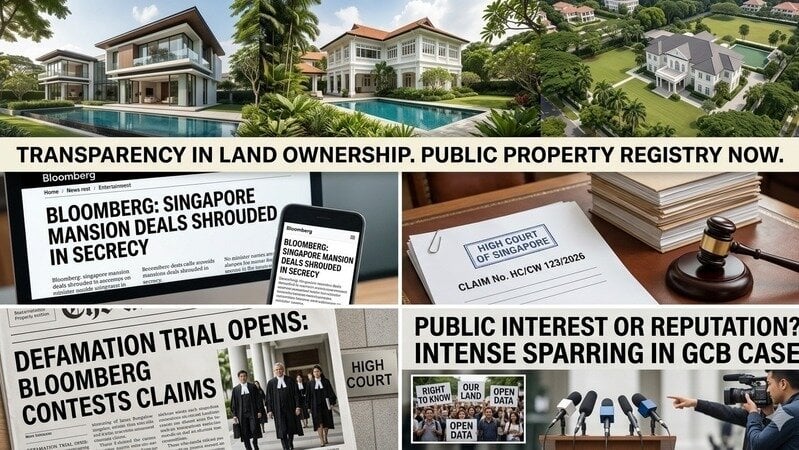
The ongoing defamation proceedings involving the Bloomberg report, titled "Singapore Mansion Deals Are Increasingly Shrouded in Secrecy," have highlighted a significant gap in public data. The central tension in this case arises from the use of legal mechanisms—such as trust structures or the decision not to lodge caveats—which can effectively shield property transactions from public view.
While these mechanisms may be legally compliant under the current framework, they create a perception of opacity. When the transactions of high-profile individuals or significant land assets are not easily verifiable by the public, it risks eroding the high level of trust that Singaporeans place in the integrity of our systems.
III. Land as a Finite National Resource
Singapore is a land-scarce nation. Every square meter of land is a strategic asset. Consequently, the ownership of this land is not merely a private financial matter but a matter of national interest.
Transparency ensures that:
Public Accountability: Citizens can verify that land is being allocated and held in a manner consistent with national priorities.
Market Integrity: A transparent registry prevents "information asymmetry," where only a privileged few have visibility over who owns what, thus ensuring a fairer real estate market for all Singaporeans.
IV. Proposed Amendments for Transparency
We propose that the new registry include the following disclosures for every property in Singapore:
Full Identity of Beneficial Owners: Removing the "shroud" of trusts or shell companies to show the actual individuals who own the property.
Universal Searchability: Allowing any citizen to search the registry by name or address without the current administrative and financial hurdles associated with INLIS.
Citizenship Status Verification: In the interest of national data and understanding the distribution of our finite land, the registry should indicate if an owner is a Singapore-born citizen or a naturalized (new) citizen.
V. Conclusion
The Bloomberg case has shown that "secrecy" in property deals, even when legal, invites speculation and social friction. By moving toward a model of radical transparency, Singapore can demonstrate that it has nothing to hide. Ensuring that every Singaporean has visibility over the ownership of our land will reinforce social cohesion and uphold the principle that our nation’s most precious resource belongs, ultimately, to the people.
We urge the Government to take this step toward a more transparent and accountable Singapore.
Respectfully submitted,
Citizens of Singapore

89
The Issue
PETITION TO THE PRIME MINISTER OF SINGAPORE
I. Objective
The purpose of this petition is to formally request the Government of Singapore to review and amend existing legislation—including the Land Titles Act and HDB regulations—to establish a fully transparent, searchable, and public registry of property ownership. This registry should cover all residential asset classes, including HDB flats, private condominiums, landed estates, and Good Class Bungalows (GCBs).
II. The Impetus: Lessons from Recent Legal Disclosures
The ongoing defamation proceedings involving the Bloomberg report, titled "Singapore Mansion Deals Are Increasingly Shrouded in Secrecy," have highlighted a significant gap in public data. The central tension in this case arises from the use of legal mechanisms—such as trust structures or the decision not to lodge caveats—which can effectively shield property transactions from public view.
While these mechanisms may be legally compliant under the current framework, they create a perception of opacity. When the transactions of high-profile individuals or significant land assets are not easily verifiable by the public, it risks eroding the high level of trust that Singaporeans place in the integrity of our systems.
III. Land as a Finite National Resource
Singapore is a land-scarce nation. Every square meter of land is a strategic asset. Consequently, the ownership of this land is not merely a private financial matter but a matter of national interest.
Transparency ensures that:
Public Accountability: Citizens can verify that land is being allocated and held in a manner consistent with national priorities.
Market Integrity: A transparent registry prevents "information asymmetry," where only a privileged few have visibility over who owns what, thus ensuring a fairer real estate market for all Singaporeans.
IV. Proposed Amendments for Transparency
We propose that the new registry include the following disclosures for every property in Singapore:
Full Identity of Beneficial Owners: Removing the "shroud" of trusts or shell companies to show the actual individuals who own the property.
Universal Searchability: Allowing any citizen to search the registry by name or address without the current administrative and financial hurdles associated with INLIS.
Citizenship Status Verification: In the interest of national data and understanding the distribution of our finite land, the registry should indicate if an owner is a Singapore-born citizen or a naturalized (new) citizen.
V. Conclusion
The Bloomberg case has shown that "secrecy" in property deals, even when legal, invites speculation and social friction. By moving toward a model of radical transparency, Singapore can demonstrate that it has nothing to hide. Ensuring that every Singaporean has visibility over the ownership of our land will reinforce social cohesion and uphold the principle that our nation’s most precious resource belongs, ultimately, to the people.
We urge the Government to take this step toward a more transparent and accountable Singapore.
Respectfully submitted,
Citizens of Singapore
The Decision Makers

Petition Updates
Share this petition
Petition created on 9 April 2026