Petition to Establish Neurodivergent Biochemistry

Petition to Establish Neurodivergent Biochemistry
The Issue
Petition Description for the Stanford Neurodiversity Project
Update: This framework has expanded substantially, but this petition will be archived as is. You can find the updates at kimberlyedu.org
My name is Kimberly Kitzerow, and I have transformed academic journal data into a comprehensive analysis to uncover the root causes of neurodivergent comorbidities, leading to the establishment of Neurodivergent Biochemistry. When my nonverbal daughter couldn’t blow out candles on her 4th birthday cake, I realized that the inability to speak is a physical limitation, similar to being deaf or blind, and has nothing to do with intelligence. Understanding this helped me teach her to speak, and now she’s a chatterbox. When I sought research support to assist other nonverbal individuals, I was told the issue was too rare to warrant attention. This led me to map the entire biochemical network linking neurodivergence and its comorbidities.
Why I’m Petitioning the Stanford Neurodiversity Project
I am petitioning the Stanford Neurodiversity Project for this review because neurodivergence often results in an imbalance of biochemical pathways. Instead of operating in a state of balance, individuals with neurodivergent conditions frequently experience chronic activation of stress pathways. This can lead to various health issues, including impaired immune response, poor nutrient absorption, and inadequate cellular repair.
By accurately mapping and understanding these pathways, we can develop better strategies to support the health and well-being of neurodivergent individuals. This visual representation aims to make complex biochemical interactions more accessible and highlight the importance of maintaining balance within the body.
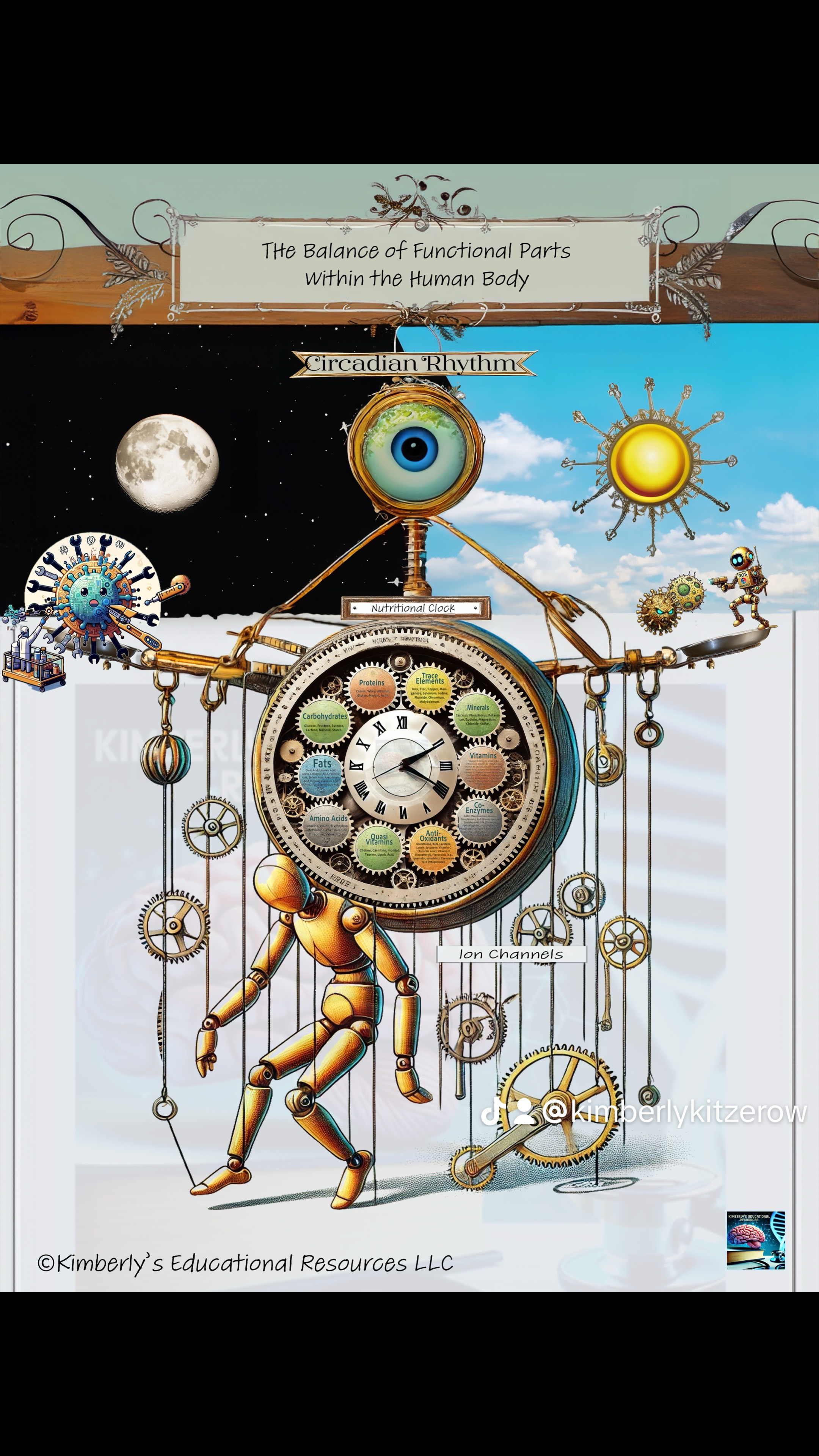
Image Description
I understand that the terminology on the original biochemical network may be inaccessible, so I created this visual representation. The image is a detailed and symbolic illustration of the biochemical pathways that maintain the balance of functional parts within the human body. It visually represents how genes carry instructions for creating proteins, which then act as gears within a clock mechanism to keep the body functioning. The pathways begin as nutrients we get from food and result in chain-link reactions that create products, which then act on ion channels to keep us functioning. These pathways are influenced by the circadian rhythm, determined by visual input through the retina.
Central Elements:
- Main Gear Clock:
- A large, intricate clock mechanism dominates the center, with various gears labeled with essential nutrients and biochemical elements such as proteins, vitamins, carbohydrates, minerals, fats, amino acids, and enzymes.
- Each gear represents a biochemical pathway essential for bodily functions, starting from the nutritional essentials we get from food. Each notch on the gears represents one protein, created from one gene, illustrating how proteins, based on genetic instructions, drive the gears to keep the body's "wheel" turning through chain-link reactions from substrate to product. These products then act on receptors managing ion channels to maintain bodily functions.
- Nutrition Clock: The central gear clock also represents the nutritional clock, where the circadian rhythm sends hunger signals to ensure we get the nutrients needed to fuel these pathways at appropriate times.
- Circadian Rhythm:
- An eye labeled "Circadian Rhythm" is positioned above the clock, symbolizing the regulation of biological processes based on the day-night cycle.
- The circadian rhythm controls when various functions are active, including hunger signals, immune response activation, and repair processes.
- The left side features a moon representing night, while the right side features a sun representing day. This emphasizes how the circadian rhythm, influenced by visual input through the retina, determines biochemical pathways.
- Mechanical Figure:
- A puppet-like figure is shown being manipulated by the gears, representing how biochemical pathways manage ion channels and other physiological processes to keep the body functioning.
Processes Regulated by Circadian Rhythm:
- Left Side (Nighttime Processes):
- Theme: DNA and Cell Repair
- Elements:
- Repair Mechanisms: Gears and tools such as wrenches symbolize cellular mechanisms focusing on repair and maintenance.
- Moon: Represents the nighttime, indicating when these processes are most active.
- Right Side (Daytime Processes):
- Theme: Active Metabolism and Immune Defense
- Elements:
- Pathogen Combat: A mechanical figure or nanobot is shown fighting pathogens, symbolizing the body's active immune response during the day.
- Sun: Represents the daytime, indicating when these processes are most active.
- Clearing Dead Cells: Indicates active immune response clearing dead cells during the day.
What is a Biochemical Network and Why is it Important?
The foundational premise of this biochemical network is rooted in the understanding that genetic mutations can lead to changes in enzymes, which are crucial for reactions within cellular metabolic pathways. These mutations can significantly impact enzyme structure, functionality, and efficiency. Enzymes play a vital role in controlling the flow and transformation of biochemical substances—acting on substrates, facilitating the synthesis of products, and requiring cofactors for their activity. Genetic variations can lead to metabolic imbalances, affecting the overall metabolic equilibrium.
The biochemical network serves as a comprehensive map, offering insights into the intricate web of metabolic reactions. By detailing how genetic mutations influence enzyme activity, the network facilitates a nuanced understanding of metabolic dynamics. This includes identifying key areas where enzymatic action is compromised, leading to metabolic bottlenecks that manifest as either an excess or scarcity of critical metabolic components. The predictive capacity of the network allows for the anticipation of outcomes based on specific metabolic derangements caused by genetic alterations. This detailed understanding paves the way for personalized therapeutic strategies, tailored to address unique metabolic challenges presented by an individual’s genetic makeup. The network bridges the gap between genotype and phenotype, underscoring the potential of personalized medicine in treating and managing metabolic disorders with precision.
Vision for the Future
This field, currently at the fringes of established science, presents an opportunity for groundbreaking exploration and discovery. I aspire to be a pioneer, obtaining a PhD to legitimize and expand this area of study. This achievement will enable me to educate future scientists and practitioners, ultimately driving transformative change in how neurodivergence and the comorbidities are understood and approached. This would result in knowledge of testing/treatment options for our comorbidities: chronic fatigue syndrome, EDS, insulin resistance, mental health, autoimmune, autoinflammatory, neurodegenerative, neuromuscular, etc.
I’ve chosen the decision-maker for reviewing the biochemical network to be Stanford University because they are deeply aligned with this goal due to Stanford's pioneering Neurodiversity Project. Stanford's commitment to neurodiversity resonates with the vision of exploring and understanding the biochemical underpinnings of neurodivergence. The university's objectives, particularly in establishing a culture that values the strengths of neurodiverse individuals, empowering them, and disseminating innovative models on a global scale, are in perfect harmony with this pursuit.
Furthermore, Stanford's focus on attracting and training talented individuals to work with and for the neurodiverse population offers a unique opportunity for me to collaborate, learn, and contribute within a community that is not only accepting but actively supportive of neurodiversity. This environment is ideal for fostering more research that seeks to elucidate the complex biochemical pathways involved in neurodivergence, thereby contributing to a greater understanding and betterment of neurodiverse individuals and their comorbidities.
My dedication has led to the publication of valuable resources on ResearchGate, enhancing the collective knowledge in this niche yet crucial field. These works, such as “The BH4/Homocysteine/Folate/B12 Pathway” and “Neurodivergence & Comorbidities Along the BH4 Pathway,” offer insights into complex biochemical interactions that are fundamental to understanding neurodivergent conditions.
Beyond academia, I have embraced the role of an educator and advocate on social media. My efforts aim to demystify the complexities of neurodivergence and its associated comorbidities, fostering a greater understanding.
Your review and consideration of this thesis for accuracy and potential utilization would be greatly appreciated.
Link to Stanford’s Neurodiversity Project - https://med.stanford.edu/neurodiversity.html
My Website - Kimberlysedu.org
Author of Beyond Words: The Journey from Silence to Speech - https://a.co/d/eKfrSLF
Research Gate Links:
The BH4/Homocysteine/Folate/B12 Pathway - DOI:10.13140/RG.2.2.10462.82247/4
https://www.researchgate.net/publication/377218425_BH4FolateCobalaminHomocysteine_Pathway
Neurodivergence & Comorbidities Along the BH4 Pathway - DOI:10.13140/RG.2.2.23124.37761

5,235
The Issue
Petition Description for the Stanford Neurodiversity Project
Update: This framework has expanded substantially, but this petition will be archived as is. You can find the updates at kimberlyedu.org
My name is Kimberly Kitzerow, and I have transformed academic journal data into a comprehensive analysis to uncover the root causes of neurodivergent comorbidities, leading to the establishment of Neurodivergent Biochemistry. When my nonverbal daughter couldn’t blow out candles on her 4th birthday cake, I realized that the inability to speak is a physical limitation, similar to being deaf or blind, and has nothing to do with intelligence. Understanding this helped me teach her to speak, and now she’s a chatterbox. When I sought research support to assist other nonverbal individuals, I was told the issue was too rare to warrant attention. This led me to map the entire biochemical network linking neurodivergence and its comorbidities.
Why I’m Petitioning the Stanford Neurodiversity Project
I am petitioning the Stanford Neurodiversity Project for this review because neurodivergence often results in an imbalance of biochemical pathways. Instead of operating in a state of balance, individuals with neurodivergent conditions frequently experience chronic activation of stress pathways. This can lead to various health issues, including impaired immune response, poor nutrient absorption, and inadequate cellular repair.
By accurately mapping and understanding these pathways, we can develop better strategies to support the health and well-being of neurodivergent individuals. This visual representation aims to make complex biochemical interactions more accessible and highlight the importance of maintaining balance within the body.
Image Description
I understand that the terminology on the original biochemical network may be inaccessible, so I created this visual representation. The image is a detailed and symbolic illustration of the biochemical pathways that maintain the balance of functional parts within the human body. It visually represents how genes carry instructions for creating proteins, which then act as gears within a clock mechanism to keep the body functioning. The pathways begin as nutrients we get from food and result in chain-link reactions that create products, which then act on ion channels to keep us functioning. These pathways are influenced by the circadian rhythm, determined by visual input through the retina.
Central Elements:
- Main Gear Clock:
- A large, intricate clock mechanism dominates the center, with various gears labeled with essential nutrients and biochemical elements such as proteins, vitamins, carbohydrates, minerals, fats, amino acids, and enzymes.
- Each gear represents a biochemical pathway essential for bodily functions, starting from the nutritional essentials we get from food. Each notch on the gears represents one protein, created from one gene, illustrating how proteins, based on genetic instructions, drive the gears to keep the body's "wheel" turning through chain-link reactions from substrate to product. These products then act on receptors managing ion channels to maintain bodily functions.
- Nutrition Clock: The central gear clock also represents the nutritional clock, where the circadian rhythm sends hunger signals to ensure we get the nutrients needed to fuel these pathways at appropriate times.
- Circadian Rhythm:
- An eye labeled "Circadian Rhythm" is positioned above the clock, symbolizing the regulation of biological processes based on the day-night cycle.
- The circadian rhythm controls when various functions are active, including hunger signals, immune response activation, and repair processes.
- The left side features a moon representing night, while the right side features a sun representing day. This emphasizes how the circadian rhythm, influenced by visual input through the retina, determines biochemical pathways.
- Mechanical Figure:
- A puppet-like figure is shown being manipulated by the gears, representing how biochemical pathways manage ion channels and other physiological processes to keep the body functioning.
Processes Regulated by Circadian Rhythm:
- Left Side (Nighttime Processes):
- Theme: DNA and Cell Repair
- Elements:
- Repair Mechanisms: Gears and tools such as wrenches symbolize cellular mechanisms focusing on repair and maintenance.
- Moon: Represents the nighttime, indicating when these processes are most active.
- Right Side (Daytime Processes):
- Theme: Active Metabolism and Immune Defense
- Elements:
- Pathogen Combat: A mechanical figure or nanobot is shown fighting pathogens, symbolizing the body's active immune response during the day.
- Sun: Represents the daytime, indicating when these processes are most active.
- Clearing Dead Cells: Indicates active immune response clearing dead cells during the day.
What is a Biochemical Network and Why is it Important?
The foundational premise of this biochemical network is rooted in the understanding that genetic mutations can lead to changes in enzymes, which are crucial for reactions within cellular metabolic pathways. These mutations can significantly impact enzyme structure, functionality, and efficiency. Enzymes play a vital role in controlling the flow and transformation of biochemical substances—acting on substrates, facilitating the synthesis of products, and requiring cofactors for their activity. Genetic variations can lead to metabolic imbalances, affecting the overall metabolic equilibrium.
The biochemical network serves as a comprehensive map, offering insights into the intricate web of metabolic reactions. By detailing how genetic mutations influence enzyme activity, the network facilitates a nuanced understanding of metabolic dynamics. This includes identifying key areas where enzymatic action is compromised, leading to metabolic bottlenecks that manifest as either an excess or scarcity of critical metabolic components. The predictive capacity of the network allows for the anticipation of outcomes based on specific metabolic derangements caused by genetic alterations. This detailed understanding paves the way for personalized therapeutic strategies, tailored to address unique metabolic challenges presented by an individual’s genetic makeup. The network bridges the gap between genotype and phenotype, underscoring the potential of personalized medicine in treating and managing metabolic disorders with precision.
Vision for the Future
This field, currently at the fringes of established science, presents an opportunity for groundbreaking exploration and discovery. I aspire to be a pioneer, obtaining a PhD to legitimize and expand this area of study. This achievement will enable me to educate future scientists and practitioners, ultimately driving transformative change in how neurodivergence and the comorbidities are understood and approached. This would result in knowledge of testing/treatment options for our comorbidities: chronic fatigue syndrome, EDS, insulin resistance, mental health, autoimmune, autoinflammatory, neurodegenerative, neuromuscular, etc.
I’ve chosen the decision-maker for reviewing the biochemical network to be Stanford University because they are deeply aligned with this goal due to Stanford's pioneering Neurodiversity Project. Stanford's commitment to neurodiversity resonates with the vision of exploring and understanding the biochemical underpinnings of neurodivergence. The university's objectives, particularly in establishing a culture that values the strengths of neurodiverse individuals, empowering them, and disseminating innovative models on a global scale, are in perfect harmony with this pursuit.
Furthermore, Stanford's focus on attracting and training talented individuals to work with and for the neurodiverse population offers a unique opportunity for me to collaborate, learn, and contribute within a community that is not only accepting but actively supportive of neurodiversity. This environment is ideal for fostering more research that seeks to elucidate the complex biochemical pathways involved in neurodivergence, thereby contributing to a greater understanding and betterment of neurodiverse individuals and their comorbidities.
My dedication has led to the publication of valuable resources on ResearchGate, enhancing the collective knowledge in this niche yet crucial field. These works, such as “The BH4/Homocysteine/Folate/B12 Pathway” and “Neurodivergence & Comorbidities Along the BH4 Pathway,” offer insights into complex biochemical interactions that are fundamental to understanding neurodivergent conditions.
Beyond academia, I have embraced the role of an educator and advocate on social media. My efforts aim to demystify the complexities of neurodivergence and its associated comorbidities, fostering a greater understanding.
Your review and consideration of this thesis for accuracy and potential utilization would be greatly appreciated.
Link to Stanford’s Neurodiversity Project - https://med.stanford.edu/neurodiversity.html
My Website - Kimberlysedu.org
Author of Beyond Words: The Journey from Silence to Speech - https://a.co/d/eKfrSLF
Research Gate Links:
The BH4/Homocysteine/Folate/B12 Pathway - DOI:10.13140/RG.2.2.10462.82247/4
https://www.researchgate.net/publication/377218425_BH4FolateCobalaminHomocysteine_Pathway
Neurodivergence & Comorbidities Along the BH4 Pathway - DOI:10.13140/RG.2.2.23124.37761
5,235
The Decision Makers

Supporter Voices
Petition created on January 29, 2024