

Oppose National Trust Lyme Car Park Relocation and Expansion Plans
The Issue
IMPORTANT: Don’t just sign this petition, you must also submit an objection to the Peak District National Park before 19th May 2023. Find a suggested response here and instructions to submit it, or go direct to the planning application here. Do it now!
—
The National Trust plan to relocate the entire car park at Lyme, a historic property on the Cheshire edge of the Peak District, further into the parkland and massively expand its permanent surfaced capacity from 395 to over 1,000 spaces.
This would result in a major net loss of green space, even more traffic on local roads, even more cars travelling even further through the park. No complementary measures whatsoever are included for cycling or sustainable travel and these plans would even make access more difficult for non-car visitors.
We, the undersigned, are calling for the organisation to withdraw this ill-considered application and come up with an alternative, fit-for-purpose plan for access, which truly reduces the impact of motor vehicles on this special place and has sustainable travel at its heart.
The National Trust’s plans include:
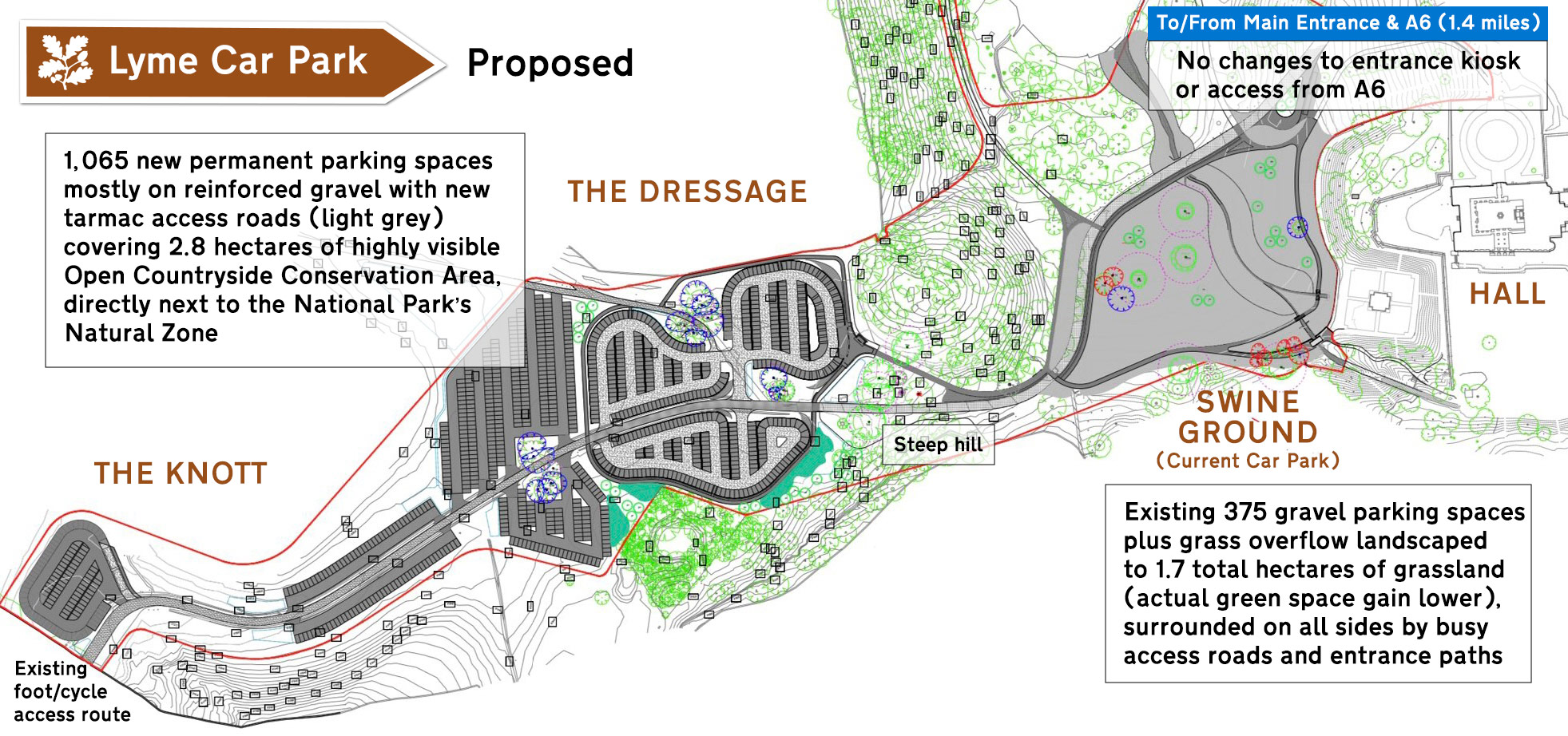
- More than doubling hard-surfaced car parking capacity from 395 to over 1,000 spaces. This would make Lyme the biggest permanent surface car park for miles around on this side of Greater Manchester, larger than major supermarkets or retail parks - and by far the biggest car park in the Peak District. The Trust claim “we’re not increasing spaces”, but they’re sneakily counting over 600 current overflow “spaces” — on unsurfaced, unmarked grassland used only on exceptionally busy days — in this figure. The truth is that the current main car park has 375 hard-surfaced spaces, with a further 20 up at the Knott. Hard-standing parking space numbers will therefore actually be increased 2.5 times over, with each of the 1,065 new spaces also larger in surface size. Lyme’s own figures show they rarely need this huge permanent capacity.
- A net loss of green space within the park. The new car parking would permanently cover over 2.8 hectares of damp grassland, but only 1.7 hectares (the existing car park) would be re-landscaped to green space.
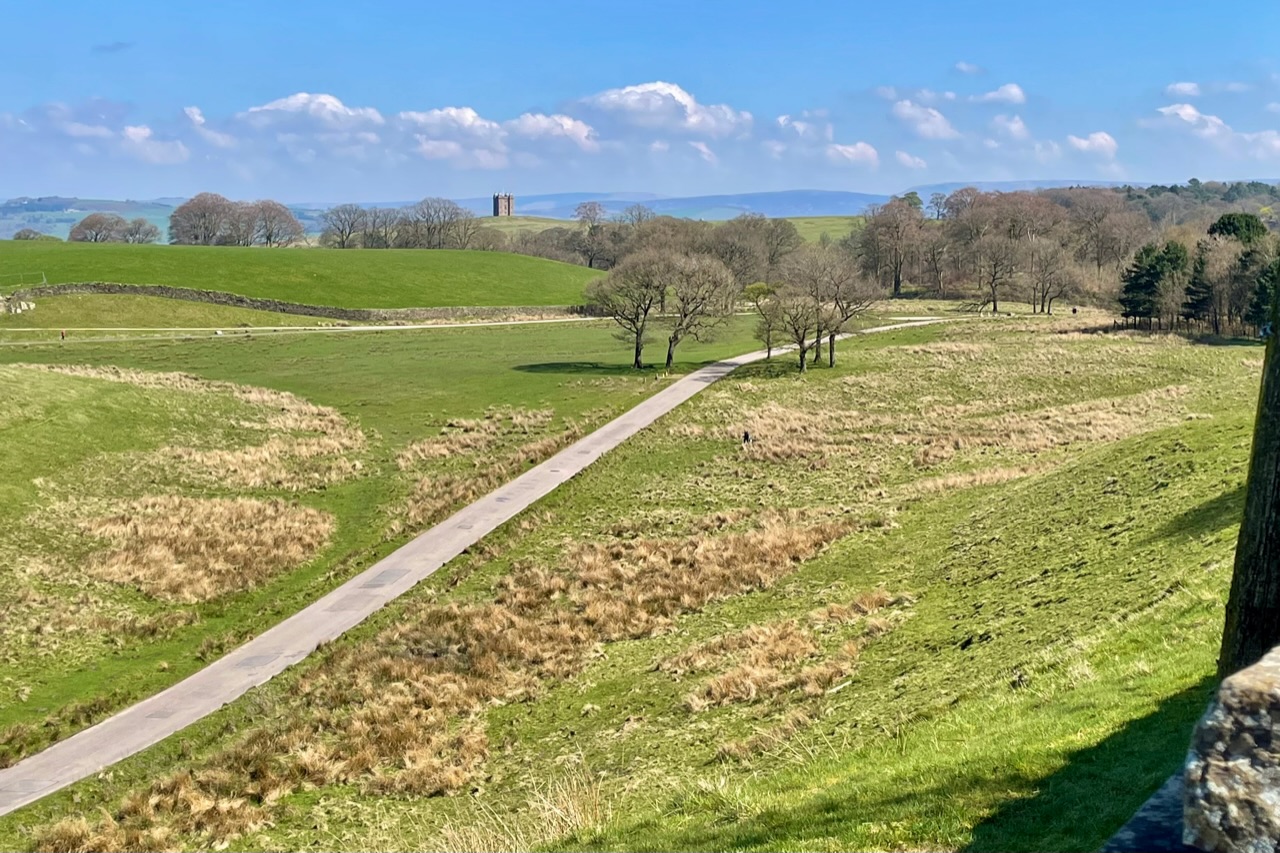
- Permanently destroying the natural beauty and safety of the “Knott” and “Dressage” areas. Gravel, tarmac and other car parking detritus would fill the elevated grassland both sides of the current narrow access road, not just on the current overflow area. Usually a quiet space, well used as a calm walking and cycling route into the park from Poynton and Middlewood Way, it would instead be flooded by car parking, far more visible from the surrounding moorland than the current shielded car park. No fewer than 15 separate access junctions for cars arriving and leaving the spaces would make it highly unpleasant and hazardous to walk and cycle through.
- All motor vehicles travelling even further - 2 miles - into the park. Since the new car park would be up the hill beyond the current car park, all visitors’ cars will have to be driven even further in and out. This includes driving right through the restored “Swine Ground” on the current car park - constant passing vehicle noise and air pollution making a mockery of what the National Trust claims would be a greener, “restored” entrance to the hall.
- All coaches parking right up at The Knott. A massively expanded tarmac and reinforced gravel car park (increased from 20 to 107 spaces) in this quiet, remote area would also be used for all coach and motor home parking. These huge vehicles would be required to traverse the steep hill and narrow existing access road, with no new facilities for pedestrians or cycles who currently enjoy this quiet route.
- No changes to admissions booth or A6 access to cope with more cars. Between 2013 and 2019, the number of visitor vehicles entering the estate grew by an astonishing 33%, to 196,000 per year. Queues to the current ticket booth and vehicles waiting to turn right into the park already cause serious congestion on the A6 at busy weekends. While Lyme say they’ve future plans to “adjust” the admissions booth, it’s not included in and won’t be a requirement of this application, which will induce even more vehicle traffic to the park - adding to the already awful local traffic and illegal levels of air pollution recorded around High Lane and Disley.
- Making access more difficult for everyone. By moving the car park up a steep hill, the average visitor would have to walk twice as far — about half a mile — doubling-back on their entry route by car, including climbing two hills both up to the Hall (which many already find difficult) and now returning to the new car park. This would require the provision of a mini bus, adding more to-and-fro traffic to the same road, amongst vehicles entering the car park, with no details on the suitability of this for visitors with reduced mobility, nor if it would be electric-powered. Lyme’s current minibus is not accessible for wheelchair users.
- No electric car charging points. The application states there are “currently no plans for the installation of any electric vehicle charging points within the new car park due to its distance from any existing electrical installation,” proving the unsuitability of this isolated location. It’s unbelievable that a brand new car park would not be built with this next generation of private travel in mind.
- No extra routes, facilities or provision for cycling. In fact, the plan states the pithy four main cycle parking stands will be moved further away from the hall, to the Timber Yard. Versus 1,065 car parking spaces, there would be only 8 acceptable public stands to lock a bike to. There will be no new or improved paths for cycling to protect people on bikes, who will have to share narrow roads with increased vehicle traffic right through the park, including coaches, making it a much less pleasant place to cycle.
- No thorough assessment of Park & Ride as a legitimate option. The Planning Supporting Statement says “Park and Ride as an alternative to car parking on site is not considered viable, given the amount of visitors to Lyme, and the lack of suitable land available to the Trust for such a purpose” with no further evidence or thorough assessment. This ignores that Lyme has previously been capable of offering a Park & Ride service to supplement its parking capacity on peak days, using a nearby 400-space Stockport Council-owned site in Hazel Grove, near the end of the A555 road.
The National Trust ironically claim that the new, massively bigger car park is needed to ensure the property is resilient against climate change. A culverted stream under the current car park would be opened up, part of a plan to reduce flood risk, and the area landscaped to grassland.
While this ambition to remove unsightly car parking from directly next to the Hall is definitely admirable, under these plans motor vehicles would continue to blight the restored “Swine Ground” by having to drive through it to access the new, isolated car park — which would instead completely destroy the current and historic setting of the Knott and Dressage areas, a net loss of green space. Surely any relocation of car parking should be closer to the main A6 access, not further away, and not be even more of a blight on the wider parkland than at present?
In Lyme’s own words, these plans are focused entirely on “improving the quality” of car parking spaces, with no complementary measures whatsoever to improve the quality of public transport or walking and cycling access. Worse, the plans would significantly undermine other access means, and negatively affect the beauty and conservation of the park itself. The proposed location, size and scope of the planned new car park is completely wrong for the property, its visitors and local access routes.
The National Trust should instead:
- Immediately restore the previous Park & Ride Shuttle Bus. For several summer seasons up to and including 2019, Lyme worked with Stagecoach Buses to provide a free, hourly, hybrid-electric shuttle bus from the 400-space, Stockport Council-owned Hazel Grove Park & Ride site. This popular offering has inexplicably failed to return since the Covid pandemic. It should be reinstated and expanded to a permanent, signposted offering for weekends and school holidays at least — perhaps also connecting to Hazel Grove railway station and even Stockport Bus Station — either free or with a small charge, which could then be deducted from house entry.
- Manage demand with timed pre-booking for car parking on expected “exceptional” days (except for NT members). This would effectively limit the number of car visitors attempting to enter the estate at one time, ironing-out demand both across the day and across weekdays, reducing the huge Sunday spikes seen at present. Covid showed this is workable and that the Trust has the systems in place to operate it. Members could be excluded from the need to pre-book. Any “on the day” visitors could be intercepted and redirected by effective road signage (perhaps even electronic signs) to the Park and Ride suggested above, meaning no-one will be refused entry, but those who don’t pre-book for busy weekends will need to park off-site.
- Offer discounts or incentives for visitors not arriving by car. Many visitor attractions now provide discounted entry for those arriving by public transport or by foot or cycle, with GoodJourney being an excellent resource. Despite suggesting this to Lyme numerous times, they have yet to offer such a scheme. RHS Bridgewater, for example, gives car-free visitors over 25% off entry, to recognise the significantly lower impact they have on local and site infrastructure.
- Diversify income streams beyond car parking. Private car visitors will always be a major component of Lyme's visitor income, but at present it relies far too heavily and lazily on this sole income stream. It's not sustainable and at times places enormous pressure on local roads. It must urgently seek other revenue streams such as dramatically enhancing its food and beverage offerings - and offering a reduced-price National Trust membership which doesn't include car parking.
- Dramatically increase and improve cycle parking and welcome. The quantity and placement of the 8 existing acceptable public stands is woefully inadequate. Lyme should as a basic requirement provide a ratio of cycle parking at least 1:10 with the number of surfaced car parking spaces (so, approx 40 stands at present), well-signposted and spread between multiple locations such as the Timber Yard. The main visitor stands should be covered by a suitable, in-keeping shelter, with a public repair stand, maps and information to provide a key “Cycling Welcome” hub. Routes where cycling is welcome should be clearly signposted, with maps at every entry gate. The key off-road West Park Drive entrance from Shrigley Road should be restored to a standard suitable for all bikes.
- Urgently improve “Getting There” website information. Lyme’s own online access information is next to useless, with no maps or directions describing how the park can be accessed from key points such as Disley railway station. No links are provided to bus or train timetables. For cycling there is no information whatsoever, only a “cycle route information” link pointing to a pin dropped on Google Maps, which is notoriously poor for cycle routes. No wonder most people don’t bother and just drive instead!
- Work with Cheshire East Council to secure improved off-road access for all users. Lyme is always keen to note that all routes into the park except the A6 are “footpath” rights of way only — even the key West Gate route from Shrigley Road and Red Lane from Disley, which are both full-width tarmac roads and have been well-used for cycling over many decades. It must work urgently and proactively with the council and neighbours to officially make these permissive cycle routes, and actively promote their use.
- Extend a minibus shuttle offering to Disley railway station. A mini bus currently provides visitors with a ride from the car admissions booth off the A6 with the main Hall area. Even if only by request or pre-booking, this could be extended to Disley railway station, dramatically improving the quality of visitor welcome by public transport. Lyme should also work with Cheshire East and Disley Parish Council to provide a clear, signposted walking route into the park via Red Lane.
- Engage proactively with park visitors and Trust members on their needs. Despite being years in the making, little to no prior consultation took place with general visitors before these plans were suddenly submitted. This has to change - Lyme needs to involve visitors from the outset in major plans, while actually listening and acting on smaller-scale suggestions to improve park access.
- Design and re-submit a comprehensive, progressive access plan for all visitors, with sustainable travel at its heart - including redesigned car parking and vehicle access. Still seeking to reduce impact on the Hall, but with no increase in hard-surfaced capacity and no new or expanded car parking in the Knott or Dressage areas. It would be possible to open up the culverted stream and to increase planting to reduce visual impact of the existing car park without a significant loss of hard capacity, as shown in earlier drafts. Relocating some or all of the car park would be a good ambition, but any relocated car parking capacity must be placed closer to the main access point of the A6, not even further into the park as proposed. Redesigning the access off the A6 is now essential for the number of vehicles Lyme wishes to welcome.
Some of the above ideas are included in Lyme’s Travel Plan, submitted as part of the application, but with only vague dates to “investigate” or implement them. They won’t be included in the car park permission as firm requirements, meaning National Trust could simply build the car park and do nothing more. For such a major proposal as this, it is essential that complementary measures are a firm component and requirement of the planning permission — as they would be for a housing or retail development, for example.
The application has been submitted by Land Studio, a planning agency working on behalf of the National Trust. All figures quoted above sourced from the planning application itself, notably the Transport Study. The petition writer is a resident of the local area who supports the National Trust and cares deeply about Lyme and its surrounding countryside, visiting the park regularly (by foot, cycle and yes, sometimes as a car passenger with family).

Victory
The Issue
IMPORTANT: Don’t just sign this petition, you must also submit an objection to the Peak District National Park before 19th May 2023. Find a suggested response here and instructions to submit it, or go direct to the planning application here. Do it now!
—
The National Trust plan to relocate the entire car park at Lyme, a historic property on the Cheshire edge of the Peak District, further into the parkland and massively expand its permanent surfaced capacity from 395 to over 1,000 spaces.
This would result in a major net loss of green space, even more traffic on local roads, even more cars travelling even further through the park. No complementary measures whatsoever are included for cycling or sustainable travel and these plans would even make access more difficult for non-car visitors.
We, the undersigned, are calling for the organisation to withdraw this ill-considered application and come up with an alternative, fit-for-purpose plan for access, which truly reduces the impact of motor vehicles on this special place and has sustainable travel at its heart.
The National Trust’s plans include:
- More than doubling hard-surfaced car parking capacity from 395 to over 1,000 spaces. This would make Lyme the biggest permanent surface car park for miles around on this side of Greater Manchester, larger than major supermarkets or retail parks - and by far the biggest car park in the Peak District. The Trust claim “we’re not increasing spaces”, but they’re sneakily counting over 600 current overflow “spaces” — on unsurfaced, unmarked grassland used only on exceptionally busy days — in this figure. The truth is that the current main car park has 375 hard-surfaced spaces, with a further 20 up at the Knott. Hard-standing parking space numbers will therefore actually be increased 2.5 times over, with each of the 1,065 new spaces also larger in surface size. Lyme’s own figures show they rarely need this huge permanent capacity.
- A net loss of green space within the park. The new car parking would permanently cover over 2.8 hectares of damp grassland, but only 1.7 hectares (the existing car park) would be re-landscaped to green space.
- Permanently destroying the natural beauty and safety of the “Knott” and “Dressage” areas. Gravel, tarmac and other car parking detritus would fill the elevated grassland both sides of the current narrow access road, not just on the current overflow area. Usually a quiet space, well used as a calm walking and cycling route into the park from Poynton and Middlewood Way, it would instead be flooded by car parking, far more visible from the surrounding moorland than the current shielded car park. No fewer than 15 separate access junctions for cars arriving and leaving the spaces would make it highly unpleasant and hazardous to walk and cycle through.
- All motor vehicles travelling even further - 2 miles - into the park. Since the new car park would be up the hill beyond the current car park, all visitors’ cars will have to be driven even further in and out. This includes driving right through the restored “Swine Ground” on the current car park - constant passing vehicle noise and air pollution making a mockery of what the National Trust claims would be a greener, “restored” entrance to the hall.
- All coaches parking right up at The Knott. A massively expanded tarmac and reinforced gravel car park (increased from 20 to 107 spaces) in this quiet, remote area would also be used for all coach and motor home parking. These huge vehicles would be required to traverse the steep hill and narrow existing access road, with no new facilities for pedestrians or cycles who currently enjoy this quiet route.
- No changes to admissions booth or A6 access to cope with more cars. Between 2013 and 2019, the number of visitor vehicles entering the estate grew by an astonishing 33%, to 196,000 per year. Queues to the current ticket booth and vehicles waiting to turn right into the park already cause serious congestion on the A6 at busy weekends. While Lyme say they’ve future plans to “adjust” the admissions booth, it’s not included in and won’t be a requirement of this application, which will induce even more vehicle traffic to the park - adding to the already awful local traffic and illegal levels of air pollution recorded around High Lane and Disley.
- Making access more difficult for everyone. By moving the car park up a steep hill, the average visitor would have to walk twice as far — about half a mile — doubling-back on their entry route by car, including climbing two hills both up to the Hall (which many already find difficult) and now returning to the new car park. This would require the provision of a mini bus, adding more to-and-fro traffic to the same road, amongst vehicles entering the car park, with no details on the suitability of this for visitors with reduced mobility, nor if it would be electric-powered. Lyme’s current minibus is not accessible for wheelchair users.
- No electric car charging points. The application states there are “currently no plans for the installation of any electric vehicle charging points within the new car park due to its distance from any existing electrical installation,” proving the unsuitability of this isolated location. It’s unbelievable that a brand new car park would not be built with this next generation of private travel in mind.
- No extra routes, facilities or provision for cycling. In fact, the plan states the pithy four main cycle parking stands will be moved further away from the hall, to the Timber Yard. Versus 1,065 car parking spaces, there would be only 8 acceptable public stands to lock a bike to. There will be no new or improved paths for cycling to protect people on bikes, who will have to share narrow roads with increased vehicle traffic right through the park, including coaches, making it a much less pleasant place to cycle.
- No thorough assessment of Park & Ride as a legitimate option. The Planning Supporting Statement says “Park and Ride as an alternative to car parking on site is not considered viable, given the amount of visitors to Lyme, and the lack of suitable land available to the Trust for such a purpose” with no further evidence or thorough assessment. This ignores that Lyme has previously been capable of offering a Park & Ride service to supplement its parking capacity on peak days, using a nearby 400-space Stockport Council-owned site in Hazel Grove, near the end of the A555 road.
The National Trust ironically claim that the new, massively bigger car park is needed to ensure the property is resilient against climate change. A culverted stream under the current car park would be opened up, part of a plan to reduce flood risk, and the area landscaped to grassland.
While this ambition to remove unsightly car parking from directly next to the Hall is definitely admirable, under these plans motor vehicles would continue to blight the restored “Swine Ground” by having to drive through it to access the new, isolated car park — which would instead completely destroy the current and historic setting of the Knott and Dressage areas, a net loss of green space. Surely any relocation of car parking should be closer to the main A6 access, not further away, and not be even more of a blight on the wider parkland than at present?
In Lyme’s own words, these plans are focused entirely on “improving the quality” of car parking spaces, with no complementary measures whatsoever to improve the quality of public transport or walking and cycling access. Worse, the plans would significantly undermine other access means, and negatively affect the beauty and conservation of the park itself. The proposed location, size and scope of the planned new car park is completely wrong for the property, its visitors and local access routes.
The National Trust should instead:
- Immediately restore the previous Park & Ride Shuttle Bus. For several summer seasons up to and including 2019, Lyme worked with Stagecoach Buses to provide a free, hourly, hybrid-electric shuttle bus from the 400-space, Stockport Council-owned Hazel Grove Park & Ride site. This popular offering has inexplicably failed to return since the Covid pandemic. It should be reinstated and expanded to a permanent, signposted offering for weekends and school holidays at least — perhaps also connecting to Hazel Grove railway station and even Stockport Bus Station — either free or with a small charge, which could then be deducted from house entry.
- Manage demand with timed pre-booking for car parking on expected “exceptional” days (except for NT members). This would effectively limit the number of car visitors attempting to enter the estate at one time, ironing-out demand both across the day and across weekdays, reducing the huge Sunday spikes seen at present. Covid showed this is workable and that the Trust has the systems in place to operate it. Members could be excluded from the need to pre-book. Any “on the day” visitors could be intercepted and redirected by effective road signage (perhaps even electronic signs) to the Park and Ride suggested above, meaning no-one will be refused entry, but those who don’t pre-book for busy weekends will need to park off-site.
- Offer discounts or incentives for visitors not arriving by car. Many visitor attractions now provide discounted entry for those arriving by public transport or by foot or cycle, with GoodJourney being an excellent resource. Despite suggesting this to Lyme numerous times, they have yet to offer such a scheme. RHS Bridgewater, for example, gives car-free visitors over 25% off entry, to recognise the significantly lower impact they have on local and site infrastructure.
- Diversify income streams beyond car parking. Private car visitors will always be a major component of Lyme's visitor income, but at present it relies far too heavily and lazily on this sole income stream. It's not sustainable and at times places enormous pressure on local roads. It must urgently seek other revenue streams such as dramatically enhancing its food and beverage offerings - and offering a reduced-price National Trust membership which doesn't include car parking.
- Dramatically increase and improve cycle parking and welcome. The quantity and placement of the 8 existing acceptable public stands is woefully inadequate. Lyme should as a basic requirement provide a ratio of cycle parking at least 1:10 with the number of surfaced car parking spaces (so, approx 40 stands at present), well-signposted and spread between multiple locations such as the Timber Yard. The main visitor stands should be covered by a suitable, in-keeping shelter, with a public repair stand, maps and information to provide a key “Cycling Welcome” hub. Routes where cycling is welcome should be clearly signposted, with maps at every entry gate. The key off-road West Park Drive entrance from Shrigley Road should be restored to a standard suitable for all bikes.
- Urgently improve “Getting There” website information. Lyme’s own online access information is next to useless, with no maps or directions describing how the park can be accessed from key points such as Disley railway station. No links are provided to bus or train timetables. For cycling there is no information whatsoever, only a “cycle route information” link pointing to a pin dropped on Google Maps, which is notoriously poor for cycle routes. No wonder most people don’t bother and just drive instead!
- Work with Cheshire East Council to secure improved off-road access for all users. Lyme is always keen to note that all routes into the park except the A6 are “footpath” rights of way only — even the key West Gate route from Shrigley Road and Red Lane from Disley, which are both full-width tarmac roads and have been well-used for cycling over many decades. It must work urgently and proactively with the council and neighbours to officially make these permissive cycle routes, and actively promote their use.
- Extend a minibus shuttle offering to Disley railway station. A mini bus currently provides visitors with a ride from the car admissions booth off the A6 with the main Hall area. Even if only by request or pre-booking, this could be extended to Disley railway station, dramatically improving the quality of visitor welcome by public transport. Lyme should also work with Cheshire East and Disley Parish Council to provide a clear, signposted walking route into the park via Red Lane.
- Engage proactively with park visitors and Trust members on their needs. Despite being years in the making, little to no prior consultation took place with general visitors before these plans were suddenly submitted. This has to change - Lyme needs to involve visitors from the outset in major plans, while actually listening and acting on smaller-scale suggestions to improve park access.
- Design and re-submit a comprehensive, progressive access plan for all visitors, with sustainable travel at its heart - including redesigned car parking and vehicle access. Still seeking to reduce impact on the Hall, but with no increase in hard-surfaced capacity and no new or expanded car parking in the Knott or Dressage areas. It would be possible to open up the culverted stream and to increase planting to reduce visual impact of the existing car park without a significant loss of hard capacity, as shown in earlier drafts. Relocating some or all of the car park would be a good ambition, but any relocated car parking capacity must be placed closer to the main access point of the A6, not even further into the park as proposed. Redesigning the access off the A6 is now essential for the number of vehicles Lyme wishes to welcome.
Some of the above ideas are included in Lyme’s Travel Plan, submitted as part of the application, but with only vague dates to “investigate” or implement them. They won’t be included in the car park permission as firm requirements, meaning National Trust could simply build the car park and do nothing more. For such a major proposal as this, it is essential that complementary measures are a firm component and requirement of the planning permission — as they would be for a housing or retail development, for example.
The application has been submitted by Land Studio, a planning agency working on behalf of the National Trust. All figures quoted above sourced from the planning application itself, notably the Transport Study. The petition writer is a resident of the local area who supports the National Trust and cares deeply about Lyme and its surrounding countryside, visiting the park regularly (by foot, cycle and yes, sometimes as a car passenger with family).
The Decision Makers

Petition Updates
Share this petition
Petition created on 10 April 2023