

OpenAI: Stop Cutting Corners and Deprioritizing Safety
The Issue
OpenAI and its leadership cannot be trusted to responsibly develop advanced artificial intelligence.
Since pivoting from their nonprofit origins to begin rapidly scaling AI models in 2020, OpenAI and its senior executives have shown repeated, critical failures of oversight and accountability.
They have:
- Drifted far from their nonprofit origins, including opening and rapidly scaling a for-profit subsidiary;
- Fallen under the control of financial interests and megacorporations;
- Appointed a CEO with a history of allegations of "manipulation" and "dishonesty;"
- Kicked out, or lost the trust of, many of their key safety employees;
- Potentially violated copyright in data collection for training new models, and in allegedly impersonating of a celebrity's voice;
- Generally failing to meet their own safety standards and promises, including reportedly failing to give their safety staff computing resources they previously promised.
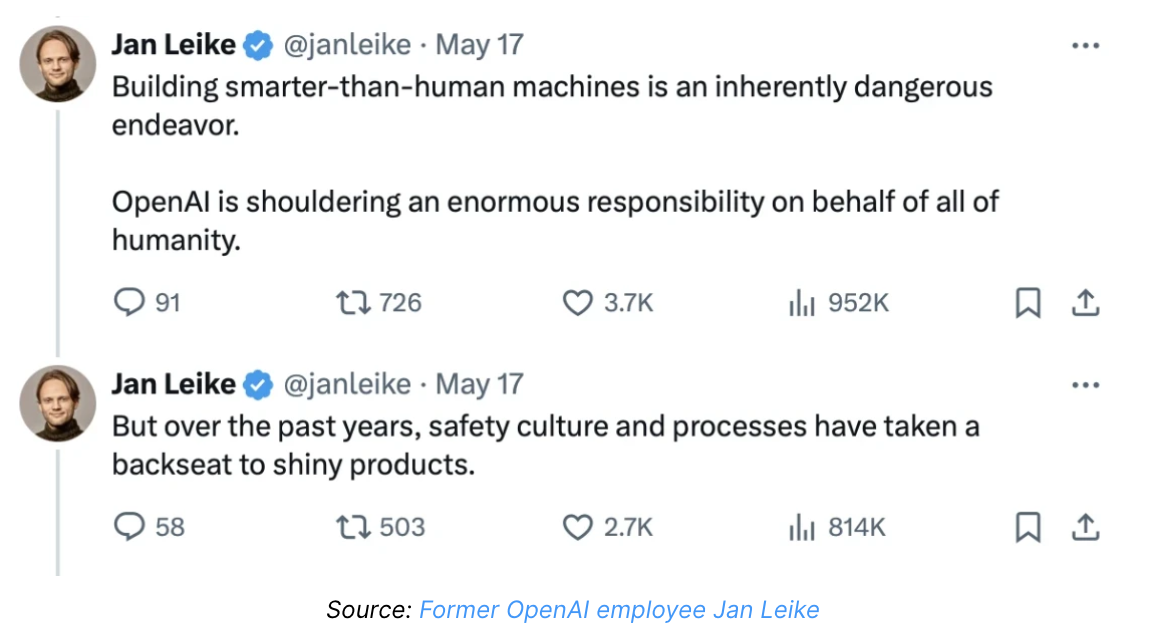
While the “move fast and break things” attitude may be celebrated at some tech companies, it is not remotely appropriate for a technology as consequential and dangerous as this one. We must hold the people and corporations building AI to an unusually high standard. “Good enough” won’t cut it for something so important.
www.openailetter.org contains evidence supporting our conclusion. The signatories of this letter demand that OpenAI be held accountable for its past and future actions to ensure that it does not cause further avoidable harm.
Relevant accountability mechanisms may include, but are not limited to:
- Appointing a nonprofit board predominantly composed of leaders in AI safety and civil society, as opposed to its current overwhelming bias toward industry leaders.
- Ensuring the nonprofit is fully insulated from the financial incentives of the for-profit subsidiary.
- Committing to provide early model access to third party auditors including nonprofits, regulators, and academics.
- Expanding internal teams focused on safety and ethics, and pre-assigning them meaningful “veto power” in future development decisions and product releases.
- Publishing a more detailed, and more binding, preparedness framework.
- Publicly announcing the release of all former employees from non-disparagement obligations, assuming there is nothing to hide.
- Accepting increased government scrutiny to ensure that OpenAI follows all applicable laws and regulations, and refraining from lobbying to water down such regulation.
- Accepting clear legal liability for the current and future harms to people and society caused by OpenAI’s products.
Our future is at stake. OpenAI and its leaders must act cautiously and with real accountability as they enter uncharted territory developing advanced AI. Local and federal government agencies, lawmakers, the media, and the global public must work proactively to hold OpenAI accountable.

84
The Issue
OpenAI and its leadership cannot be trusted to responsibly develop advanced artificial intelligence.
Since pivoting from their nonprofit origins to begin rapidly scaling AI models in 2020, OpenAI and its senior executives have shown repeated, critical failures of oversight and accountability.
They have:
- Drifted far from their nonprofit origins, including opening and rapidly scaling a for-profit subsidiary;
- Fallen under the control of financial interests and megacorporations;
- Appointed a CEO with a history of allegations of "manipulation" and "dishonesty;"
- Kicked out, or lost the trust of, many of their key safety employees;
- Potentially violated copyright in data collection for training new models, and in allegedly impersonating of a celebrity's voice;
- Generally failing to meet their own safety standards and promises, including reportedly failing to give their safety staff computing resources they previously promised.
While the “move fast and break things” attitude may be celebrated at some tech companies, it is not remotely appropriate for a technology as consequential and dangerous as this one. We must hold the people and corporations building AI to an unusually high standard. “Good enough” won’t cut it for something so important.
www.openailetter.org contains evidence supporting our conclusion. The signatories of this letter demand that OpenAI be held accountable for its past and future actions to ensure that it does not cause further avoidable harm.
Relevant accountability mechanisms may include, but are not limited to:
- Appointing a nonprofit board predominantly composed of leaders in AI safety and civil society, as opposed to its current overwhelming bias toward industry leaders.
- Ensuring the nonprofit is fully insulated from the financial incentives of the for-profit subsidiary.
- Committing to provide early model access to third party auditors including nonprofits, regulators, and academics.
- Expanding internal teams focused on safety and ethics, and pre-assigning them meaningful “veto power” in future development decisions and product releases.
- Publishing a more detailed, and more binding, preparedness framework.
- Publicly announcing the release of all former employees from non-disparagement obligations, assuming there is nothing to hide.
- Accepting increased government scrutiny to ensure that OpenAI follows all applicable laws and regulations, and refraining from lobbying to water down such regulation.
- Accepting clear legal liability for the current and future harms to people and society caused by OpenAI’s products.
Our future is at stake. OpenAI and its leaders must act cautiously and with real accountability as they enter uncharted territory developing advanced AI. Local and federal government agencies, lawmakers, the media, and the global public must work proactively to hold OpenAI accountable.
The Decision Makers

Supporter Voices
Petition Updates
Share this petition
Petition created on May 21, 2024