

Open Letter Against Recent Herbicide Use at Alum Rock Park
The Issue
Dear PRNS Management, other City Staff, City Council, and Mayor Mahan:
We are horrified to have learned that the roadsides of Alum Rock Park appear to have been entirely blanketed with herbicide on April 4th, 2025, under the guise of “fuel reduction”. This mistreatment of a beloved and highly visited park raises numerous concerns in three main categories:
1: There was inadequate and inaccurate notice to the public, and park visitors may have been placed in harm’s way.
2: Sensitive habitats and species were sprayed, including a rare population of a native orchid.
3: The spraying did not follow fuel reduction best practices and may have increased fire danger rather than lessened it.

The spraying also blatantly disregarded the City of San José's Pollution Prevention Plan, and its Best Management Practices for Integrated Pest Management.
We request that the City of San Jose:
A: Conduct an open and transparent inquiry into what went wrong and how to prevent future recurrence.
B: Contract for habitat restoration to see if the rare Michael’s Rein Orchid population can be saved from going locally extinct.
C: Immediately address the ecological land management concerns created by the spraying debacle. This must include proper wildfire risk reduction before the upcoming fire season.
D: Create an internal staffing structure for accountability and ownership of wise natural lands stewardship at Alum Rock Park.
Photos of the spray's impacts can be seen on our Google Drive.
Section 1 - PUBLIC RISK:
There was inadequate and inaccurate notice to the public, and park visitors may have been placed in harm’s way. A copy of the warning sign issued by the parks department can be found here: Copy of Herbicide Use Signage. It states that the spraying used three herbicide products: Rodeo, Milestone, and Dimension. It lists the active ingredient as Glyphosate.
A: Misleading Signage: The active ingredient in Rodeo is indeed glyphosate. However, the active ingredient in Milestone is aminopyralid, and the active ingredient in Dimension is dithiopyr. If the public wanted to avoid being in the park after the spraying of certain chemicals, or even if they were curious what had been sprayed, then this sign was misleading and erroneous.
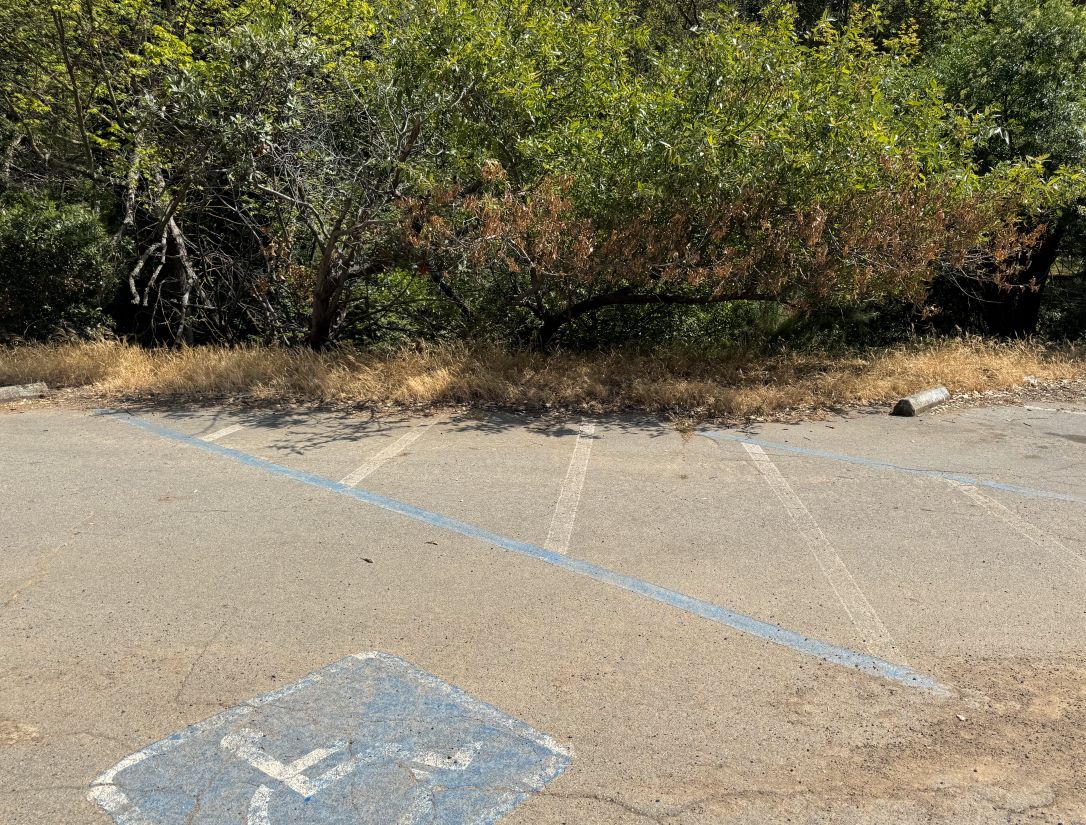
B: Hazardous Chemical: The sign states that fuel reduction took place from 9-1 PM. The park reopened at 1 PM. However, upon reopening, no signage indicated that people should avoid sprayed vegetation. Upon the park's reopening, there were multiple freshly-sprayed areas adjacent to and in walking paths, parking spaces (including wheelchair accessible loading zones), and places where children might be present. This image shows herbicide damage on the lower limbs of this willow, where it protrudes over the loading zone for a wheelchair accessible parking spot.
One of the chemicals used, Dimension/dithiopyr, is classified as hazardous under the criteria of the Federal OSHA Hazard Communication Standard 29CFR 1910.1200. It’s classed as Category 2 for Skin irritation, Sub-category 1B for Skin sensitisation, and Category 2 for Reproductive toxicity. The materials safety data sheet for dithiopyr issues the following precautionary statements:
- Avoid breathing dust/ fume/ gas/ mist/ vapours/ spray.
- Wash skin thoroughly after handling.
- Contaminated work clothing should not be allowed out of the workplace.
- Wear protective gloves.
- Use personal protective equipment as required.
- Response IF ON SKIN: Wash with plenty of soap and water.
- IF exposed or concerned: Get medical advice/ attention.
- If skin irritation or rash occurs: Get medical advice/ attention.
- Take off contaminated clothing and wash before reuse.
From: https://labelsds.com/images/user_uploads/Dimension%202%20EW%20SDS%208-25-16.pdf accessed 4/21/25.
C: Possible risk to visitors and their households: Because this active ingredient was not listed, and because the park was reopened immediately after the spray period ended, park visitors may have sustained damage or risk that would have been avoidable with proper signage. People may have touched vegetation freshly sprayed with dithiopyr. They may have brushed up against it with their clothes, and then gone home and, wearing those same clothes, picked up their children or pets. Anyone in their home with a compromised immune system or allergies to certain chemicals may also have been at risk.
Section 2 - ENVIRONMENTAL DESTRUCTION:
Sensitive habitats and species were sprayed, including a known population of a rare orchid. Alum Rock Park is a rich center of biological diversity. Several rare plant and animal species call the park home. As the oldest municipal park in California, Alum Rock Park serves an important role as a habitat refuge amidst other areas which have already been paved over.
A: Vulnerable species: Penitencia Creek Road, per its name, parallels the creek. In some cases, the creek even crisscrosses under the road. Creekside, or riparian, habitat is often considered more sensitive than upland areas. Numerous rare, special status, or sensitive species have been documented in Penitencia Creek within Alum Rock Park, including but not limited to:
- California red-legged frog (Rana draytonii) - federally listed as threatened by the USFWS. California Priority 1 Species of Special Concern - see https://wildlife.ca.gov/Conservation/SSC for definitions.
- Monarch butterflies (Danaus plexippus) - proposed federal listing as endangered. California listed Terrestrial and Vernal Pool Invertebrates of Conservation Priority, and Species of Greatest Conservation Need in California’s Wildlife Action Plan. See: https://wildlife.ca.gov/Conservation/Invertebrates/Monarch-Butterfly#status for more information.
- Western pond turtle (Clemmys marmorata) - proposed federal listing as threatened, California Species of Special Concern.
- California roach (Hesperoleucus venustus) - California State Species of Special Concern.

The above picture shows how creekside native plants - like this California blackberry - were sprayed, creating dead zones in relatively high moisture areas.
B: Was the wrong chemical used?: Two of the three chemicals listed on the signage may not have been appropriate for riparian (creek) zones. Milestone should only be used when those riparian areas are seasonally dry. All of Penitencia Creek was still running when the spraying was done; the few areas in the park that do dry out had not yet done so for the year. The Dimension warning label lists acute toxicity to fish, acute toxicity to aquatic invertebrates, and acute toxicity to algae and aquatic plants. The herbicide spray line is easily visible along the intersection of Alum Rock and Penitencia Creek roads, affecting willow, holly-leaved cherry, snowberry, and California blackberry, among other native riparian plants. Therefore, it appears that chemicals not approved for use in riparian (creek) zones may have been applied in an area that contains documented rare or special status species.
C: California native flowers, shrubs, and trees were sprayed: Many native plants received the full brunt of the spray, including but not limited to the following plants indigenous to - and in some cases only found in - California: sagebrush, morning glory, paintbrush, owl's clover, coast live oak, valley oak, polypody fern, gumplant, sticky monkeyflower, canyon dudleya, California bay laurel, toyon, coast live oak, valley oak, arroyo willow, snowberry, California blackberry, hedgenettle, native lilies, native grasses, and other wildflowers, shrubs, trees, and perennials. Ranger had created a native California wildflower restoration was sprayed.
D: Rare orchid sprayed, possible local extinction caused: Perhaps the most disturbing abuse of the natural environment was the spraying of a rare orchid. Michael’s rein orchid, Piperia michaelii, has a California Native Plant Society rare plant rank of 4.2B. The vulnerable population in Alum Rock is isolated from other individuals in the county and is locally rare.
A park visitor, Bob Jarrett, had brought the orchid to the Rangers’ attention several years ago. Jarrett and Rangers worked over the years to flag, weed around, and protect the orchids. With these efforts, the observed population grew from 8 orchids to more than 20. Because the entire population was alongside one of the park’s internal roads, recently the Park Rangers worked with an Eagle Scout troop to install a sturdy wooden fence. This was to prevent the orchids from accidentally being stepped on or otherwise damaged. Therefore, in addition to being ecologically significant, the population had been known, protected, and cared for for many years.
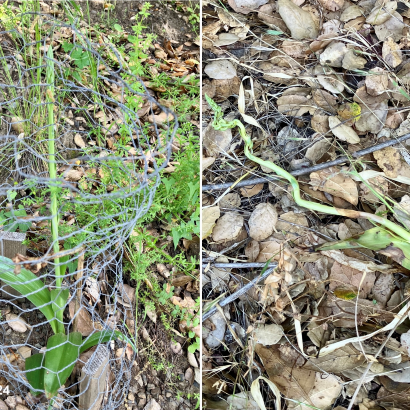
On the left, a healthy Michael's Rein Orchid, caged against accidental damage by visitors or maintenance staff, in April 2024. On right, the orchid in April 2025, after being sprayed.
More photos in the Google Drive
Orchids are shallowly rooted. These plants were sprayed while they were at full growth and about to flower. It seems unlikely that the population will survive. This is extremely grievous because this is how extinctions happen. Whether through carelessness, avarice, or incompetence, population after population winks out, until eventually, none are left at all. PRNS can be - must be - better than this. This handful of orchids was a rare and unusual population in Santa Clara County. Now, it is most likely gone.
E: Were nesting birds sprayed? The parks’ information email address was queried about whether a nesting bird survey was done prior to the work. The response neither confirmed nor denied whether such was done. Doing a nesting bird survey would have been a part of ecological best practices in fuel reduction. Many birds covered by the Migratory Bird Treaty Act live within the spray corridor. Just a small example includes: red-winged blackbirds, western bluebird, American crow, mourning dove, great egret, snowy egret, Canada goose, Cooper’s hawk, red-tailed hawk, red-shouldered hawk, California towhee, barn owl, great horned owl, screech owl, and others. A nesting bird survey would have allowed the contractor to avoid spraying areas where sensitive species might forage or hunt. If this was not done, then these birds were not protected.
- There are screech owl family generations that live in a sycamore tree next to the road. These birds have been documented in many photographs by staff and visitors over the years. This owl in this tree was shared on the PRNS Facebook page in 2020. Spray carpeted the vegetation all along the base of the tree, where the prey those owls need to hunt lives.
- While California quail are not protected by this treaty, they are nonetheless ecologically significant and bear a special place in the hearts of many park users. April and May are the time when quail are nesting and egg laying. An area where California quail hatch broods year after year, by the Rustic Lands parking lot, was thoroughly sprayed, and any nests or eggs that were in that area were sprayed as well.
Section 3: The spraying was not done in accordance with fuel reduction best practices, and may have increased fire danger rather than lessening it.
A: The spraying was done when foliage was still green, creating a dead zone of tall standing weeds where there was previously moist green foliage.
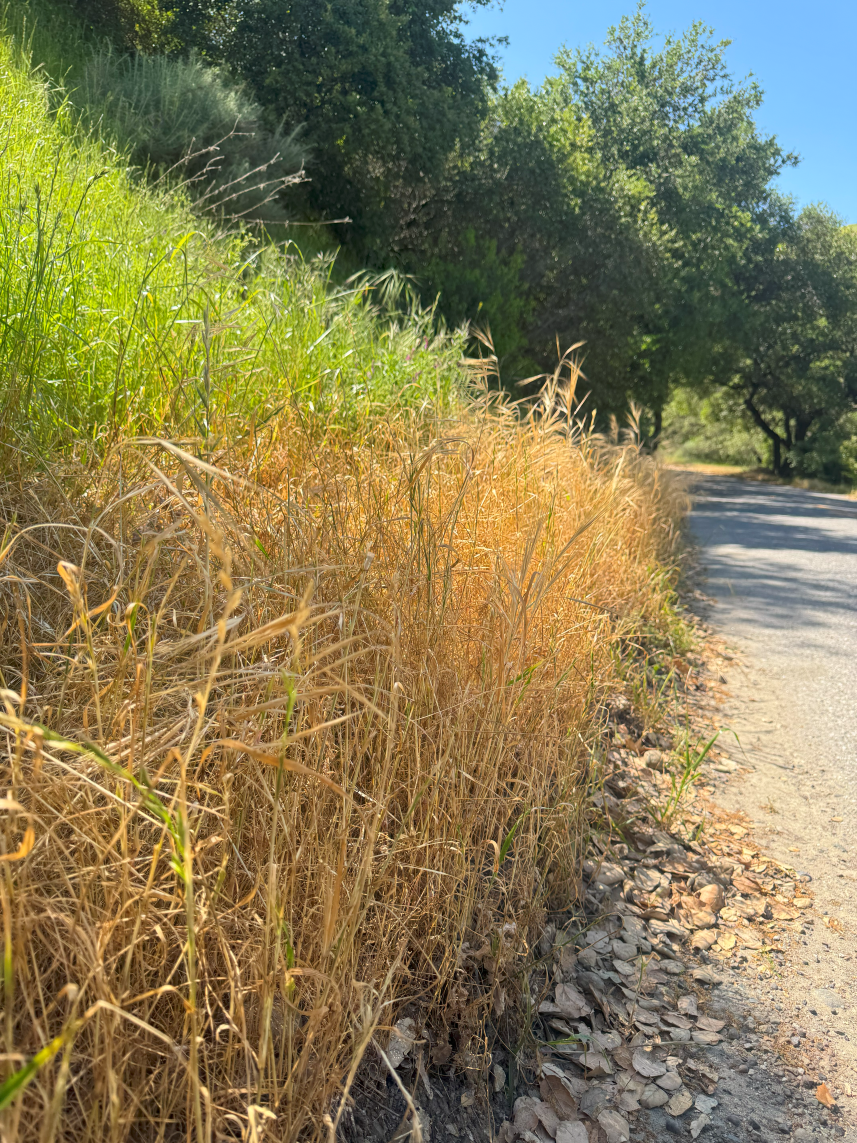
B: The spraying did not differentiate between grass/herbs and shrubs/trees. Thus, it created numerous areas of killed grass that lead into killed lower limbs of shrubs. This is a perfect recipe for a “fuel ladder” to bring flames from a lower to a higher strata of vegetation. Fuel ladders are very dangerous. More information about them can be found at Fire Safe Marin.
C: High moisture plants, including ferns, succulents, and willows were sprayed.
D: Pre-existing piles of dead branches and foliage were sprayed with herbicide instead of being removed.
E. Many trees that were sprayed are already exhibiting limb die back in the spray zones. In addition to the immediate concern of dead and dying vegetation, this creates an issue for future fire safety. Trees that have been blasted with herbicide may become sick or struggle to survive. Sick vegetation contains less fuel moisture than healthy vegetation. Some of these trees may end up dying. Dead foliage contains the least moisture of them all.
F: Best practices in roadside fuel reduction are generally considered as follows:
- Mow /cut grass and weeds when it begins to dry out.
- Remove invasive plants.
- Limb up trees to create a shaded fuel break.
- Depending on the species, either cut back or remove brush.
- Remove all dead and dying vegetation.
Indeed, the Santa Clara County Community Wildfire Protection Plan details numerous such sensible fuel reduction steps for Alum Rock Park and the surrounding communities, for example:
- Limb trees and remove brush along roadways to at least reclaim full original width and height. Goal: minimum 20-foot clear width and 15-foot clear height.
- Encourage continued grazing in parks and open space for grass/light fuel maintenance.
- Clear brush, limb trees, and remove dead woody materials, located within 10 feet of road edges
- Regular maintenance needed to ensure the fuel break remains clear of vegetation.
- Monitor for erosion and invasive species.
Limbing trees and removing dead materials makes sense. Broadcast herbicide spraying in the middle of spring does not. It’s doubtful whether any fire authority could see these before and after photos and conclude that fire danger was lessened by these actions. It is widely known that the creation of dead fuels and ladder fuels is part of the problem, not part of the solution. Literally doing nothing would have provided more fire risk reduction than this.

To say that Alum Rock Park is important to San Jose residents is an understatement. The park is deeply beloved. As the oldest municipal park in California, this park contains a rich history for many folks who have visited it all their lives. They hold dear the experiences of wildflowers, the hills which turn green and then gold, and maybe even a sighting of a hawk or a fox. For animals, plants, and even humans, Alum Rock Park is home. You don’t treat your home like this.
To prevent such a catastrophe from happening again, we request the following accountability measures:
- PRNS should conduct a thorough internal investigation and fact-finding. What went wrong, and how will you prevent it from happening again, either here or on other city lands? Results should be reported to the public.
- The City needs better communication with its own staff as well as with the community at large. To endanger public health with inaccurate signage of wide-scale herbicide use in a popular park and play area is unacceptable. Additionally, Park Ranger staff were well aware of many of these sensitive areas and species, having worked on them over the years. What methods will be put in place to improve communication within and outside the city, and prevent a recurrence of this travesty?
- PRNS needs skilled ecological oversight. All of the regional parks, as well as some others such as Montgomery Hill Park, contain actual and potential habitat for listed and sensitive species. That, combined with high recreation use and proximity to critical fire danger zones, make skilled ecological land management an imperative. However, since this letter is specifically about Alum Rock Park, we ask the city to investigate options for wise natural lands stewardship of this park, and to report back with an update.
- Although the City of San Jose is one of the highest-income areas in the country, PRNS is chronically underfunded. However, the Bay Area is rich with supportive resources and frameworks to guide skilled land use.
- The Bay Area Open Space Council, Committee for Green Foothills, Santa Clara Valley Fire Safe Council, Santa Clara Valley Greenprint, Together Bay Area, the California Native Plant Society Santa Clara Valley Chapter, and many others provide a wealth of knowledge, skill, information, and training which could shape natural resources protection at Alum Rock Park and beyond.
- The Open Space Authority (OSA) owns and manages Sierra Vista Open Space Preserve, contiguous with Alum Rock Park. Some listed species with unique habitat needs, such as burrowing owls, are present in both parks. Unlike PRNS, OSA has staff with robust natural resources training. Can a memorandum of understanding, or other agreement, be crafted whereby OSA guides the natural resources stewardship of Alum Rock Park?
- There needs to be a staff person or department with accountability and ownership of wise natural resources stewardship at Alum Rock Park. In the aftermath of most failures, the parties involved may point fingers away from themselves to avoid blame. If that is happening in this case, the solution would be to build the ownership and accountability for making proper ecological land management happen into one person's job. There should be one person who deploys funding wisely, or, if there is not enough funding, who coordinates and collaborates with existing knowledge pools so that this harm is not replicated. Someone, somewhere, needs to say: "This is my job. The buck stops here." If this person does not exist, then, in the interests of protecting public health, following the laws, reducing wildfire risk, and protecting treasured natural resources, you should find them.
- The City must undertake habitat restoration, particularly to see if there’s anything that can be done to salvage the population of Michael’s rein orchid. Since PRNS does not have a dedicated natural resources staff, restoration should be guided by an expert consultant, such as Ecological Concerns Incorporated, Shelterbelt Builders, HT Harvey, or Jones and Stokes. There is precedent for this - Guadalupe Oak Grove Park is managed in part through an ecological consulting firm.
- Habitat restoration should not be dismissed with a “mitigation” strategy by which additional trees or plants are installed elsewhere in the park. You can visit the abandoned mitigation area - filled with wire tree protection cages, invasive plants, and a fair amount of actual garbage - along Penitencia Creek Trail past the hot springs to see why this is a meaningless step. Alum Rock Park is bursting with native flora and fauna. You don't need to plant new plants. You just need to step up and take better care of the ones you have.
- Alum Rock Park still needs fuel reduction! Piles of dead and poisoned brush should be removed, dead grass and weeds should be cut, fuel ladders created by the spraying should be disconnected. This should be done with ecological best practices such as exclusion of sensitive species and nesting birds.
The mission of the Parks, Recreation, and Neighborhood Services is to “Build healthy communities through people, parks, and programs.” Alum Rock Park, specifically, deserves to be treated with the respect and care that its status as a cherished community icon and precious natural resource deserves.
The actions and consequences discussed above were anything but healthy. How will you do better in the future? What will you do to try and make this right?
Very truly yours - cosigners include concerned community members, voting constituents, taxpayers, park visitors, and volunteers.

835
The Issue
Dear PRNS Management, other City Staff, City Council, and Mayor Mahan:
We are horrified to have learned that the roadsides of Alum Rock Park appear to have been entirely blanketed with herbicide on April 4th, 2025, under the guise of “fuel reduction”. This mistreatment of a beloved and highly visited park raises numerous concerns in three main categories:
1: There was inadequate and inaccurate notice to the public, and park visitors may have been placed in harm’s way.
2: Sensitive habitats and species were sprayed, including a rare population of a native orchid.
3: The spraying did not follow fuel reduction best practices and may have increased fire danger rather than lessened it.
The spraying also blatantly disregarded the City of San José's Pollution Prevention Plan, and its Best Management Practices for Integrated Pest Management.
We request that the City of San Jose:
A: Conduct an open and transparent inquiry into what went wrong and how to prevent future recurrence.
B: Contract for habitat restoration to see if the rare Michael’s Rein Orchid population can be saved from going locally extinct.
C: Immediately address the ecological land management concerns created by the spraying debacle. This must include proper wildfire risk reduction before the upcoming fire season.
D: Create an internal staffing structure for accountability and ownership of wise natural lands stewardship at Alum Rock Park.
Photos of the spray's impacts can be seen on our Google Drive.
Section 1 - PUBLIC RISK:
There was inadequate and inaccurate notice to the public, and park visitors may have been placed in harm’s way. A copy of the warning sign issued by the parks department can be found here: Copy of Herbicide Use Signage. It states that the spraying used three herbicide products: Rodeo, Milestone, and Dimension. It lists the active ingredient as Glyphosate.
A: Misleading Signage: The active ingredient in Rodeo is indeed glyphosate. However, the active ingredient in Milestone is aminopyralid, and the active ingredient in Dimension is dithiopyr. If the public wanted to avoid being in the park after the spraying of certain chemicals, or even if they were curious what had been sprayed, then this sign was misleading and erroneous.
B: Hazardous Chemical: The sign states that fuel reduction took place from 9-1 PM. The park reopened at 1 PM. However, upon reopening, no signage indicated that people should avoid sprayed vegetation. Upon the park's reopening, there were multiple freshly-sprayed areas adjacent to and in walking paths, parking spaces (including wheelchair accessible loading zones), and places where children might be present. This image shows herbicide damage on the lower limbs of this willow, where it protrudes over the loading zone for a wheelchair accessible parking spot.
One of the chemicals used, Dimension/dithiopyr, is classified as hazardous under the criteria of the Federal OSHA Hazard Communication Standard 29CFR 1910.1200. It’s classed as Category 2 for Skin irritation, Sub-category 1B for Skin sensitisation, and Category 2 for Reproductive toxicity. The materials safety data sheet for dithiopyr issues the following precautionary statements:
- Avoid breathing dust/ fume/ gas/ mist/ vapours/ spray.
- Wash skin thoroughly after handling.
- Contaminated work clothing should not be allowed out of the workplace.
- Wear protective gloves.
- Use personal protective equipment as required.
- Response IF ON SKIN: Wash with plenty of soap and water.
- IF exposed or concerned: Get medical advice/ attention.
- If skin irritation or rash occurs: Get medical advice/ attention.
- Take off contaminated clothing and wash before reuse.
From: https://labelsds.com/images/user_uploads/Dimension%202%20EW%20SDS%208-25-16.pdf accessed 4/21/25.
C: Possible risk to visitors and their households: Because this active ingredient was not listed, and because the park was reopened immediately after the spray period ended, park visitors may have sustained damage or risk that would have been avoidable with proper signage. People may have touched vegetation freshly sprayed with dithiopyr. They may have brushed up against it with their clothes, and then gone home and, wearing those same clothes, picked up their children or pets. Anyone in their home with a compromised immune system or allergies to certain chemicals may also have been at risk.
Section 2 - ENVIRONMENTAL DESTRUCTION:
Sensitive habitats and species were sprayed, including a known population of a rare orchid. Alum Rock Park is a rich center of biological diversity. Several rare plant and animal species call the park home. As the oldest municipal park in California, Alum Rock Park serves an important role as a habitat refuge amidst other areas which have already been paved over.
A: Vulnerable species: Penitencia Creek Road, per its name, parallels the creek. In some cases, the creek even crisscrosses under the road. Creekside, or riparian, habitat is often considered more sensitive than upland areas. Numerous rare, special status, or sensitive species have been documented in Penitencia Creek within Alum Rock Park, including but not limited to:
- California red-legged frog (Rana draytonii) - federally listed as threatened by the USFWS. California Priority 1 Species of Special Concern - see https://wildlife.ca.gov/Conservation/SSC for definitions.
- Monarch butterflies (Danaus plexippus) - proposed federal listing as endangered. California listed Terrestrial and Vernal Pool Invertebrates of Conservation Priority, and Species of Greatest Conservation Need in California’s Wildlife Action Plan. See: https://wildlife.ca.gov/Conservation/Invertebrates/Monarch-Butterfly#status for more information.
- Western pond turtle (Clemmys marmorata) - proposed federal listing as threatened, California Species of Special Concern.
- California roach (Hesperoleucus venustus) - California State Species of Special Concern.
The above picture shows how creekside native plants - like this California blackberry - were sprayed, creating dead zones in relatively high moisture areas.
B: Was the wrong chemical used?: Two of the three chemicals listed on the signage may not have been appropriate for riparian (creek) zones. Milestone should only be used when those riparian areas are seasonally dry. All of Penitencia Creek was still running when the spraying was done; the few areas in the park that do dry out had not yet done so for the year. The Dimension warning label lists acute toxicity to fish, acute toxicity to aquatic invertebrates, and acute toxicity to algae and aquatic plants. The herbicide spray line is easily visible along the intersection of Alum Rock and Penitencia Creek roads, affecting willow, holly-leaved cherry, snowberry, and California blackberry, among other native riparian plants. Therefore, it appears that chemicals not approved for use in riparian (creek) zones may have been applied in an area that contains documented rare or special status species.
C: California native flowers, shrubs, and trees were sprayed: Many native plants received the full brunt of the spray, including but not limited to the following plants indigenous to - and in some cases only found in - California: sagebrush, morning glory, paintbrush, owl's clover, coast live oak, valley oak, polypody fern, gumplant, sticky monkeyflower, canyon dudleya, California bay laurel, toyon, coast live oak, valley oak, arroyo willow, snowberry, California blackberry, hedgenettle, native lilies, native grasses, and other wildflowers, shrubs, trees, and perennials. Ranger had created a native California wildflower restoration was sprayed.
D: Rare orchid sprayed, possible local extinction caused: Perhaps the most disturbing abuse of the natural environment was the spraying of a rare orchid. Michael’s rein orchid, Piperia michaelii, has a California Native Plant Society rare plant rank of 4.2B. The vulnerable population in Alum Rock is isolated from other individuals in the county and is locally rare.
A park visitor, Bob Jarrett, had brought the orchid to the Rangers’ attention several years ago. Jarrett and Rangers worked over the years to flag, weed around, and protect the orchids. With these efforts, the observed population grew from 8 orchids to more than 20. Because the entire population was alongside one of the park’s internal roads, recently the Park Rangers worked with an Eagle Scout troop to install a sturdy wooden fence. This was to prevent the orchids from accidentally being stepped on or otherwise damaged. Therefore, in addition to being ecologically significant, the population had been known, protected, and cared for for many years.
On the left, a healthy Michael's Rein Orchid, caged against accidental damage by visitors or maintenance staff, in April 2024. On right, the orchid in April 2025, after being sprayed.
More photos in the Google Drive
Orchids are shallowly rooted. These plants were sprayed while they were at full growth and about to flower. It seems unlikely that the population will survive. This is extremely grievous because this is how extinctions happen. Whether through carelessness, avarice, or incompetence, population after population winks out, until eventually, none are left at all. PRNS can be - must be - better than this. This handful of orchids was a rare and unusual population in Santa Clara County. Now, it is most likely gone.
E: Were nesting birds sprayed? The parks’ information email address was queried about whether a nesting bird survey was done prior to the work. The response neither confirmed nor denied whether such was done. Doing a nesting bird survey would have been a part of ecological best practices in fuel reduction. Many birds covered by the Migratory Bird Treaty Act live within the spray corridor. Just a small example includes: red-winged blackbirds, western bluebird, American crow, mourning dove, great egret, snowy egret, Canada goose, Cooper’s hawk, red-tailed hawk, red-shouldered hawk, California towhee, barn owl, great horned owl, screech owl, and others. A nesting bird survey would have allowed the contractor to avoid spraying areas where sensitive species might forage or hunt. If this was not done, then these birds were not protected.
- There are screech owl family generations that live in a sycamore tree next to the road. These birds have been documented in many photographs by staff and visitors over the years. This owl in this tree was shared on the PRNS Facebook page in 2020. Spray carpeted the vegetation all along the base of the tree, where the prey those owls need to hunt lives.
- While California quail are not protected by this treaty, they are nonetheless ecologically significant and bear a special place in the hearts of many park users. April and May are the time when quail are nesting and egg laying. An area where California quail hatch broods year after year, by the Rustic Lands parking lot, was thoroughly sprayed, and any nests or eggs that were in that area were sprayed as well.
Section 3: The spraying was not done in accordance with fuel reduction best practices, and may have increased fire danger rather than lessening it.
A: The spraying was done when foliage was still green, creating a dead zone of tall standing weeds where there was previously moist green foliage.
B: The spraying did not differentiate between grass/herbs and shrubs/trees. Thus, it created numerous areas of killed grass that lead into killed lower limbs of shrubs. This is a perfect recipe for a “fuel ladder” to bring flames from a lower to a higher strata of vegetation. Fuel ladders are very dangerous. More information about them can be found at Fire Safe Marin.
C: High moisture plants, including ferns, succulents, and willows were sprayed.
D: Pre-existing piles of dead branches and foliage were sprayed with herbicide instead of being removed.
E. Many trees that were sprayed are already exhibiting limb die back in the spray zones. In addition to the immediate concern of dead and dying vegetation, this creates an issue for future fire safety. Trees that have been blasted with herbicide may become sick or struggle to survive. Sick vegetation contains less fuel moisture than healthy vegetation. Some of these trees may end up dying. Dead foliage contains the least moisture of them all.
F: Best practices in roadside fuel reduction are generally considered as follows:
- Mow /cut grass and weeds when it begins to dry out.
- Remove invasive plants.
- Limb up trees to create a shaded fuel break.
- Depending on the species, either cut back or remove brush.
- Remove all dead and dying vegetation.
Indeed, the Santa Clara County Community Wildfire Protection Plan details numerous such sensible fuel reduction steps for Alum Rock Park and the surrounding communities, for example:
- Limb trees and remove brush along roadways to at least reclaim full original width and height. Goal: minimum 20-foot clear width and 15-foot clear height.
- Encourage continued grazing in parks and open space for grass/light fuel maintenance.
- Clear brush, limb trees, and remove dead woody materials, located within 10 feet of road edges
- Regular maintenance needed to ensure the fuel break remains clear of vegetation.
- Monitor for erosion and invasive species.
Limbing trees and removing dead materials makes sense. Broadcast herbicide spraying in the middle of spring does not. It’s doubtful whether any fire authority could see these before and after photos and conclude that fire danger was lessened by these actions. It is widely known that the creation of dead fuels and ladder fuels is part of the problem, not part of the solution. Literally doing nothing would have provided more fire risk reduction than this.
To say that Alum Rock Park is important to San Jose residents is an understatement. The park is deeply beloved. As the oldest municipal park in California, this park contains a rich history for many folks who have visited it all their lives. They hold dear the experiences of wildflowers, the hills which turn green and then gold, and maybe even a sighting of a hawk or a fox. For animals, plants, and even humans, Alum Rock Park is home. You don’t treat your home like this.
To prevent such a catastrophe from happening again, we request the following accountability measures:
- PRNS should conduct a thorough internal investigation and fact-finding. What went wrong, and how will you prevent it from happening again, either here or on other city lands? Results should be reported to the public.
- The City needs better communication with its own staff as well as with the community at large. To endanger public health with inaccurate signage of wide-scale herbicide use in a popular park and play area is unacceptable. Additionally, Park Ranger staff were well aware of many of these sensitive areas and species, having worked on them over the years. What methods will be put in place to improve communication within and outside the city, and prevent a recurrence of this travesty?
- PRNS needs skilled ecological oversight. All of the regional parks, as well as some others such as Montgomery Hill Park, contain actual and potential habitat for listed and sensitive species. That, combined with high recreation use and proximity to critical fire danger zones, make skilled ecological land management an imperative. However, since this letter is specifically about Alum Rock Park, we ask the city to investigate options for wise natural lands stewardship of this park, and to report back with an update.
- Although the City of San Jose is one of the highest-income areas in the country, PRNS is chronically underfunded. However, the Bay Area is rich with supportive resources and frameworks to guide skilled land use.
- The Bay Area Open Space Council, Committee for Green Foothills, Santa Clara Valley Fire Safe Council, Santa Clara Valley Greenprint, Together Bay Area, the California Native Plant Society Santa Clara Valley Chapter, and many others provide a wealth of knowledge, skill, information, and training which could shape natural resources protection at Alum Rock Park and beyond.
- The Open Space Authority (OSA) owns and manages Sierra Vista Open Space Preserve, contiguous with Alum Rock Park. Some listed species with unique habitat needs, such as burrowing owls, are present in both parks. Unlike PRNS, OSA has staff with robust natural resources training. Can a memorandum of understanding, or other agreement, be crafted whereby OSA guides the natural resources stewardship of Alum Rock Park?
- There needs to be a staff person or department with accountability and ownership of wise natural resources stewardship at Alum Rock Park. In the aftermath of most failures, the parties involved may point fingers away from themselves to avoid blame. If that is happening in this case, the solution would be to build the ownership and accountability for making proper ecological land management happen into one person's job. There should be one person who deploys funding wisely, or, if there is not enough funding, who coordinates and collaborates with existing knowledge pools so that this harm is not replicated. Someone, somewhere, needs to say: "This is my job. The buck stops here." If this person does not exist, then, in the interests of protecting public health, following the laws, reducing wildfire risk, and protecting treasured natural resources, you should find them.
- The City must undertake habitat restoration, particularly to see if there’s anything that can be done to salvage the population of Michael’s rein orchid. Since PRNS does not have a dedicated natural resources staff, restoration should be guided by an expert consultant, such as Ecological Concerns Incorporated, Shelterbelt Builders, HT Harvey, or Jones and Stokes. There is precedent for this - Guadalupe Oak Grove Park is managed in part through an ecological consulting firm.
- Habitat restoration should not be dismissed with a “mitigation” strategy by which additional trees or plants are installed elsewhere in the park. You can visit the abandoned mitigation area - filled with wire tree protection cages, invasive plants, and a fair amount of actual garbage - along Penitencia Creek Trail past the hot springs to see why this is a meaningless step. Alum Rock Park is bursting with native flora and fauna. You don't need to plant new plants. You just need to step up and take better care of the ones you have.
- Alum Rock Park still needs fuel reduction! Piles of dead and poisoned brush should be removed, dead grass and weeds should be cut, fuel ladders created by the spraying should be disconnected. This should be done with ecological best practices such as exclusion of sensitive species and nesting birds.
The mission of the Parks, Recreation, and Neighborhood Services is to “Build healthy communities through people, parks, and programs.” Alum Rock Park, specifically, deserves to be treated with the respect and care that its status as a cherished community icon and precious natural resource deserves.
The actions and consequences discussed above were anything but healthy. How will you do better in the future? What will you do to try and make this right?
Very truly yours - cosigners include concerned community members, voting constituents, taxpayers, park visitors, and volunteers.
The Decision Makers


Supporter Voices
Petition Updates
Share this petition
Petition created on May 1, 2025