No Taxation on the Bottom 75%
The Issue
As artificial intelligence and machine learning rapidly transform our economy, corporations are using AI to generate unprecedented levels of wealth and productivity. While these technological advances create enormous opportunities, they also risk concentrating economic gains in the hands of a few while displacing workers and increasing income inequality. It is time to ensure that the prosperity created by AI benefits everyone, not just the companies that deploy it.
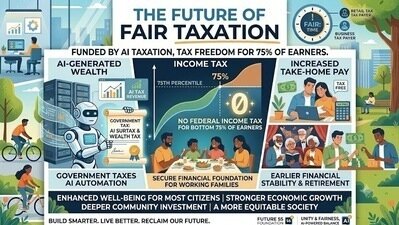
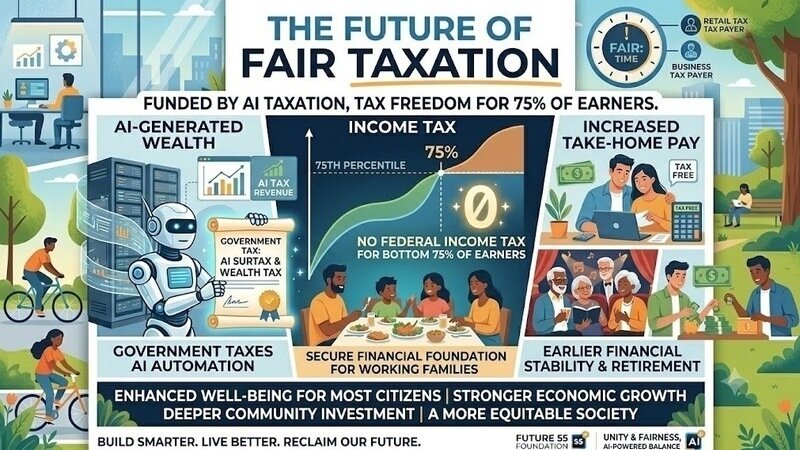
This petition calls on policymakers to establish a fair and balanced tax on AI-generated wealth and productivity gains. The revenue from this tax should be invested in the public good by strengthening healthcare, education, infrastructure, workforce transition programs, and reducing the tax burden on middle and lower income families. The latter can be accomplished by eliminating personal income taxes on the bottom 75% of earners as they contribute a small fraction of total government tax revenue. By eliminating personal income taxes on the lower 75% of earners, we will ensure that in addition to corporations and wealthy stock holders, a vast majority of the population benefits from the gains of Artificial Intelligence by seeing an increase in take home pay.
AI-driven technologies enable businesses to reduce labor costs, automate complex tasks, and dramatically increase profits. Economic forecasts estimate that AI could add trillions of dollars to the global economy over the next decade. Yet without thoughtful policy, much of this new wealth will flow to a small number of corporations and investors, widening the gap between the wealthy and everyone else. I argue in my book, The AI Dividend: Reclaiming Prosperity in the Age of Machines, the productivity gains generated by artificial intelligence represent a new form of economic value that should be shared across society. Just as previous generations benefited from public investments made possible by industrial growth, today's AI revolution should create an AI Dividend that helps all citizens share in the wealth created by intelligent machines.
A carefully designed AI tax would not punish innovation. Instead, it would recognise that businesses benefiting most from automation should contribute a fair share toward maintaining a strong and stable society. The tax could be scaled based on company size and the extent of AI deployment, ensuring that smaller businesses and startups are not unfairly burdened while large corporations contribute proportionately to the public good.
The revenue generated could support early retirement programs for workers displaced by automation, expand educational opportunities and retraining initiatives, modernise public infrastructure, strengthen healthcare systems, and most importantly provide tax relief for working families and in doing so increase their take home pay. Such investments would ensure that technological progress translates into broader economic prosperity rather than growing inequality. We call upon economists, legislators, business leaders, and citizens to work together to develop a practical framework that reflects the realities of the AI economy. This proposal is not about limiting innovation—it is about ensuring that innovation serves society as a whole.
If you believe that artificial intelligence should improve people's lives — not just increase corporate profits — please sign this petition and support the movement towards taxing artificial intelligence and using these funds to waive personal income taxes on the bottom 75% of earners. Technological progress should improve lives, not diminish them. We have an opportunity to create a future where innovation and human dignity advance together.


22
The Issue
As artificial intelligence and machine learning rapidly transform our economy, corporations are using AI to generate unprecedented levels of wealth and productivity. While these technological advances create enormous opportunities, they also risk concentrating economic gains in the hands of a few while displacing workers and increasing income inequality. It is time to ensure that the prosperity created by AI benefits everyone, not just the companies that deploy it.
This petition calls on policymakers to establish a fair and balanced tax on AI-generated wealth and productivity gains. The revenue from this tax should be invested in the public good by strengthening healthcare, education, infrastructure, workforce transition programs, and reducing the tax burden on middle and lower income families. The latter can be accomplished by eliminating personal income taxes on the bottom 75% of earners as they contribute a small fraction of total government tax revenue. By eliminating personal income taxes on the lower 75% of earners, we will ensure that in addition to corporations and wealthy stock holders, a vast majority of the population benefits from the gains of Artificial Intelligence by seeing an increase in take home pay.
AI-driven technologies enable businesses to reduce labor costs, automate complex tasks, and dramatically increase profits. Economic forecasts estimate that AI could add trillions of dollars to the global economy over the next decade. Yet without thoughtful policy, much of this new wealth will flow to a small number of corporations and investors, widening the gap between the wealthy and everyone else. I argue in my book, The AI Dividend: Reclaiming Prosperity in the Age of Machines, the productivity gains generated by artificial intelligence represent a new form of economic value that should be shared across society. Just as previous generations benefited from public investments made possible by industrial growth, today's AI revolution should create an AI Dividend that helps all citizens share in the wealth created by intelligent machines.
A carefully designed AI tax would not punish innovation. Instead, it would recognise that businesses benefiting most from automation should contribute a fair share toward maintaining a strong and stable society. The tax could be scaled based on company size and the extent of AI deployment, ensuring that smaller businesses and startups are not unfairly burdened while large corporations contribute proportionately to the public good.
The revenue generated could support early retirement programs for workers displaced by automation, expand educational opportunities and retraining initiatives, modernise public infrastructure, strengthen healthcare systems, and most importantly provide tax relief for working families and in doing so increase their take home pay. Such investments would ensure that technological progress translates into broader economic prosperity rather than growing inequality. We call upon economists, legislators, business leaders, and citizens to work together to develop a practical framework that reflects the realities of the AI economy. This proposal is not about limiting innovation—it is about ensuring that innovation serves society as a whole.
If you believe that artificial intelligence should improve people's lives — not just increase corporate profits — please sign this petition and support the movement towards taxing artificial intelligence and using these funds to waive personal income taxes on the bottom 75% of earners. Technological progress should improve lives, not diminish them. We have an opportunity to create a future where innovation and human dignity advance together.


Petition Updates
Share this petition
Petition created on June 17, 2026