
What can I say but a HUGE thank you to everyone who has taken the time to sign this petition so far. And an even bigger one to those who have put their hands in their pockets for Juma to make this petition go even further. It's hard to describe just how much I loved my pony - enough to let him have a fabulous life of freedom with his mother and his herd. At the time of his death, he was still unweaned.
This is how I wrote about it in one of my books:
"Of all the breeds of horses and ponies that I came across, the New Forest ponies were always my favourite, epitomising the earthy quality of the Forest itself, the trees and the heather, their coats smelling of loam and salt. In their autumnal colours, some daybreak and dusk, it was as if they grew out of the soil itself. I loved their stoical attitude and their practical appearance.
Some of the ponies paid a high price for their freedom on the Forest, and it angered me that so many car drivers viewed them with indifference. Others were just ignorant, relying on the ponies not to suddenly step out into the road as they whizzed by, treating them as if they were statues rather than living, breathing, unpredictable creatures. It also annoyed me that the visitors, and even some of the locals, fed them close to the roadside, drawing them towards danger with their foals in tow; it was bad enough that the ponies chose to stand on the verges during the summer, taking advantage of the turbulence from passing cars to whisk the flies away.
I had never become reconciled to the idea that my own ponies might be killed by someone, and hardly dared breathe as I watched them cross the road, wandering off to find water or to take shelter in the trees. I was grateful that Nelly and Blue, my older mares, rarely went over to Janesmoor Pond, steering clear of the ice-cream van and a diet of cones. They had formed a peaceful and stable group with two ponies that did not belong to me. Confusingly one of them, a white-grey gelding, was also called Blue and the other, a pretty, dark bay mare with a thin, white stripe down her nose, I nick-named Nanny because of the way that she looked after the foals. Blue – white Blue – also took a keen interest in the welfare of Blue and Nelly’s foals and provided them with a superb male-role model. Although he couldn’t sire any foals, he acted like a benevolent stallion and marshalled his harem carefully.
One year I noticed that Nelly needed a wider gap in order to fit in between the cows, and it was obvious from her expanded waistline that she was pregnant again. Somehow, she had managed to escape white-Blue’s affectionate but watchful eye to enjoy a secret tryst with the local Forest-run stallion. There was no apparent rift between Nelly and her cuckolded partner concerning this infidelity, but I did wonder whether I might receive my own divorce papers in light of David’s earlier warning about extra horses. Luckily, when I told him, he just shrugged his shoulders helplessly.
Nelly herself looked less than enthusiastic about her condition as she began to balloon in the early summer heat. She stood listlessly beside the other ponies with her head down and her ears at ten to three. She looked as if she thought that the discomfort would never end and as May turned to June, Tracey and I wondered if she might be expecting a baby elephant. We seemed to be the only ones that were excited about the impending arrival, and every day we would scour the ponies’ widening haunt to see whether she had given birth. Given how late the foal was, there was the awful prospect that she might be pregnant by some rag-tag colt or, worse still, one of the jack donkeys, because the registered stallions were only turned out for a defined period.
One Tuesday afternoon, following a pleasant lunch at the Royal Oak, Tracey and I decided to take one more tour of the local area even though we had been round three times already. As it had rained, the ponies were often to be found at an area of lush grazing by the stream at Howen Bottom. Tracey and I walked up to a number of likely looking herds with the requisite number of white, blue roan, and shades of mahogany ponies, but were disappointed each time. Suddenly we came across a group out in the open and there, lying at Nelly’s feet, was a pinky-orange foal which was only a few hours old. At last!
Tracey and I approached the little herd cautiously, keeping a respectful distance from the mare and foal just like the other members. The foal appeared to be healthy, and was sitting upright with its tiny head resting on its knees, occasionally nickering in response to Nelly’s guttural whickering. Although she was picking at the grass, she was protective of her baby and put her ears back menacingly if either of the two Blues came over to investigate. After a while, the little foal stood up unsteadily and yawned, stretching its neck inwards like a seahorse before approaching Nelly for a drink. Nelly guided the foal towards her swollen teats, and lifted up her expansive belly to make them easier to reach.
“I think she’s a filly,” I said, already falling in love with this heavenly creature with her pretty feminine head, curved ears and kinky white and chestnut tail. “Let’s call her Patsy after my mum’s first pony.”
It was hard to drag ourselves away from this idyllic scenario, the quiet valley which was so far from the traffic and the tourists, and the gentle squeaky munching of the ponies eating the moist grass. Eventually we got to our feet and agreed to meet up in the morning to come back down to see them.
During the night the ponies had not ventured very far and were situated half way up the hill in the brown heather. Tracey and I settled down for a few hours to watch them, sitting cross-legged on the grassy mounds. As the ponies came closer, the foal decided to come and investigate, touching my hair and my bare arms with her muzzle. I held my breath and didn’t move, not wanting to frighten her or get her used to my presence.
“Erm,” said Tracey suddenly, “I think she may be a colt.”
Underneath the tummy of the distinctly feminine-looking foal there was a small, pink sausage hanging below his soft white tummy coat.
“Ah well, in that case let’s call him Juma, short for Jumanne which is Swahili for Tuesday.”
At least there was no doubt about who Juma’s sire was since he was an exact duplicate of his father, Sandhole Whispering Grass, with the same fiery red undercoat and slightly elongated nose. All of his foals looked the same. The stallion, who had been selected following the official Stallion Inspection carried out by the Breed Society and the Verderers, was a rugged sort of chap, who had entertained a large and enthusiastic band of mares, only beginning to look weary towards the end of his six week shift.
Eventually, as the weather dried up and the grass dried out, Nelly and the rest of her crew emerged from the valley and moved back up to the plain, often to be found in the middle of a large triangular area which was dissected by two roads. From here they had access to the diminishing pond by the main road, which was frequented by cows who treated it as a bar and a toilet. Understandably, the ponies preferred to take a well-trodden path to the water trough which had been installed during the war when the pond had been temporarily contaminated. The trough, although it was half-full of silt and covered in thick blanket weed, was constantly replenished by fresh, clean water.
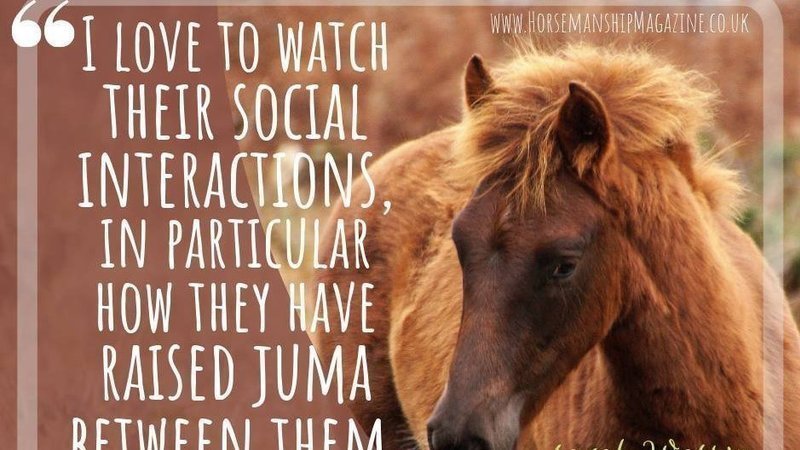
Watching Juma and the herd cross the increasingly busy road en route was a constant torment, but I was heartened to see how Nelly and white-Blue sandwiched him between them as they set off across the tarmac, seeming almost to insist that he held their hands. Indeed, Juma seemed to have been born middle-aged and sensible, rarely playing with other foals, and preferring the company of his rather staid family, all of whom doted upon him. White-Blue in particular took great care of him in his grave manner and seemed to take his responsibilities extremely seriously, interacting with Juma as if he really was his son.
They say that it takes a village to raise a child and in Juma’s case he had a very willing set of villagers. I could rely on them to teach him everything he needed to know about living wild...and came to the conclusion that I should not tame Juma to the extent that I had tamed his brothers who had always been intended to be sold into domesticity. In Juma’s case, I wanted him to be able to remain on the Forest for the whole of his life. #rememberjuma