Обновление к петицииEnd "catch up" and let's "build up". Extend principles of quality early education to 7.
Government response

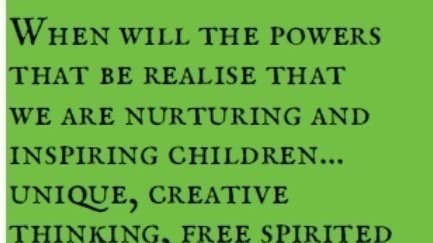
Keeping Early Years Unique
19 мар. 2016 г.
We are building a case here of real Stories, so please email kym@kymscott.co.uk with your experiences of how this ridiculous system is damaging our children, families and teachers!
Yesterday with almost 16,000 signatures on https://petition.parliament.uk/petitions/121681 (have you signed here too)
The government replied with this reply (below) which tells us nothing new. The government think everything is ok. We all know it's not! They will not change their outdated, ridiculous curriculum and they won't stop testing. But we will stand together to make sure that every child gets the very best start. The paperwork may say national curriculum when children reach year one and two (but we know some aren't ready) ...but the best teachers find ways to play the game, tick the boxes, spin the plates, juggle the balls and teach what REALLY needs to be taught whilst allowing children to play, explore, develop and learn in ways that make sense to them. So keep talking and sharing and sign the government site too!
At 10k they reply. At 100k they consider debate! Let's build so much evidence that they have to listen!
Thanks to you all!
Elaine
-----------------------------------------------------------------------------------
The petitions committee said...
Early years providers, including schools, are required to use the Statutory Framework for the early years foundation stage (EYFS). The EYFS sets the standards that all early years providers must meet to ensure that children learn and develop well and are kept healthy and safe. It promotes teaching and learning and gives children the broad range of knowledge and skills that provide the right foundation for good future progress through school and life.
The areas of learning and development outlined in the EYFS provide the right baseline for the primary national curriculum. The new national curriculum was introduced in September 2014 and is carefully designed to provide a smooth transition from the EYFS to key stage 1.
The national curriculum focuses on the essential knowledge that must be taught, allowing teachers to take greater control over the wider curriculum in schools and how it is taught. Teachers will use their professional judgement to decide how best to ensure that their pupils develop important characteristics and skills such as creativity, resilience, independence and risk taking. Extra-curricular activities such as sports clubs, music and drama all help to build character and give younger children opportunities to flourish.
Pupils should not miss out on knowledge and skills development when they start key stage 1. For example, the key stage 1 programme of study for English makes clear that during year 1 teachers should build on work from the EYFS and build on what pupils have already learnt. Where pupils entering year 1 have not met the early learning goals they should continue to follow their school’s curriculum for EYFS to develop the appropriate knowledge and skills to ensure a good grounding for the key stage 1 curriculum.
Подписать
Подписать петицию
Скопировать ссылку
WhatsApp
Facebook
Nextdoor
Эл. почта
X