

Maribyrnong: promote cat enclosures & DESEX! DESEX!! DESEX!!!
The issue
To keep wildlife safe & domestic cats safe:
- The highest priority should be for supporting and investing in DESEXING PROGRAMS, and
- ACTIVATE the PET EXPO events: promote cat enclosures with product suppliers and installers; consult on challenges with containment through effective face to face engagement with the community; and hold interactive discussions on the wildlife most at risk at specific locations.
There’s a wide range of proactive and constructive steps that the council may apply to improve cat management – implementing cat curfews or mandatory containment is not one of those.
The Domestic Animal Management Plan (*DAMP) needs to be based on tangible & measurable benefits.
DESEX! DESEX! DESEX!
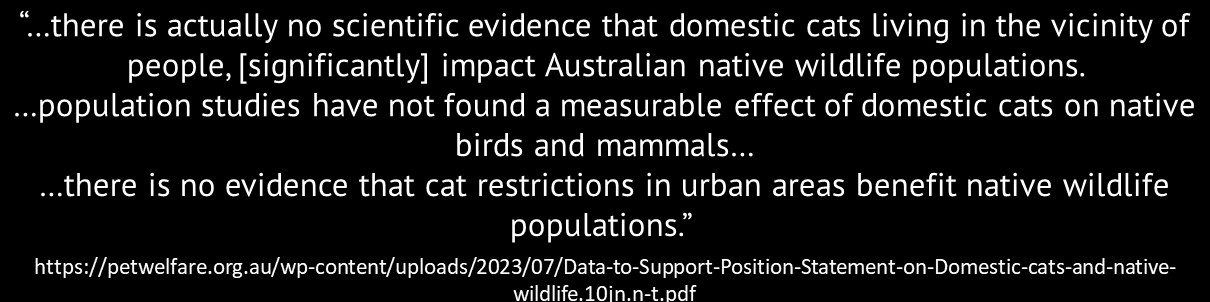
Evidence-based research shows a range of desexing programs provide better value for money and return on investment, examples include (*APWF 1)
- Community cat programs in QLD last year achieved “2,604 cats desexed in Qld… Stopped 7,500 kittens being born… Euthanasia decreased 57% - 85%”,
- Banyule Council saved hundreds of thousands over eight years with its “Moderate-intensity program, microtargeted by AMOs in 3 problematic suburbs; low-intensity microtargeted over whole city”, and
- In NSW, “one year of targeted free cat desexing through Keeping Cats Safe at Home, cat nuisance complaints reduced dramatically in Campbelltown (-56%), City of Parramatta (-49%), Shoalhaven (-56%), Weddin Shire (-66%)”
Jenny Cotterell as an AMO at Banyule Council championed free desexing - a research paper is expected in the coming few weeks. (*Banyule).
Research also includes "desexing and adoption or return of stray cats can be an effective and humane method of reducing urban stray cat populations, cat-related complaints, and pound and shelter intake...
Decreasing urban stray cat numbers will decrease wildlife predation". (*APWF 2)
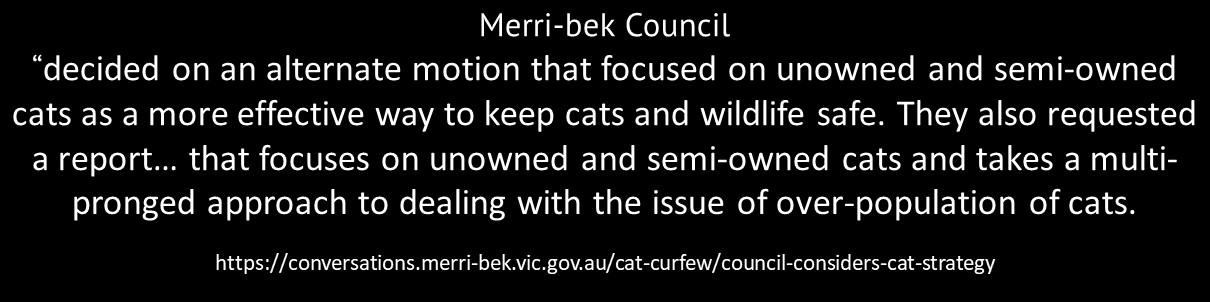
THE PROBLEMS WITH CAT CURFEWS & MANDATORY CONTAINMENT
“Cat curfews increase complaints, increase costs to councils, increase the number of cats impounded, increase exposure to adverse mental health effects (including PTSD) of staff involved in killing healthy cats and kittens, and result in no decrease in the number of free-roaming cats.” (*APWF 3)
Similarly, “mandated 24/7 cat containment is not an effective strategy to reduce wandering cats or …nuisance complaints or potential wildlife predation. Mandated 24/7 cat containment is already proven to be a failure at reducing wandering cats in both the short, medium and long-term.” (*APWF 3)
Just one of the negative consequences of mandated containment is it “Increases risks of cruelty towards cats, increasing animal pain and suffering”. (*APWF 3)
How will the council team ensure that if cat curfews are made mandatory that this will not incite cat haters to take matters into their own hands? That is, if a roaming cat may then be deemed “illegal” and will be at risk of harm?
OTHER COUNCILS & MANDATORY CAT CONTAINMENT
“Overall, councils with cat containment regulations have not been able to demonstrate any measurable reduction in cat complaints or cats wandering at large following the introduction of the regulations”. (*RSPCA)
“Based on data from councils, 24/7 cat containment regulations would not provide any measurable benefit in reducing complaints, cat impoundments, potential wildlife predation or cat-related costs and would instead increase costs to local governments…
The City of Hobsons Bay (Melbourne, Victoria) has publicly acknowledged that mandated 24/7 cat containment is not an effective strategy for reducing the number of wandering cats or associated issues and has rejected cat curfews (Hobsons Bay 2014).
Some USA jurisdictions have introduced mandated 24/7 cat containment known as cat “leash laws” which have proven to be ineffective and impossible to enforce.” (*APWF 4)
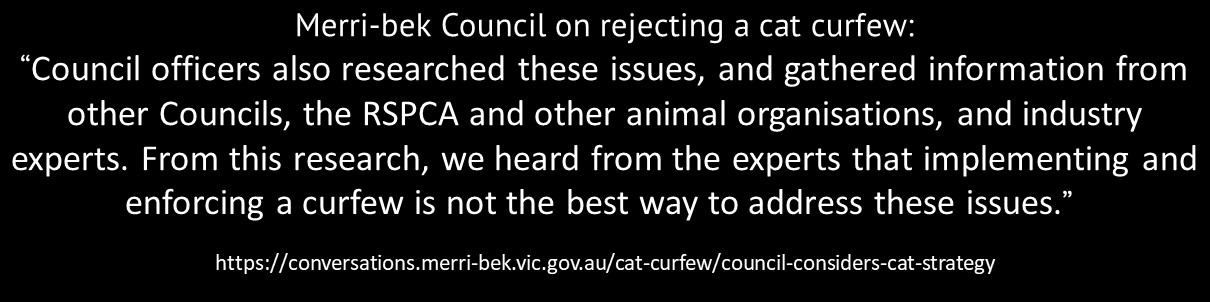
It is critical that any risks to wildlife and domestic cats are effectively minimised, approaches aligned, and decisions are based on tangible and measured benefits, and included in the DAMP.
REFERENCE SOURCES
*RSPCA Australia https://kb.rspca.org.au/wp-content/uploads/2019/01/Findings-and-Recommendations-Identifying-Best-Practice-Domestic-Cat-Management.pdf
*APWF 1 https://petwelfare.org.au/wp-content/uploads/2023/10/Aust-Community-Cat-Program-EOFY-2023-Report.pdf
*Banyule unofficial video https://www.youtube.com/watch?v=I_zE__bGsck
*APWF 3 Australian Pet Welfare Foundation https://petwelfare.org.au/response-to-draft-tap/

685
The issue
To keep wildlife safe & domestic cats safe:
- The highest priority should be for supporting and investing in DESEXING PROGRAMS, and
- ACTIVATE the PET EXPO events: promote cat enclosures with product suppliers and installers; consult on challenges with containment through effective face to face engagement with the community; and hold interactive discussions on the wildlife most at risk at specific locations.
There’s a wide range of proactive and constructive steps that the council may apply to improve cat management – implementing cat curfews or mandatory containment is not one of those.
The Domestic Animal Management Plan (*DAMP) needs to be based on tangible & measurable benefits.
DESEX! DESEX! DESEX!
Evidence-based research shows a range of desexing programs provide better value for money and return on investment, examples include (*APWF 1)
- Community cat programs in QLD last year achieved “2,604 cats desexed in Qld… Stopped 7,500 kittens being born… Euthanasia decreased 57% - 85%”,
- Banyule Council saved hundreds of thousands over eight years with its “Moderate-intensity program, microtargeted by AMOs in 3 problematic suburbs; low-intensity microtargeted over whole city”, and
- In NSW, “one year of targeted free cat desexing through Keeping Cats Safe at Home, cat nuisance complaints reduced dramatically in Campbelltown (-56%), City of Parramatta (-49%), Shoalhaven (-56%), Weddin Shire (-66%)”
Jenny Cotterell as an AMO at Banyule Council championed free desexing - a research paper is expected in the coming few weeks. (*Banyule).
Research also includes "desexing and adoption or return of stray cats can be an effective and humane method of reducing urban stray cat populations, cat-related complaints, and pound and shelter intake...
Decreasing urban stray cat numbers will decrease wildlife predation". (*APWF 2)
THE PROBLEMS WITH CAT CURFEWS & MANDATORY CONTAINMENT
“Cat curfews increase complaints, increase costs to councils, increase the number of cats impounded, increase exposure to adverse mental health effects (including PTSD) of staff involved in killing healthy cats and kittens, and result in no decrease in the number of free-roaming cats.” (*APWF 3)
Similarly, “mandated 24/7 cat containment is not an effective strategy to reduce wandering cats or …nuisance complaints or potential wildlife predation. Mandated 24/7 cat containment is already proven to be a failure at reducing wandering cats in both the short, medium and long-term.” (*APWF 3)
Just one of the negative consequences of mandated containment is it “Increases risks of cruelty towards cats, increasing animal pain and suffering”. (*APWF 3)
How will the council team ensure that if cat curfews are made mandatory that this will not incite cat haters to take matters into their own hands? That is, if a roaming cat may then be deemed “illegal” and will be at risk of harm?
OTHER COUNCILS & MANDATORY CAT CONTAINMENT
“Overall, councils with cat containment regulations have not been able to demonstrate any measurable reduction in cat complaints or cats wandering at large following the introduction of the regulations”. (*RSPCA)
“Based on data from councils, 24/7 cat containment regulations would not provide any measurable benefit in reducing complaints, cat impoundments, potential wildlife predation or cat-related costs and would instead increase costs to local governments…
The City of Hobsons Bay (Melbourne, Victoria) has publicly acknowledged that mandated 24/7 cat containment is not an effective strategy for reducing the number of wandering cats or associated issues and has rejected cat curfews (Hobsons Bay 2014).
Some USA jurisdictions have introduced mandated 24/7 cat containment known as cat “leash laws” which have proven to be ineffective and impossible to enforce.” (*APWF 4)
It is critical that any risks to wildlife and domestic cats are effectively minimised, approaches aligned, and decisions are based on tangible and measured benefits, and included in the DAMP.
REFERENCE SOURCES
*RSPCA Australia https://kb.rspca.org.au/wp-content/uploads/2019/01/Findings-and-Recommendations-Identifying-Best-Practice-Domestic-Cat-Management.pdf
*APWF 1 https://petwelfare.org.au/wp-content/uploads/2023/10/Aust-Community-Cat-Program-EOFY-2023-Report.pdf
*Banyule unofficial video https://www.youtube.com/watch?v=I_zE__bGsck
*APWF 3 Australian Pet Welfare Foundation https://petwelfare.org.au/response-to-draft-tap/
The Decision Makers

Petition Updates
Share this petition
Petition created on 29 February 2024