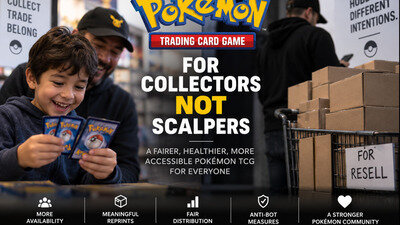

Make Pokemon TCG Collecting More Rewarding Than Speculating
The Issue
A Petition to The Pokémon Company International and The Pokémon Company
The Pokémon Trading Card Game is experiencing extraordinary popularity.
That should be a good thing.
More people are collecting. More people are playing. Adults who grew up with Pokémon are returning to the hobby, new generations are discovering it, and Pokémon cards have become one of the most recognizable collectibles in the world.
But for many collectors, players, parents, and longtime fans, that popularity has also created a frustrating reality:
Pokémon products are increasingly difficult to find at normal retail prices, while some modern cards have become extraordinarily expensive almost immediately after release.
Major releases can disappear from shelves rapidly. Products intended to be opened and enjoyed are sometimes purchased in bulk specifically for resale. Highly desirable cards can become so difficult to pull that their scarcity adds significant speculative value to sealed product itself.
We believe Pokémon can preserve the excitement, rarity, and collectibility of the Pokémon TCG while making the hobby more accessible to the people who actually want to collect and play it.
Our goal is simple:
Make collecting Pokémon more rewarding than speculating on Pokémon.
How We Reached This Point
The current Pokémon TCG market did not develop overnight.
During the COVID-19 pandemic, Pokémon experienced an enormous resurgence in popularity. Many adults rediscovered hobbies from their childhood at the same time that manufacturing and distribution systems around the world were experiencing disruption.
Pokémon cards also received unprecedented attention through social media, livestreams, high-profile pack openings, record-setting card sales, grading, and online marketplaces.
This brought many genuine collectors back into the hobby.
It also changed the economics surrounding Pokémon cards.
Modern cards and sealed Pokémon products increasingly began to be viewed not only as collectibles, toys, and game pieces, but also as financial assets.
Sealed products could be purchased and held.
Rare cards could appreciate significantly.
Graded cards became easier to value and trade.
Social media regularly highlighted expensive pulls and rapidly rising card prices.
And whenever a newly released product could be purchased at retail and immediately resold for substantially more money, there was an obvious incentive to acquire as much of that product as possible.
That incentive continues today.
Reselling Is Not the Problem
We want to make an important distinction.
The secondary market is an important part of the Pokémon Trading Card Game.
Collectors should be able to sell cards they no longer want.
Players should be able to purchase individual cards for their decks.
Collectors should be able to trade duplicates.
Someone who does not want to open hundreds of booster packs should be able to purchase the specific card they want.
Local game stores, card shows, online marketplaces, and individual sellers all play legitimate roles in the hobby.
This petition is not asking Pokémon to eliminate reselling.
The problem is scarcity-driven speculative purchasing.
When a newly released Pokémon product can immediately be resold for a large premium, people have a financial incentive to buy as much inventory as possible before ordinary customers can get it.
That can create a damaging cycle:
Limited supply → higher resale prices → greater profit opportunity → more bulk purchasing → faster sellouts → greater perceived scarcity → even higher prices.
As prices rise, the next release becomes even more attractive to speculative buyers.
That speculative demand then competes directly with collectors, players, parents, and children who simply want the product.
The Goal Should Be to Make Scalping Less Profitable
Pokémon cannot eliminate every reseller.
It should not attempt to eliminate the legitimate secondary market.
Instead, Pokémon can reduce the economic conditions that make large-scale scalping and speculative hoarding profitable.
If buyers know that popular products will continue receiving meaningful restocks...
If they know Pokémon will reprint sets experiencing extreme shortages...
If purchase limits prevent a handful of people from acquiring most available inventory...
If chase cards remain rare but realistically obtainable...
If distributors cannot exploit shortages through excessive wholesale pricing...
And if additional inventory continues reaching consumers at normal retail prices...
Then purchasing hundreds of boxes solely because someone expects them to rapidly increase in value becomes considerably riskier.
The most effective anti-scalping policy may ultimately be very simple:
Reduce the expected profit.
What We Are Asking Pokémon To Do
1. Continue Increasing Production and Aggressively Reprint High-Demand Products
When current-generation Pokémon TCG products remain consistently difficult to purchase near their suggested retail price, Pokémon should continue producing or reprinting those products whenever practical until normal retail availability improves.
A modern Pokémon product should not become extremely valuable simply because ordinary customers cannot find it shortly after release.
Temporary shortages are understandable.
Long-term artificial scarcity should not become the standard business model for modern Pokémon products.
2. Establish a Clear Reprint Philosophy
Collectors should have confidence that severe shortages will eventually be addressed.
We encourage Pokémon to adopt a standing principle:
When legitimate consumer demand causes a current Pokémon TCG product to remain significantly above its intended retail price for an extended period, additional production or reprints should be strongly considered whenever practical.
This alone could reduce panic buying.
If consumers know more inventory is coming, they have less reason to pay extreme secondary-market prices.
And if speculative buyers know Pokémon may continue printing a product until retail availability improves, hoarding large quantities becomes considerably riskier.
3. Communicate Major Reprints and Restocks More Clearly
Collectors often purchase products at inflated prices because they do not know whether additional supply is coming.
Pokémon should provide more communication when substantial additional production or restocks are planned.
This does not require releasing exact production numbers.
Even simple statements such as:
“Additional waves of this product are planned.”
could reduce panic buying and discourage speculative hoarding.
Make Chase Cards Rare, Not Unrealistic
Rare cards are an important part of Pokémon.
Opening a special card should feel exciting.
We are not asking Pokémon to remove that excitement.
We are asking Pokémon to reconsider situations where a specific modern chase card becomes so statistically difficult to pull that ordinary collectors effectively have no realistic opportunity to obtain it through normal opening.
There is a major difference between:
“This card is difficult to pull.”
and
“You could open hundreds of packs and still have little realistic chance of seeing this card.”
A reasonable collecting system should allow someone opening a substantial amount of Pokémon product to have a meaningful chance of obtaining a flagship card without guaranteeing that result.
4. Establish Reasonable Rarity Targets for Flagship Chase Cards
We encourage Pokémon to design future rarity structures so that flagship chase cards generally remain within a realistically obtainable range.
As a general benchmark, we believe an individual flagship chase card in a standard expansion should ideally fall somewhere around:
Approximately 1 in 150 to 250 booster packs.
This is still extremely rare.
At approximately 1 in 200 packs, a collector opening a traditional 36-pack booster box would have only about a 16–17% chance of pulling that specific card.
Even after opening several booster boxes, the card would never be guaranteed.
That preserves meaningful rarity.
But it also avoids situations where a collector might statistically need to open many hundreds—or potentially over a thousand—packs just to have a realistic chance at one particular card.
Premium rarity should create excitement.
It should not make pulling a desired modern card statistically unrealistic for an ordinary collector.
5. Increase Overall Premium Hit Rates While Preserving Randomness
We believe premium rarity tiers such as Special Illustration Rares could generally appear at approximately:
1 premium hit every 15–25 packs.
The exact number can vary by set.
The more important issue is the probability of obtaining a specific card.
For example, if a set contains eight premium chase cards and the overall premium hit rate is approximately 1 in 20 packs, each individual card would theoretically fall near 1 in 160 packs if evenly distributed.
That still creates meaningful rarity.
It still makes pulling the exact card you want difficult.
But collectors would regularly experience exciting pulls.
That encourages opening, collecting, and trading without requiring extreme scarcity.
6. Avoid Guaranteed Chase Cards Per Booster Box
We are not asking Pokémon to guarantee the highest rarity card in every booster box.
Uncertainty is part of what makes opening Pokémon cards exciting.
A better balance would be:
High probability, not certainty.
Collectors should frequently see something exciting when opening a significant quantity of product while still experiencing the unpredictability that makes the hobby enjoyable.
7. Use Promotional Releases to Make Popular Artwork More Accessible
Pokémon can preserve extremely rare versions of cards while also providing obtainable alternatives.
Popular Pokémon and artwork could later appear through:
Collection boxes
Promotional cards
Tournament products
Pokémon Center products
Special event releases
Alternate versions
A difficult-to-pull premium version could remain highly collectible while another version allows more fans to enjoy the Pokémon or artwork.
Scarcity does not need to mean complete exclusion.
Improve Product Access
8. Strengthen Purchase Limits During Major Releases
For products experiencing unusually high demand, meaningful per-customer or per-household purchase limits should be used during initial release periods.
The purpose is not to restrict genuine collectors.
It is to prevent a small number of customers from acquiring a disproportionate amount of available inventory before others have a chance to purchase it.
Once supply stabilizes, those limits can be relaxed.
9. Continue Improving Anti-Bot and Anti-Circumvention Systems
Pokémon should continue investing in systems that identify:
Automated purchasing
Multiple accounts used to bypass purchase limits
Repeated addresses or payment methods used to defeat restrictions
Coordinated bulk purchasing during high-demand launches
During a major release, a genuine individual customer should have a reasonable chance to purchase the product.
10. Expand Direct-to-Consumer Availability
Pokémon should continue increasing legitimate ways for customers to purchase products directly or through closely controlled channels.
Examples include:
Pokémon Center
Pokémon vending machines
Official events
Direct retail partnerships
Other controlled distribution programs
Every product sold directly to a collector at normal retail pricing is one less product that collector must obtain through an inflated secondary market.
Address Problems Within Distribution
Producing more cards alone may not solve the problem if product becomes significantly more expensive before it ever reaches consumers.
Pokémon should also examine how high-demand products move through the distribution system.
11. Establish Fair Standards for Authorized Distributors and Wholesalers
Authorized distribution partners should help Pokémon products reach retailers fairly.
Pokémon should establish clear expectations regarding:
Wholesale pricing during shortages
Product allocation
Artificial withholding of inventory
Preferential allocation practices
Forced purchasing of unwanted products to obtain desirable products
Excessive scarcity-driven wholesale markups
Other practices that unnecessarily increase prices before products reach consumers
12. Take Corrective Action When Distribution Partners Abuse Scarcity
When authorized distributors repeatedly violate fair-distribution standards, Pokémon should consider appropriate corrective measures.
Depending on the circumstances, these could include:
Reduced allocations
Loss of preferred distributor status
Contractual changes
Increased auditing
Additional direct distribution
Termination of the business relationship when appropriate
The purpose should not be punishment for its own sake.
The goal should be ensuring Pokémon products reach stores and customers through a fair and sustainable system.
13. Protect Local Game Stores
Local card shops are important to the Pokémon community.
They host tournaments.
They introduce new players to the game.
They provide places for collectors to trade and interact.
And many depend heavily on trading card products to survive.
Pokémon should work toward allocation systems that give legitimate local stores meaningful access to high-demand releases without forcing them to purchase inventory at inflated wholesale prices.
A healthy Pokémon ecosystem requires both major retailers and sustainable local game stores.
14. Reward Retailers That Support Fair Consumer Access
Where legally and commercially practical, Pokémon should consider giving allocation preference or other incentives to retailers that consistently demonstrate responsible sales practices.
Examples could include retailers that:
Honor reasonable purchase limits
Maintain transparent pricing
Make meaningful quantities available to individual customers
Attempt to prevent a small number of buyers from acquiring most available inventory
Support organized Pokémon play and collecting communities
Pokémon may not be able to control every retailer's final selling price.
But it can decide which businesses receive the strongest support from its distribution system.
Improve Pricing Transparency
15. Make Suggested Retail Pricing Easier to Find
Official suggested retail pricing should be clearly visible on Pokémon product pages and other official resources whenever practical.
Many casual collectors and parents do not know what a Pokémon product is supposed to cost.
When a product normally intended to sell for one price appears online for twice that amount, an inexperienced customer may assume the inflated price is normal.
Official price transparency gives consumers a reference point.
Use Demand Information More Effectively
16. Expand Controlled Preorders for High-Demand Products
Where production timelines allow, Pokémon should consider broader controlled preorder periods with reasonable customer limits.
This could serve two purposes.
First, collectors would have a better opportunity to secure products before release-day shortages.
Second, preorder demand could provide useful information about the amount of product the market actually wants.
That information could help determine additional production or reprint needs earlier.
Why These Changes Would Help
There is no single solution to scalping.
Printing more cards alone may not solve distribution problems.
Purchase limits alone will not fix extremely low chase-card pull rates.
Better hit rates alone will not prevent bots from buying products.
Distributor standards alone will not solve shortages.
But these measures reinforce one another.
More supply reduces scarcity.
More predictable reprints reduce panic buying.
More realistic pull rates reduce extreme chase-card scarcity.
Purchase limits reduce bulk acquisition.
Anti-bot systems improve initial access.
Fair distribution reduces unnecessary wholesale markups.
Direct sales give consumers access to products at normal prices.
And clear communication reduces the fear that someone must buy immediately or miss the product forever.
Together, these measures reduce the financial incentive to treat modern Pokémon products primarily as speculative assets.
Preserve Collectibility Without Manufacturing Extreme Scarcity
We understand that scarcity is part of collecting.
Not every card should be equally common.
Not every collector should immediately obtain every chase card.
Not every product needs to remain permanently available.
But scarcity should primarily come from genuine collector demand and meaningful rarity—not from a system where ordinary customers routinely cannot obtain newly manufactured products.
A card can be rare without being virtually unobtainable.
A product can sell out temporarily without remaining unavailable for months.
A chase card can be exciting without requiring statistically extreme quantities of packs.
A healthy collectible market does not require every desirable product to become an investment vehicle.
Pokémon Should Encourage Trading, Not Extreme Scarcity
Pokémon is a Trading Card Game.
A healthy rarity structure can actually encourage more trading.
If collectors frequently obtain valuable and desirable cards—but not necessarily the exact card they personally want—they have a reason to interact with other collectors.
Someone may pull the card another collector wants.
That collector may have something desirable in return.
This creates an active collecting and trading community.
By contrast, when the rarest cards are so difficult to pull that very few copies enter circulation, trading increasingly gets replaced by simply purchasing expensive singles from the secondary market.
More obtainable premium cards can strengthen the social and trading side of the hobby without eliminating rarity.
What We Are Not Asking For
We are not asking Pokémon to eliminate rare cards.
We are not asking Pokémon to eliminate valuable cards.
We are not asking Pokémon to guarantee chase cards.
We are not asking Pokémon to eliminate the secondary market.
We are not asking Pokémon to prohibit ordinary collectors from selling their cards.
We are not asking Pokémon to make every product unlimited.
And we are not asking Pokémon to eliminate the excitement of opening booster packs.
We are asking for a Pokémon TCG market in which ordinary collectors have a realistic opportunity to participate.
Our Request
We respectfully ask The Pokémon Company International and The Pokémon Company to examine the entire system surrounding modern Pokémon TCG scarcity:
Production.
Reprints.
Pull rates.
Distribution.
Wholesale practices.
Purchase limits.
Bots.
Retail access.
Pricing transparency.
Communication.
No single change will eliminate scalping or high secondary-market prices.
But Pokémon does not need to eliminate reselling to improve the situation.
It needs to reduce the conditions that make large-scale speculative purchasing unusually profitable.
When modern sealed product becomes reliably obtainable...
When collectors know additional supply is coming...
When flagship cards are rare but realistically pullable...
When distributors cannot profit excessively from shortages...
And when ordinary customers have a reasonable opportunity to purchase products at retail...
The incentive to clear shelves simply to resell those products becomes weaker.
That benefits collectors.
It benefits players.
It benefits parents.
It benefits children discovering Pokémon for the first time.
It benefits local game stores.
And we believe it benefits the long-term health of Pokémon itself.
The Pokémon Trading Card Game should remain collectible.
It should remain exciting.
It should remain unpredictable.
But above all, it should remain accessible to the people who love it.
Make collecting Pokémon more rewarding than speculating on Pokémon.
We know The Pokemon Company did not create this situation, but you are the only ones who can fix it.

16
The Issue
A Petition to The Pokémon Company International and The Pokémon Company
The Pokémon Trading Card Game is experiencing extraordinary popularity.
That should be a good thing.
More people are collecting. More people are playing. Adults who grew up with Pokémon are returning to the hobby, new generations are discovering it, and Pokémon cards have become one of the most recognizable collectibles in the world.
But for many collectors, players, parents, and longtime fans, that popularity has also created a frustrating reality:
Pokémon products are increasingly difficult to find at normal retail prices, while some modern cards have become extraordinarily expensive almost immediately after release.
Major releases can disappear from shelves rapidly. Products intended to be opened and enjoyed are sometimes purchased in bulk specifically for resale. Highly desirable cards can become so difficult to pull that their scarcity adds significant speculative value to sealed product itself.
We believe Pokémon can preserve the excitement, rarity, and collectibility of the Pokémon TCG while making the hobby more accessible to the people who actually want to collect and play it.
Our goal is simple:
Make collecting Pokémon more rewarding than speculating on Pokémon.
How We Reached This Point
The current Pokémon TCG market did not develop overnight.
During the COVID-19 pandemic, Pokémon experienced an enormous resurgence in popularity. Many adults rediscovered hobbies from their childhood at the same time that manufacturing and distribution systems around the world were experiencing disruption.
Pokémon cards also received unprecedented attention through social media, livestreams, high-profile pack openings, record-setting card sales, grading, and online marketplaces.
This brought many genuine collectors back into the hobby.
It also changed the economics surrounding Pokémon cards.
Modern cards and sealed Pokémon products increasingly began to be viewed not only as collectibles, toys, and game pieces, but also as financial assets.
Sealed products could be purchased and held.
Rare cards could appreciate significantly.
Graded cards became easier to value and trade.
Social media regularly highlighted expensive pulls and rapidly rising card prices.
And whenever a newly released product could be purchased at retail and immediately resold for substantially more money, there was an obvious incentive to acquire as much of that product as possible.
That incentive continues today.
Reselling Is Not the Problem
We want to make an important distinction.
The secondary market is an important part of the Pokémon Trading Card Game.
Collectors should be able to sell cards they no longer want.
Players should be able to purchase individual cards for their decks.
Collectors should be able to trade duplicates.
Someone who does not want to open hundreds of booster packs should be able to purchase the specific card they want.
Local game stores, card shows, online marketplaces, and individual sellers all play legitimate roles in the hobby.
This petition is not asking Pokémon to eliminate reselling.
The problem is scarcity-driven speculative purchasing.
When a newly released Pokémon product can immediately be resold for a large premium, people have a financial incentive to buy as much inventory as possible before ordinary customers can get it.
That can create a damaging cycle:
Limited supply → higher resale prices → greater profit opportunity → more bulk purchasing → faster sellouts → greater perceived scarcity → even higher prices.
As prices rise, the next release becomes even more attractive to speculative buyers.
That speculative demand then competes directly with collectors, players, parents, and children who simply want the product.
The Goal Should Be to Make Scalping Less Profitable
Pokémon cannot eliminate every reseller.
It should not attempt to eliminate the legitimate secondary market.
Instead, Pokémon can reduce the economic conditions that make large-scale scalping and speculative hoarding profitable.
If buyers know that popular products will continue receiving meaningful restocks...
If they know Pokémon will reprint sets experiencing extreme shortages...
If purchase limits prevent a handful of people from acquiring most available inventory...
If chase cards remain rare but realistically obtainable...
If distributors cannot exploit shortages through excessive wholesale pricing...
And if additional inventory continues reaching consumers at normal retail prices...
Then purchasing hundreds of boxes solely because someone expects them to rapidly increase in value becomes considerably riskier.
The most effective anti-scalping policy may ultimately be very simple:
Reduce the expected profit.
What We Are Asking Pokémon To Do
1. Continue Increasing Production and Aggressively Reprint High-Demand Products
When current-generation Pokémon TCG products remain consistently difficult to purchase near their suggested retail price, Pokémon should continue producing or reprinting those products whenever practical until normal retail availability improves.
A modern Pokémon product should not become extremely valuable simply because ordinary customers cannot find it shortly after release.
Temporary shortages are understandable.
Long-term artificial scarcity should not become the standard business model for modern Pokémon products.
2. Establish a Clear Reprint Philosophy
Collectors should have confidence that severe shortages will eventually be addressed.
We encourage Pokémon to adopt a standing principle:
When legitimate consumer demand causes a current Pokémon TCG product to remain significantly above its intended retail price for an extended period, additional production or reprints should be strongly considered whenever practical.
This alone could reduce panic buying.
If consumers know more inventory is coming, they have less reason to pay extreme secondary-market prices.
And if speculative buyers know Pokémon may continue printing a product until retail availability improves, hoarding large quantities becomes considerably riskier.
3. Communicate Major Reprints and Restocks More Clearly
Collectors often purchase products at inflated prices because they do not know whether additional supply is coming.
Pokémon should provide more communication when substantial additional production or restocks are planned.
This does not require releasing exact production numbers.
Even simple statements such as:
“Additional waves of this product are planned.”
could reduce panic buying and discourage speculative hoarding.
Make Chase Cards Rare, Not Unrealistic
Rare cards are an important part of Pokémon.
Opening a special card should feel exciting.
We are not asking Pokémon to remove that excitement.
We are asking Pokémon to reconsider situations where a specific modern chase card becomes so statistically difficult to pull that ordinary collectors effectively have no realistic opportunity to obtain it through normal opening.
There is a major difference between:
“This card is difficult to pull.”
and
“You could open hundreds of packs and still have little realistic chance of seeing this card.”
A reasonable collecting system should allow someone opening a substantial amount of Pokémon product to have a meaningful chance of obtaining a flagship card without guaranteeing that result.
4. Establish Reasonable Rarity Targets for Flagship Chase Cards
We encourage Pokémon to design future rarity structures so that flagship chase cards generally remain within a realistically obtainable range.
As a general benchmark, we believe an individual flagship chase card in a standard expansion should ideally fall somewhere around:
Approximately 1 in 150 to 250 booster packs.
This is still extremely rare.
At approximately 1 in 200 packs, a collector opening a traditional 36-pack booster box would have only about a 16–17% chance of pulling that specific card.
Even after opening several booster boxes, the card would never be guaranteed.
That preserves meaningful rarity.
But it also avoids situations where a collector might statistically need to open many hundreds—or potentially over a thousand—packs just to have a realistic chance at one particular card.
Premium rarity should create excitement.
It should not make pulling a desired modern card statistically unrealistic for an ordinary collector.
5. Increase Overall Premium Hit Rates While Preserving Randomness
We believe premium rarity tiers such as Special Illustration Rares could generally appear at approximately:
1 premium hit every 15–25 packs.
The exact number can vary by set.
The more important issue is the probability of obtaining a specific card.
For example, if a set contains eight premium chase cards and the overall premium hit rate is approximately 1 in 20 packs, each individual card would theoretically fall near 1 in 160 packs if evenly distributed.
That still creates meaningful rarity.
It still makes pulling the exact card you want difficult.
But collectors would regularly experience exciting pulls.
That encourages opening, collecting, and trading without requiring extreme scarcity.
6. Avoid Guaranteed Chase Cards Per Booster Box
We are not asking Pokémon to guarantee the highest rarity card in every booster box.
Uncertainty is part of what makes opening Pokémon cards exciting.
A better balance would be:
High probability, not certainty.
Collectors should frequently see something exciting when opening a significant quantity of product while still experiencing the unpredictability that makes the hobby enjoyable.
7. Use Promotional Releases to Make Popular Artwork More Accessible
Pokémon can preserve extremely rare versions of cards while also providing obtainable alternatives.
Popular Pokémon and artwork could later appear through:
Collection boxes
Promotional cards
Tournament products
Pokémon Center products
Special event releases
Alternate versions
A difficult-to-pull premium version could remain highly collectible while another version allows more fans to enjoy the Pokémon or artwork.
Scarcity does not need to mean complete exclusion.
Improve Product Access
8. Strengthen Purchase Limits During Major Releases
For products experiencing unusually high demand, meaningful per-customer or per-household purchase limits should be used during initial release periods.
The purpose is not to restrict genuine collectors.
It is to prevent a small number of customers from acquiring a disproportionate amount of available inventory before others have a chance to purchase it.
Once supply stabilizes, those limits can be relaxed.
9. Continue Improving Anti-Bot and Anti-Circumvention Systems
Pokémon should continue investing in systems that identify:
Automated purchasing
Multiple accounts used to bypass purchase limits
Repeated addresses or payment methods used to defeat restrictions
Coordinated bulk purchasing during high-demand launches
During a major release, a genuine individual customer should have a reasonable chance to purchase the product.
10. Expand Direct-to-Consumer Availability
Pokémon should continue increasing legitimate ways for customers to purchase products directly or through closely controlled channels.
Examples include:
Pokémon Center
Pokémon vending machines
Official events
Direct retail partnerships
Other controlled distribution programs
Every product sold directly to a collector at normal retail pricing is one less product that collector must obtain through an inflated secondary market.
Address Problems Within Distribution
Producing more cards alone may not solve the problem if product becomes significantly more expensive before it ever reaches consumers.
Pokémon should also examine how high-demand products move through the distribution system.
11. Establish Fair Standards for Authorized Distributors and Wholesalers
Authorized distribution partners should help Pokémon products reach retailers fairly.
Pokémon should establish clear expectations regarding:
Wholesale pricing during shortages
Product allocation
Artificial withholding of inventory
Preferential allocation practices
Forced purchasing of unwanted products to obtain desirable products
Excessive scarcity-driven wholesale markups
Other practices that unnecessarily increase prices before products reach consumers
12. Take Corrective Action When Distribution Partners Abuse Scarcity
When authorized distributors repeatedly violate fair-distribution standards, Pokémon should consider appropriate corrective measures.
Depending on the circumstances, these could include:
Reduced allocations
Loss of preferred distributor status
Contractual changes
Increased auditing
Additional direct distribution
Termination of the business relationship when appropriate
The purpose should not be punishment for its own sake.
The goal should be ensuring Pokémon products reach stores and customers through a fair and sustainable system.
13. Protect Local Game Stores
Local card shops are important to the Pokémon community.
They host tournaments.
They introduce new players to the game.
They provide places for collectors to trade and interact.
And many depend heavily on trading card products to survive.
Pokémon should work toward allocation systems that give legitimate local stores meaningful access to high-demand releases without forcing them to purchase inventory at inflated wholesale prices.
A healthy Pokémon ecosystem requires both major retailers and sustainable local game stores.
14. Reward Retailers That Support Fair Consumer Access
Where legally and commercially practical, Pokémon should consider giving allocation preference or other incentives to retailers that consistently demonstrate responsible sales practices.
Examples could include retailers that:
Honor reasonable purchase limits
Maintain transparent pricing
Make meaningful quantities available to individual customers
Attempt to prevent a small number of buyers from acquiring most available inventory
Support organized Pokémon play and collecting communities
Pokémon may not be able to control every retailer's final selling price.
But it can decide which businesses receive the strongest support from its distribution system.
Improve Pricing Transparency
15. Make Suggested Retail Pricing Easier to Find
Official suggested retail pricing should be clearly visible on Pokémon product pages and other official resources whenever practical.
Many casual collectors and parents do not know what a Pokémon product is supposed to cost.
When a product normally intended to sell for one price appears online for twice that amount, an inexperienced customer may assume the inflated price is normal.
Official price transparency gives consumers a reference point.
Use Demand Information More Effectively
16. Expand Controlled Preorders for High-Demand Products
Where production timelines allow, Pokémon should consider broader controlled preorder periods with reasonable customer limits.
This could serve two purposes.
First, collectors would have a better opportunity to secure products before release-day shortages.
Second, preorder demand could provide useful information about the amount of product the market actually wants.
That information could help determine additional production or reprint needs earlier.
Why These Changes Would Help
There is no single solution to scalping.
Printing more cards alone may not solve distribution problems.
Purchase limits alone will not fix extremely low chase-card pull rates.
Better hit rates alone will not prevent bots from buying products.
Distributor standards alone will not solve shortages.
But these measures reinforce one another.
More supply reduces scarcity.
More predictable reprints reduce panic buying.
More realistic pull rates reduce extreme chase-card scarcity.
Purchase limits reduce bulk acquisition.
Anti-bot systems improve initial access.
Fair distribution reduces unnecessary wholesale markups.
Direct sales give consumers access to products at normal prices.
And clear communication reduces the fear that someone must buy immediately or miss the product forever.
Together, these measures reduce the financial incentive to treat modern Pokémon products primarily as speculative assets.
Preserve Collectibility Without Manufacturing Extreme Scarcity
We understand that scarcity is part of collecting.
Not every card should be equally common.
Not every collector should immediately obtain every chase card.
Not every product needs to remain permanently available.
But scarcity should primarily come from genuine collector demand and meaningful rarity—not from a system where ordinary customers routinely cannot obtain newly manufactured products.
A card can be rare without being virtually unobtainable.
A product can sell out temporarily without remaining unavailable for months.
A chase card can be exciting without requiring statistically extreme quantities of packs.
A healthy collectible market does not require every desirable product to become an investment vehicle.
Pokémon Should Encourage Trading, Not Extreme Scarcity
Pokémon is a Trading Card Game.
A healthy rarity structure can actually encourage more trading.
If collectors frequently obtain valuable and desirable cards—but not necessarily the exact card they personally want—they have a reason to interact with other collectors.
Someone may pull the card another collector wants.
That collector may have something desirable in return.
This creates an active collecting and trading community.
By contrast, when the rarest cards are so difficult to pull that very few copies enter circulation, trading increasingly gets replaced by simply purchasing expensive singles from the secondary market.
More obtainable premium cards can strengthen the social and trading side of the hobby without eliminating rarity.
What We Are Not Asking For
We are not asking Pokémon to eliminate rare cards.
We are not asking Pokémon to eliminate valuable cards.
We are not asking Pokémon to guarantee chase cards.
We are not asking Pokémon to eliminate the secondary market.
We are not asking Pokémon to prohibit ordinary collectors from selling their cards.
We are not asking Pokémon to make every product unlimited.
And we are not asking Pokémon to eliminate the excitement of opening booster packs.
We are asking for a Pokémon TCG market in which ordinary collectors have a realistic opportunity to participate.
Our Request
We respectfully ask The Pokémon Company International and The Pokémon Company to examine the entire system surrounding modern Pokémon TCG scarcity:
Production.
Reprints.
Pull rates.
Distribution.
Wholesale practices.
Purchase limits.
Bots.
Retail access.
Pricing transparency.
Communication.
No single change will eliminate scalping or high secondary-market prices.
But Pokémon does not need to eliminate reselling to improve the situation.
It needs to reduce the conditions that make large-scale speculative purchasing unusually profitable.
When modern sealed product becomes reliably obtainable...
When collectors know additional supply is coming...
When flagship cards are rare but realistically pullable...
When distributors cannot profit excessively from shortages...
And when ordinary customers have a reasonable opportunity to purchase products at retail...
The incentive to clear shelves simply to resell those products becomes weaker.
That benefits collectors.
It benefits players.
It benefits parents.
It benefits children discovering Pokémon for the first time.
It benefits local game stores.
And we believe it benefits the long-term health of Pokémon itself.
The Pokémon Trading Card Game should remain collectible.
It should remain exciting.
It should remain unpredictable.
But above all, it should remain accessible to the people who love it.
Make collecting Pokémon more rewarding than speculating on Pokémon.
We know The Pokemon Company did not create this situation, but you are the only ones who can fix it.
The Decision Makers

Supporter Voices
Petition Updates
Share this petition
Petition created on September 21, 2026