Solutions given by Federation of RWA Noida (Delhi NCR)for curtailing stray dog problem in their area

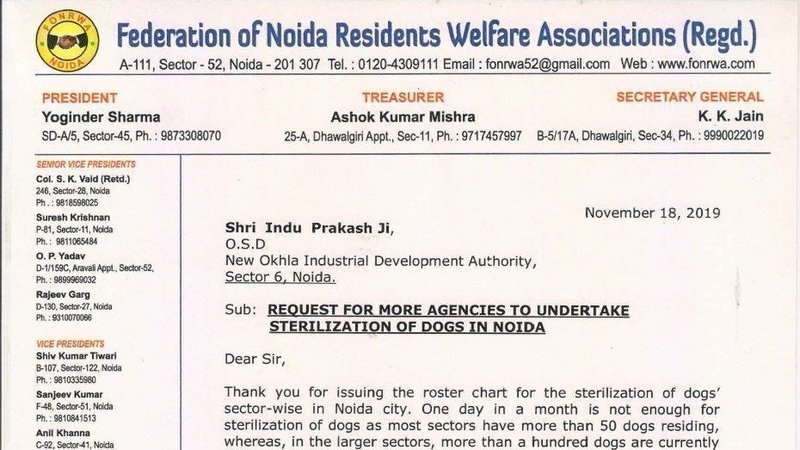
The Federation of Noida Residents Welfare Association has written a letter to the OSD, New Okhla Industrial Development Authority, Noida to open more Sterilization units as the stray dog population is quite high in the city of Noida.
They have talked about two kinds of solutions. One long term and another short term. In the short term they are insisting on having more Sterilization units open so that the dogs get sterilized and in the long term solution they are asking for opening shelters houses where all the dogs of Noida can be put.
The short term solution talks about the sensibility and awareness of dog laws where the supreme court has categorically specified that no stray dog shall be killed or removed from its birth place. The only way the dog problem can be tackled in India is by getting them sterilised and vaccinated. This way not only the population of stray dogs will be curtailed in a humane manner but also help the country become canine rabies free.
The long term solution which the RWA is requesting is absolutely useless and mindless.
Opening shelters and keeping all the dogs at one place will not only deprive them of their natural environment but also place a huge financial burden on the government. Providing the dogs with food and medicine is a recurring cost and just cannot be compromised. Apart from this there are expenses on running the shelter like it's maintenance cost, electricity bills and salary of the employees. Where will all this come from? Who will bear the cost?
India has the second largest population in the world after china. Land is the most scarce resource for we Indians. Can we afford acres of land as homes for stray dogs?
Secondly, India is a developing country with half of it's population still poor.
Can we afford such huge budget in running homes for stray dogs?
Are the long term solutions suggested by the RWA feasible?
Let's see what can be the more sensible, feasible and achievable long term solutions for stray dogs:
1 Encourage stray dog adoption. It's very sad that pet keeping in India is still quite low. Even if people keep dogs as pets they go for pedigree breeds and not the Indian breed dogs. There are several myths attached with these dogs. Like they are dirty, rabid and poor breed dogs. The government should try to bust these myths and do everything possible to increase pet keeping.
2 Encourage people to become caregivers . These are the people who give food, water and all kinds of medical assistance to the stay dogs residing in their area. On an average a caregiver in India is taking care of 10 to 12 stray dogs which is not physically and mentally healthy for him / her. These are the people who are also helping in getting the dogs sterilized and vaccinated. They are still very few in number but their contribution has been immense. Unfortunately their contribution is neither acknowledged by the government nor the society. They often face resistance from their own neighbours and RWA for taking care of the dogs.
3 Organize awareness campaigns on dog bites and rabies in schools, colleges and residential colonies so that people know how to behave with the stray dogs. Dogs do not bite without provocation and in India people keep provoking them all the time. Sometimes people provoke them for fun too. Rabies too is a disease which can be easily prevented by annual dog vaccination. For this the RWA can organize annual vaccination programme in their colony. This way the dog will be safe and so will be the children and their parents
4 sterilization centres are a must but in the long run the number of centres may be reduced as the number of unsterilized dogs shall also become less.
The RWAs are calling the man dog co-existence problem in the cities as dog menace. Are dogs responsible for this menace?
Who has created this menace?