
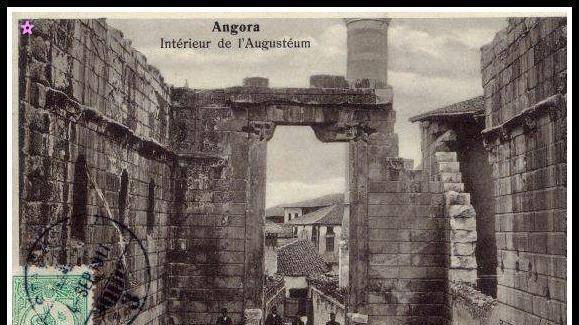
Augustus Mabedi yanındaki "Fıskiyeli Havuz" kaldırılsın .. YAZITLAR KRALİÇESİ YOK OLUYOR!
Lütfen kampanyayı destekleyiniz..
ODTÜ'den Suna Güven hocamızın bir makalesini paylaşıyorum.
Displaying the Res Gestae of Augustus
A Monument of Imperial Image for All
by SUNA GÜVEN,
Middle East Technical University, Ankara
Roman inscriptions, and others, are usually studied as
extual documents that record history. In this traditional
approach, specialists in epigraphy literally translate the written
text so that it becomes, on its own, the veritable evidence for
what it records. Such a reductive function, however, ignores
the active aspect of inscriptions as interpretive instruments in
forminghistory. As cultural products, inscriptions have continuous and multiple narratives.1 Context, different forms of literacy, and memory contribute to the formation of these
narratives. The narrative of what we call "history" depends,
therefore, not only on who first writes it, but also on the reader.
Seen in its role in forming history through the creation of an
imperial image, the Res Gestaeinscription constitutes an extraordinary example. It provides the rare instance of the same
inscription found in different locations, all copies of a lost
original. Although the intended location is known, our information today comes principally from the copies, all found in Galatia.
The texts of the Res Gestaeinscriptions and the architectural
settings in which they were found have usually been treated
separately. While philologists, epigraphists, and historians have
worked on problems of verification and textual analysis, archaeologists have concentrated on piecing together the archaeological record, with little interaction between the two groups.2
However, it is precisely through the overlay of the two types of
evidence that a narrative text may be formed to understand
better Augustan policies and their impact.3 Despite copious
research on the Res Gestae, highlighting its architectonic and
contextual character remains a desideratum. What regulates
the text of the Res Gestae as a master narrative, however, is
precisely its monumental character interpreted through changing audiences and different settings. Considering all of these
helps explain both the wish ofAugustus to have the inscription
put in place posthumously and the nature of the connection
between Galatia and Rome.
A MONUMENTAL TEXT
What is the Res Gestae, or more properly, the Res Gestae Divi
Augusti? We learn from Suetonius (Augustus 101.4) that in the
most literal sense, it is basically a catalogue of the achievements of the Divine Augustus. Looking at it another way, we
could say that it starts off as an altruistic record of the first
Roman emperor and his performance designed by a "memory
entrepreneur," to use a term coined by James Young.4 Following the last injunction of the emperor, who died on 19 August
A.D. 14, the list was to be inscribed on bronze tablets and
installed before his mausoleum in Rome. Although the original inscription is lost, the purpose and the intended location
are explicitly stated in introduction to a copy in Ankara: "A
copy is set out below of 'The Achievements of the Divine
Augustus, by which he brought the world under the empire of
the Roman people, and of the expenses which he bore for the
state and people of Rome'; the original is engraved on two
bronze pillars set up at Rome."5
Composed entirely in the first person, it presented the life
of Augustus the way he wished to be remembered. Neither a
perfunctory oratory nor a brazen show of power, the inscription was intended to ensure the continuity of empire spawned
and nurtured by Augustus. This purpose explains the design
of the Res Gestae as a posthumous project by its author. Ironically, today the inscription is known only from the surviving
copies of it, not in Rome but all in Galatia, a distant province of
the Roman Empire in the highlands of Anatolia. As a result,
and partly because of this, the Res Gestae inscription serves a
function beyond that of the written word with extraordinary
power and lucidity. It becomes a textual monument in the
service of imperial ideology. The potency of the content stems
precisely from monumental context, and the inscription loses
much of its meaning when read simply as a written text.
Makalenin tamamı: https://berlinarchaeology.files.wordpress.com/2012/08/gc3bcven-1998.pdf