

Journalism Is Not a Crime: Free Azerbaijan’s 40 Imprisoned Journalists and Bloggers
Das Problem
Forty journalists, bloggers and media workers are currently imprisoned in Azerbaijan. They include members of Abzas Media, Toplum TV, the Institute for Democratic Initiatives, Meydan TV, independent journalists, photojournalists and bloggers.
Their cases have raised serious concerns about politically motivated prosecution, the criminalization of journalism, prolonged pre-trial detention, unfair judicial proceedings, ill-treatment, denial of adequate medical care and restrictions on access to lawyers and families.
Journalism is not a crime. Investigating corruption, reporting human rights violations, expressing critical opinions and informing the public are fundamental elements of the “public watchdog” role protected by Article 10 of the European Convention on Human Rights.
On 24 June 2026, the Parliamentary Assembly of the Council of Europe adopted Resolution 2663 (2026), “Silencing critical voices in Azerbaijan”. In its final paragraph, the Assembly resolved to remain engaged with the protection of independent journalists and human rights defenders in Azerbaijan.
CORE DEMAND
We call upon international organisations and democratic states to demand, openly and in a coordinated manner, that the Azerbaijani authorities immediately and unconditionally release the 40 journalists, bloggers, media workers and persons associated with media activity covered by this petition. It is the legal position of this petition that the deprivation of liberty or criminal prosecution of the named persons is connected with their lawful journalistic activities, their investigation and dissemination of information of public interest, the expression of critical views and the exercise of freedom of expression, thereby raising serious legal questions under Articles 5, 6 and 10—and, in specific cases, Article 18—of the European Convention on Human Rights (ECHR), as well as Articles 9 and 19 of the International Covenant on Civil and Political Rights [5][8]. In respect of those convicted, we demand the quashing of judgments considered unlawful or politically motivated, the removal of the legal consequences of conviction and the restoration of their rights. In respect of those held in pre-trial detention or subject to ongoing judicial proceedings, we demand the immediate lifting of detention measures and the discontinuance of criminal prosecutions considered politically motivated.
LIMITED EFFECTIVENESS OF DOMESTIC REMEDIES AND THE NEED FOR URGENT INTERNATIONAL INTERVENTION
Since the final quarter of 2023, pressure on independent media, journalists, media workers and critical voices in Azerbaijan has escalated sharply. International human rights and media freedom organisations have characterised the cases involving Abzas Media, Toplum TV and Meydan TV, as well as the criminal prosecution of individual journalists and bloggers, as serious interference with freedom of expression and media freedom [11][17][18].
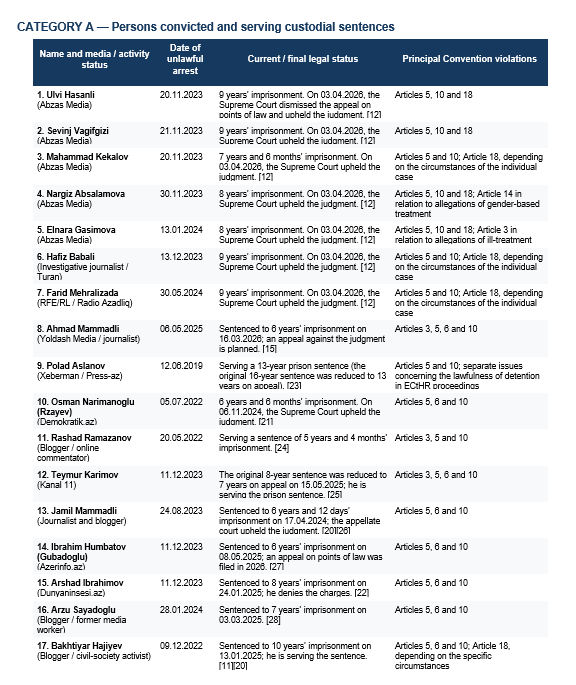
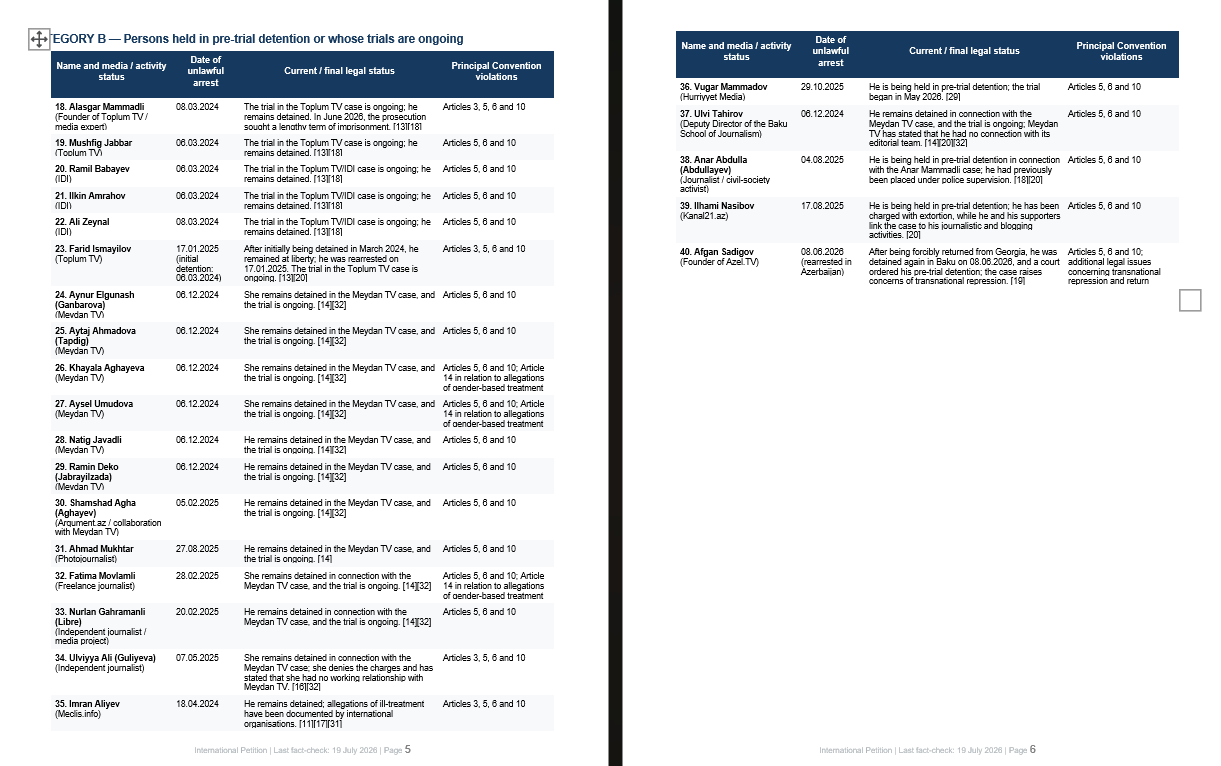
In the Abzas Media case, six journalists and media workers, together with RFE/RL journalist Farid Mehralizada, were sentenced to lengthy terms of imprisonment. On 3 April 2026, the Supreme Court dismissed their appeals on points of law and upheld the judgments [12]. The trial in the case involving Toplum TV and the Institute for Democratic Initiatives is ongoing, and in June 2026 the prosecution sought lengthy terms of imprisonment for the defendants [13]. The cases of 12 persons associated with Meydan TV are before the courts [14][32].
The accused persons, their lawyers and international organisations state that, in a number of cases, the financial, economic and other criminal charges brought are connected with journalism, media activity and public criticism of the Government. The Azerbaijani authorities deny the existence of politically motivated arrests. Against the background of these conflicting positions, the presumption of innocence, the reasonable-suspicion standard, the independence of the judiciary and the question of an ulterior purpose under Article 18 of the ECHR require an independent and impartial legal assessment [5].
PACE Resolution 2663 (2026), “Silencing critical voices in Azerbaijan”, adopted on 24 June 2026, expresses concern about the systematic silencing of critical voices in the country, severe restrictions on media freedom and persistent problems concerning the execution of judgments of the European Court of Human Rights. At the time of its adoption, the Resolution noted that the Council of Europe Platform for the Safety of Journalists had recorded 36 journalists in detention [1][2].
In paragraph 20, its final paragraph, the Assembly resolves to “remain seized of the issue of protecting human rights defenders and independent journalists in Azerbaijan”. In keeping with the logic of that institutional decision, this petition calls upon PACE and other international actors to keep the matter actively on their agendas; to take the petition and the signatures collected into account as an expression of public opinion and as supplementary monitoring material; and to strengthen hearing and accountability mechanisms [1].
This appeal is not directed against the people of Azerbaijan, state sovereignty or the country’s legitimate economic interests. Its purpose is to defend freedom of expression, human dignity, the rule of law and the international legal obligations undertaken by Azerbaijan. In a number of cases, delays in domestic remedies, their ineffectiveness, or serious questions about their independence make urgent international intervention a necessary supplementary protection mechanism.
DOCUMENTED URGENT CONCERNS AND SERIOUS ALLEGATIONS
• The case of Alasgar Mammadli: Credible information indicates that he has serious health problems, including swelling of the thyroid gland and difficulty breathing, and that his access to essential specialist medical care in detention is limited. These circumstances engage the obligation to provide an urgent medical assessment and adequate treatment under Article 3 of the ECHR [18].
• The cases of Ulviyya Ali, Ahmad Mammadli and Imran Aliyev: Allegations of physical violence and ill-treatment during arrest and questioning have been reported. These allegations require an effective, independent and transparent investigation; both the negative and procedural obligations of the State under Article 3 of the ECHR may be engaged [11][15][16][31].
• The case of Farid Ismayilov: According to medical information provided by his family, he has been diagnosed with pneumothorax, cardiopulmonary failure and severe respiratory problems and has undergone several surgical procedures. This information requires urgent verification by an independent medical examination, the provision of necessary inpatient treatment and an assessment of whether his state of health is compatible with detention.
• Treatment of women journalists in detention: PACE Resolution 2663 (2026) states that the Assembly is appalled by recent reports of sexual violence, threats of rape and sexual harassment against nine detained women journalists. These allegations require an urgent independent investigation under Article 3 of the ECHR and, if a discriminatory element is established, Article 14 [1].
• Procedural and individual rights: Allegations of unlawful or disproportionate interference with confidential communication with counsel, family contact, correspondence, medical care and the ability to mount an effective defence raise serious legal concerns under Articles 6 and 8 of the ECHR, as well as the Nelson Mandela Rules [5][8].
LEGAL STATUS REGISTER OF 40 IMPRISONED JOURNALISTS, BLOGGERS AND MEDIA WORKERS
The register is presented in two categories according to the individuals’ current procedural status. The columns “Date of unlawful arrest” and “Principal Convention violations” reflect the legal position of the petition. Unless a specific ECtHR judgment is cited separately, those formulations do not constitute a final judgment of an international court; they identify the legal allegations and Convention issues raised by the respective case.
CATEGORY A — Persons convicted and serving custodial sentences
CATEGORY B — Persons held in pre-trial detention or whose trials are ongoing
EIGHT SPECIFIC DEMANDS ADDRESSED TO INTERNATIONAL BODIES
We call upon international organisations, human rights mechanisms and democratic states to take the following coordinated legal and diplomatic steps within their respective mandates:
1. Immediate and unconditional release, discontinuance of criminal prosecutions considered politically motivated, and restoration of rights
• In respect of those convicted: demand their immediate release, the quashing—through lawful procedures—of judgments considered politically motivated or connected with expression or media activity, the removal of the legal consequences of conviction, and the provision of effective remedies [1][2].
• In respect of those subject to ongoing investigations or judicial proceedings: demand the immediate lifting of pre-trial detention measures, their release, and the discontinuance of criminal prosecutions considered politically motivated and connected with expression or media activity [5][8].
2. Urgent protection, medical care and prevention of ill-treatment
• Pending their release, demand urgent measures to ensure independent medical examinations, essential specialist treatment, confidential communication with counsel, family contact, correspondence and personal security [5][8].
• In individual cases involving a real and imminent risk of irreparable harm to life or health, provide legal and technical support to the individuals’ lawyers or representatives in submitting requests for interim measures under Rule 39 of the Rules of Court. Rule 39 is not a general release mechanism and is applied by the ECtHR only in specific circumstances.
• We ask the CPT to take account of the information submitted; to assess, where necessary, the possibility of an ad hoc visit to Azerbaijan; and to raise with the Azerbaijani authorities the conditions of detention, access to medical care, isolation and allegations of torture.
3. Diplomatic démarches and procedural monitoring
• Deliver coordinated joint diplomatic démarches to the Government of Azerbaijan; request written explanations concerning the named persons; secure access to court hearings for international observers and diplomatic representatives; and hold regular meetings with human rights defenders, lawyers and families [1][3].
4. Activation of UN mechanisms
• Ask the United Nations Working Group on Arbitrary Detention (WGAD) to give priority consideration to appropriate individual submissions, transmit communications to the Government of Azerbaijan and adopt opinions on the compliance of the cases with international law [7].
• Call upon the special procedures on freedom of opinion and expression, human rights defenders, torture, the right to health and the independence of judges and lawyers to issue joint communications and urgent appeals in appropriate cases [9].
5. Strengthening treaty and supervisory mechanisms within the Council of Europe
• Support the Secretary General’s exercise of the power under Article 52 of the ECHR to request a formal explanation from the Azerbaijani authorities as to how the effective implementation of the Convention is secured in domestic law [5].
• Ask the Committee of Ministers to keep the execution of relevant ECtHR judgments concerning Azerbaijan under enhanced supervision, require the implementation of individual and general measures and, where necessary, adopt interim resolutions [4].
• Note that infringement proceedings under Article 46 § 4 of the ECHR may be considered separately only where the legal conditions concerning a refusal to execute a specific final ECtHR judgment are met, and with the requisite two-thirds majority in the Committee of Ministers [4][5].
• If systematic and serious violations are not remedied, consider the possibility of a separate institutional assessment under Article 8 of the Statute of the Council of Europe [6].
6. Individual and targeted sanctions mechanisms
• Where sufficient legal and factual grounds establish direct responsibility for unlawful detention, torture, inhuman treatment and systematic violations of freedom of expression, consider evidence-based targeted measures against the persons responsible, including visa restrictions and asset freezes [10].
• Reject collective punishment; family members and associated persons should be subject to measures only where there is an individual legal basis linking them to the concealment or management of assets, or to benefiting from violations.
7. Legal conditionality and bilateral relations
• Link specific benefits of political, energy, security and institutional cooperation with Azerbaijan to the release of journalists and measurable human rights benchmarks. In the negotiations reactivated in 2026 on a new EU–Azerbaijan bilateral agreement and Partnership Priorities, include human rights conditionality as a specific and measurable element [30].
• Safeguard humanitarian, social and educational programmes, and programmes providing direct support to independent civil society, so that they are not adversely affected by this conditionality.
8. Continuous institutional oversight and follow-up to PACE Resolution 2663 (2026)
• In accordance with paragraph 20 of the Resolution, keep the protection of human rights defenders and independent journalists in Azerbaijan on the Assembly’s active agenda [1].
• Take this petition and the signatures collected into account as an expression of public opinion and as supplementary monitoring material; promote a regularly updated, name-by-name monitoring register, trial observation, monitoring of detention conditions and periodic public reporting [1][2][3].
“52 → 46 → 8” — POTENTIAL TOOLS FOR ESCALATING THE INSTITUTIONAL RESPONSE WITHIN THE COUNCIL OF EUROPE
Legal clarification: Articles 52 and 46 of the ECHR and Article 8 of the Statute of the Council of Europe do not constitute a single legal procedure in which one automatically follows another. They are independent mechanisms with distinct legal bases, competent bodies and procedural conditions. The expression “52 → 46 → 8” is used here solely as an analytical framework to explain potential avenues of political and legal escalation.
• Article 52 of the ECHR — request for an explanation by the Secretary General: The Secretary General may request a Contracting State to furnish an explanation of the manner in which its internal law ensures the effective implementation of the Convention; the Contracting State must furnish that explanation. This mechanism is not, in itself, a sanction or a judicial decision [5].
• Article 46 of the ECHR — execution of judgments: The Committee of Ministers supervises the execution of final ECtHR judgments. Enhanced supervision, interim resolutions and infringement proceedings under Article 46 § 4 are distinct tools. Infringement proceedings may be initiated, by a two-thirds majority, in the specific circumstances of a State failing to fulfil its obligation to execute a particular final judgment [4][5].
• Article 8 of the Statute of the Council of Europe — measures concerning membership and representation: A member State that has seriously violated Article 3 of the Statute may be suspended from its rights of representation and requested to withdraw from the Organisation; if it does not comply with that request, the Committee of Ministers may decide that its membership has ceased. These measures are not automatic and require a separate political and legal decision [6].
FINAL APPEAL
The criminalisation of lawful journalistic and media activity is incompatible with the foundations of a democratic society and with international human rights standards. Investigating matters of public interest, reporting allegations of corruption and abuse, demanding accountability from state institutions and informing the public lie at the heart of the media’s “public watchdog” function and form an integral part of the freedom of expression protected by Article 10 of the ECHR [5].
In the present circumstances, general statements of “concern” alone are insufficient. We demand the coordinated use of legal mandates, diplomatic leverage and monitoring mechanisms; measurable results; and the immediate and unconditional release of the 40 persons covered by this petition [1][2][11].
We, the signatories to this appeal, call upon international organisations, democratic states, parliamentarians and diplomatic representations to take the following steps in accordance with their treaty, statutory and political obligations:
• Place this petition on their official agendas and include it in their human rights dialogues with Azerbaijan;
• Request written explanations from the competent authorities of the Republic of Azerbaijan concerning the arrest and detention of the named persons, their conditions of detention and compliance with international legal obligations;
• Ensure regular public reporting and transparency concerning the legal, diplomatic and preventive steps taken;
• Sign and share the petition, and demand specific action from their national governments, parliaments and international representatives.
SELECTED SOURCES AND FACT-CHECKING RECORD
The sources have been grouped according to their legal, institutional and factual function for this publication. The links below are active.
[1] PACE Resolution 2663 (2026) — “Silencing critical voices in Azerbaijan”, 24 June 2026. [Source]
[2] PACE Report Doc. 16414 (2026) — Committee on Legal Affairs and Human Rights, rapporteur Christophe Lacroix. [Source]
[3] Council of Europe Platform for the Safety of Journalists. [Source]
[4] Council of Europe — Supervision of the execution of judgments of the European Court of Human Rights. [Source]
[5] European Convention on Human Rights (ECHR) — official text. [Source]
[6] Statute of the Council of Europe — Articles 3 and 8. [Source]
[7] UN Working Group on Arbitrary Detention (WGAD). [Source]
[8] International Covenant on Civil and Political Rights (ICCPR) and UN Nelson Mandela Rules. [Source]
[9] UN Special Procedures — submission portal. [Source]
[10] EU Global Human Rights Sanctions Regime. [Source]
[11] Human Rights Watch — World Report 2026: Azerbaijan. [Source]
[12] Committee to Protect Journalists — Azerbaijan Supreme Court rejects appeal of 7 Abzas Media / RFE-RL imprisoned journalists, 8 April 2026. [Source]
[13] Committee to Protect Journalists — Prosecutors seek up to 16 years in Toplum TV case, 10 June 2026. [Source]
[14] Amnesty International — Urgent Action on 12 detained Meydan TV journalists and associated media workers, January 2026. [Source]
[15] Committee to Protect Journalists — Ahmad Mammadli sentenced to 6 years in prison, 19 March 2026. [Source]
[16] Committee to Protect Journalists — Azerbaijan arrests Ulviyya Ali and Ahmad Mammadli, 9 May 2025. [Source]
[17] Justice for Journalists Foundation — Media workers behind bars, report published 9 March 2026. [Source]
[18] Amnesty International — Azerbaijan country report (current report page). [Source]
[19] Human Rights Watch — Azerbaijan rearrests journalist Afgan Sadigov, 12 June 2026. [Source]
[20] Institute for Peace and Democracy — List of Political Prisoners, 15 January 2026 (detailed status register). [Source]
[21] IRFS — Supreme Court upholds sentence of Osman Narimanoglu (Rzayev), 6 November 2024. [Source]
[22] Freedom House — Freedom on the Net 2025: Azerbaijan. [Source]
[23] Committee to Protect Journalists — Polad Aslanov profile. [Source]
[24] PEN America — Rashad Ramazanov, Writer at Risk profile. [Source]
[25] Institute for Human Rights — Teymur Karimov’s prison sentence reduced to 7 years, 15 May 2025. [Source]
[26] Voice of America Azerbaijani — Appeal court upholds Jamil Mammadli sentence, 24 June 2024. [Source]
[27] APA — Ibrahim Humbatov sentenced to 6 years, 8 May 2025. [Source]
[28] RFE/RL Azerbaijani — Blogger Arzu Sayadoglu sentenced to 7 years, 3 March 2025. [Source]
[29] Modern.az — Trial of Hurriyyet editor-in-chief Vugar Mammadov begins, 4 May 2026. [Source]
[30] EEAS — EU-Azerbaijan 7th Security Dialogue: renewed Partnership Priorities and new bilateral agreement, 22 May 2026. [Source]
[31] Amnesty International — Urgent Action: release arrested journalists, including Imran Aliyev. [Source]
[32] Meydan TV — ongoing Meydan TV case and detained defendants (court reporting, 2026). [Source]
FACT-CHECKING NOTE — The information contained in this document was reverified as of 19 July 2026 against open and reliable sources and, where possible, official or internationally authoritative sources. Because detention and procedural statuses may change rapidly, future versions of the document should be updated. Where reports of torture, physical abuse, sexual violence, ill-treatment or denial of adequate medical care have not been confirmed by the findings of an independent court or investigation, they are presented as allegations or reports and require an urgent independent investigation.

134
Das Problem
Forty journalists, bloggers and media workers are currently imprisoned in Azerbaijan. They include members of Abzas Media, Toplum TV, the Institute for Democratic Initiatives, Meydan TV, independent journalists, photojournalists and bloggers.
Their cases have raised serious concerns about politically motivated prosecution, the criminalization of journalism, prolonged pre-trial detention, unfair judicial proceedings, ill-treatment, denial of adequate medical care and restrictions on access to lawyers and families.
Journalism is not a crime. Investigating corruption, reporting human rights violations, expressing critical opinions and informing the public are fundamental elements of the “public watchdog” role protected by Article 10 of the European Convention on Human Rights.
On 24 June 2026, the Parliamentary Assembly of the Council of Europe adopted Resolution 2663 (2026), “Silencing critical voices in Azerbaijan”. In its final paragraph, the Assembly resolved to remain engaged with the protection of independent journalists and human rights defenders in Azerbaijan.
CORE DEMAND
We call upon international organisations and democratic states to demand, openly and in a coordinated manner, that the Azerbaijani authorities immediately and unconditionally release the 40 journalists, bloggers, media workers and persons associated with media activity covered by this petition. It is the legal position of this petition that the deprivation of liberty or criminal prosecution of the named persons is connected with their lawful journalistic activities, their investigation and dissemination of information of public interest, the expression of critical views and the exercise of freedom of expression, thereby raising serious legal questions under Articles 5, 6 and 10—and, in specific cases, Article 18—of the European Convention on Human Rights (ECHR), as well as Articles 9 and 19 of the International Covenant on Civil and Political Rights [5][8]. In respect of those convicted, we demand the quashing of judgments considered unlawful or politically motivated, the removal of the legal consequences of conviction and the restoration of their rights. In respect of those held in pre-trial detention or subject to ongoing judicial proceedings, we demand the immediate lifting of detention measures and the discontinuance of criminal prosecutions considered politically motivated.
LIMITED EFFECTIVENESS OF DOMESTIC REMEDIES AND THE NEED FOR URGENT INTERNATIONAL INTERVENTION
Since the final quarter of 2023, pressure on independent media, journalists, media workers and critical voices in Azerbaijan has escalated sharply. International human rights and media freedom organisations have characterised the cases involving Abzas Media, Toplum TV and Meydan TV, as well as the criminal prosecution of individual journalists and bloggers, as serious interference with freedom of expression and media freedom [11][17][18].
In the Abzas Media case, six journalists and media workers, together with RFE/RL journalist Farid Mehralizada, were sentenced to lengthy terms of imprisonment. On 3 April 2026, the Supreme Court dismissed their appeals on points of law and upheld the judgments [12]. The trial in the case involving Toplum TV and the Institute for Democratic Initiatives is ongoing, and in June 2026 the prosecution sought lengthy terms of imprisonment for the defendants [13]. The cases of 12 persons associated with Meydan TV are before the courts [14][32].
The accused persons, their lawyers and international organisations state that, in a number of cases, the financial, economic and other criminal charges brought are connected with journalism, media activity and public criticism of the Government. The Azerbaijani authorities deny the existence of politically motivated arrests. Against the background of these conflicting positions, the presumption of innocence, the reasonable-suspicion standard, the independence of the judiciary and the question of an ulterior purpose under Article 18 of the ECHR require an independent and impartial legal assessment [5].
PACE Resolution 2663 (2026), “Silencing critical voices in Azerbaijan”, adopted on 24 June 2026, expresses concern about the systematic silencing of critical voices in the country, severe restrictions on media freedom and persistent problems concerning the execution of judgments of the European Court of Human Rights. At the time of its adoption, the Resolution noted that the Council of Europe Platform for the Safety of Journalists had recorded 36 journalists in detention [1][2].
In paragraph 20, its final paragraph, the Assembly resolves to “remain seized of the issue of protecting human rights defenders and independent journalists in Azerbaijan”. In keeping with the logic of that institutional decision, this petition calls upon PACE and other international actors to keep the matter actively on their agendas; to take the petition and the signatures collected into account as an expression of public opinion and as supplementary monitoring material; and to strengthen hearing and accountability mechanisms [1].
This appeal is not directed against the people of Azerbaijan, state sovereignty or the country’s legitimate economic interests. Its purpose is to defend freedom of expression, human dignity, the rule of law and the international legal obligations undertaken by Azerbaijan. In a number of cases, delays in domestic remedies, their ineffectiveness, or serious questions about their independence make urgent international intervention a necessary supplementary protection mechanism.
DOCUMENTED URGENT CONCERNS AND SERIOUS ALLEGATIONS
• The case of Alasgar Mammadli: Credible information indicates that he has serious health problems, including swelling of the thyroid gland and difficulty breathing, and that his access to essential specialist medical care in detention is limited. These circumstances engage the obligation to provide an urgent medical assessment and adequate treatment under Article 3 of the ECHR [18].
• The cases of Ulviyya Ali, Ahmad Mammadli and Imran Aliyev: Allegations of physical violence and ill-treatment during arrest and questioning have been reported. These allegations require an effective, independent and transparent investigation; both the negative and procedural obligations of the State under Article 3 of the ECHR may be engaged [11][15][16][31].
• The case of Farid Ismayilov: According to medical information provided by his family, he has been diagnosed with pneumothorax, cardiopulmonary failure and severe respiratory problems and has undergone several surgical procedures. This information requires urgent verification by an independent medical examination, the provision of necessary inpatient treatment and an assessment of whether his state of health is compatible with detention.
• Treatment of women journalists in detention: PACE Resolution 2663 (2026) states that the Assembly is appalled by recent reports of sexual violence, threats of rape and sexual harassment against nine detained women journalists. These allegations require an urgent independent investigation under Article 3 of the ECHR and, if a discriminatory element is established, Article 14 [1].
• Procedural and individual rights: Allegations of unlawful or disproportionate interference with confidential communication with counsel, family contact, correspondence, medical care and the ability to mount an effective defence raise serious legal concerns under Articles 6 and 8 of the ECHR, as well as the Nelson Mandela Rules [5][8].
LEGAL STATUS REGISTER OF 40 IMPRISONED JOURNALISTS, BLOGGERS AND MEDIA WORKERS
The register is presented in two categories according to the individuals’ current procedural status. The columns “Date of unlawful arrest” and “Principal Convention violations” reflect the legal position of the petition. Unless a specific ECtHR judgment is cited separately, those formulations do not constitute a final judgment of an international court; they identify the legal allegations and Convention issues raised by the respective case.
CATEGORY A — Persons convicted and serving custodial sentences
CATEGORY B — Persons held in pre-trial detention or whose trials are ongoing
EIGHT SPECIFIC DEMANDS ADDRESSED TO INTERNATIONAL BODIES
We call upon international organisations, human rights mechanisms and democratic states to take the following coordinated legal and diplomatic steps within their respective mandates:
1. Immediate and unconditional release, discontinuance of criminal prosecutions considered politically motivated, and restoration of rights
• In respect of those convicted: demand their immediate release, the quashing—through lawful procedures—of judgments considered politically motivated or connected with expression or media activity, the removal of the legal consequences of conviction, and the provision of effective remedies [1][2].
• In respect of those subject to ongoing investigations or judicial proceedings: demand the immediate lifting of pre-trial detention measures, their release, and the discontinuance of criminal prosecutions considered politically motivated and connected with expression or media activity [5][8].
2. Urgent protection, medical care and prevention of ill-treatment
• Pending their release, demand urgent measures to ensure independent medical examinations, essential specialist treatment, confidential communication with counsel, family contact, correspondence and personal security [5][8].
• In individual cases involving a real and imminent risk of irreparable harm to life or health, provide legal and technical support to the individuals’ lawyers or representatives in submitting requests for interim measures under Rule 39 of the Rules of Court. Rule 39 is not a general release mechanism and is applied by the ECtHR only in specific circumstances.
• We ask the CPT to take account of the information submitted; to assess, where necessary, the possibility of an ad hoc visit to Azerbaijan; and to raise with the Azerbaijani authorities the conditions of detention, access to medical care, isolation and allegations of torture.
3. Diplomatic démarches and procedural monitoring
• Deliver coordinated joint diplomatic démarches to the Government of Azerbaijan; request written explanations concerning the named persons; secure access to court hearings for international observers and diplomatic representatives; and hold regular meetings with human rights defenders, lawyers and families [1][3].
4. Activation of UN mechanisms
• Ask the United Nations Working Group on Arbitrary Detention (WGAD) to give priority consideration to appropriate individual submissions, transmit communications to the Government of Azerbaijan and adopt opinions on the compliance of the cases with international law [7].
• Call upon the special procedures on freedom of opinion and expression, human rights defenders, torture, the right to health and the independence of judges and lawyers to issue joint communications and urgent appeals in appropriate cases [9].
5. Strengthening treaty and supervisory mechanisms within the Council of Europe
• Support the Secretary General’s exercise of the power under Article 52 of the ECHR to request a formal explanation from the Azerbaijani authorities as to how the effective implementation of the Convention is secured in domestic law [5].
• Ask the Committee of Ministers to keep the execution of relevant ECtHR judgments concerning Azerbaijan under enhanced supervision, require the implementation of individual and general measures and, where necessary, adopt interim resolutions [4].
• Note that infringement proceedings under Article 46 § 4 of the ECHR may be considered separately only where the legal conditions concerning a refusal to execute a specific final ECtHR judgment are met, and with the requisite two-thirds majority in the Committee of Ministers [4][5].
• If systematic and serious violations are not remedied, consider the possibility of a separate institutional assessment under Article 8 of the Statute of the Council of Europe [6].
6. Individual and targeted sanctions mechanisms
• Where sufficient legal and factual grounds establish direct responsibility for unlawful detention, torture, inhuman treatment and systematic violations of freedom of expression, consider evidence-based targeted measures against the persons responsible, including visa restrictions and asset freezes [10].
• Reject collective punishment; family members and associated persons should be subject to measures only where there is an individual legal basis linking them to the concealment or management of assets, or to benefiting from violations.
7. Legal conditionality and bilateral relations
• Link specific benefits of political, energy, security and institutional cooperation with Azerbaijan to the release of journalists and measurable human rights benchmarks. In the negotiations reactivated in 2026 on a new EU–Azerbaijan bilateral agreement and Partnership Priorities, include human rights conditionality as a specific and measurable element [30].
• Safeguard humanitarian, social and educational programmes, and programmes providing direct support to independent civil society, so that they are not adversely affected by this conditionality.
8. Continuous institutional oversight and follow-up to PACE Resolution 2663 (2026)
• In accordance with paragraph 20 of the Resolution, keep the protection of human rights defenders and independent journalists in Azerbaijan on the Assembly’s active agenda [1].
• Take this petition and the signatures collected into account as an expression of public opinion and as supplementary monitoring material; promote a regularly updated, name-by-name monitoring register, trial observation, monitoring of detention conditions and periodic public reporting [1][2][3].
“52 → 46 → 8” — POTENTIAL TOOLS FOR ESCALATING THE INSTITUTIONAL RESPONSE WITHIN THE COUNCIL OF EUROPE
Legal clarification: Articles 52 and 46 of the ECHR and Article 8 of the Statute of the Council of Europe do not constitute a single legal procedure in which one automatically follows another. They are independent mechanisms with distinct legal bases, competent bodies and procedural conditions. The expression “52 → 46 → 8” is used here solely as an analytical framework to explain potential avenues of political and legal escalation.
• Article 52 of the ECHR — request for an explanation by the Secretary General: The Secretary General may request a Contracting State to furnish an explanation of the manner in which its internal law ensures the effective implementation of the Convention; the Contracting State must furnish that explanation. This mechanism is not, in itself, a sanction or a judicial decision [5].
• Article 46 of the ECHR — execution of judgments: The Committee of Ministers supervises the execution of final ECtHR judgments. Enhanced supervision, interim resolutions and infringement proceedings under Article 46 § 4 are distinct tools. Infringement proceedings may be initiated, by a two-thirds majority, in the specific circumstances of a State failing to fulfil its obligation to execute a particular final judgment [4][5].
• Article 8 of the Statute of the Council of Europe — measures concerning membership and representation: A member State that has seriously violated Article 3 of the Statute may be suspended from its rights of representation and requested to withdraw from the Organisation; if it does not comply with that request, the Committee of Ministers may decide that its membership has ceased. These measures are not automatic and require a separate political and legal decision [6].
FINAL APPEAL
The criminalisation of lawful journalistic and media activity is incompatible with the foundations of a democratic society and with international human rights standards. Investigating matters of public interest, reporting allegations of corruption and abuse, demanding accountability from state institutions and informing the public lie at the heart of the media’s “public watchdog” function and form an integral part of the freedom of expression protected by Article 10 of the ECHR [5].
In the present circumstances, general statements of “concern” alone are insufficient. We demand the coordinated use of legal mandates, diplomatic leverage and monitoring mechanisms; measurable results; and the immediate and unconditional release of the 40 persons covered by this petition [1][2][11].
We, the signatories to this appeal, call upon international organisations, democratic states, parliamentarians and diplomatic representations to take the following steps in accordance with their treaty, statutory and political obligations:
• Place this petition on their official agendas and include it in their human rights dialogues with Azerbaijan;
• Request written explanations from the competent authorities of the Republic of Azerbaijan concerning the arrest and detention of the named persons, their conditions of detention and compliance with international legal obligations;
• Ensure regular public reporting and transparency concerning the legal, diplomatic and preventive steps taken;
• Sign and share the petition, and demand specific action from their national governments, parliaments and international representatives.
SELECTED SOURCES AND FACT-CHECKING RECORD
The sources have been grouped according to their legal, institutional and factual function for this publication. The links below are active.
[1] PACE Resolution 2663 (2026) — “Silencing critical voices in Azerbaijan”, 24 June 2026. [Source]
[2] PACE Report Doc. 16414 (2026) — Committee on Legal Affairs and Human Rights, rapporteur Christophe Lacroix. [Source]
[3] Council of Europe Platform for the Safety of Journalists. [Source]
[4] Council of Europe — Supervision of the execution of judgments of the European Court of Human Rights. [Source]
[5] European Convention on Human Rights (ECHR) — official text. [Source]
[6] Statute of the Council of Europe — Articles 3 and 8. [Source]
[7] UN Working Group on Arbitrary Detention (WGAD). [Source]
[8] International Covenant on Civil and Political Rights (ICCPR) and UN Nelson Mandela Rules. [Source]
[9] UN Special Procedures — submission portal. [Source]
[10] EU Global Human Rights Sanctions Regime. [Source]
[11] Human Rights Watch — World Report 2026: Azerbaijan. [Source]
[12] Committee to Protect Journalists — Azerbaijan Supreme Court rejects appeal of 7 Abzas Media / RFE-RL imprisoned journalists, 8 April 2026. [Source]
[13] Committee to Protect Journalists — Prosecutors seek up to 16 years in Toplum TV case, 10 June 2026. [Source]
[14] Amnesty International — Urgent Action on 12 detained Meydan TV journalists and associated media workers, January 2026. [Source]
[15] Committee to Protect Journalists — Ahmad Mammadli sentenced to 6 years in prison, 19 March 2026. [Source]
[16] Committee to Protect Journalists — Azerbaijan arrests Ulviyya Ali and Ahmad Mammadli, 9 May 2025. [Source]
[17] Justice for Journalists Foundation — Media workers behind bars, report published 9 March 2026. [Source]
[18] Amnesty International — Azerbaijan country report (current report page). [Source]
[19] Human Rights Watch — Azerbaijan rearrests journalist Afgan Sadigov, 12 June 2026. [Source]
[20] Institute for Peace and Democracy — List of Political Prisoners, 15 January 2026 (detailed status register). [Source]
[21] IRFS — Supreme Court upholds sentence of Osman Narimanoglu (Rzayev), 6 November 2024. [Source]
[22] Freedom House — Freedom on the Net 2025: Azerbaijan. [Source]
[23] Committee to Protect Journalists — Polad Aslanov profile. [Source]
[24] PEN America — Rashad Ramazanov, Writer at Risk profile. [Source]
[25] Institute for Human Rights — Teymur Karimov’s prison sentence reduced to 7 years, 15 May 2025. [Source]
[26] Voice of America Azerbaijani — Appeal court upholds Jamil Mammadli sentence, 24 June 2024. [Source]
[27] APA — Ibrahim Humbatov sentenced to 6 years, 8 May 2025. [Source]
[28] RFE/RL Azerbaijani — Blogger Arzu Sayadoglu sentenced to 7 years, 3 March 2025. [Source]
[29] Modern.az — Trial of Hurriyyet editor-in-chief Vugar Mammadov begins, 4 May 2026. [Source]
[30] EEAS — EU-Azerbaijan 7th Security Dialogue: renewed Partnership Priorities and new bilateral agreement, 22 May 2026. [Source]
[31] Amnesty International — Urgent Action: release arrested journalists, including Imran Aliyev. [Source]
[32] Meydan TV — ongoing Meydan TV case and detained defendants (court reporting, 2026). [Source]
FACT-CHECKING NOTE — The information contained in this document was reverified as of 19 July 2026 against open and reliable sources and, where possible, official or internationally authoritative sources. Because detention and procedural statuses may change rapidly, future versions of the document should be updated. Where reports of torture, physical abuse, sexual violence, ill-treatment or denial of adequate medical care have not been confirmed by the findings of an independent court or investigation, they are presented as allegations or reports and require an urgent independent investigation.
Die Entscheidungsträger*innen


Neuigkeiten zur Petition
Diese Petition teilen
Petition am 20. Juli 2026 erstellt