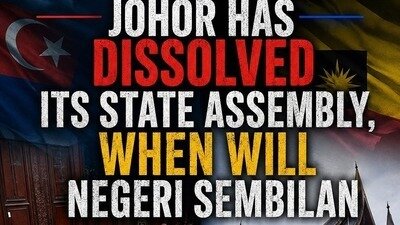

Johor Has Dissolved Its State Assembly, When Will Negeri Sembilan Follow? Political Promis
The Issue
The dissolution of the Johor State Legislative Assembly (DUN) on 1 June 2026 has opened a new chapter in Malaysia’s political landscape. The decision announced by Johor Menteri Besar Onn Hafiz Ghazi not only paved the way for the Johor State Election but also raised significant questions about the political future of Negeri Sembilan.
One question frequently raised by political observers is:
“Johor has dissolved its State Assembly, but when will Negeri Sembilan do the same?”
The issue became even more interesting when the public recalled remarks made by Anthony Loke Siew Fook during the Pakatan Harapan Convention held at Persada Johor International Convention Centre on 18 May 2026.
According to media reports, he stated that if Johor dissolved its State Assembly, Negeri Sembilan would also take a similar step. Today, Johor has already done so, while Negeri Sembilan has yet to make an official announcement regarding the dissolution of its State Assembly.
Johor Takes the First Step
On 1 June 2026, Onn Hafiz Ghazi officially announced the dissolution of the Johor State Legislative Assembly after receiving royal consent from the Johor Palace.
According to him, the dissolution was intended to allow the democratic process to continue and to seek a fresh mandate from the people of Johor.
For many political observers, the move was not entirely unexpected. Speculation about a possible Johor state election had been circulating for months.
Johor, which has 56 state seats, is one of the most influential states in Malaysian politics. Following the 2022 Johor state election, Barisan Nasional secured a commanding majority in the state assembly.
Supporters of the state government argue that an early election would provide a renewed mandate to continue Johor’s development agenda. The state is currently involved in several major strategic initiatives, including the Johor–Singapore Special Economic Zone, high-technology industrial investments, and large-scale infrastructure projects.
For this reason, supporters believe that the government requires a strong and updated mandate to continue implementing its policies effectively.
Anthony Loke’s Remarks Draw Attention
What makes the current situation more intriguing is the statement made by Anthony Loke during the Pakatan Harapan convention in Johor Bahru on 18 May 2026.
According to media reports, he indicated that if Johor dissolved its State Assembly, Negeri Sembilan would likely do the same. The statement was made in the context of election preparations and Pakatan Harapan’s political strategy in both states.
The remarks quickly became a topic of discussion on social media.
Many Pakatan Harapan supporters viewed the statement as a signal that Negeri Sembilan was prepared to face a state election at any time.
On the other hand, opposition supporters interpreted it as political pressure on the Negeri Sembilan administration to coordinate its election timing with Johor.
However, political statements are often made based on prevailing circumstances and expectations. In politics, a statement does not necessarily constitute a final legal commitment, as the authority to dissolve a State Assembly ultimately rests with the state government and requires the appropriate constitutional processes.
Therefore, it may be more accurate to view the statement as a political position expressed at that particular moment rather than a definitive guarantee that both states would dissolve their assemblies simultaneously.
Negeri Sembilan’s Current Position
Negeri Sembilan is currently administered by Menteri Besar Aminuddin Harun.
The state government is led by Pakatan Harapan in cooperation with parties within Malaysia’s Unity Government framework.
As of early June 2026, no official announcement has been made regarding the dissolution of the Negeri Sembilan State Assembly.
This situation has inevitably generated speculation.
Some observers believe the state government may be waiting to assess political developments in Johor before making a decision.
Others suggest that Negeri Sembilan is evaluating economic conditions and the readiness of party machinery before deciding whether to seek a fresh mandate.
Under Malaysia’s federal system, each state has the constitutional authority to determine the timing of its own State Assembly dissolution, provided it complies with the relevant state laws and constitutional provisions.
Consequently, Johor and Negeri Sembilan are not required to hold elections simultaneously.
Factors That May Influence Negeri Sembilan’s Decision
Several factors may explain why Negeri Sembilan has not yet followed Johor’s example.
1. Economic Considerations
Elections involve significant financial and administrative costs.
The state government may wish to ensure that development projects and public welfare initiatives continue smoothly before entering an election period.
2. Coordination with the Federal Government
Negeri Sembilan is governed by Pakatan Harapan and maintains close cooperation with the Federal Government.
Major political decisions are often considered within the broader context of national political developments.
3. Political Strategy
Timing is a crucial factor in politics.
Political parties continuously assess public sentiment and electoral momentum before deciding on the most advantageous time to seek a fresh mandate.
4. Administrative Priorities
The state government may believe that its current priority should be governance and policy implementation rather than preparing for an immediate election.
Reactions from Supporters and Opposition Parties
The dissolution of the Johor State Assembly has generated diverse reactions.
Supporters of Barisan Nasional view the move as evidence of the state government’s confidence in its level of public support.
They argue that a government confident in its performance should not hesitate to seek a renewed mandate from voters.
Meanwhile, supporters of Pakatan Harapan maintain that every state has its own unique political considerations and that conclusions should not be drawn solely from a statement made several weeks earlier.
Opposition parties have used the issue to question the consistency of Pakatan Harapan’s political messaging in Negeri Sembilan.
They argue that if synchronized elections were considered important in May, questions naturally arise as to why Negeri Sembilan has not yet taken similar action after Johor officially dissolved its assembly.
This debate is likely to continue until the Negeri Sembilan government announces its final decision regarding the future of the State Assembly.
Major Challenges Await All Political Parties
Regardless of when elections are eventually held, all political parties face significant challenges.
Barisan Nasional
Barisan Nasional must defend the strong performance it achieved in the previous Johor state election.
Past success does not automatically guarantee future victories.
Pakatan Harapan
Pakatan Harapan must demonstrate that it continues to enjoy substantial support, particularly among urban and semi-urban voters.
Perikatan Nasional
Perikatan Nasional is expected to capitalize on any dissatisfaction or divisions among voters toward the incumbent governments.
Other Parties and Independent Candidates
Smaller parties and independent candidates may also play important roles in closely contested constituencies.
What Do the People Want?
Beyond political debates, most citizens remain focused on everyday concerns.
The cost of living, employment opportunities, housing, education, healthcare, and infrastructure development continue to be the issues that matter most to voters.
For the people of Johor, the upcoming state election will serve as an opportunity to assess the performance of the state government over the past term.
For the people of Negeri Sembilan, attention remains focused on whether their state will follow Johor’s path or wait for what leaders consider a more appropriate time.
Conclusion
The dissolution of the Johor State Legislative Assembly on 1 June 2026 represents a significant development in Malaysia’s political landscape.
At the same time, Anthony Loke’s remarks on 18 May suggesting that Negeri Sembilan would also dissolve its State Assembly if Johor did so have continued to attract public attention and political discussion.
However, as of now, Negeri Sembilan has not officially announced the dissolution of its State Assembly.
Whether the state will move toward an election in the near future or wait until a later date remains a decision for the state leadership.
What is certain is that the situation highlights the dynamic and constantly evolving nature of Malaysian politics.
Johor has already taken the first step toward a new state election.
Now, political attention is increasingly focused on Negeri Sembilan.
The question remains: Johor has dissolved its State Assembly—when will Negeri Sembilan follow?

2
The Issue
The dissolution of the Johor State Legislative Assembly (DUN) on 1 June 2026 has opened a new chapter in Malaysia’s political landscape. The decision announced by Johor Menteri Besar Onn Hafiz Ghazi not only paved the way for the Johor State Election but also raised significant questions about the political future of Negeri Sembilan.
One question frequently raised by political observers is:
“Johor has dissolved its State Assembly, but when will Negeri Sembilan do the same?”
The issue became even more interesting when the public recalled remarks made by Anthony Loke Siew Fook during the Pakatan Harapan Convention held at Persada Johor International Convention Centre on 18 May 2026.
According to media reports, he stated that if Johor dissolved its State Assembly, Negeri Sembilan would also take a similar step. Today, Johor has already done so, while Negeri Sembilan has yet to make an official announcement regarding the dissolution of its State Assembly.
Johor Takes the First Step
On 1 June 2026, Onn Hafiz Ghazi officially announced the dissolution of the Johor State Legislative Assembly after receiving royal consent from the Johor Palace.
According to him, the dissolution was intended to allow the democratic process to continue and to seek a fresh mandate from the people of Johor.
For many political observers, the move was not entirely unexpected. Speculation about a possible Johor state election had been circulating for months.
Johor, which has 56 state seats, is one of the most influential states in Malaysian politics. Following the 2022 Johor state election, Barisan Nasional secured a commanding majority in the state assembly.
Supporters of the state government argue that an early election would provide a renewed mandate to continue Johor’s development agenda. The state is currently involved in several major strategic initiatives, including the Johor–Singapore Special Economic Zone, high-technology industrial investments, and large-scale infrastructure projects.
For this reason, supporters believe that the government requires a strong and updated mandate to continue implementing its policies effectively.
Anthony Loke’s Remarks Draw Attention
What makes the current situation more intriguing is the statement made by Anthony Loke during the Pakatan Harapan convention in Johor Bahru on 18 May 2026.
According to media reports, he indicated that if Johor dissolved its State Assembly, Negeri Sembilan would likely do the same. The statement was made in the context of election preparations and Pakatan Harapan’s political strategy in both states.
The remarks quickly became a topic of discussion on social media.
Many Pakatan Harapan supporters viewed the statement as a signal that Negeri Sembilan was prepared to face a state election at any time.
On the other hand, opposition supporters interpreted it as political pressure on the Negeri Sembilan administration to coordinate its election timing with Johor.
However, political statements are often made based on prevailing circumstances and expectations. In politics, a statement does not necessarily constitute a final legal commitment, as the authority to dissolve a State Assembly ultimately rests with the state government and requires the appropriate constitutional processes.
Therefore, it may be more accurate to view the statement as a political position expressed at that particular moment rather than a definitive guarantee that both states would dissolve their assemblies simultaneously.
Negeri Sembilan’s Current Position
Negeri Sembilan is currently administered by Menteri Besar Aminuddin Harun.
The state government is led by Pakatan Harapan in cooperation with parties within Malaysia’s Unity Government framework.
As of early June 2026, no official announcement has been made regarding the dissolution of the Negeri Sembilan State Assembly.
This situation has inevitably generated speculation.
Some observers believe the state government may be waiting to assess political developments in Johor before making a decision.
Others suggest that Negeri Sembilan is evaluating economic conditions and the readiness of party machinery before deciding whether to seek a fresh mandate.
Under Malaysia’s federal system, each state has the constitutional authority to determine the timing of its own State Assembly dissolution, provided it complies with the relevant state laws and constitutional provisions.
Consequently, Johor and Negeri Sembilan are not required to hold elections simultaneously.
Factors That May Influence Negeri Sembilan’s Decision
Several factors may explain why Negeri Sembilan has not yet followed Johor’s example.
1. Economic Considerations
Elections involve significant financial and administrative costs.
The state government may wish to ensure that development projects and public welfare initiatives continue smoothly before entering an election period.
2. Coordination with the Federal Government
Negeri Sembilan is governed by Pakatan Harapan and maintains close cooperation with the Federal Government.
Major political decisions are often considered within the broader context of national political developments.
3. Political Strategy
Timing is a crucial factor in politics.
Political parties continuously assess public sentiment and electoral momentum before deciding on the most advantageous time to seek a fresh mandate.
4. Administrative Priorities
The state government may believe that its current priority should be governance and policy implementation rather than preparing for an immediate election.
Reactions from Supporters and Opposition Parties
The dissolution of the Johor State Assembly has generated diverse reactions.
Supporters of Barisan Nasional view the move as evidence of the state government’s confidence in its level of public support.
They argue that a government confident in its performance should not hesitate to seek a renewed mandate from voters.
Meanwhile, supporters of Pakatan Harapan maintain that every state has its own unique political considerations and that conclusions should not be drawn solely from a statement made several weeks earlier.
Opposition parties have used the issue to question the consistency of Pakatan Harapan’s political messaging in Negeri Sembilan.
They argue that if synchronized elections were considered important in May, questions naturally arise as to why Negeri Sembilan has not yet taken similar action after Johor officially dissolved its assembly.
This debate is likely to continue until the Negeri Sembilan government announces its final decision regarding the future of the State Assembly.
Major Challenges Await All Political Parties
Regardless of when elections are eventually held, all political parties face significant challenges.
Barisan Nasional
Barisan Nasional must defend the strong performance it achieved in the previous Johor state election.
Past success does not automatically guarantee future victories.
Pakatan Harapan
Pakatan Harapan must demonstrate that it continues to enjoy substantial support, particularly among urban and semi-urban voters.
Perikatan Nasional
Perikatan Nasional is expected to capitalize on any dissatisfaction or divisions among voters toward the incumbent governments.
Other Parties and Independent Candidates
Smaller parties and independent candidates may also play important roles in closely contested constituencies.
What Do the People Want?
Beyond political debates, most citizens remain focused on everyday concerns.
The cost of living, employment opportunities, housing, education, healthcare, and infrastructure development continue to be the issues that matter most to voters.
For the people of Johor, the upcoming state election will serve as an opportunity to assess the performance of the state government over the past term.
For the people of Negeri Sembilan, attention remains focused on whether their state will follow Johor’s path or wait for what leaders consider a more appropriate time.
Conclusion
The dissolution of the Johor State Legislative Assembly on 1 June 2026 represents a significant development in Malaysia’s political landscape.
At the same time, Anthony Loke’s remarks on 18 May suggesting that Negeri Sembilan would also dissolve its State Assembly if Johor did so have continued to attract public attention and political discussion.
However, as of now, Negeri Sembilan has not officially announced the dissolution of its State Assembly.
Whether the state will move toward an election in the near future or wait until a later date remains a decision for the state leadership.
What is certain is that the situation highlights the dynamic and constantly evolving nature of Malaysian politics.
Johor has already taken the first step toward a new state election.
Now, political attention is increasingly focused on Negeri Sembilan.
The question remains: Johor has dissolved its State Assembly—when will Negeri Sembilan follow?
Petition Updates
Share this petition
Petition created on 3 June 2026