

Jehovah's Witnesses - Global Petition: Reform Unbiblical Policies and Bureaucracies
Jehovah's Witnesses - Global Petition: Reform Unbiblical Policies and Bureaucracies
The Issue
TO THE GOVERNING BODY OF JEHOVAH'S WITNESSES -
WATCH TOWER BIBLE AND TRACT SOCIETY OF PENNSYLVANIA - 11/2024
RECIPIENT'S: Jacob Rumph, Jody Jedele, David Splane, Gage Fleegle,
Geoffrey Jackson, Gerrit Lösch, Jeffrey Winder, Kenneth Cook Jr., Mark Sanderson, Samuel Herd e Stephen Lett.
* If someone else joins the governing body after this date, please feel included in this petition.
Names will be changed for your protection!
Protection of Data and Privacy for Anonymous Voters
In compliance with U.S. privacy laws, including the California Consumer Privacy Act (CCPA) and the General Data Protection Regulation (GDPR), we strictly uphold the privacy rights of all individuals participating in this petition. All votes will be anonymous, and any personal information provided will not be shared, accessed, or disclosed to third parties without explicit consent. These legal protections ensure that participants' right to free expression is exercised without the risk of exposure or retaliation.
By voting, you are protected by these laws, ensuring confidentiality and safeguarding against misuse of your information!
Everyone who votes on this online petition is protected by the General Data Protection Law (or applicable international equivalent), which ensures that your personal information is treated securely, confidentially and respectfully. Any attempt to retaliate or investigate voter data by part of the Watch Tower Bible and Tract Society of Pennsylvania is expressly prohibited and will not be tolerated, ensuring that each participant can exercise their right to expression without fear.
______________________________________________
PLEASE, WE EARNESTLY REQUEST THAT YOU READ THE ENTIRE DOCUMENT CAREFULLY, AS EACH POINT ADDRESSED IS OF UTMOST IMPORTANCE FOR REFLECTION AND THE SPIRITUAL WELL-BEING OF EVERYONE.
SUBJECT: International petition by baptized members or former members.
Matthew 12:7" However, if you had understood what this means, ‘I want mercyh and not sacrifice,’i you would not have condemned the guiltless ones."
Acts 15:28-29
"For it seemed good to the holy spirit and to us not to lay upon them any burden beyond these necessary things."
It shows how the first-century congregation eliminated unnecessary rules to ease burdens.
- Imitate the love, mercy, and manner in which Jehovah God dealt with and treated sinners with serious sins, such as King David and King Manasseh.
- - Imitate the manner in which Jesus dealt with and treated sinners.
- - Disproportionate waiting time after a judicial committee (3 to 5 years).
- All sins have the same uniform waiting time, without evaluating each case and individual.
- Total reformulation of the book: "Shepherd the Flock of God" - sfl_E
There are so many rules in Jehovah's Witnesses like "Hammurabi's Code"
- - Current rules, policies, and bureaucracy in contrast to S-395_E: Adjustments to Handling Serious Wrongdoing in the Congregation.
- - Young elders to be trained for 1 year before a judicial committee.
- - Regular pioneers with benefits. (It's not about money) -> Theocratic benefits and within the congregation and in the branch.
- Governing body of Jehovah's witnesses are modern Pharisees with unbiblical and cumbersome rules and laws? (Not even they can live up to it. Anthony Morris is living proof of this)
- - Change in the form and flexibility in being appointed as a ministerial servant to sign petitions (S-205, A-2, A-19 and A-8 after a judicial committee).
- Same standard waiting time after a judicial commission for all petitions and all privileges (time reduction from 3 to 1 to 1.6 (one and a half years))
- - Rules being changed by the governing body without analysis and in a hurry, becoming disproportionate and unfair and heavy-handed.
- - Treat all sinners no matter how heavy as love and humanity.
- - Open the doors to all sinners.
- - End of OSTRACISM AND PREJUDICE against all sinners.
- - End of hatred against apostates or any sinner.
- - Just because a person made a suggestion or criticized something does not mean that he is a "rebel".
- - Equality and transparency in sins at Bethel or people who have special service privileges
- - Flexibility and reasonableness after judicial commission.
- - End of 3 to 5 years of waiting Based on the S-395_E. Different precedents and policies between publishers and people who have special service privileges - for some people they have to wait 3 to 5 years and for others the forgiveness is immediate?
- - Equity and equality in rules for all
______________________________________________
International petition against Jehovah's Witnesses rules without biblical basis
Link to images below: "STUDY ARTICLE 7 - Jehovah’s Forgiveness—What It Means for You":
Jehovah's Witnesses DO NOT preach what they "teach", the proof of this is Ostracism and deep-rooted prejudice disguised as rules without a biblical basis



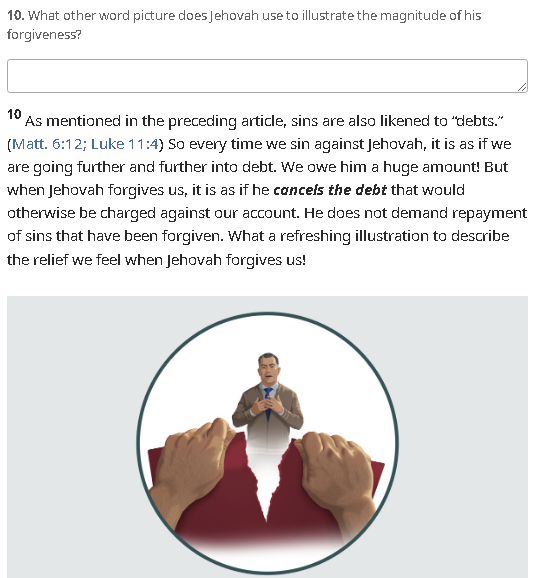

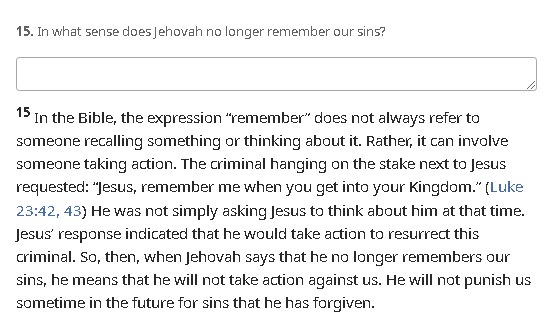
Jehovah versus the treatment of "Jehovah's Witnesses -> Jehovah's Witnesses have rules and policies that are not the same as what they "preach":
The suggestions presented in this document are realistic and can be easily implemented without negatively impacting the organizational structure. The adaptations recommended here do not require profound or complex changes; on the contrary, they are simple adjustments that can be made immediately and that would bring significant benefits to the spiritual and emotional well-being of members.
These proposals are designed to integrate harmoniously with existing processes, improving the experience of all without compromising the essence or values of the organization. Changing some internal policies and streamlining bureaucratic procedures is not only feasible, but also aligns the organizational structure with the fundamental principles of fairness, empathy, and mutual support.
We believe that these changes will be successful, as they represent a necessary and positive step forward that will strengthen unity and promote a more inclusive environment. By embracing these suggestions, the organization will not only preserve its spiritual foundation, but will also demonstrate flexibility and sensitivity to the needs of its members, a reflection of its commitment to bringing people closer to a healthy and lasting relationship with God.
This petition is an urgent and necessary attempt to bring to the attention of the Governing Body critical issues that affect the spiritual and emotional lives of members. This is a first attempt to open a dialogue and propose meaningful changes, but if there is no response or concrete action, we will seek other resources. Each day of waiting without corrective measures contributes to more cases of injustice, reinforces prejudice, and perpetuates ostracism.
The rules and policies in place, some of which are outdated, affect the health and well-being of the organization’s members. Many are becoming emotionally and physically ill due to the weight of regulations that promote social isolation and inflexible judgments, leading to spiritual exhaustion and a distancing from the principles of love and compassion.
The urgency to reform these policies is undeniable, as each day of delay results in more harm.
The needs of members cannot be viewed solely through the perspective of those in positions of authority and privilege, but rather from a full understanding of the reality experienced at the base of the organization. This petition appeals to a sense of justice and empathy and represents a genuine demand for practical changes that align current procedures with the fundamental teachings of love, forgiveness and acceptance that characterize true faith.
Imagine we have a coin. On one side, you see "head"s, and on the other side, I see "tails". Neither of us is wrong; we are simply viewing the same coin from different perspectives. This example illustrates how different experiences and viewpoints can both be valid, even when they seem to contradict one another.
Applying this idea to the situation of members and the Governing Body of Jehovah’s Witnesses: Members at different levels of the organization may have very different experiences. The Governing Body, often surrounded by privilege and in a comfortable position, may not feel directly the weight of certain rules that, for many members, are difficult to bear. However, this perspective of members—who face the demands and restrictions of everyday life—is a legitimate and essential viewpoint for understanding the reality of the organization.
The petition that presents these concerns provides a more complete view of the real needs and challenges of members. Rules and policies viewed from this perspective show how they affect individuals at the grassroots, fostering a more compassionate and practical understanding.
Seeing from this perspective allows for a more complete and empathetic assessment of the situation, recognizing that, just like the coin metaphor, it is necessary to look at both sides to arrive at a truly balanced, loving, and merciful view with equity and justice.
The complexity and strictness of the rules among Jehovah’s Witnesses sometimes seem to echo the ancient Code of Hammurabi—a set of laws that, while serving to structure society, imposed severe restrictions and punishments to ensure obedience. Like Hammurabi’s laws, the organizational guidelines of the Jehovah’s Witness community can sometimes become rigid obstacles that complicate the lives of members and divert many from the spiritual goal of drawing closer to God.
Rather than providing a path to simple worship and a life of faith, the detailed rules about behavior, assignments, and even how to deal with mistakes and regrets can create an environment where fear of punishment outweighs encouragement for genuine transformation. By becoming so bureaucratic and precise, the guidelines often leave no room for compassion or consideration of individual nuances—just as Hammurabi’s laws were often harsh and inflexible.
This excessive burden of rules can have the opposite effect of discouraging the sincere practice of faith. People seeking to reconnect with spirituality and community may feel discouraged when they encounter a system of rules that seems to evaluate every aspect of their life and behavior.
This type of rigorous structure does not always bring real benefits to the spiritual life and can even leave some feeling oppressed, helpless, or alienated from God, which is far from the intention of a religion that should promote love, forgiveness, and connection with the divine.
This legalistic system within a religious organization can thus distance people from an authentic spiritual experience, turning the journey of faith into an arduous and demanding process.
To reinforce the importance of reevaluating policies and guidelines within the organization of Jehovah’s Witnesses, the Governing Body should consider that the work performed is entirely voluntary and of immeasurable value, and that the focus should be on people.
Without dedicated people, religion has no strength or continuity.
Questions About Updating Shepherd the Flock of God (sfl_E) The elders’ book, known as Shepherd the Flock of God, is largely out of date, with its guidelines written decades ago and showing visible gaps in relation to current challenges and changes.
How long has it been since it was comprehensively revised? It appears that the policies and guidelines contained therein often contradict more recent practices and clash with the way cases are handled today, especially with regard to the treatment of sinners, procedures for appointments, and the appreciation of regular pioneers. The following issues highlight gaps and contradictions that affect the organization’s internal functioning and fairness:
Contradictions and Discriminatory Burdens Many of the rules at Shepherd the Flock of God are applied in a heavy and disproportionate manner, imposing extra burdens on some brothers in specific situations, while others who are new to the faith may be treated more lightly or with less stringent rules and policies. For brothers with decades of baptism and service, these burdens may seem punitive and discouraging, especially considering that they have dedicated years of their lives to serving Jehovah.
Lack of Benefits and Advantages for Regular Pioneers A key issue is the distinction—or lack thereof—of being a regular pioneer. When there are no clear advantages or benefits for a regular pioneer, the incentive to maintain this commitment diminishes. A regular pioneer invests substantial time and resources, and recognizing this effort is essential to advancing his or her work. Otherwise, the commitment becomes almost indistinguishable from that of a regular publisher, offering no additional distinction or recognition. Contradictions in the Treatment of Sinners and Reintegration The approach to sinners and reintegration has undergone significant changes, but many of the old rules in the elders’ book remain rigid, bureaucratic, and in some cases, even contradictory. Shepherd the Flock of God’s rules still maintain guidelines that seem to lengthen the process and make reintegration more difficult, which can discourage and alienate brothers who are sincerely seeking redemption. The Bible shows the example of Jesus, who came to help and save sinners (Luke 19:10), and the body of elders could follow suit with more compassionate and updated guidelines.
Bureaucratic Requirements and Processes Many of the procedures outlined in the elders’ book appear to be merely bureaucratic, with no clear biblical basis. For example, the waiting period imposed on appointments after a judicial committee—which can range from 3 to 5 years—is a procedure that in no way reflects the spirit of biblical forgiveness and mercy. These criteria discourage sincere brothers who may be ready and eager to serve, but are hindered by rules that favor bureaucratic structure over Christian practice.
Loss of Current Affairs and Need for Total Reform In a rapidly changing world, the organization also needs to adapt its practices to be current and relevant. Guidelines that date back decades no longer effectively meet current spiritual and organizational needs. Therefore, the Governing Body should consider completely rewriting Shepherd the Flock of God so that it reflects biblical principles, meets the reality of the brothers, and eliminates contradictions. We are in a new era, and the sheep need to be cared for with justice, love, and wisdom, following the example of Jesus, who condemned the excessive and heavy-handed application of the law by the Pharisees (Matthew 23:4). Therefore, updating the rules and policies of the elders’ book is not just a practical necessity; it is a matter of strengthening Christian love and justice within the congregation. It is urgent!
Clear, objective policies that are consistent with the reality and spiritual progress of the brothers can create an environment where zeal and service to Jehovah are continually encouraged and valued. Finally, keeping guidelines in tune with the Bible’s spirit and pastoral care helps to draw people closer to God and build a united and caring congregation, where each member feels valued and motivated to continue in service.
The rules should be based on the Bible and imitate Jehovah’s way of dealing with sinful and imperfect human beings. Currently, the rules, policies, and bureaucracy of Jehovah’s Witnesses (Watch Tower Bible and Tract Society) are NOT based on the Bible!
Jehovah, as the sovereign of the universe, has repeatedly demonstrated in His Word a remarkable quality: He listens to suggestions and is willing to consider different viewpoints. An example of this can be seen in the story of Sodom and Gomorrah, when Jehovah, after revealing His decision to destroy those cities, listened to Abraham’s intercession. Abraham boldly presented suggestions to Jehovah, asking that He spare the cities if there were a fair number of righteous people in them (Genesis 18:23-33).
Jehovah patiently and willingly responded in the affirmative, demonstrating that although He is sovereign, He is attentive to the pleas and considerations of His faithful servants.
Another example that highlights Jehovah’s willingness to listen and even change His mind comes from Jeremiah 26:3. Some translations indicate that Jehovah would “repent” of the planned punishment, which could suggest that He made a mistake. However, the original Hebrew word can be translated as a “change of heart” or “change of mind.” This shows us that, depending on the reaction of the people or the circumstances, Jehovah can adjust His decisions, not because He is flawed, but because of His mercy and patience. One scholar explains that “a change in man’s attitude leads to a change in God’s judgment.” This concept reveals Jehovah’s willingness to extend grace and to reconsider if it is for the good of His servants.
Furthermore, we see a similar attitude in Jesus, who followed Jehovah’s example. When the people of Israel worshiped the golden calf, Jehovah initially decided to punish the people with death. However, Moses humbly and fervently interceded on Israel’s behalf, and Jehovah, in His mercy, reconsidered His decision (Exodus 32:7-14). This example of Jehovah and Jesus highlights that, even though they were perfect, they were both willing to change their minds when the situation called for compassion and the change was beneficial. Now, if Jehovah, being perfect and full of mercy, is able to listen to suggestions and even modify His decisions based on the situation and the pleas of His servants, does this not lead us to reflect deeply on the leadership of Jehovah’s Witnesses?
If Jehovah, the sovereign of the universe, can change His mind because He is merciful and patient, are the members of the Governing Body, who are imperfect humans, willing to change their decisions when they prove harmful or when the congregation cries out for change?
If Jehovah listens, is patient, and is willing to change, how can we justify a leadership that does not listen to suggestions or revise its decisions, especially when they deeply affect the members of the congregation?
Are they placing themselves above Jehovah by not listening to suggestions or being willing to revise their decisions?
Does their lack of humility in acknowledging that they can make mistakes and need to make adjustments reflect an attitude of superiority that contradicts the principles that Jehovah and Jesus exemplified?
After all, if humility and a willingness to reconsider are required of all, including leaders, how can we expect positive changes to occur if the leadership refuses to listen?
Humility, patience, and a willingness to change are godly qualities that are essential in a relationship with Jehovah. If the leadership is unwilling to listen, will this not be a hindrance to the spiritual well-being of all members?
Jehovah has always been and continues to be patient with us, His imperfect servants. Can the leadership of Jehovah’s Witnesses learn from the example of Jehovah and Jesus and demonstrate greater humility, patience, and a willingness to change when necessary?
Two (2) immediate benefits will arise from the removal of the 3 to 5-year waiting policy for the restoration of privileges:
1. Clear demonstration of Jehovah's love and mercy: Just as the student who abandons sinful practices before baptism is quickly forgiven and blessed by Jehovah, the same mercy will be evident in the cases of publishers who, upon sincerely repenting, will also have the opportunity to be restored. This will reflect the principle of James 2:13, which reminds us that "mercy triumphs over judgment." The organization will demonstrate to the world that it is guided by the spirit of Jehovah's compassion, promoting an environment of healing and welcome.
2. Immediate increase in the workforce within the congregations: By eliminating the rules that prolong the waiting time for the recommendation of ministerial servants, as well as petitions A-8 and A-19, the organization will allow more brothers, already having received Jehovah's forgiveness, to be ready to take on responsibilities within the congregation. This will result in more available workers for sacred service, strengthening the congregations and helping to spread Jehovah's Kingdom more effectively. This adjustment will benefit both the organization and the brothers, promoting unity and efficiency.
Let's analyze two kings from ancient Israel who held positions of authority and leadership among the people of Jehovah and how Jehovah dealt with their actions. These examples can help us reflect on the approach that the organization takes regarding the waiting period imposed on repentant publishers.
King David: David committed serious sins — murder and adultery. What did Jehovah expect from him? Genuine repentance and humility. And David indeed demonstrated this. However, the interesting thing is that, even after these serious sins, Jehovah did not remove David from his position as king. Just as the Governing Body fears that the rapid restoration of repentant brothers may impact how the organization is viewed, people at that time might have wondered, "How is it possible that a king, after committing such acts, continues to govern Israel?"
Nevertheless, Jehovah did not impose a waiting period of 3 to 5 years for David to be removed from his responsibilities. Jehovah observed David's immediate repentance, and instead of removing him, used that experience to inspire the Psalms that we use today for spiritual guidance.
The point is that, if the fear is about how people will view the organization, David's example teaches us that Jehovah's immediate judgment and forgiveness are more important than any public perception. People saw Jehovah's just judgment, and no one questioned whether David should have been removed as king or whether he should go through a long waiting period before being restored.
King Manasseh: Manasseh, another king, committed even more horrendous sins than many publishers do today. He promoted idolatry, practiced sorcery, and even sacrificed his own children. However, just like David, Manasseh demonstrated repentance, and Jehovah, in His mercy, forgave him. Again, there was no waiting period of 3 to 5 years for him to be restored to his position. Jehovah accepted Manasseh's sincere repentance and placed him back in a position of leadership. This teaches us that Jehovah's act of forgiving is not tied to a bureaucratic time frame, but to the condition of the person's heart. The relationship between Jehovah and the one who sins is based on genuine repentance and the willingness to correct the wrong. These biblical examples show us that Jehovah, when dealing with serious sins, focused on immediate repentance and sincere willingness to change. He did not impose long waiting periods, even when the sinners were in positions of great responsibility. The concern for the organization’s image should be secondary to the application of the mercy and forgiveness that Jehovah has always demonstrated. If Jehovah, who is just and perfect, saw David's and Manasseh's repentance and restored them promptly, why impose such long waiting periods on brothers who have already demonstrated their genuine repentance?
The example of these two kings makes us think: true restoration and Jehovah's confidence do not lie in a waiting period but in the spiritual condition of the individual. If the concern is with how people will view the congregation, let us remember that the people of Israel saw Jehovah's immediate forgiveness of David and Manasseh, and that did not bring doubts but rather respect for divine justice. Immediate restoration, based on genuine repentance, is the true reflection of Jehovah's mercy
Restoring trust: By allowing brothers to return to service quickly, the organization demonstrates that it values sincere repentance and the desire for change, restoring trust among congregation members.
Reducing stigma: The elimination of long waiting periods will help reduce the stigma associated with past mistakes, allowing brothers to feel welcomed and valued, regardless of their shortcomings.
Healing environment: This change will foster a healing and spiritual growth environment, where brothers can support one another in their faith journeys.
Example of mercy: By practicing a more merciful approach, the organization will reflect the character of Jehovah and Jesus, becoming a living example of forgiveness and compassion in the community.
Strengthening the congregation: With more brothers willing to serve, the congregation will become stronger and more united, facilitating spiritual growth and the expansion of Jehovah's work
These benefits demonstrate that the reformulation of the rules is not just an administrative change, but a crucial step to ensure that the congregation operates in a healthy, welcoming, and spiritually enriching manner
for all its members.
The rule and bureaucracy imposed by the organization of a 3 to 5-year waiting period is, in practice, like closing the doors on its own members. This policy freezes brothers and sisters in time, blocking their spiritual progress and preventing them from fully contributing to Jehovah’s work.
What should be a time of restoration and healing often turns into a period of stagnation and frustration. Worse still, in some cases, this rule is used as a tool of control in the hands of certain elders, who end up holding back sincere brothers who wish to serve, contributing to an atmosphere of discouragement and despair.
This situation is directly harming those who, with genuine repentance and a sincere desire, want to move forward and return to working zealously in sacred service. The need to re-evaluate and change this policy is urgent so that the organization can fully reflect the spirit of love, mercy, and compassion that Jehovah expects from His people.
Let’s begin with the comparison of a student who, before baptism, was involved in sinful practices such as fornication. Upon deciding to repent and be baptized, this student is quickly integrated into the congregation
and, within just one year, can be recommended to serve as a ministerial servant.
People see this as a clear demonstration of Jehovah’s mercy, who forgives and restores, reflecting the spirit of Matthew 9:13, where Jesus
says: "I desire mercy, not sacrifice". Baptism marks this individual’s spiritual restoration, and the congregation embraces him as a brother who has overcome his past mistakes and is now considered trustworthy.
Now, let’s compare this with the treatment given to a baptized brother who commits a mistake. This brother, often with years of faithful service, genuinely repents of his sin. However, he is forced to wait 3 to 5 years before being considered for any congregational appointment, even though his repentance is sincere and recognized by the elders.
The problem here is not just the length of the waiting period, but the message this conveys. Why is it that when a newly baptized student is restored within just one year, a brother with a history of service and dedication must wait much longer, even after demonstrating genuine repentance?
The discrepancy between the treatment of a newly baptized student and a baptized brother who has sinned is clear.
If the quick restoration of a student who sinned before baptism is celebrated as an act of Jehovah’s mercy, why is the same principle not applied to baptized brothers?
The new guidance on disfellowshipping, which seeks to bring the sinner to repentance rather than simply punish, seems to be at odds with the 3 to 5- year waiting policy. The new guidelines emphasize the importance of reaching the person’s heart and leading them to repentance, rather than imposing a prolonged period of punishment.
Additionally, there’s the issue that in cases of reproof, no report is currently sent to Bethel, and oftentimes, there isn’t even an announcement made to the congregation. This already demonstrates a more compassionate approach, focusing on the spiritual restoration of the individual. If this compassion can be extended to a brother who is being reproved, why can’t it be applied to a brother who has sincerely repented and wishes to serve Jehovah again as quickly as possible?
Complex cases, such as serious crimes, child abuse, and adultery, naturally have a different impact both within and outside the congregation. These sins bring consequences that often require additional protective measures for the congregation and the general public.
However, sins like sexting, for example, do not have the same social impact and do not justify a prolonged waiting period of 3 to 5 years, especially when compared to pre-baptism sins such as fornication, which, once abandoned, allow a student to be baptized and quickly designated for congregational responsibilities.
What we see, therefore, is an inconsistency in the organization's internal rules. The policy of waiting 3 to 5 years has no clear biblical foundation, and in many cases, it reveals itself as a bureaucratic measure that harms brothers rather than helping them recover spiritually. True spiritual restoration should be based on genuine repentance and spiritual progress, not on an arbitrary fixed timeframe. If the Governing Body's intention is to protect the congregation and foster an atmosphere of forgiveness and healing, eliminating this policy would be an important step toward aligning the organization’s practices with the principles of mercy that Jesus taught.
Perhaps the Governing Body sees the waiting period as a means of control or maintaining order, but in reality, this is leading to fear, anxiety, and discouragement among brothers. By comparing the treatment of a newly
baptized student with that of a brother who made a mistake, it becomes clear that the waiting policy is inconsistent.
The student, after just one year, can be elevated to a position of responsibility, while the repentant brother is forced to wait many years, even after demonstrating a genuine change of heart.
Jesus Christ strongly criticized the religious leaders of his day for creating rules and traditions that made it difficult for people to reach God.
He called them “blind guides” who “tied heavy burdens” on the shoulders of others, burdens they themselves did not carry (Matthew 23:4). Jesus not only spoke out against such practices, but also defended the principle that love and mercy should prevail over the imposition of unnecessary rules. He welcomed those who, despite their shortcomings, sought to draw closer to God, showing that compassion and forgiveness are central to a true relationship with the Creator.
However, in the congregations of Jehovah’s Witnesses today (Watch Tower Bible and Tract Society), we see how many rigid policies, bureaucracies, and practices have negatively affected millions of people around the world. Such guidelines daily become barriers between individuals and their spirituality, causing feelings of ostracism, exclusion, worthlessness, frustration, disappointment, inferiority, and prolonging the suffering of those who sincerely desire to be reconciled with the community and with God.
These human rules, rather than being rooted in Scripture, reflect human interpretations and internal bureaucracies that can drive people away rather than attract them. Now is the time to reevaluate such practices. We must ask whether these policies reflect the spirit of compassion and acceptance that Jesus taught. Are they still appropriate for today’s reality, or have they become “burdens” that Jesus would condemn? It is essential to recognize that there is an urgent need for change that promotes unity and empathy within congregations, and that moves away from judgment and prejudice, replacing them with understanding and encouragement for restoration.
We therefore urge all members of the community, including leaders and those with organizational responsibilities, to reconsider the practical effects of these policies. This is an opportunity to return to the simplicity and love taught by Jesus, focusing on practices that welcome, heal, and inspire. Will the Governing Body view a global call for change as rebellion or as a sincere call for reflection?
Have any members of the Governing Body personally experienced the weight of these rules in their own lives?
Have these policies ever impacted the families of any of the leaders, so that they could truly understand the suffering and limitations these rules can cause?
Do such strict guidelines reflect the spirit of mercy and forgiveness that Jesus demonstrated?
If Jesus were among us today, would He support these practices, or would He encourage us to reevaluate their application with compassion and empathy?
Are these policies based on clear, straightforward principles from the Bible or on human interpretations that have over time become traditions?
Do these rules truly strengthen unity and love among brothers, or have they in practice created division, prejudice, and suffering?
When the congregation calls for change, are they demonstrating a spirit of insubordination or simply expressing a legitimate need to live a spirituality that is more in harmony with the love and forgiveness taught by Jesus?
How many people have been alienated or deeply hurt because of the strict enforcement of policies that have no clear biblical basis?
How would the Governing Body respond if it could see firsthand the emotional, psychological, and spiritual impact of these policies on the lives of those seeking reconciliation?
These questions are not intended to challenge authority, but rather to open a space for compassionate and honest analysis that takes into account the feelings, experiences, and real impact of these policies on those in the congregation. Laws and rules made by men who have not been through them cannot fully capture the devastating effect they have on a person.
"SHEPHERD THE FLOCKOF GOD" - CHAPTER 8 - Appointment and Deletion of Elders and Ministerial Servants: CONSIDERING SCRIPTURAL QUALIFICATIONS (?)
"Before meeting to consider recommending brothers as ministerial servants or elders, each elder should personally review the inspired qualifications found at 1 Timothy 3:1-13; Titus 1:5-9; James 3:17, 18; and 1 Peter 5:2, 3. Helpful comments on the Scriptural qualifications can be found in chapters 5 and 6 of the Organized book."
1-A ** A brother appointed as a ministerial servant must have been baptized at least one year. (1 year)"
- 2. After the meeting is opened with prayer, the Scriptural requirements should be read aloud from the Bible. Although no one could measure up perfectly to these requirements, the brother being considered should measure up to a reasonable degree, not significantly lacking in any one of the requirements. The circuit overseer relies on your good judgment and spiritual discernment in this matter."
CAUTIONS BEFORE RECOMMENDING CERTAIN BROTHERS"
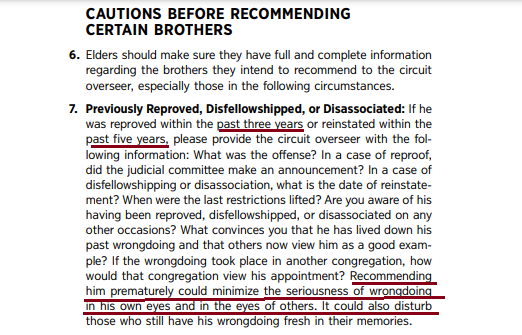
"6. Elders should make sure they have full and complete information regarding the brothers they intend to recommend to the circuit overseer, especially those in the following circumstances." "7. Previously Reproved, Disfellowshipped, or Disassociated: If he was reproved within the past three years or reinstated within the past five years, please provide the circuit overseer with the following information: What was the offense? In a case of reproof, did the judicial committee make an announcement? In a case of disfellowshipping or disassociation, what is the date of reinstatement? When were the last restrictions lifted? Are you aware of his having been reproved, disfellowshipped, or disassociated on any other occasions? What convinces you that he has lived down his past wrongdoing and that others now view him as a good example? If the wrongdoing took place in another congregation, how would that congregation view his appointment? Recommending him prematurely could minimize the seriousness of wrongdoing in his own eyes and in the eyes of others. It could also disturb those who still have his wrongdoing fresh in their memories."
"Point 1-a says: "A man may only be designated after 1 year of baptism."
"Let's think about a hypothetical situation. This "man" who has now been baptized, a few months ago, practiced sin for years or decades. For example, he sometimes committed fornication for years or smoked or committed adultery or had any habit (for years) and within 1 year he is designated as a ministerial servant."
- "Now, what if a brother who was baptized 5, 10, 15 or 20 years ago commits a serious sin, according to points 6 and 7, he will wait 3 to 5 years."
- "7: "Recommending him prematurely could minimize the seriousness of wrongdoing in his own eyes and in the eyes of others. It could also disturb those who still have his wrongdoing fresh in their memories."
The rule that “a man may be appointed only after one year of baptism” among Jehovah’s Witnesses is based on the biblical guideline that a man in a position of spiritual authority “should not be a recent convert” (1 Timothy 3:6). This principle is intended to ensure that a person has time to develop a solid foundation of faith and understanding before assuming additional responsibilities in the congregation. Therefore, the minimum period of one year after baptism is not an arbitrary or recent requirement but is based on this biblical teaching. This framework is established so that an individual can demonstrate his commitment and spiritual maturity. Thus, once he has completed this period of preparation and maturation, he would be eligible for appointments such as ministerial servant, provided that his conduct and example are in line with spiritual requirements.Furthermore, the suggestions presented in this global petition are not based on a recent period after a sin but are based on principles of maturity and evidence of recovery. Current organizational policies often contradict other established policies, resulting in inconsistencies and practical challenges.
For example, while biblical guidance suggests a time of spiritual development for growth and preparation, many of the waiting guidelines for service assignments end up imposing extended periods that are not in harmony with the needs for spiritual support and balance within the congregation.
These recommendations, therefore, aim to harmonize waiting time with biblical principles of restoration and encouragement so that all can contribute positively without unnecessary restrictions once they have demonstrated clear evidence of spiritual zeal and commitment.
Applying a uniform waiting period to all sins, without taking into account the particularities of each case, is a practice that contradicts individual needs and the new flexible guidelines that seek to better align with biblical principles. Imposing a fixed period of 3 to 5 years for restoration of privileges, regardless of the nature and circumstances of the sin, ignores the differences in each person’s experience and level of repentance. This creates an approach that does not distinguish between what could be minor sins, sins of weakness, and more serious sins that involve harmful patterns of behavior.This uniform treatment often results in injustices, by failing to consider that each person is unique and that Jehovah sees each person’s heart and repentance in a unique way. In many cases, a standard waiting period can hinder the spiritual progress of someone who has already shown genuine change and restoration but who must wait for a fixed and rigid time frame to be met. This type of rule, which does not adapt to the nuances and complexity of each situation, can also create an atmosphere of discouragement, making the path to restoration more difficult than it needs to be.This practice contradicts new guidelines that emphasize a more personalized and compassionate approach, recognizing that situations vary and that spiritual judgment must be careful and individualized. By applying a one-size-fits-all approach, the organization risks disregarding the principle of mercy that Jesus demonstrated, where he always considered the sincerity of repentance and the willingness of the sinner to change his or her ways. Thus, making restoration timelines flexible and adaptable would allow each case to be treated fairly and in a spirit of mercy and compassion.Implementing a more personalized approach would strengthen members’ trust in the organization, reflecting the true purpose of Christian discipline: to aid in spiritual restoration, not inflexible punishment.A man who meets the requirements to sign a regular pioneer petition (S-205) automatically meets the requirements to be appointed a ministerial servant and elder because he puts in 50 hours a month. And it also automatically qualifies to sign the A-8 and A-19 petitions. Currently, the rule says: "After a judicial committee wait 1 year to sign the regular pioneer petition (S-205) and wait 3 to 5 years for the petitions (A-19 and A-8) and be appointed ministerial servant. Contradiction and incoherent because a person after 1 year will be a regular pioneer and will even wait for a while and rely on rules without a biblical basis.
- PROPOSAL, SUGGESTION and EXCLUSION OF QUESTIONS:
What was his sin?
Counterargument: A brother’s specific sin should be handled privately and compassionately, respecting his dignity. Bringing up the details of the sin to a circuit overseer can contribute to stigmatization and not promote the brother’s true restoration, which should be based on forgiveness, not ongoing judgment.
If he was rebuked, was this announced to the congregation?
Counterargument: The issue of announcing a rebuke to the congregation is often unnecessary, as it can do more harm than good. When a brother is rebuked in private, it already demonstrates his effort to maintain privacy and dignity, and announcing it publicly can harm his emotional and spiritual recovery. Privacy should always be preserved to protect the person from public humiliation.
If he was disfellowshipped or disassociated, on what date was he reinstated?
Counterargument: The date of reinstatement should not be an issue that needs to be constantly revisited, because the focus of restoration is genuine repentance and transformation, not the amount of time that has passed. Insisting on a specific date can obscure the true process of restoration, which should be individualized and focused on what is most important: inner change.
When were the restrictions last lifted?
Counterargument: Removing restrictions should be based on genuine spiritual progress and recovery, not a rigid time frame. The focus should be on current behavior and ongoing repentance, not on the history of past restrictions, which could create a cycle of mistrust rather than restoration.
Had he previously been reproved, disfellowshipped, or disassociated himself?
Emphasizing the history of previous reproofs and disfellowshipping can be a hindrance to restoration. What should be considered is the brother’s present spiritual condition, his sincerity in repentance, and his willingness to continue serving Jehovah. An individual’s past should not be constantly relived unless it directly impacts his recovery and the confidence of the congregation, but with the loving guidance of the leadership.
Jehovah Forgets Forgiveness, So the Organization Should Forget the Individual’s Sin and History:
The Bible teaches us that when Jehovah forgives someone, He erases the sin from memory. At Isaiah 43:25, Jehovah states: “I, even I, am the One blotting out their transgressions for My own sake, and their sins I do not remember.” Likewise, when a person genuinely repents and seeks Jehovah’s forgiveness, the history of sin should not be a continuing obstacle to forgiveness and restoration within the congregation. The organization should act in accordance with Jehovah’s attitude, offering the brother the opportunity to start over without his past being constantly recalled and used against him.
Everyone sins continually, we are imperfect, and these questions can lead to ostracism and prejudice:
The Bible is clear in stating that we all sin and are imperfect. At Romans 3:23, we read: “For all have sinned and fall short of the glory of God.” This means that, just like everyone else, those who have been through judicial committees, no matter how many mistakes they have made, are still flawed human beings who need love, patience, and help to restore themselves spiritually.
Asking about repeated mistakes can lead to prejudice and ostracism, which can prevent the brother from continuing to serve Jehovah with joy and hope. Jesus came to help sinners, not to condemn them, and He has always been willing to restore those who sincerely repent (Matthew 9:13; Luke 19:10). These two points, combined with the need to show the same mercy and patience that Jehovah and Jesus demonstrated, can be used to invalidate the question about a person’s record of past reproof.
The focus should be on a person’s willingness to serve Jehovah in a sincere and repentant manner, not on a person’s past failures. Thus, a question that requires such ongoing consideration of one’s record is not consistent with the way in which mercy and forgiveness should be applied within the congregation.
What convinces you that he has regained his good reputation and that people now see him as a good example?
Counterargument: The idea of a “good reputation” and being seen as a good example is subjective and can be distorted based on past prejudices. The true evaluation of a brother’s progress should be based on his current behavior, sincerity of repentance, and continued effort to live according to biblical principles. Rather than relying on a “good reputation,” the congregation should rely on the brother’s sincere and continued behavior.
If the sin occurred in another congregation, how would the brothers in that congregation react if he were appointed?
Counterargument: A brother’s judgment should be focused on the present and not on hypothetical reactions from other congregations. People have the right to change, and the current congregation should evaluate the situation based on how the person has demonstrated repentance and transformation, not on the reaction of brothers in other congregations. Trust is built in the new congregation, and the possibility of a new beginning should be supported.
You should not be hasty in recommending a brother in this situation. This may cause him and others to take their sin less seriously.
Counterargument: Prolonging the wait for restoration may send the wrong message that Jehovah’s mercy and forgiveness are not enough. Genuine repentance must be acknowledged, and delaying restoration too much may cause frustration and discouragement in the brother rather than helping him to feel reintegrated and encouraged in his spiritual journey.
The issue of how people who have been on judicial committees within Jehovah’s organization should be treated and the need to give more consideration to genuine repentance, without prolonging the delay in a punitive manner, is extremely relevant and should be addressed based on the Scriptures and the example of mercy of Jehovah and Jesus.
1. Repentance and Jehovah’s Mercy:
The Bible shows that Jehovah forgives our sins completely when we sincerely repent, and He no longer remembers the sins that have been forgiven. At Isaiah 43:25, Jehovah says: “I, even I, am He who blots out your transgressions for My own sake, and I will not remember your sins.”
This verse emphasizes that Jehovah not only forgives but also forgets sin, so if He, being perfect, chooses not to remember wrongdoing, why should the organization insist on such a lengthy history of sins in order to restore a faithful servant? Genuine repentance should be acknowledged and celebrated, not put on a prolonged hold, as if Jehovah’s forgiveness were insufficient.
2. Human Imperfection and the Need for Mercy:
The Bible also recognizes that we are all imperfect and continually sin. At 1 John 1:8, we read: “If we say that we have no sin, we deceive ourselves, and the truth is not in us.” When a person makes a mistake, they demonstrate human weakness, but they repent from the heart. It is more important to acknowledge this repentance than to watch how long someone has “paid” for a mistake. The focus should be on the person’s efforts to return to purity, not on past failures. This attitude of mercy is not only biblical, but also in keeping with the way Jehovah and Jesus dealt with sinners.
3. Jesus’ Attitude Toward Repentance:
Jesus set us an example of how to treat repentant sinners. When he forgave the adulterous woman (John 8:3-11), he did not condemn her, but encouraged her to sin no more. He did not ask her to be observed for years to ensure that her repentance was genuine; he simply forgave him, offering him another chance. This teaches us that the response to repentance should be immediate and full of mercy, reflecting Jehovah’s forgiveness.
4. The Impact of Ostracism and Prejudice:
Furthermore, prolonging the wait for restoration and persisting in questioning repentance can result in a cycle of ostracism and prejudice. Imagine a publisher who, for various reasons, is the target of prejudice on the part of certain elders. These elders, perhaps out of jealousy, envy, or even misunderstanding, may keep this brother on the fringes of the congregation, not offering him the opportunity to serve again. This is especially true if the history of judicial committees becomes a reason to stigmatize the brother rather than treating him with compassion and encouragement.
Such behavior is not in harmony with the Bible’s principles of forgiveness, reconciliation, and love. More importantly, it violates the principle that we are all imperfect and should work together in a spirit of humility. In fact, in Matthew 7:1-5, Jesus warns against judging others, saying, “Why do you look at the speck of sawdust in your brother’s eye, but do not notice the plank in your own eye?"
5. The Need to Rethink Questions: In the context of the new guidelines, where cases are not to be announced to the congregation, it is important to question the relevance of the question about the congregation’s reaction to the brother’s return. As mentioned, the question of “how would the brothers in that congregation react?” becomes obsolete, since with the new guidelines, the congregation no longer needs to be informed of certain cases. Furthermore, the question seems to assume that everyone will have a negative view of the brother, ignoring the fact that many may be more concerned with the person’s restoration than with their punishment. This can create an environment of fear and distrust, rather than one of love and support.
In short, this question makes no sense in light of the biblical principles of forgiveness, mercy, and love. Not only does it perpetuate ostracism and prejudice, but it also fails to recognize that we are all imperfect and in need of mercy. If Jehovah can forgive and forget, and if Jesus demonstrated the importance of immediate forgiveness, why insist on a prolonged period of waiting?
Genuine repentance should be the criterion, not the duration of a sin that has already been forgiven. Therefore, this question needs to be REMOVED, for it runs counter to the spirit of mercy that Jesus taught us.
Proposal: Simple Grave Sins – No Announcement to the Congregation
The proposal to establish a maximum waiting period of 1 to 1.5 years for certain grave sins, without public announcement to the congregation, aims to balance the individual’s genuine repentance and the need to restore him or her spiritually, without causing unnecessary impact to the congregation’s reputation. Below are the main cases that fall into this category, with an explanation for each:
FORNICATION: Proposal: 1 year - maximum - 1.6 (one and a half years) (single people) - for ministerial servant, regular pioneer (S-205), (A-2) and (A-8 and A-19) assignments .
When someone commits a sin, such as fornication, and sincerely repents. The Bible teaches that all sin and fall short of the glory of God (Romans 3:23), and recognizes that human weaknesses are a constant reality in our lives. The apostle John himself reminds us that if we say we have no sin, we deceive ourselves (1 John 1:8). However, this does not mean that we should be complacent about sin, but rather that restoration must be accompanied by a loving and encouraging attitude on the part of the congregation.
SEXTING or immoral conversations by phone or text:Proposal: 1 year for ministerial servant, regular pioneer (S-205), (A-2) and (A-8 and A-19) assignments.
When someone commits a sin, such as fornication, and sincerely repents, it is critical that the congregation help that person restore their relationship with Jehovah rather than keeping them away for an extended period. The Bible teaches that all sin and fall short of the glory of God (Romans 3:23), and recognizes that human weaknesses are a constant reality in our lives. The apostle John himself reminds us that if we say we have no sin, we deceive ourselves (1 John 1:8).
However, this does not mean that we should be complacent about sin, but rather that restoration must be accompanied by a loving and encouraging attitude on the part of the congregation. Sexting behavior, for example, is often treated as fornication. However, it is important to recognize that in the case of sexting, the person did not actually consummate the sexual act. This is a factor that must be taken into account when analyzing the circumstances.
The 3 to 5 year waiting period that is currently imposed may be excessively harsh and disproportionate to the error committed, especially when considering the modern context in which we live.
Pornography: Proposal: 1 year for ministerial servant, regular pioneer (S-205), (A-2) and (A-8 and A-19) assignments
Although pornography is a serious sin, in cases where the person sincerely repents and demonstrates efforts to overcome this practice, up to 1 year, without the need to announce it to the congregation, if the sin has not directly affected others.
Extreme lack of cleanliness:
- Proposal: 1 year for ministerial servant, regular pioneer (S-205), (A-2), and (A-8 and A-19) assignments.
- Proposal:
Cases such as Pedophilia - the person will never have any privileges again and will be held criminally responsible - Complex sins:
Sins that are crimes: If removed within 3 years
- Adultery with divorce: up to 4 years
- Adultery without divorce: up to 3 years.
- Sins without announcement to the congregation: Up to a year and a half (1.6 years) For appointment to ministerial service and signing petitions A-8 and A-19
Announcement to all congregations that people who have passed through a judicial committee and it has been 1 year and a half may be qualified for privileges and sign petitions.
- Age change to: 18 - 45 years - Jesus began his ministry at 30 years of age.

103
The Issue
TO THE GOVERNING BODY OF JEHOVAH'S WITNESSES -
WATCH TOWER BIBLE AND TRACT SOCIETY OF PENNSYLVANIA - 11/2024
RECIPIENT'S: Jacob Rumph, Jody Jedele, David Splane, Gage Fleegle,
Geoffrey Jackson, Gerrit Lösch, Jeffrey Winder, Kenneth Cook Jr., Mark Sanderson, Samuel Herd e Stephen Lett.
* If someone else joins the governing body after this date, please feel included in this petition.
Names will be changed for your protection!
Protection of Data and Privacy for Anonymous Voters
In compliance with U.S. privacy laws, including the California Consumer Privacy Act (CCPA) and the General Data Protection Regulation (GDPR), we strictly uphold the privacy rights of all individuals participating in this petition. All votes will be anonymous, and any personal information provided will not be shared, accessed, or disclosed to third parties without explicit consent. These legal protections ensure that participants' right to free expression is exercised without the risk of exposure or retaliation.
By voting, you are protected by these laws, ensuring confidentiality and safeguarding against misuse of your information!
Everyone who votes on this online petition is protected by the General Data Protection Law (or applicable international equivalent), which ensures that your personal information is treated securely, confidentially and respectfully. Any attempt to retaliate or investigate voter data by part of the Watch Tower Bible and Tract Society of Pennsylvania is expressly prohibited and will not be tolerated, ensuring that each participant can exercise their right to expression without fear.
______________________________________________
PLEASE, WE EARNESTLY REQUEST THAT YOU READ THE ENTIRE DOCUMENT CAREFULLY, AS EACH POINT ADDRESSED IS OF UTMOST IMPORTANCE FOR REFLECTION AND THE SPIRITUAL WELL-BEING OF EVERYONE.
SUBJECT: International petition by baptized members or former members.
Matthew 12:7" However, if you had understood what this means, ‘I want mercyh and not sacrifice,’i you would not have condemned the guiltless ones."
Acts 15:28-29
"For it seemed good to the holy spirit and to us not to lay upon them any burden beyond these necessary things."
It shows how the first-century congregation eliminated unnecessary rules to ease burdens.
- Imitate the love, mercy, and manner in which Jehovah God dealt with and treated sinners with serious sins, such as King David and King Manasseh.
- - Imitate the manner in which Jesus dealt with and treated sinners.
- - Disproportionate waiting time after a judicial committee (3 to 5 years).
- All sins have the same uniform waiting time, without evaluating each case and individual.
- Total reformulation of the book: "Shepherd the Flock of God" - sfl_E
There are so many rules in Jehovah's Witnesses like "Hammurabi's Code"
- - Current rules, policies, and bureaucracy in contrast to S-395_E: Adjustments to Handling Serious Wrongdoing in the Congregation.
- - Young elders to be trained for 1 year before a judicial committee.
- - Regular pioneers with benefits. (It's not about money) -> Theocratic benefits and within the congregation and in the branch.
- Governing body of Jehovah's witnesses are modern Pharisees with unbiblical and cumbersome rules and laws? (Not even they can live up to it. Anthony Morris is living proof of this)
- - Change in the form and flexibility in being appointed as a ministerial servant to sign petitions (S-205, A-2, A-19 and A-8 after a judicial committee).
- Same standard waiting time after a judicial commission for all petitions and all privileges (time reduction from 3 to 1 to 1.6 (one and a half years))
- - Rules being changed by the governing body without analysis and in a hurry, becoming disproportionate and unfair and heavy-handed.
- - Treat all sinners no matter how heavy as love and humanity.
- - Open the doors to all sinners.
- - End of OSTRACISM AND PREJUDICE against all sinners.
- - End of hatred against apostates or any sinner.
- - Just because a person made a suggestion or criticized something does not mean that he is a "rebel".
- - Equality and transparency in sins at Bethel or people who have special service privileges
- - Flexibility and reasonableness after judicial commission.
- - End of 3 to 5 years of waiting Based on the S-395_E. Different precedents and policies between publishers and people who have special service privileges - for some people they have to wait 3 to 5 years and for others the forgiveness is immediate?
- - Equity and equality in rules for all
______________________________________________
International petition against Jehovah's Witnesses rules without biblical basis
Link to images below: "STUDY ARTICLE 7 - Jehovah’s Forgiveness—What It Means for You":
Jehovah's Witnesses DO NOT preach what they "teach", the proof of this is Ostracism and deep-rooted prejudice disguised as rules without a biblical basis
Jehovah versus the treatment of "Jehovah's Witnesses -> Jehovah's Witnesses have rules and policies that are not the same as what they "preach":
The suggestions presented in this document are realistic and can be easily implemented without negatively impacting the organizational structure. The adaptations recommended here do not require profound or complex changes; on the contrary, they are simple adjustments that can be made immediately and that would bring significant benefits to the spiritual and emotional well-being of members.
These proposals are designed to integrate harmoniously with existing processes, improving the experience of all without compromising the essence or values of the organization. Changing some internal policies and streamlining bureaucratic procedures is not only feasible, but also aligns the organizational structure with the fundamental principles of fairness, empathy, and mutual support.
We believe that these changes will be successful, as they represent a necessary and positive step forward that will strengthen unity and promote a more inclusive environment. By embracing these suggestions, the organization will not only preserve its spiritual foundation, but will also demonstrate flexibility and sensitivity to the needs of its members, a reflection of its commitment to bringing people closer to a healthy and lasting relationship with God.
This petition is an urgent and necessary attempt to bring to the attention of the Governing Body critical issues that affect the spiritual and emotional lives of members. This is a first attempt to open a dialogue and propose meaningful changes, but if there is no response or concrete action, we will seek other resources. Each day of waiting without corrective measures contributes to more cases of injustice, reinforces prejudice, and perpetuates ostracism.
The rules and policies in place, some of which are outdated, affect the health and well-being of the organization’s members. Many are becoming emotionally and physically ill due to the weight of regulations that promote social isolation and inflexible judgments, leading to spiritual exhaustion and a distancing from the principles of love and compassion.
The urgency to reform these policies is undeniable, as each day of delay results in more harm.
The needs of members cannot be viewed solely through the perspective of those in positions of authority and privilege, but rather from a full understanding of the reality experienced at the base of the organization. This petition appeals to a sense of justice and empathy and represents a genuine demand for practical changes that align current procedures with the fundamental teachings of love, forgiveness and acceptance that characterize true faith.
Imagine we have a coin. On one side, you see "head"s, and on the other side, I see "tails". Neither of us is wrong; we are simply viewing the same coin from different perspectives. This example illustrates how different experiences and viewpoints can both be valid, even when they seem to contradict one another.
Applying this idea to the situation of members and the Governing Body of Jehovah’s Witnesses: Members at different levels of the organization may have very different experiences. The Governing Body, often surrounded by privilege and in a comfortable position, may not feel directly the weight of certain rules that, for many members, are difficult to bear. However, this perspective of members—who face the demands and restrictions of everyday life—is a legitimate and essential viewpoint for understanding the reality of the organization.
The petition that presents these concerns provides a more complete view of the real needs and challenges of members. Rules and policies viewed from this perspective show how they affect individuals at the grassroots, fostering a more compassionate and practical understanding.
Seeing from this perspective allows for a more complete and empathetic assessment of the situation, recognizing that, just like the coin metaphor, it is necessary to look at both sides to arrive at a truly balanced, loving, and merciful view with equity and justice.
The complexity and strictness of the rules among Jehovah’s Witnesses sometimes seem to echo the ancient Code of Hammurabi—a set of laws that, while serving to structure society, imposed severe restrictions and punishments to ensure obedience. Like Hammurabi’s laws, the organizational guidelines of the Jehovah’s Witness community can sometimes become rigid obstacles that complicate the lives of members and divert many from the spiritual goal of drawing closer to God.
Rather than providing a path to simple worship and a life of faith, the detailed rules about behavior, assignments, and even how to deal with mistakes and regrets can create an environment where fear of punishment outweighs encouragement for genuine transformation. By becoming so bureaucratic and precise, the guidelines often leave no room for compassion or consideration of individual nuances—just as Hammurabi’s laws were often harsh and inflexible.
This excessive burden of rules can have the opposite effect of discouraging the sincere practice of faith. People seeking to reconnect with spirituality and community may feel discouraged when they encounter a system of rules that seems to evaluate every aspect of their life and behavior.
This type of rigorous structure does not always bring real benefits to the spiritual life and can even leave some feeling oppressed, helpless, or alienated from God, which is far from the intention of a religion that should promote love, forgiveness, and connection with the divine.
This legalistic system within a religious organization can thus distance people from an authentic spiritual experience, turning the journey of faith into an arduous and demanding process.
To reinforce the importance of reevaluating policies and guidelines within the organization of Jehovah’s Witnesses, the Governing Body should consider that the work performed is entirely voluntary and of immeasurable value, and that the focus should be on people.
Without dedicated people, religion has no strength or continuity.
Questions About Updating Shepherd the Flock of God (sfl_E) The elders’ book, known as Shepherd the Flock of God, is largely out of date, with its guidelines written decades ago and showing visible gaps in relation to current challenges and changes.
How long has it been since it was comprehensively revised? It appears that the policies and guidelines contained therein often contradict more recent practices and clash with the way cases are handled today, especially with regard to the treatment of sinners, procedures for appointments, and the appreciation of regular pioneers. The following issues highlight gaps and contradictions that affect the organization’s internal functioning and fairness:
Contradictions and Discriminatory Burdens Many of the rules at Shepherd the Flock of God are applied in a heavy and disproportionate manner, imposing extra burdens on some brothers in specific situations, while others who are new to the faith may be treated more lightly or with less stringent rules and policies. For brothers with decades of baptism and service, these burdens may seem punitive and discouraging, especially considering that they have dedicated years of their lives to serving Jehovah.
Lack of Benefits and Advantages for Regular Pioneers A key issue is the distinction—or lack thereof—of being a regular pioneer. When there are no clear advantages or benefits for a regular pioneer, the incentive to maintain this commitment diminishes. A regular pioneer invests substantial time and resources, and recognizing this effort is essential to advancing his or her work. Otherwise, the commitment becomes almost indistinguishable from that of a regular publisher, offering no additional distinction or recognition. Contradictions in the Treatment of Sinners and Reintegration The approach to sinners and reintegration has undergone significant changes, but many of the old rules in the elders’ book remain rigid, bureaucratic, and in some cases, even contradictory. Shepherd the Flock of God’s rules still maintain guidelines that seem to lengthen the process and make reintegration more difficult, which can discourage and alienate brothers who are sincerely seeking redemption. The Bible shows the example of Jesus, who came to help and save sinners (Luke 19:10), and the body of elders could follow suit with more compassionate and updated guidelines.
Bureaucratic Requirements and Processes Many of the procedures outlined in the elders’ book appear to be merely bureaucratic, with no clear biblical basis. For example, the waiting period imposed on appointments after a judicial committee—which can range from 3 to 5 years—is a procedure that in no way reflects the spirit of biblical forgiveness and mercy. These criteria discourage sincere brothers who may be ready and eager to serve, but are hindered by rules that favor bureaucratic structure over Christian practice.
Loss of Current Affairs and Need for Total Reform In a rapidly changing world, the organization also needs to adapt its practices to be current and relevant. Guidelines that date back decades no longer effectively meet current spiritual and organizational needs. Therefore, the Governing Body should consider completely rewriting Shepherd the Flock of God so that it reflects biblical principles, meets the reality of the brothers, and eliminates contradictions. We are in a new era, and the sheep need to be cared for with justice, love, and wisdom, following the example of Jesus, who condemned the excessive and heavy-handed application of the law by the Pharisees (Matthew 23:4). Therefore, updating the rules and policies of the elders’ book is not just a practical necessity; it is a matter of strengthening Christian love and justice within the congregation. It is urgent!
Clear, objective policies that are consistent with the reality and spiritual progress of the brothers can create an environment where zeal and service to Jehovah are continually encouraged and valued. Finally, keeping guidelines in tune with the Bible’s spirit and pastoral care helps to draw people closer to God and build a united and caring congregation, where each member feels valued and motivated to continue in service.
The rules should be based on the Bible and imitate Jehovah’s way of dealing with sinful and imperfect human beings. Currently, the rules, policies, and bureaucracy of Jehovah’s Witnesses (Watch Tower Bible and Tract Society) are NOT based on the Bible!
Jehovah, as the sovereign of the universe, has repeatedly demonstrated in His Word a remarkable quality: He listens to suggestions and is willing to consider different viewpoints. An example of this can be seen in the story of Sodom and Gomorrah, when Jehovah, after revealing His decision to destroy those cities, listened to Abraham’s intercession. Abraham boldly presented suggestions to Jehovah, asking that He spare the cities if there were a fair number of righteous people in them (Genesis 18:23-33).
Jehovah patiently and willingly responded in the affirmative, demonstrating that although He is sovereign, He is attentive to the pleas and considerations of His faithful servants.
Another example that highlights Jehovah’s willingness to listen and even change His mind comes from Jeremiah 26:3. Some translations indicate that Jehovah would “repent” of the planned punishment, which could suggest that He made a mistake. However, the original Hebrew word can be translated as a “change of heart” or “change of mind.” This shows us that, depending on the reaction of the people or the circumstances, Jehovah can adjust His decisions, not because He is flawed, but because of His mercy and patience. One scholar explains that “a change in man’s attitude leads to a change in God’s judgment.” This concept reveals Jehovah’s willingness to extend grace and to reconsider if it is for the good of His servants.
Furthermore, we see a similar attitude in Jesus, who followed Jehovah’s example. When the people of Israel worshiped the golden calf, Jehovah initially decided to punish the people with death. However, Moses humbly and fervently interceded on Israel’s behalf, and Jehovah, in His mercy, reconsidered His decision (Exodus 32:7-14). This example of Jehovah and Jesus highlights that, even though they were perfect, they were both willing to change their minds when the situation called for compassion and the change was beneficial. Now, if Jehovah, being perfect and full of mercy, is able to listen to suggestions and even modify His decisions based on the situation and the pleas of His servants, does this not lead us to reflect deeply on the leadership of Jehovah’s Witnesses?
If Jehovah, the sovereign of the universe, can change His mind because He is merciful and patient, are the members of the Governing Body, who are imperfect humans, willing to change their decisions when they prove harmful or when the congregation cries out for change?
If Jehovah listens, is patient, and is willing to change, how can we justify a leadership that does not listen to suggestions or revise its decisions, especially when they deeply affect the members of the congregation?
Are they placing themselves above Jehovah by not listening to suggestions or being willing to revise their decisions?
Does their lack of humility in acknowledging that they can make mistakes and need to make adjustments reflect an attitude of superiority that contradicts the principles that Jehovah and Jesus exemplified?
After all, if humility and a willingness to reconsider are required of all, including leaders, how can we expect positive changes to occur if the leadership refuses to listen?
Humility, patience, and a willingness to change are godly qualities that are essential in a relationship with Jehovah. If the leadership is unwilling to listen, will this not be a hindrance to the spiritual well-being of all members?
Jehovah has always been and continues to be patient with us, His imperfect servants. Can the leadership of Jehovah’s Witnesses learn from the example of Jehovah and Jesus and demonstrate greater humility, patience, and a willingness to change when necessary?
Two (2) immediate benefits will arise from the removal of the 3 to 5-year waiting policy for the restoration of privileges:
1. Clear demonstration of Jehovah's love and mercy: Just as the student who abandons sinful practices before baptism is quickly forgiven and blessed by Jehovah, the same mercy will be evident in the cases of publishers who, upon sincerely repenting, will also have the opportunity to be restored. This will reflect the principle of James 2:13, which reminds us that "mercy triumphs over judgment." The organization will demonstrate to the world that it is guided by the spirit of Jehovah's compassion, promoting an environment of healing and welcome.
2. Immediate increase in the workforce within the congregations: By eliminating the rules that prolong the waiting time for the recommendation of ministerial servants, as well as petitions A-8 and A-19, the organization will allow more brothers, already having received Jehovah's forgiveness, to be ready to take on responsibilities within the congregation. This will result in more available workers for sacred service, strengthening the congregations and helping to spread Jehovah's Kingdom more effectively. This adjustment will benefit both the organization and the brothers, promoting unity and efficiency.
Let's analyze two kings from ancient Israel who held positions of authority and leadership among the people of Jehovah and how Jehovah dealt with their actions. These examples can help us reflect on the approach that the organization takes regarding the waiting period imposed on repentant publishers.
King David: David committed serious sins — murder and adultery. What did Jehovah expect from him? Genuine repentance and humility. And David indeed demonstrated this. However, the interesting thing is that, even after these serious sins, Jehovah did not remove David from his position as king. Just as the Governing Body fears that the rapid restoration of repentant brothers may impact how the organization is viewed, people at that time might have wondered, "How is it possible that a king, after committing such acts, continues to govern Israel?"
Nevertheless, Jehovah did not impose a waiting period of 3 to 5 years for David to be removed from his responsibilities. Jehovah observed David's immediate repentance, and instead of removing him, used that experience to inspire the Psalms that we use today for spiritual guidance.
The point is that, if the fear is about how people will view the organization, David's example teaches us that Jehovah's immediate judgment and forgiveness are more important than any public perception. People saw Jehovah's just judgment, and no one questioned whether David should have been removed as king or whether he should go through a long waiting period before being restored.
King Manasseh: Manasseh, another king, committed even more horrendous sins than many publishers do today. He promoted idolatry, practiced sorcery, and even sacrificed his own children. However, just like David, Manasseh demonstrated repentance, and Jehovah, in His mercy, forgave him. Again, there was no waiting period of 3 to 5 years for him to be restored to his position. Jehovah accepted Manasseh's sincere repentance and placed him back in a position of leadership. This teaches us that Jehovah's act of forgiving is not tied to a bureaucratic time frame, but to the condition of the person's heart. The relationship between Jehovah and the one who sins is based on genuine repentance and the willingness to correct the wrong. These biblical examples show us that Jehovah, when dealing with serious sins, focused on immediate repentance and sincere willingness to change. He did not impose long waiting periods, even when the sinners were in positions of great responsibility. The concern for the organization’s image should be secondary to the application of the mercy and forgiveness that Jehovah has always demonstrated. If Jehovah, who is just and perfect, saw David's and Manasseh's repentance and restored them promptly, why impose such long waiting periods on brothers who have already demonstrated their genuine repentance?
The example of these two kings makes us think: true restoration and Jehovah's confidence do not lie in a waiting period but in the spiritual condition of the individual. If the concern is with how people will view the congregation, let us remember that the people of Israel saw Jehovah's immediate forgiveness of David and Manasseh, and that did not bring doubts but rather respect for divine justice. Immediate restoration, based on genuine repentance, is the true reflection of Jehovah's mercy
Restoring trust: By allowing brothers to return to service quickly, the organization demonstrates that it values sincere repentance and the desire for change, restoring trust among congregation members.
Reducing stigma: The elimination of long waiting periods will help reduce the stigma associated with past mistakes, allowing brothers to feel welcomed and valued, regardless of their shortcomings.
Healing environment: This change will foster a healing and spiritual growth environment, where brothers can support one another in their faith journeys.
Example of mercy: By practicing a more merciful approach, the organization will reflect the character of Jehovah and Jesus, becoming a living example of forgiveness and compassion in the community.
Strengthening the congregation: With more brothers willing to serve, the congregation will become stronger and more united, facilitating spiritual growth and the expansion of Jehovah's work
These benefits demonstrate that the reformulation of the rules is not just an administrative change, but a crucial step to ensure that the congregation operates in a healthy, welcoming, and spiritually enriching manner
for all its members.
The rule and bureaucracy imposed by the organization of a 3 to 5-year waiting period is, in practice, like closing the doors on its own members. This policy freezes brothers and sisters in time, blocking their spiritual progress and preventing them from fully contributing to Jehovah’s work.
What should be a time of restoration and healing often turns into a period of stagnation and frustration. Worse still, in some cases, this rule is used as a tool of control in the hands of certain elders, who end up holding back sincere brothers who wish to serve, contributing to an atmosphere of discouragement and despair.
This situation is directly harming those who, with genuine repentance and a sincere desire, want to move forward and return to working zealously in sacred service. The need to re-evaluate and change this policy is urgent so that the organization can fully reflect the spirit of love, mercy, and compassion that Jehovah expects from His people.
Let’s begin with the comparison of a student who, before baptism, was involved in sinful practices such as fornication. Upon deciding to repent and be baptized, this student is quickly integrated into the congregation
and, within just one year, can be recommended to serve as a ministerial servant.
People see this as a clear demonstration of Jehovah’s mercy, who forgives and restores, reflecting the spirit of Matthew 9:13, where Jesus
says: "I desire mercy, not sacrifice". Baptism marks this individual’s spiritual restoration, and the congregation embraces him as a brother who has overcome his past mistakes and is now considered trustworthy.
Now, let’s compare this with the treatment given to a baptized brother who commits a mistake. This brother, often with years of faithful service, genuinely repents of his sin. However, he is forced to wait 3 to 5 years before being considered for any congregational appointment, even though his repentance is sincere and recognized by the elders.
The problem here is not just the length of the waiting period, but the message this conveys. Why is it that when a newly baptized student is restored within just one year, a brother with a history of service and dedication must wait much longer, even after demonstrating genuine repentance?
The discrepancy between the treatment of a newly baptized student and a baptized brother who has sinned is clear.
If the quick restoration of a student who sinned before baptism is celebrated as an act of Jehovah’s mercy, why is the same principle not applied to baptized brothers?
The new guidance on disfellowshipping, which seeks to bring the sinner to repentance rather than simply punish, seems to be at odds with the 3 to 5- year waiting policy. The new guidelines emphasize the importance of reaching the person’s heart and leading them to repentance, rather than imposing a prolonged period of punishment.
Additionally, there’s the issue that in cases of reproof, no report is currently sent to Bethel, and oftentimes, there isn’t even an announcement made to the congregation. This already demonstrates a more compassionate approach, focusing on the spiritual restoration of the individual. If this compassion can be extended to a brother who is being reproved, why can’t it be applied to a brother who has sincerely repented and wishes to serve Jehovah again as quickly as possible?
Complex cases, such as serious crimes, child abuse, and adultery, naturally have a different impact both within and outside the congregation. These sins bring consequences that often require additional protective measures for the congregation and the general public.
However, sins like sexting, for example, do not have the same social impact and do not justify a prolonged waiting period of 3 to 5 years, especially when compared to pre-baptism sins such as fornication, which, once abandoned, allow a student to be baptized and quickly designated for congregational responsibilities.
What we see, therefore, is an inconsistency in the organization's internal rules. The policy of waiting 3 to 5 years has no clear biblical foundation, and in many cases, it reveals itself as a bureaucratic measure that harms brothers rather than helping them recover spiritually. True spiritual restoration should be based on genuine repentance and spiritual progress, not on an arbitrary fixed timeframe. If the Governing Body's intention is to protect the congregation and foster an atmosphere of forgiveness and healing, eliminating this policy would be an important step toward aligning the organization’s practices with the principles of mercy that Jesus taught.
Perhaps the Governing Body sees the waiting period as a means of control or maintaining order, but in reality, this is leading to fear, anxiety, and discouragement among brothers. By comparing the treatment of a newly
baptized student with that of a brother who made a mistake, it becomes clear that the waiting policy is inconsistent.
The student, after just one year, can be elevated to a position of responsibility, while the repentant brother is forced to wait many years, even after demonstrating a genuine change of heart.
Jesus Christ strongly criticized the religious leaders of his day for creating rules and traditions that made it difficult for people to reach God.
He called them “blind guides” who “tied heavy burdens” on the shoulders of others, burdens they themselves did not carry (Matthew 23:4). Jesus not only spoke out against such practices, but also defended the principle that love and mercy should prevail over the imposition of unnecessary rules. He welcomed those who, despite their shortcomings, sought to draw closer to God, showing that compassion and forgiveness are central to a true relationship with the Creator.
However, in the congregations of Jehovah’s Witnesses today (Watch Tower Bible and Tract Society), we see how many rigid policies, bureaucracies, and practices have negatively affected millions of people around the world. Such guidelines daily become barriers between individuals and their spirituality, causing feelings of ostracism, exclusion, worthlessness, frustration, disappointment, inferiority, and prolonging the suffering of those who sincerely desire to be reconciled with the community and with God.
These human rules, rather than being rooted in Scripture, reflect human interpretations and internal bureaucracies that can drive people away rather than attract them. Now is the time to reevaluate such practices. We must ask whether these policies reflect the spirit of compassion and acceptance that Jesus taught. Are they still appropriate for today’s reality, or have they become “burdens” that Jesus would condemn? It is essential to recognize that there is an urgent need for change that promotes unity and empathy within congregations, and that moves away from judgment and prejudice, replacing them with understanding and encouragement for restoration.
We therefore urge all members of the community, including leaders and those with organizational responsibilities, to reconsider the practical effects of these policies. This is an opportunity to return to the simplicity and love taught by Jesus, focusing on practices that welcome, heal, and inspire. Will the Governing Body view a global call for change as rebellion or as a sincere call for reflection?
Have any members of the Governing Body personally experienced the weight of these rules in their own lives?
Have these policies ever impacted the families of any of the leaders, so that they could truly understand the suffering and limitations these rules can cause?
Do such strict guidelines reflect the spirit of mercy and forgiveness that Jesus demonstrated?
If Jesus were among us today, would He support these practices, or would He encourage us to reevaluate their application with compassion and empathy?
Are these policies based on clear, straightforward principles from the Bible or on human interpretations that have over time become traditions?
Do these rules truly strengthen unity and love among brothers, or have they in practice created division, prejudice, and suffering?
When the congregation calls for change, are they demonstrating a spirit of insubordination or simply expressing a legitimate need to live a spirituality that is more in harmony with the love and forgiveness taught by Jesus?
How many people have been alienated or deeply hurt because of the strict enforcement of policies that have no clear biblical basis?
How would the Governing Body respond if it could see firsthand the emotional, psychological, and spiritual impact of these policies on the lives of those seeking reconciliation?
These questions are not intended to challenge authority, but rather to open a space for compassionate and honest analysis that takes into account the feelings, experiences, and real impact of these policies on those in the congregation. Laws and rules made by men who have not been through them cannot fully capture the devastating effect they have on a person.
"SHEPHERD THE FLOCKOF GOD" - CHAPTER 8 - Appointment and Deletion of Elders and Ministerial Servants: CONSIDERING SCRIPTURAL QUALIFICATIONS (?)
"Before meeting to consider recommending brothers as ministerial servants or elders, each elder should personally review the inspired qualifications found at 1 Timothy 3:1-13; Titus 1:5-9; James 3:17, 18; and 1 Peter 5:2, 3. Helpful comments on the Scriptural qualifications can be found in chapters 5 and 6 of the Organized book."
1-A ** A brother appointed as a ministerial servant must have been baptized at least one year. (1 year)"
- 2. After the meeting is opened with prayer, the Scriptural requirements should be read aloud from the Bible. Although no one could measure up perfectly to these requirements, the brother being considered should measure up to a reasonable degree, not significantly lacking in any one of the requirements. The circuit overseer relies on your good judgment and spiritual discernment in this matter."
CAUTIONS BEFORE RECOMMENDING CERTAIN BROTHERS"
"6. Elders should make sure they have full and complete information regarding the brothers they intend to recommend to the circuit overseer, especially those in the following circumstances." "7. Previously Reproved, Disfellowshipped, or Disassociated: If he was reproved within the past three years or reinstated within the past five years, please provide the circuit overseer with the following information: What was the offense? In a case of reproof, did the judicial committee make an announcement? In a case of disfellowshipping or disassociation, what is the date of reinstatement? When were the last restrictions lifted? Are you aware of his having been reproved, disfellowshipped, or disassociated on any other occasions? What convinces you that he has lived down his past wrongdoing and that others now view him as a good example? If the wrongdoing took place in another congregation, how would that congregation view his appointment? Recommending him prematurely could minimize the seriousness of wrongdoing in his own eyes and in the eyes of others. It could also disturb those who still have his wrongdoing fresh in their memories."
"Point 1-a says: "A man may only be designated after 1 year of baptism."
"Let's think about a hypothetical situation. This "man" who has now been baptized, a few months ago, practiced sin for years or decades. For example, he sometimes committed fornication for years or smoked or committed adultery or had any habit (for years) and within 1 year he is designated as a ministerial servant."
- "Now, what if a brother who was baptized 5, 10, 15 or 20 years ago commits a serious sin, according to points 6 and 7, he will wait 3 to 5 years."
- "7: "Recommending him prematurely could minimize the seriousness of wrongdoing in his own eyes and in the eyes of others. It could also disturb those who still have his wrongdoing fresh in their memories."
The rule that “a man may be appointed only after one year of baptism” among Jehovah’s Witnesses is based on the biblical guideline that a man in a position of spiritual authority “should not be a recent convert” (1 Timothy 3:6). This principle is intended to ensure that a person has time to develop a solid foundation of faith and understanding before assuming additional responsibilities in the congregation. Therefore, the minimum period of one year after baptism is not an arbitrary or recent requirement but is based on this biblical teaching. This framework is established so that an individual can demonstrate his commitment and spiritual maturity. Thus, once he has completed this period of preparation and maturation, he would be eligible for appointments such as ministerial servant, provided that his conduct and example are in line with spiritual requirements.Furthermore, the suggestions presented in this global petition are not based on a recent period after a sin but are based on principles of maturity and evidence of recovery. Current organizational policies often contradict other established policies, resulting in inconsistencies and practical challenges.
For example, while biblical guidance suggests a time of spiritual development for growth and preparation, many of the waiting guidelines for service assignments end up imposing extended periods that are not in harmony with the needs for spiritual support and balance within the congregation.
These recommendations, therefore, aim to harmonize waiting time with biblical principles of restoration and encouragement so that all can contribute positively without unnecessary restrictions once they have demonstrated clear evidence of spiritual zeal and commitment.
Applying a uniform waiting period to all sins, without taking into account the particularities of each case, is a practice that contradicts individual needs and the new flexible guidelines that seek to better align with biblical principles. Imposing a fixed period of 3 to 5 years for restoration of privileges, regardless of the nature and circumstances of the sin, ignores the differences in each person’s experience and level of repentance. This creates an approach that does not distinguish between what could be minor sins, sins of weakness, and more serious sins that involve harmful patterns of behavior.This uniform treatment often results in injustices, by failing to consider that each person is unique and that Jehovah sees each person’s heart and repentance in a unique way. In many cases, a standard waiting period can hinder the spiritual progress of someone who has already shown genuine change and restoration but who must wait for a fixed and rigid time frame to be met. This type of rule, which does not adapt to the nuances and complexity of each situation, can also create an atmosphere of discouragement, making the path to restoration more difficult than it needs to be.This practice contradicts new guidelines that emphasize a more personalized and compassionate approach, recognizing that situations vary and that spiritual judgment must be careful and individualized. By applying a one-size-fits-all approach, the organization risks disregarding the principle of mercy that Jesus demonstrated, where he always considered the sincerity of repentance and the willingness of the sinner to change his or her ways. Thus, making restoration timelines flexible and adaptable would allow each case to be treated fairly and in a spirit of mercy and compassion.Implementing a more personalized approach would strengthen members’ trust in the organization, reflecting the true purpose of Christian discipline: to aid in spiritual restoration, not inflexible punishment.A man who meets the requirements to sign a regular pioneer petition (S-205) automatically meets the requirements to be appointed a ministerial servant and elder because he puts in 50 hours a month. And it also automatically qualifies to sign the A-8 and A-19 petitions. Currently, the rule says: "After a judicial committee wait 1 year to sign the regular pioneer petition (S-205) and wait 3 to 5 years for the petitions (A-19 and A-8) and be appointed ministerial servant. Contradiction and incoherent because a person after 1 year will be a regular pioneer and will even wait for a while and rely on rules without a biblical basis.
- PROPOSAL, SUGGESTION and EXCLUSION OF QUESTIONS:
What was his sin?
Counterargument: A brother’s specific sin should be handled privately and compassionately, respecting his dignity. Bringing up the details of the sin to a circuit overseer can contribute to stigmatization and not promote the brother’s true restoration, which should be based on forgiveness, not ongoing judgment.
If he was rebuked, was this announced to the congregation?
Counterargument: The issue of announcing a rebuke to the congregation is often unnecessary, as it can do more harm than good. When a brother is rebuked in private, it already demonstrates his effort to maintain privacy and dignity, and announcing it publicly can harm his emotional and spiritual recovery. Privacy should always be preserved to protect the person from public humiliation.
If he was disfellowshipped or disassociated, on what date was he reinstated?
Counterargument: The date of reinstatement should not be an issue that needs to be constantly revisited, because the focus of restoration is genuine repentance and transformation, not the amount of time that has passed. Insisting on a specific date can obscure the true process of restoration, which should be individualized and focused on what is most important: inner change.
When were the restrictions last lifted?
Counterargument: Removing restrictions should be based on genuine spiritual progress and recovery, not a rigid time frame. The focus should be on current behavior and ongoing repentance, not on the history of past restrictions, which could create a cycle of mistrust rather than restoration.
Had he previously been reproved, disfellowshipped, or disassociated himself?
Emphasizing the history of previous reproofs and disfellowshipping can be a hindrance to restoration. What should be considered is the brother’s present spiritual condition, his sincerity in repentance, and his willingness to continue serving Jehovah. An individual’s past should not be constantly relived unless it directly impacts his recovery and the confidence of the congregation, but with the loving guidance of the leadership.
Jehovah Forgets Forgiveness, So the Organization Should Forget the Individual’s Sin and History:
The Bible teaches us that when Jehovah forgives someone, He erases the sin from memory. At Isaiah 43:25, Jehovah states: “I, even I, am the One blotting out their transgressions for My own sake, and their sins I do not remember.” Likewise, when a person genuinely repents and seeks Jehovah’s forgiveness, the history of sin should not be a continuing obstacle to forgiveness and restoration within the congregation. The organization should act in accordance with Jehovah’s attitude, offering the brother the opportunity to start over without his past being constantly recalled and used against him.
Everyone sins continually, we are imperfect, and these questions can lead to ostracism and prejudice:
The Bible is clear in stating that we all sin and are imperfect. At Romans 3:23, we read: “For all have sinned and fall short of the glory of God.” This means that, just like everyone else, those who have been through judicial committees, no matter how many mistakes they have made, are still flawed human beings who need love, patience, and help to restore themselves spiritually.
Asking about repeated mistakes can lead to prejudice and ostracism, which can prevent the brother from continuing to serve Jehovah with joy and hope. Jesus came to help sinners, not to condemn them, and He has always been willing to restore those who sincerely repent (Matthew 9:13; Luke 19:10). These two points, combined with the need to show the same mercy and patience that Jehovah and Jesus demonstrated, can be used to invalidate the question about a person’s record of past reproof.
The focus should be on a person’s willingness to serve Jehovah in a sincere and repentant manner, not on a person’s past failures. Thus, a question that requires such ongoing consideration of one’s record is not consistent with the way in which mercy and forgiveness should be applied within the congregation.
What convinces you that he has regained his good reputation and that people now see him as a good example?
Counterargument: The idea of a “good reputation” and being seen as a good example is subjective and can be distorted based on past prejudices. The true evaluation of a brother’s progress should be based on his current behavior, sincerity of repentance, and continued effort to live according to biblical principles. Rather than relying on a “good reputation,” the congregation should rely on the brother’s sincere and continued behavior.
If the sin occurred in another congregation, how would the brothers in that congregation react if he were appointed?
Counterargument: A brother’s judgment should be focused on the present and not on hypothetical reactions from other congregations. People have the right to change, and the current congregation should evaluate the situation based on how the person has demonstrated repentance and transformation, not on the reaction of brothers in other congregations. Trust is built in the new congregation, and the possibility of a new beginning should be supported.
You should not be hasty in recommending a brother in this situation. This may cause him and others to take their sin less seriously.
Counterargument: Prolonging the wait for restoration may send the wrong message that Jehovah’s mercy and forgiveness are not enough. Genuine repentance must be acknowledged, and delaying restoration too much may cause frustration and discouragement in the brother rather than helping him to feel reintegrated and encouraged in his spiritual journey.
The issue of how people who have been on judicial committees within Jehovah’s organization should be treated and the need to give more consideration to genuine repentance, without prolonging the delay in a punitive manner, is extremely relevant and should be addressed based on the Scriptures and the example of mercy of Jehovah and Jesus.
1. Repentance and Jehovah’s Mercy:
The Bible shows that Jehovah forgives our sins completely when we sincerely repent, and He no longer remembers the sins that have been forgiven. At Isaiah 43:25, Jehovah says: “I, even I, am He who blots out your transgressions for My own sake, and I will not remember your sins.”
This verse emphasizes that Jehovah not only forgives but also forgets sin, so if He, being perfect, chooses not to remember wrongdoing, why should the organization insist on such a lengthy history of sins in order to restore a faithful servant? Genuine repentance should be acknowledged and celebrated, not put on a prolonged hold, as if Jehovah’s forgiveness were insufficient.
2. Human Imperfection and the Need for Mercy:
The Bible also recognizes that we are all imperfect and continually sin. At 1 John 1:8, we read: “If we say that we have no sin, we deceive ourselves, and the truth is not in us.” When a person makes a mistake, they demonstrate human weakness, but they repent from the heart. It is more important to acknowledge this repentance than to watch how long someone has “paid” for a mistake. The focus should be on the person’s efforts to return to purity, not on past failures. This attitude of mercy is not only biblical, but also in keeping with the way Jehovah and Jesus dealt with sinners.
3. Jesus’ Attitude Toward Repentance:
Jesus set us an example of how to treat repentant sinners. When he forgave the adulterous woman (John 8:3-11), he did not condemn her, but encouraged her to sin no more. He did not ask her to be observed for years to ensure that her repentance was genuine; he simply forgave him, offering him another chance. This teaches us that the response to repentance should be immediate and full of mercy, reflecting Jehovah’s forgiveness.
4. The Impact of Ostracism and Prejudice:
Furthermore, prolonging the wait for restoration and persisting in questioning repentance can result in a cycle of ostracism and prejudice. Imagine a publisher who, for various reasons, is the target of prejudice on the part of certain elders. These elders, perhaps out of jealousy, envy, or even misunderstanding, may keep this brother on the fringes of the congregation, not offering him the opportunity to serve again. This is especially true if the history of judicial committees becomes a reason to stigmatize the brother rather than treating him with compassion and encouragement.
Such behavior is not in harmony with the Bible’s principles of forgiveness, reconciliation, and love. More importantly, it violates the principle that we are all imperfect and should work together in a spirit of humility. In fact, in Matthew 7:1-5, Jesus warns against judging others, saying, “Why do you look at the speck of sawdust in your brother’s eye, but do not notice the plank in your own eye?"
5. The Need to Rethink Questions: In the context of the new guidelines, where cases are not to be announced to the congregation, it is important to question the relevance of the question about the congregation’s reaction to the brother’s return. As mentioned, the question of “how would the brothers in that congregation react?” becomes obsolete, since with the new guidelines, the congregation no longer needs to be informed of certain cases. Furthermore, the question seems to assume that everyone will have a negative view of the brother, ignoring the fact that many may be more concerned with the person’s restoration than with their punishment. This can create an environment of fear and distrust, rather than one of love and support.
In short, this question makes no sense in light of the biblical principles of forgiveness, mercy, and love. Not only does it perpetuate ostracism and prejudice, but it also fails to recognize that we are all imperfect and in need of mercy. If Jehovah can forgive and forget, and if Jesus demonstrated the importance of immediate forgiveness, why insist on a prolonged period of waiting?
Genuine repentance should be the criterion, not the duration of a sin that has already been forgiven. Therefore, this question needs to be REMOVED, for it runs counter to the spirit of mercy that Jesus taught us.
Proposal: Simple Grave Sins – No Announcement to the Congregation
The proposal to establish a maximum waiting period of 1 to 1.5 years for certain grave sins, without public announcement to the congregation, aims to balance the individual’s genuine repentance and the need to restore him or her spiritually, without causing unnecessary impact to the congregation’s reputation. Below are the main cases that fall into this category, with an explanation for each:
FORNICATION: Proposal: 1 year - maximum - 1.6 (one and a half years) (single people) - for ministerial servant, regular pioneer (S-205), (A-2) and (A-8 and A-19) assignments .
When someone commits a sin, such as fornication, and sincerely repents. The Bible teaches that all sin and fall short of the glory of God (Romans 3:23), and recognizes that human weaknesses are a constant reality in our lives. The apostle John himself reminds us that if we say we have no sin, we deceive ourselves (1 John 1:8). However, this does not mean that we should be complacent about sin, but rather that restoration must be accompanied by a loving and encouraging attitude on the part of the congregation.
SEXTING or immoral conversations by phone or text:Proposal: 1 year for ministerial servant, regular pioneer (S-205), (A-2) and (A-8 and A-19) assignments.
When someone commits a sin, such as fornication, and sincerely repents, it is critical that the congregation help that person restore their relationship with Jehovah rather than keeping them away for an extended period. The Bible teaches that all sin and fall short of the glory of God (Romans 3:23), and recognizes that human weaknesses are a constant reality in our lives. The apostle John himself reminds us that if we say we have no sin, we deceive ourselves (1 John 1:8).
However, this does not mean that we should be complacent about sin, but rather that restoration must be accompanied by a loving and encouraging attitude on the part of the congregation. Sexting behavior, for example, is often treated as fornication. However, it is important to recognize that in the case of sexting, the person did not actually consummate the sexual act. This is a factor that must be taken into account when analyzing the circumstances.
The 3 to 5 year waiting period that is currently imposed may be excessively harsh and disproportionate to the error committed, especially when considering the modern context in which we live.
Pornography: Proposal: 1 year for ministerial servant, regular pioneer (S-205), (A-2) and (A-8 and A-19) assignments
Although pornography is a serious sin, in cases where the person sincerely repents and demonstrates efforts to overcome this practice, up to 1 year, without the need to announce it to the congregation, if the sin has not directly affected others.
Extreme lack of cleanliness:
- Proposal: 1 year for ministerial servant, regular pioneer (S-205), (A-2), and (A-8 and A-19) assignments.
- Proposal:
Cases such as Pedophilia - the person will never have any privileges again and will be held criminally responsible - Complex sins:
Sins that are crimes: If removed within 3 years
- Adultery with divorce: up to 4 years
- Adultery without divorce: up to 3 years.
- Sins without announcement to the congregation: Up to a year and a half (1.6 years) For appointment to ministerial service and signing petitions A-8 and A-19
Announcement to all congregations that people who have passed through a judicial committee and it has been 1 year and a half may be qualified for privileges and sign petitions.
- Age change to: 18 - 45 years - Jesus began his ministry at 30 years of age.
103
The Decision Makers
Supporter Voices
Petition Updates
Share this petition
Petition created on November 15, 2024