

It's time to move Canada away from FPTP and toward PR voting!
It's time to move Canada away from FPTP and toward PR voting!
The Issue
PR voting is the future of Canada! This two-party feud we are letting into parliament with FPTP must end. It is vital that we allow our voices to be heard in our government, which cannot be achieved through our current FPTP system. PR voting allows smaller parties to enter the race, and provides a more diverse government. Taking the results of the 2021 election under a hypothetical proportional representation (PR) system, we would see more parties gaining voices in parliament. The NDP would win around 60 seats, the BLOC with 24, the PPC with 21, and the Greens with 11. A much more fair interpretation of the results compared to the ones we received during the 2021 election under our current FPTP system.
For years, the Liberals have used the FPTP system in order to remain in power and ensure that no changes are made to the government. Yet the FPTP system has shown itself to not represent the people to the fullest extent.
In 2021, 33.7% of the vote went to the CPC while 32.6% went to the Liberals, and yet the Liberals won the election. In that same year, the PPC won 4.9% of the vote while the Greens won only 2.3%. And yet, the Greens secured 2 seats while the PPC gained none. In 2019, we noticed the same results: The CPC won 34% and the Liberals had 33%, yet the Liberals won the election! FPTP in recent years no longer represents the government chosen by the people nor does it represent the seats in parliament by vote share. The world is changing, and with it so are the people.
Canadians do not care about our FPTP voting system, or the idea of voting for specific candidates. Canadians would rather vote for a party and look at the party's values as a whole rather than each individual candidate's personality. Canadians need a PR voting system in order to more fairly get the representation they want in Ottawa, and let the parties choose who they will send to Parliament. A perfect example is Maxime Bernier. Former CPC candidate and Parliamentarian, Maxime ran in the riding of Beauce, Quebec. From 2006-2015, Mr. Bernier won every time in that riding, always securing between 50-67% of the popular vote. Maxime Bernier was a very popular candidate, who even worked as a cabinet minister in the Harper government. Yet from the moment Bernier left the CPC, he no longer had the support he once had, and hasn't won in that riding since. What has changed? He is still the same man as he was, believing in the same values and traditions. Yet from the moment his party’s name changed, voters could not care less and betrayed Maxime Bernier. From a gain of at most 67% back in the CPC, Maxime only received 5.7% of the popular vote in his riding in 2025. This instant, and many more (throughout the 2025 elections, including candidates like Pierre Poilievre) have shown that Canadians do not care for an individual, they care about the party.
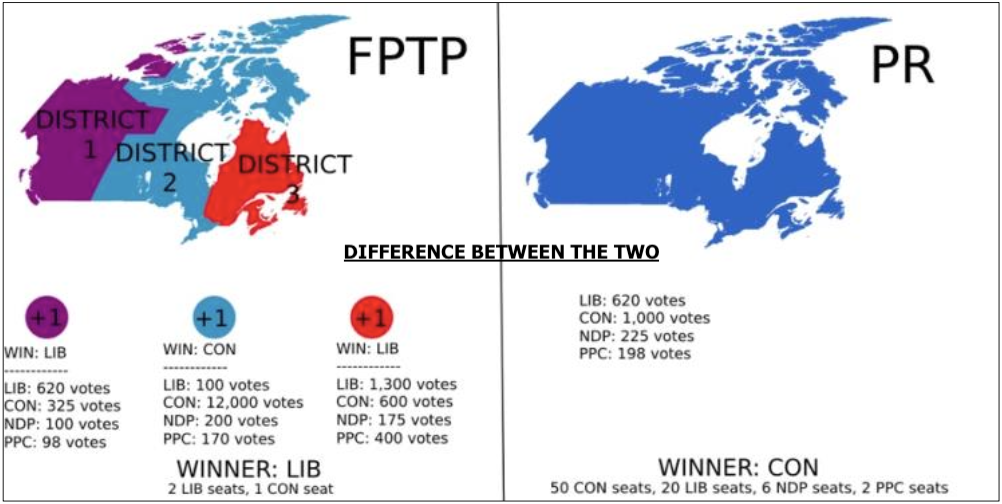
PR voting is the only system that can fully show representation in parliament properly. Why should a party with (for example) 500,000 votes get 0 seats, yet a party with 200,000 get 1 seat just because supporters of the small party are in a concentrated area? PR voting systems allocate seats based on the total percentage of votes each party receives across the entire electorate, rather than relying on geographical concentrations of support. This means that even smaller parties with widespread but less concentrated support can gain representation proportional to their share of the vote. As a result, PR voting ensures that every vote carries equal weight, reducing disparities and providing a more accurate reflection of the electorate's overall preferences in parliament. This system encourages a more diverse range of political voices and perspectives, leading to a richer and more inclusive democratic process. It also incentivizes parties to appeal to a broader segment of the population, promoting collaboration and coalition-building rather than divisive, winner-takes-all strategies. Furthermore, PR voting can increase voter engagement and turnout, as citizens feel that their vote is more likely to make a difference in the political landscape.
Canada is not a two-party system country, yet it is the same two parties that end up on top over and over again. If our politicians truly care for the people and our voices, then they should fight for a change to our system and introduce PR voting in all future elections and replace the FPTP system!
There is a need to replace the FPTP voting system with a fair system based on the simple principle: that parliament seats are closely matched to the level of support they receive throughout the country.
Join Canadians in urging our public servants to change the status quo in favour of a more fair and free election by signing this petition.
WE CALL ON ALL POLITICIANS IN OFFICE, TO PUT FORWARD MOTIONS TO CHANGE THE VOTING SYSTEM IN CANADA!

2
The Issue
PR voting is the future of Canada! This two-party feud we are letting into parliament with FPTP must end. It is vital that we allow our voices to be heard in our government, which cannot be achieved through our current FPTP system. PR voting allows smaller parties to enter the race, and provides a more diverse government. Taking the results of the 2021 election under a hypothetical proportional representation (PR) system, we would see more parties gaining voices in parliament. The NDP would win around 60 seats, the BLOC with 24, the PPC with 21, and the Greens with 11. A much more fair interpretation of the results compared to the ones we received during the 2021 election under our current FPTP system.
For years, the Liberals have used the FPTP system in order to remain in power and ensure that no changes are made to the government. Yet the FPTP system has shown itself to not represent the people to the fullest extent.
In 2021, 33.7% of the vote went to the CPC while 32.6% went to the Liberals, and yet the Liberals won the election. In that same year, the PPC won 4.9% of the vote while the Greens won only 2.3%. And yet, the Greens secured 2 seats while the PPC gained none. In 2019, we noticed the same results: The CPC won 34% and the Liberals had 33%, yet the Liberals won the election! FPTP in recent years no longer represents the government chosen by the people nor does it represent the seats in parliament by vote share. The world is changing, and with it so are the people.
Canadians do not care about our FPTP voting system, or the idea of voting for specific candidates. Canadians would rather vote for a party and look at the party's values as a whole rather than each individual candidate's personality. Canadians need a PR voting system in order to more fairly get the representation they want in Ottawa, and let the parties choose who they will send to Parliament. A perfect example is Maxime Bernier. Former CPC candidate and Parliamentarian, Maxime ran in the riding of Beauce, Quebec. From 2006-2015, Mr. Bernier won every time in that riding, always securing between 50-67% of the popular vote. Maxime Bernier was a very popular candidate, who even worked as a cabinet minister in the Harper government. Yet from the moment Bernier left the CPC, he no longer had the support he once had, and hasn't won in that riding since. What has changed? He is still the same man as he was, believing in the same values and traditions. Yet from the moment his party’s name changed, voters could not care less and betrayed Maxime Bernier. From a gain of at most 67% back in the CPC, Maxime only received 5.7% of the popular vote in his riding in 2025. This instant, and many more (throughout the 2025 elections, including candidates like Pierre Poilievre) have shown that Canadians do not care for an individual, they care about the party.
PR voting is the only system that can fully show representation in parliament properly. Why should a party with (for example) 500,000 votes get 0 seats, yet a party with 200,000 get 1 seat just because supporters of the small party are in a concentrated area? PR voting systems allocate seats based on the total percentage of votes each party receives across the entire electorate, rather than relying on geographical concentrations of support. This means that even smaller parties with widespread but less concentrated support can gain representation proportional to their share of the vote. As a result, PR voting ensures that every vote carries equal weight, reducing disparities and providing a more accurate reflection of the electorate's overall preferences in parliament. This system encourages a more diverse range of political voices and perspectives, leading to a richer and more inclusive democratic process. It also incentivizes parties to appeal to a broader segment of the population, promoting collaboration and coalition-building rather than divisive, winner-takes-all strategies. Furthermore, PR voting can increase voter engagement and turnout, as citizens feel that their vote is more likely to make a difference in the political landscape.
Canada is not a two-party system country, yet it is the same two parties that end up on top over and over again. If our politicians truly care for the people and our voices, then they should fight for a change to our system and introduce PR voting in all future elections and replace the FPTP system!
There is a need to replace the FPTP voting system with a fair system based on the simple principle: that parliament seats are closely matched to the level of support they receive throughout the country.
Join Canadians in urging our public servants to change the status quo in favour of a more fair and free election by signing this petition.
WE CALL ON ALL POLITICIANS IN OFFICE, TO PUT FORWARD MOTIONS TO CHANGE THE VOTING SYSTEM IN CANADA!
2
Petition Updates
Share this petition
Petition created on May 14, 2025