
We want to take a moment to update our community on recent developments and ongoing advocacy around endometriosis care in Ireland.
Since December, there have been a number of protests calling for change.
And while awareness is always important, it is equally important that advocacy is clear, informed, and strategically aligned.
Ireland now has a published Endometriosis Framework - something that took decades of tireless work by longstanding campaigners to achieve.
This framework was never intended to solve the crisis overnight, but it represents a critical foundation for progress.
The endometriosis crisis is global - not uniquely Irish.
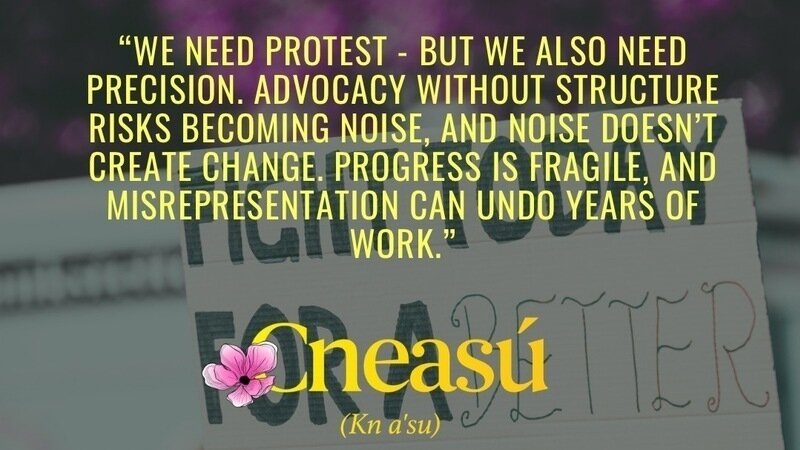
Real change requires both pressure and precision.
We are also seeing meaningful movement, including the introduction of the ESAIS interim scheme, which is helping to remove financial barriers for patients who previously could not access care abroad due to upfront costs.
These are not small developments - they matter.
Recent national media coverage, including reporting in the Irish Examiner, has highlighted advocacy activity led by specific organisations. While this brings important attention to the issue, it also raises questions around representation, inclusion, and whose voices are being platformed.
This is where clarity matters.
Endometriosis is complex.
There is no one-size-fits-all approach to care, and no single clinic or pathway that suits every patient.
It is essential that public information reflects this reality and is grounded in both lived experience and evidence-based understanding.
The ESAIS scheme is NOT “BS” that is misinformation!
We must also ask important questions about how advocacy is being carried out:
- Why are moments of active government dialogue not being strategically aligned with protest action?
- Where were these organisations during the nationwide public meetings resourced by Sinn Féin
- Where was the support for sharing this petition calling for a national inquiry?
- Where was the support in sharing events dedicated to the entire endometriosis community - not just a select few?
All voices need to be represented.
- Why are endometriosis organisations not consistently sharing all Irish endometriosis events with one another to ensure the community is fully informed?
- How many established known campaigners were invited to speak at a recent retreat in Kilkenny and the upcoming National Charity Endo Event in Dublin?
- How are advocates expected to know when protests and events are happening if they are being blocked, misrepresented, defamed, gossiped about, being humiliated by being shown private communications screenshots shared without informed consent or permission or excluded on social media platforms?
- Communication must be accessible and inclusive - relying solely on social media or direct messages is not sufficient.
- Important updates, invitations, and calls to action should also be shared through formal channels such as email, ensuring everyone has equal opportunity to engage.
On September 1st, at the first listening forum and then the launch of the Endometriosis Framework in October, this same organisation publicly welcomed the progress and gave mainstream media interviews then two months later were protesting against what they had just publicly welcomed.
On March 5th, another listening forum took place - yet engagement did not reflect the same visibility as protest action.
This is not about point-scoring - but it does need to be addressed.
The endometriosis community must be united, not divided.
It is also important to recognise that our national charity is not government-funded and does not represent all patients - particularly when members are not always informed of decisions made at board level.
The division within the community is increasingly visible.
And until all voices are represented - with transparency, inclusion, and consent -
there will continue to be noise, exclusion, and fragmentation.
We need a model of advocacy where every voice is respected, represented, and informed.
We also need to address conduct within the advocacy space itself.
How can inclusivity be claimed while anonymously posting untruths or defamatory content on social media, publicly sharing private messages to humiliate advocates, or using and replicating others’ work and events without credit - sometimes in ways that divide or undermine the community?
That is a double standard.
There are ways to build genuine inclusion:
- Reaching out to longstanding campaigners directly
- Being open to their knowledge, wisdom, and decades of experience
- Creating space for collaboration -not exclusion
- Communicating transparently through inclusive channels such as email - not relying solely on DMs or restricted platforms
Advocacy should never become about creating noise to build individual profiles while simultaneously excluding those who laid the foundations.
It is also deeply concerning when newer organisations - some only recently established - are positioned publicly in ways that can appear to represent or take credit for work built over decades by others.
That kind of narrative, whether intentional or not, risks enabling a culture of poor accountability, lack of vetting, and the silencing of experienced voices.
Advocacy must be inclusive, collaborative, and accountable.
We fully support the right to protest and the need to hold systems accountable.
But without clear structure, unified messaging, and accurate representation, there is a risk that efforts become counterproductive and confusing for those most in need of support.
Now more than ever, we need to come together - to build on progress, not fracture it.
Because real change happens when lived experience, expertise, and community are working in alignment.
Support the petition and help ensure advocacy remains informed, inclusive, and effective: