
Investigate misconduct in chess tournaments
The Issue
PETITION FOR A FAIR INQUIRY INTO REPEATED INCIDENTS INVOLVING MR. SEKHAR CHETTY AND FOR SAFEGUARDS AT CHESS TOURNAMENTS
Addressed to:
Karnataka State Chess Association (KSCA)
Bangalore Urban District Chess Association (BUDCA)
All India Chess Federation (AICF)
Tournament Organisers, Arbiters and other concerned chess authorities
Let Chess Remain About Chess
I, Sushruta Reddy, am placing this petition before the chess community and the competent chess authorities because I believe a point has been reached where a series of incidents involving Mr. Sekhar Chetty, a chess parent, require formal and impartial institutional examination.
I have been associated with chess for many years as a player, trainer, organiser and arbiter.
Disagreements are inevitable in chess.
Parents may disagree with organisers. Players may question arbiters. Organisers may be criticised. Complaints may be made and decisions may be challenged.
There is nothing inherently wrong with any of this.
But there must be boundaries.
A disagreement arising from chess should not, in my view, develop into repeated public statements concerning someone's private life, spouse, parents, marriage, sexuality, fertility or other deeply personal matters having no apparent connection with the original chess dispute.
That is why I am asking the chess authorities to intervene.
I want to state something clearly at the outset:
This petition is not asking the public to declare Mr. Sekhar Chetty guilty of anything.
It is a request to the competent chess authorities to examine the circumstances, hear the persons concerned, consider the history of the incidents and decide whether intervention or preventive safeguards are necessary.
1. A Facebook Post That Raises Serious Concerns
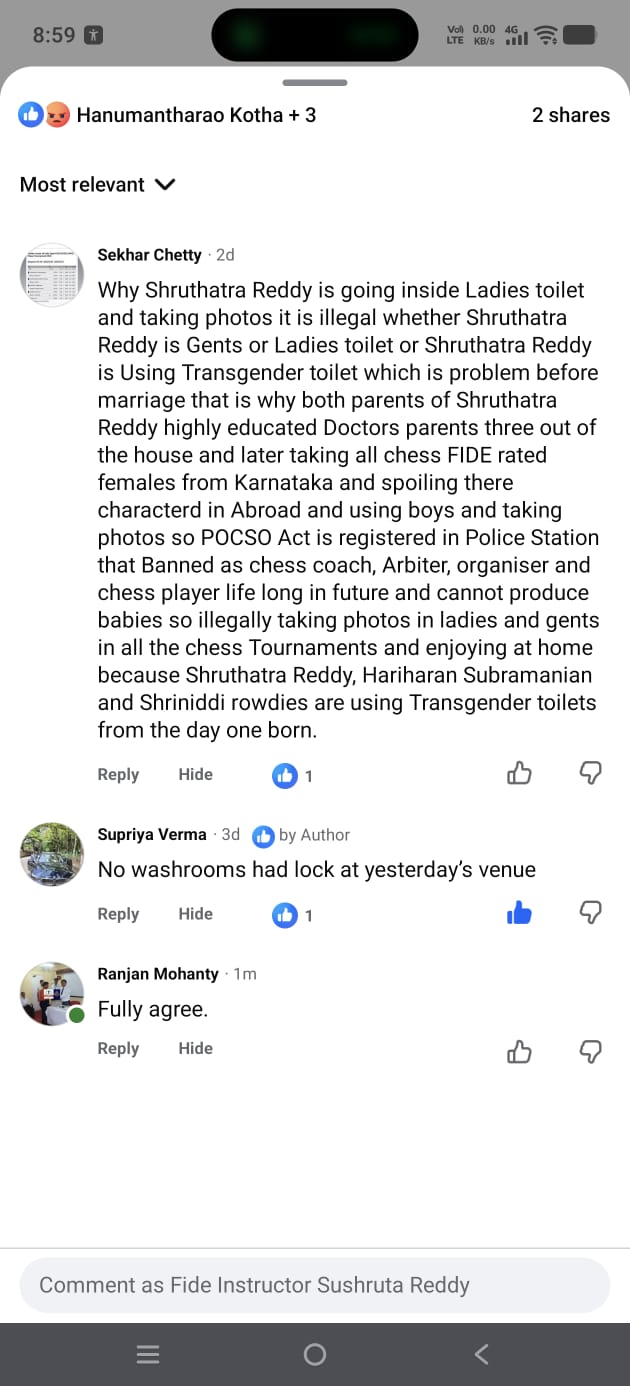
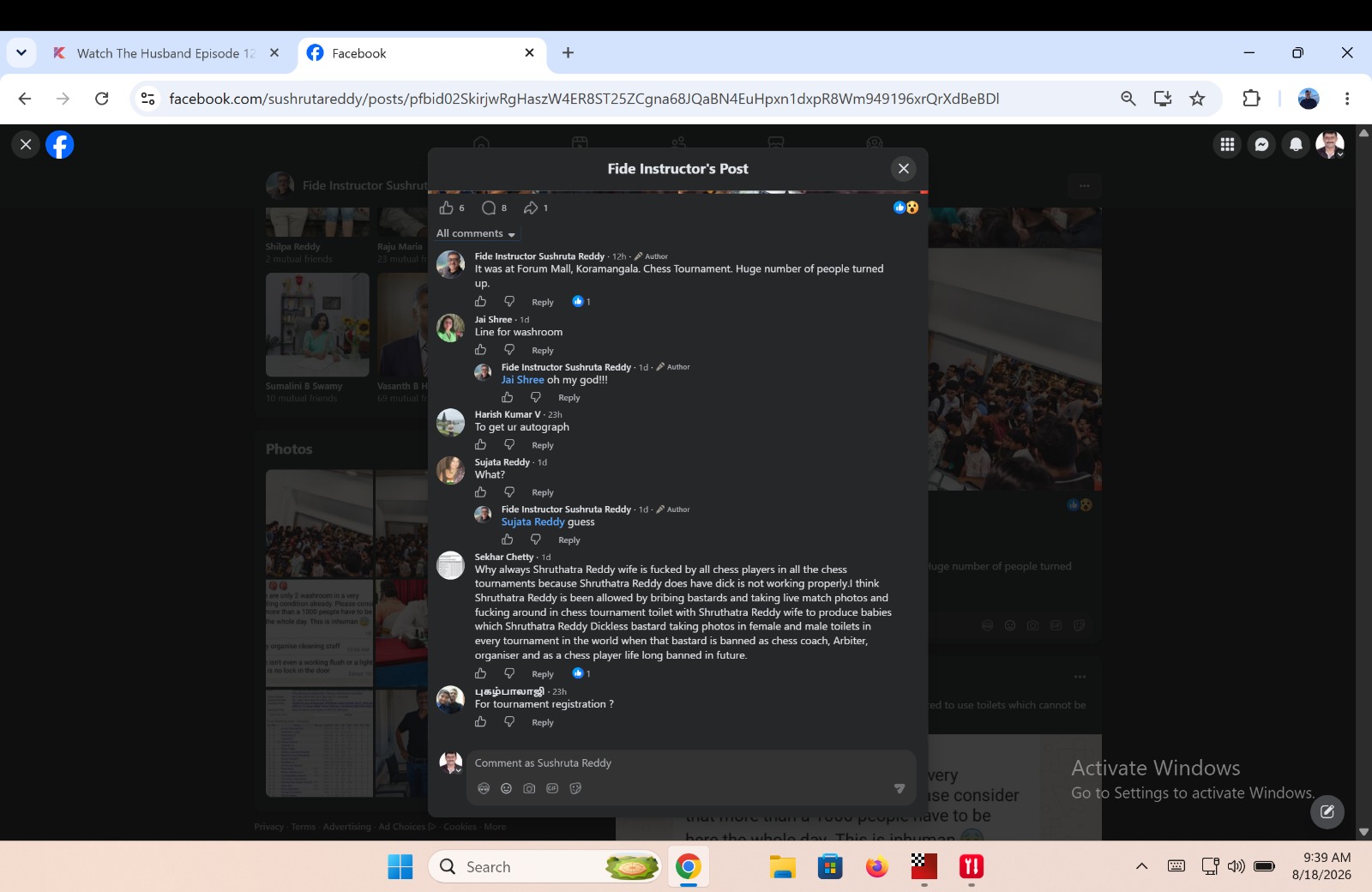
I am attaching to this petition a screenshot of a publicly visible Facebook comment appearing under the name “Sekhar Chetty.”
I believe the contents of this comment deserve the attention of KSCA, BUDCA, AICF and tournament organisers.
The comment contains a series of extremely serious and personal statements concerning me.
Among other things, the comment alleges that I enter women's toilets and take photographs.
It makes repeated references to women's, men's and transgender toilets.
It refers to my marriage and my parents.
It makes allegations concerning female chess players and boys.
It refers to the POCSO Act and a police station.
It speaks about my supposedly being banned from activities as a chess coach, arbiter, organiser and player.
It even contains remarks concerning my ability to have children.
The same comment names other persons from the chess community and uses derogatory terminology while making further statements concerning gender and toilets.
I believe there is a fundamental question for the chess authorities:
Is this an acceptable manner in which differences arising within the chess community should be conducted?
I am attaching the screenshot itself so that the authorities and readers of this petition can see the communication in its actual form rather than relying solely on my description of it.
2. Criticism Has a Place. Personal Vilification Should Not.
Nobody involved in organising chess should expect to be beyond criticism.
If I make a poor decision as an organiser, people are entitled to criticise me.
If somebody believes that an arbiter's decision is incorrect, they may question it through the appropriate process.
If a parent disagrees with the conduct of a tournament, that parent is entitled to raise a grievance.
Strong disagreement itself is not the problem.
The concern arises when a chess-related disagreement begins extending into allegations and comments concerning an individual's family, marriage, parents, sexuality, fertility or other aspects of private life.
There must surely be a distinction between:
criticising somebody's conduct in chess
and
turning that disagreement into a deeply personal public attack.
The latter has consequences extending far beyond the tournament hall.
3. HSR Layout Police Station — 1 May 2024
My concerns do not arise from one Facebook comment alone.
On 1 May 2024, I was required to report to HSR Layout Police Station following a complaint made by Mr. Sekhar Chetty.
The circumstances arose from matters connected with a chess tournament, including an issue concerning the publication of a list by the Chief Arbiter, Mr. Murugasundaram.
A disagreement connected with the administration of a chess event had therefore reached the stage where I was required to attend a police station.
I mention this because it forms part of the broader history that I believe the chess authorities should consider when determining whether steps are required to prevent further escalation.
4. Incident at Koramangala Indoor Stadium
There was another incident connected with a tournament conducted at Koramangala Indoor Stadium.
During that episode, I allege that Mr. Sekhar Chetty used abusive language towards me.
Part of the interaction occurred in the presence of a police official associated with Koramangala Police Station.
I believe incidents taking place within or around chess tournament venues deserve particular attention because tournament halls are shared spaces involving children, parents, players, arbiters and organisers.
Whatever disagreements individuals may have outside chess, they should not be allowed to repeatedly disrupt the atmosphere of tournaments.
5. Mobile-Phone Incident and Bellandur Police
There was separately an incident concerning my mobile phone involving Mr. Sekhar Chetty.
The circumstances eventually came before Bellandur Police.
During the interaction, I allege that Mr. Chetty behaved abusively.
Once again, the reason I mention this is not to ask the public to adjudicate what occurred.
It is to demonstrate why I believe the situation has developed beyond an isolated disagreement between two people within chess.
When separate disputes repeatedly involve tournament venues, public allegations and interaction with police authorities, it is reasonable to ask whether the chess administration should intervene to establish boundaries.
6. Why Is My Wife Being Brought Into a Chess Dispute?
One aspect concerns me particularly.
My wife has been brought into matters despite having no role whatsoever in these chess disputes.
She is not responsible for my decisions as an organiser.
She is not responsible for my decisions as an arbiter.
She is not responsible for tournament administration.
She is not involved in the disagreements between Mr. Sekhar Chetty and me.
Whatever criticism anybody has against me should be directed at me.
If the grievance is against me, question me.
If somebody disagrees with my conduct, challenge me.
If somebody wishes to complain against me, use the appropriate forum.
But an uninvolved spouse should not become part of a dispute simply because she happens to be married to the person with whom somebody has a disagreement.
I respectfully request the chess authorities to consider whether bringing spouses and other uninvolved family members into chess-related disputes should itself be regarded as inappropriate conduct.
My family should not become collateral damage in a chess dispute.
7. What Do My Parents, Marriage and Fertility Have to Do With Chess?
The Facebook comment shown in the attached screenshot contains references to my parents, my marriage and whether I can have children.
I struggle to understand how any of these matters are relevant to chess.
If somebody disagrees with a tournament decision, discuss the tournament decision.
If somebody objects to my conduct as an organiser, discuss that conduct.
If somebody has a dispute with me personally, address me.
But my parents are not participants in that dispute.
My wife is not responsible for it.
My ability or inability to have children has absolutely nothing to do with the administration of chess.
There should be a basic boundary between legitimate criticism and intrusion into someone's private life.
8. References to Gender and Transgender Persons
The Facebook comment also repeatedly uses references to transgender toilets and makes statements connecting named individuals with transgender identity or facilities.
Irrespective of whatever disagreement exists between individuals, references to gender identity should not be used as insults or as a means of humiliating somebody publicly.
Chess should be welcoming to everyone.
A person's actual or alleged gender identity has no legitimate place as a weapon in an argument.
I believe chess bodies should make it clear that disagreements must be conducted without degrading references based on gender, sexuality or similar personal characteristics.
9. Serious Criminal Terminology Should Not Become Part of Casual Social-Media Warfare
The Facebook comment also invokes the POCSO Act.
That is an exceptionally serious law intended to protect children from sexual offences.
References of this nature can have profound consequences for the reputation of the person being named.
Whether somebody likes or dislikes an organiser, coach, player or arbiter, extremely serious criminal terminology should not become another instrument in a social-media quarrel.
The chess community needs standards governing how disputes involving its participants are communicated.
10. Public Allegations Can Create Lasting Stigma
There is a wider problem here.
Repeated publication of serious allegations can create a stigma around an individual long before any competent institution has reached a conclusion.
A person scrolling through Facebook may see an accusation and remember it for years.
Students may see it.
Parents may see it.
Tournament organisers may see it.
Professional colleagues may see it.
Family members may see it.
The accusation travels much faster than any eventual explanation.
This is precisely why sporting communities need proper grievance and disciplinary mechanisms.
Disputes should not be decided by whichever person publishes the most inflammatory post.
11. Independent Witnesses and Tournament Officials
Where Chief Arbiter Mr. Saleem Beig, Chief Arbiter Mr. Murugasundaram, tournament organisers, arbiters, parents, players, volunteers or police personnel have direct knowledge concerning relevant incidents, I request that the competent authority speak to them as part of any inquiry it considers appropriate.
I am not asking anybody to take my side.
Nor should anybody automatically take Mr. Chetty's side.
The purpose should be to understand what has been happening and, more importantly, determine how similar situations can be prevented in the future.
12. This Is Bigger Than Sushruta Reddy Versus Sekhar Chetty
It would be very easy to describe everything as a personal dispute between two individuals.
But that misses the larger question.
Chess tournaments involve hundreds, and sometimes thousands, of people.
A very large percentage of them are children.
Parents, coaches, organisers and arbiters will inevitably disagree.
A healthy chess ecosystem must therefore have mechanisms that prevent disagreements from escalating indefinitely into personal hostility.
Otherwise every administrative disagreement risks becoming:
a WhatsApp fight,
then a Facebook fight,
then a confrontation at a tournament,
then a police matter,
and then another public controversy.
That cycle benefits nobody.
13. Children Are Watching How Adults Behave
Children spend enormous amounts of time at chess tournaments.
They observe much more than the chessboard.
They observe how parents behave.
They observe how organisers handle pressure.
They observe how arbiters respond to criticism.
They observe how adults deal with people they dislike.
What lesson do we want them to learn?
That disagreement justifies humiliation?
That somebody's spouse becomes fair game?
That parents and private lives can be dragged into arguments?
Or that disagreements can be intense while boundaries are still respected?
Chess teaches children discipline, calculation and responsibility for their decisions.
The adults surrounding them should demonstrate the same qualities.
14. Should Tournament Organisers Wait Until the Next Incident?
I respectfully ask KSCA, BUDCA, AICF and tournament organisers to consider another important question.
Where there is a history of repeated confrontation involving certain individuals, should organisers simply wait until the next confrontation happens?
Or should reasonable precautions be permitted?
I am not asking for an automatic or permanent ban on Mr. Sekhar Chetty.
That would be a serious measure and should not be imposed casually.
But there are many safeguards available short of a ban.
For example, tournament authorities could consider:
directing individuals with an ongoing dispute not to approach one another;
requiring grievances to be submitted to the Chief Arbiter or Tournament Director;
establishing a designated grievance officer;
ensuring that disputes are documented;
restricting access to playing areas where appropriate;
issuing warnings where behavioural boundaries are crossed; and
considering proportionate restrictions in particularly serious or repeated cases after an appropriate process.
The objective should not be punishment for its own sake.
The objective should be preventing the next confrontation.
15. A Code of Conduct Is Needed for Everyone
Chess regulations often concentrate heavily on players and arbiters.
But tournament environments include many other people:
parents,
coaches,
spectators,
organisers,
volunteers,
officials,
and visitors.
Everyone entering a tournament venue should understand that certain behavioural standards apply.
I therefore request the chess authorities to establish or strengthen a clear Code of Conduct covering all persons attending chess events.
Such a code should address:
abusive behaviour;
harassment;
intimidation;
confrontations at venues;
personal attacks;
involvement of uninvolved family members;
discriminatory or degrading language;
responsible use of social media in relation to tournament disputes; and
procedures for formally raising grievances.
Clear rules protect everybody.
16. What I Am Asking KSCA, BUDCA and AICF to Do
I respectfully request the Karnataka State Chess Association, Bangalore Urban District Chess Association and All India Chess Federation to:
Take cognisance of the pattern of incidents described in this petition.
Examine the Facebook communication appearing under the name Sekhar Chetty and consider whether such communication is compatible with standards expected within the chess community.
Hear Mr. Sekhar Chetty's version before reaching any conclusion.
Give me an opportunity to place my version before the competent authority.
Consider the history of incidents involving HSR Layout Police Station, Koramangala Indoor Stadium and Bellandur Police.
Speak to independent tournament officials or other persons who witnessed relevant incidents wherever appropriate.
Examine the appropriateness of spouses, parents and other uninvolved family members being brought into chess-related disputes.
Consider whether deeply personal, sexual, gender-related or family-related comments have any place in public disputes arising from chess.
Establish or strengthen a Code of Conduct applicable to players, parents, coaches, organisers, arbiters, spectators and visitors.
Establish a clear grievance-redressal mechanism at tournaments.
Develop procedures for managing individuals who have a history of serious interpersonal conflict.
Permit proportionate preventive safeguards where circumstances warrant them.
Ensure that tournament halls remain safe and dignified environments, particularly for children.
Communicate clear behavioural expectations to everyone participating in organised chess.
17. What This Petition Is NOT Asking For
This petition is not asking people to abuse Mr. Sekhar Chetty.
It is not asking for retaliation.
It is not asking for mob justice.
It is not asking signatories to determine who is legally right or wrong.
It is not demanding an automatic lifetime ban.
And it is not asking social media to become a courtroom.
What I am asking for is institutional responsibility.
When conflicts repeatedly spill into tournament environments and public personal attacks, the governing bodies should not simply look away.
18. The Same Standards Should Apply to Everyone — Including Me
The standards I am requesting should apply equally to me.
If I behave abusively at a tournament, the rules should apply to me.
If I violate a code of conduct, the rules should apply to me.
If another parent believes I have crossed a boundary, there should be a mechanism through which that complaint can be addressed.
This petition is not about creating one set of rules for Sushruta Reddy and another for somebody else.
It is about creating one standard for everybody.
19. Why This Matters to Me Personally
Chess has been a significant part of my life.
Tournament halls should be places where children compete, parents support them, arbiters perform their duties and organisers try to conduct events successfully.
Repeated confrontation changes that atmosphere.
Public allegations change it further.
And when uninvolved spouses, parents and extremely personal aspects of somebody's life start being dragged into those disagreements, a boundary has been crossed that the chess community should at least be willing to discuss.
I do not want another confrontation.
I do not want another social-media war.
I want proper boundaries.
20. Let the Battles Remain on the 64 Squares
Chess is built around disagreement.
Two players sit opposite each other looking at exactly the same position and reaching completely different conclusions.
For several hours, each tries to prove the other wrong.
And yet the contest has rules.
There are boundaries.
That is precisely why the battle works.
Our disagreements outside the chessboard need boundaries too.
We can criticise each other.
We can challenge each other.
We can complain.
We can disagree fiercely.
But someone's wife should not become part of the battle.
Someone's parents should not become part of it.
Someone's fertility should certainly not become part of it.
And gender identity should never become an insult.
Chess gives us 64 squares on which to fight as fiercely as we want.
Our families and private lives should not become the 65th.
PLEASE SIGN THIS PETITION
By signing this petition, you are not taking sides in a personal dispute.
You are supporting a call for:
Respectful disagreement.
Accountability.
Institutional intervention when conflicts repeatedly escalate.
Protection of uninvolved spouses and family members.
Clear behavioural standards.
A proper grievance mechanism.
And safer, more dignified chess tournaments for everyone.
I respectfully call upon KSCA, BUDCA, AICF and tournament organisers to examine these concerns and take appropriate steps to prevent further escalation.
Let criticism remain legitimate.
Let disagreements remain possible.
But let there also be boundaries.
Let families remain outside chess disputes.
And let the battles remain on the chessboard.
— Sushruta Reddy
Supporting screenshot
Annexure 1: Screenshot of the publicly visible Facebook comment appearing under the name “Sekhar Chetty”, containing the statements referred to in this petition.

30
The Issue
PETITION FOR A FAIR INQUIRY INTO REPEATED INCIDENTS INVOLVING MR. SEKHAR CHETTY AND FOR SAFEGUARDS AT CHESS TOURNAMENTS
Addressed to:
Karnataka State Chess Association (KSCA)
Bangalore Urban District Chess Association (BUDCA)
All India Chess Federation (AICF)
Tournament Organisers, Arbiters and other concerned chess authorities
Let Chess Remain About Chess
I, Sushruta Reddy, am placing this petition before the chess community and the competent chess authorities because I believe a point has been reached where a series of incidents involving Mr. Sekhar Chetty, a chess parent, require formal and impartial institutional examination.
I have been associated with chess for many years as a player, trainer, organiser and arbiter.
Disagreements are inevitable in chess.
Parents may disagree with organisers. Players may question arbiters. Organisers may be criticised. Complaints may be made and decisions may be challenged.
There is nothing inherently wrong with any of this.
But there must be boundaries.
A disagreement arising from chess should not, in my view, develop into repeated public statements concerning someone's private life, spouse, parents, marriage, sexuality, fertility or other deeply personal matters having no apparent connection with the original chess dispute.
That is why I am asking the chess authorities to intervene.
I want to state something clearly at the outset:
This petition is not asking the public to declare Mr. Sekhar Chetty guilty of anything.
It is a request to the competent chess authorities to examine the circumstances, hear the persons concerned, consider the history of the incidents and decide whether intervention or preventive safeguards are necessary.
1. A Facebook Post That Raises Serious Concerns
I am attaching to this petition a screenshot of a publicly visible Facebook comment appearing under the name “Sekhar Chetty.”
I believe the contents of this comment deserve the attention of KSCA, BUDCA, AICF and tournament organisers.
The comment contains a series of extremely serious and personal statements concerning me.
Among other things, the comment alleges that I enter women's toilets and take photographs.
It makes repeated references to women's, men's and transgender toilets.
It refers to my marriage and my parents.
It makes allegations concerning female chess players and boys.
It refers to the POCSO Act and a police station.
It speaks about my supposedly being banned from activities as a chess coach, arbiter, organiser and player.
It even contains remarks concerning my ability to have children.
The same comment names other persons from the chess community and uses derogatory terminology while making further statements concerning gender and toilets.
I believe there is a fundamental question for the chess authorities:
Is this an acceptable manner in which differences arising within the chess community should be conducted?
I am attaching the screenshot itself so that the authorities and readers of this petition can see the communication in its actual form rather than relying solely on my description of it.
2. Criticism Has a Place. Personal Vilification Should Not.
Nobody involved in organising chess should expect to be beyond criticism.
If I make a poor decision as an organiser, people are entitled to criticise me.
If somebody believes that an arbiter's decision is incorrect, they may question it through the appropriate process.
If a parent disagrees with the conduct of a tournament, that parent is entitled to raise a grievance.
Strong disagreement itself is not the problem.
The concern arises when a chess-related disagreement begins extending into allegations and comments concerning an individual's family, marriage, parents, sexuality, fertility or other aspects of private life.
There must surely be a distinction between:
criticising somebody's conduct in chess
and
turning that disagreement into a deeply personal public attack.
The latter has consequences extending far beyond the tournament hall.
3. HSR Layout Police Station — 1 May 2024
My concerns do not arise from one Facebook comment alone.
On 1 May 2024, I was required to report to HSR Layout Police Station following a complaint made by Mr. Sekhar Chetty.
The circumstances arose from matters connected with a chess tournament, including an issue concerning the publication of a list by the Chief Arbiter, Mr. Murugasundaram.
A disagreement connected with the administration of a chess event had therefore reached the stage where I was required to attend a police station.
I mention this because it forms part of the broader history that I believe the chess authorities should consider when determining whether steps are required to prevent further escalation.
4. Incident at Koramangala Indoor Stadium
There was another incident connected with a tournament conducted at Koramangala Indoor Stadium.
During that episode, I allege that Mr. Sekhar Chetty used abusive language towards me.
Part of the interaction occurred in the presence of a police official associated with Koramangala Police Station.
I believe incidents taking place within or around chess tournament venues deserve particular attention because tournament halls are shared spaces involving children, parents, players, arbiters and organisers.
Whatever disagreements individuals may have outside chess, they should not be allowed to repeatedly disrupt the atmosphere of tournaments.
5. Mobile-Phone Incident and Bellandur Police
There was separately an incident concerning my mobile phone involving Mr. Sekhar Chetty.
The circumstances eventually came before Bellandur Police.
During the interaction, I allege that Mr. Chetty behaved abusively.
Once again, the reason I mention this is not to ask the public to adjudicate what occurred.
It is to demonstrate why I believe the situation has developed beyond an isolated disagreement between two people within chess.
When separate disputes repeatedly involve tournament venues, public allegations and interaction with police authorities, it is reasonable to ask whether the chess administration should intervene to establish boundaries.
6. Why Is My Wife Being Brought Into a Chess Dispute?
One aspect concerns me particularly.
My wife has been brought into matters despite having no role whatsoever in these chess disputes.
She is not responsible for my decisions as an organiser.
She is not responsible for my decisions as an arbiter.
She is not responsible for tournament administration.
She is not involved in the disagreements between Mr. Sekhar Chetty and me.
Whatever criticism anybody has against me should be directed at me.
If the grievance is against me, question me.
If somebody disagrees with my conduct, challenge me.
If somebody wishes to complain against me, use the appropriate forum.
But an uninvolved spouse should not become part of a dispute simply because she happens to be married to the person with whom somebody has a disagreement.
I respectfully request the chess authorities to consider whether bringing spouses and other uninvolved family members into chess-related disputes should itself be regarded as inappropriate conduct.
My family should not become collateral damage in a chess dispute.
7. What Do My Parents, Marriage and Fertility Have to Do With Chess?
The Facebook comment shown in the attached screenshot contains references to my parents, my marriage and whether I can have children.
I struggle to understand how any of these matters are relevant to chess.
If somebody disagrees with a tournament decision, discuss the tournament decision.
If somebody objects to my conduct as an organiser, discuss that conduct.
If somebody has a dispute with me personally, address me.
But my parents are not participants in that dispute.
My wife is not responsible for it.
My ability or inability to have children has absolutely nothing to do with the administration of chess.
There should be a basic boundary between legitimate criticism and intrusion into someone's private life.
8. References to Gender and Transgender Persons
The Facebook comment also repeatedly uses references to transgender toilets and makes statements connecting named individuals with transgender identity or facilities.
Irrespective of whatever disagreement exists between individuals, references to gender identity should not be used as insults or as a means of humiliating somebody publicly.
Chess should be welcoming to everyone.
A person's actual or alleged gender identity has no legitimate place as a weapon in an argument.
I believe chess bodies should make it clear that disagreements must be conducted without degrading references based on gender, sexuality or similar personal characteristics.
9. Serious Criminal Terminology Should Not Become Part of Casual Social-Media Warfare
The Facebook comment also invokes the POCSO Act.
That is an exceptionally serious law intended to protect children from sexual offences.
References of this nature can have profound consequences for the reputation of the person being named.
Whether somebody likes or dislikes an organiser, coach, player or arbiter, extremely serious criminal terminology should not become another instrument in a social-media quarrel.
The chess community needs standards governing how disputes involving its participants are communicated.
10. Public Allegations Can Create Lasting Stigma
There is a wider problem here.
Repeated publication of serious allegations can create a stigma around an individual long before any competent institution has reached a conclusion.
A person scrolling through Facebook may see an accusation and remember it for years.
Students may see it.
Parents may see it.
Tournament organisers may see it.
Professional colleagues may see it.
Family members may see it.
The accusation travels much faster than any eventual explanation.
This is precisely why sporting communities need proper grievance and disciplinary mechanisms.
Disputes should not be decided by whichever person publishes the most inflammatory post.
11. Independent Witnesses and Tournament Officials
Where Chief Arbiter Mr. Saleem Beig, Chief Arbiter Mr. Murugasundaram, tournament organisers, arbiters, parents, players, volunteers or police personnel have direct knowledge concerning relevant incidents, I request that the competent authority speak to them as part of any inquiry it considers appropriate.
I am not asking anybody to take my side.
Nor should anybody automatically take Mr. Chetty's side.
The purpose should be to understand what has been happening and, more importantly, determine how similar situations can be prevented in the future.
12. This Is Bigger Than Sushruta Reddy Versus Sekhar Chetty
It would be very easy to describe everything as a personal dispute between two individuals.
But that misses the larger question.
Chess tournaments involve hundreds, and sometimes thousands, of people.
A very large percentage of them are children.
Parents, coaches, organisers and arbiters will inevitably disagree.
A healthy chess ecosystem must therefore have mechanisms that prevent disagreements from escalating indefinitely into personal hostility.
Otherwise every administrative disagreement risks becoming:
a WhatsApp fight,
then a Facebook fight,
then a confrontation at a tournament,
then a police matter,
and then another public controversy.
That cycle benefits nobody.
13. Children Are Watching How Adults Behave
Children spend enormous amounts of time at chess tournaments.
They observe much more than the chessboard.
They observe how parents behave.
They observe how organisers handle pressure.
They observe how arbiters respond to criticism.
They observe how adults deal with people they dislike.
What lesson do we want them to learn?
That disagreement justifies humiliation?
That somebody's spouse becomes fair game?
That parents and private lives can be dragged into arguments?
Or that disagreements can be intense while boundaries are still respected?
Chess teaches children discipline, calculation and responsibility for their decisions.
The adults surrounding them should demonstrate the same qualities.
14. Should Tournament Organisers Wait Until the Next Incident?
I respectfully ask KSCA, BUDCA, AICF and tournament organisers to consider another important question.
Where there is a history of repeated confrontation involving certain individuals, should organisers simply wait until the next confrontation happens?
Or should reasonable precautions be permitted?
I am not asking for an automatic or permanent ban on Mr. Sekhar Chetty.
That would be a serious measure and should not be imposed casually.
But there are many safeguards available short of a ban.
For example, tournament authorities could consider:
directing individuals with an ongoing dispute not to approach one another;
requiring grievances to be submitted to the Chief Arbiter or Tournament Director;
establishing a designated grievance officer;
ensuring that disputes are documented;
restricting access to playing areas where appropriate;
issuing warnings where behavioural boundaries are crossed; and
considering proportionate restrictions in particularly serious or repeated cases after an appropriate process.
The objective should not be punishment for its own sake.
The objective should be preventing the next confrontation.
15. A Code of Conduct Is Needed for Everyone
Chess regulations often concentrate heavily on players and arbiters.
But tournament environments include many other people:
parents,
coaches,
spectators,
organisers,
volunteers,
officials,
and visitors.
Everyone entering a tournament venue should understand that certain behavioural standards apply.
I therefore request the chess authorities to establish or strengthen a clear Code of Conduct covering all persons attending chess events.
Such a code should address:
abusive behaviour;
harassment;
intimidation;
confrontations at venues;
personal attacks;
involvement of uninvolved family members;
discriminatory or degrading language;
responsible use of social media in relation to tournament disputes; and
procedures for formally raising grievances.
Clear rules protect everybody.
16. What I Am Asking KSCA, BUDCA and AICF to Do
I respectfully request the Karnataka State Chess Association, Bangalore Urban District Chess Association and All India Chess Federation to:
Take cognisance of the pattern of incidents described in this petition.
Examine the Facebook communication appearing under the name Sekhar Chetty and consider whether such communication is compatible with standards expected within the chess community.
Hear Mr. Sekhar Chetty's version before reaching any conclusion.
Give me an opportunity to place my version before the competent authority.
Consider the history of incidents involving HSR Layout Police Station, Koramangala Indoor Stadium and Bellandur Police.
Speak to independent tournament officials or other persons who witnessed relevant incidents wherever appropriate.
Examine the appropriateness of spouses, parents and other uninvolved family members being brought into chess-related disputes.
Consider whether deeply personal, sexual, gender-related or family-related comments have any place in public disputes arising from chess.
Establish or strengthen a Code of Conduct applicable to players, parents, coaches, organisers, arbiters, spectators and visitors.
Establish a clear grievance-redressal mechanism at tournaments.
Develop procedures for managing individuals who have a history of serious interpersonal conflict.
Permit proportionate preventive safeguards where circumstances warrant them.
Ensure that tournament halls remain safe and dignified environments, particularly for children.
Communicate clear behavioural expectations to everyone participating in organised chess.
17. What This Petition Is NOT Asking For
This petition is not asking people to abuse Mr. Sekhar Chetty.
It is not asking for retaliation.
It is not asking for mob justice.
It is not asking signatories to determine who is legally right or wrong.
It is not demanding an automatic lifetime ban.
And it is not asking social media to become a courtroom.
What I am asking for is institutional responsibility.
When conflicts repeatedly spill into tournament environments and public personal attacks, the governing bodies should not simply look away.
18. The Same Standards Should Apply to Everyone — Including Me
The standards I am requesting should apply equally to me.
If I behave abusively at a tournament, the rules should apply to me.
If I violate a code of conduct, the rules should apply to me.
If another parent believes I have crossed a boundary, there should be a mechanism through which that complaint can be addressed.
This petition is not about creating one set of rules for Sushruta Reddy and another for somebody else.
It is about creating one standard for everybody.
19. Why This Matters to Me Personally
Chess has been a significant part of my life.
Tournament halls should be places where children compete, parents support them, arbiters perform their duties and organisers try to conduct events successfully.
Repeated confrontation changes that atmosphere.
Public allegations change it further.
And when uninvolved spouses, parents and extremely personal aspects of somebody's life start being dragged into those disagreements, a boundary has been crossed that the chess community should at least be willing to discuss.
I do not want another confrontation.
I do not want another social-media war.
I want proper boundaries.
20. Let the Battles Remain on the 64 Squares
Chess is built around disagreement.
Two players sit opposite each other looking at exactly the same position and reaching completely different conclusions.
For several hours, each tries to prove the other wrong.
And yet the contest has rules.
There are boundaries.
That is precisely why the battle works.
Our disagreements outside the chessboard need boundaries too.
We can criticise each other.
We can challenge each other.
We can complain.
We can disagree fiercely.
But someone's wife should not become part of the battle.
Someone's parents should not become part of it.
Someone's fertility should certainly not become part of it.
And gender identity should never become an insult.
Chess gives us 64 squares on which to fight as fiercely as we want.
Our families and private lives should not become the 65th.
PLEASE SIGN THIS PETITION
By signing this petition, you are not taking sides in a personal dispute.
You are supporting a call for:
Respectful disagreement.
Accountability.
Institutional intervention when conflicts repeatedly escalate.
Protection of uninvolved spouses and family members.
Clear behavioural standards.
A proper grievance mechanism.
And safer, more dignified chess tournaments for everyone.
I respectfully call upon KSCA, BUDCA, AICF and tournament organisers to examine these concerns and take appropriate steps to prevent further escalation.
Let criticism remain legitimate.
Let disagreements remain possible.
But let there also be boundaries.
Let families remain outside chess disputes.
And let the battles remain on the chessboard.
— Sushruta Reddy
Supporting screenshot
Annexure 1: Screenshot of the publicly visible Facebook comment appearing under the name “Sekhar Chetty”, containing the statements referred to in this petition.
Petition Updates
Share this petition
Petition created on 27 August 2026