

Include diverse gender & sexual identities in English language textbooks (Adult ESOL)
The Issue
With an estimated 2 billion speakers, a quarter of the world's population, English is the most spoken language in the world. The growing majority (about 1.6 billion) of those people are non-native speakers or English Language Learners (ELLs) who are acquiring English as a second or other language (source). In 2020, an estimated 4.9 million children in American public schools were ELLs; behind each of those children are parents and other adult relatives who are also learning English. These numbers have grown exponentially in the past decade (source). Furthermore, behind every language learner, there is a teacher-- often one who is looking for the best and most inclusive materials to use with their students.
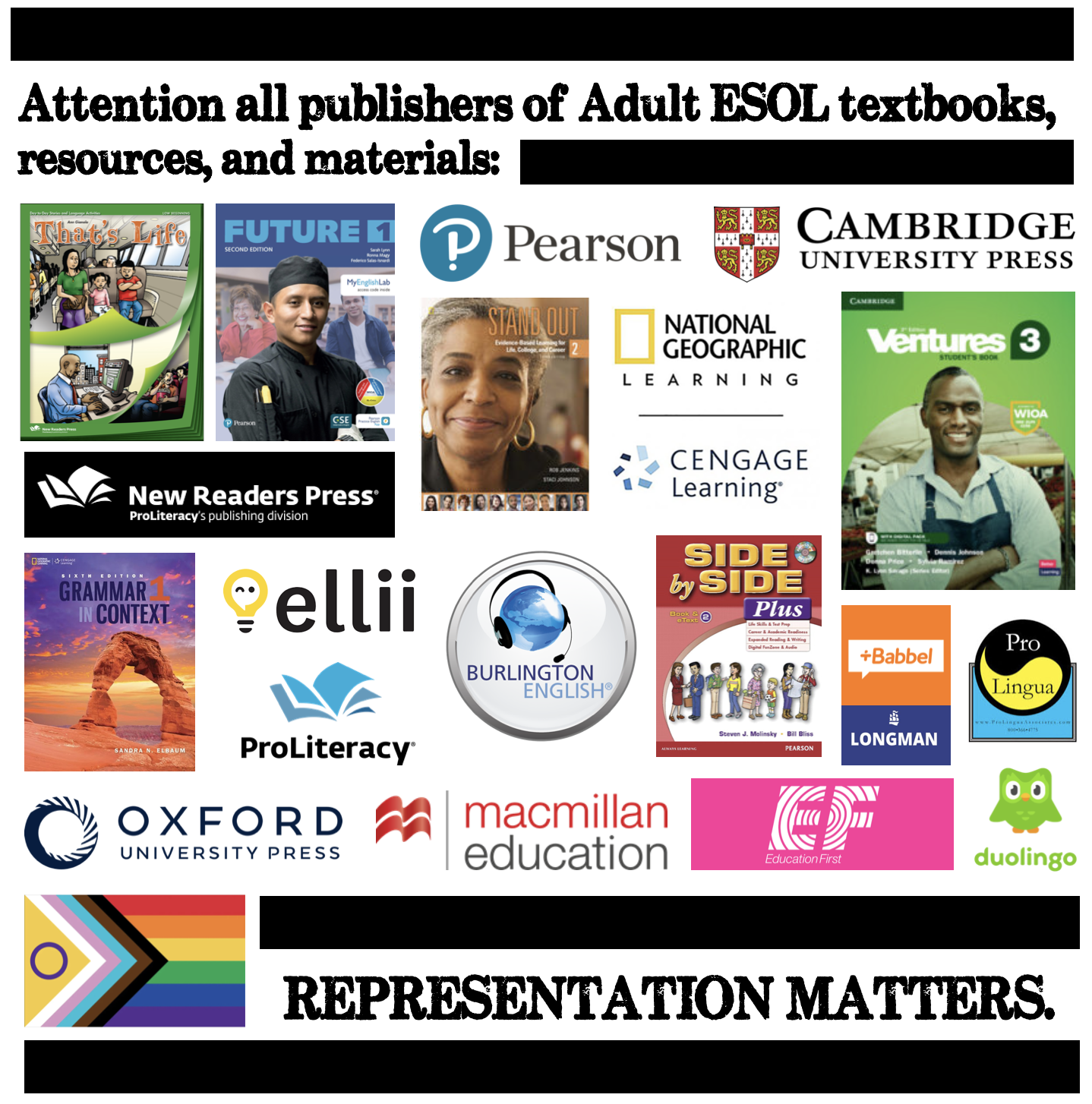
Currently, there is a major lack of diversity in the English for Speakers of Other Languages (ESOL) textbooks, learning materials, and apps being distributed by major publishers such as Pearson, Cambridge, Cengage, Duolingo, Ellii, and others. In particular, available ESOL instructional materials completely lack representation of diverse gender and sexual identities. Queer erasure in ESOL materials leaves out the approximately 15 million adults in the US who identify as LGBT+ (source). The d/Deaf, Hard of Hearing and blind people, people with disabilities, limb and facial differences, people from a variety of cultures, and many other marginalized groups also lack adequate representation in English language learning materials.
Why does representation matter? Because all learners (and their teachers!) deserve to see themselves and their identities reflected in the curriculum. Inclusion is critical for learning. Building a sense of belongingness and trust is central to creating safe/brave learning environments for all students. Science and experience tell us that our brains learn best when we feel validated, safe, and able to be our fullest truest selves in the classroom. A lack of inclusion leads to unaddressed microaggressions that put students on the defensive, with their brains on constant alert for threats, rather than focusing on learning (source).
Now is the time to show ESOL textbook publishers and all makers of English learning materials that we demand:
- The end of queer erasure: Greater representation of diverse gender and sexual identities, including singular they, Mx title, giving and asking for pronouns, nonbinary, transgender, and other queer/LGBT+ people, their families, relationships, and lived experiences.
- Greater diversity in all areas, especially inclusion of identities, families, and relationships outside of heteronormative and cisgender stereotypes
- More representation (and language instruction) around people living and thriving with disabilities and differences
- Representation of a greater variety of cultures

466
The Issue
With an estimated 2 billion speakers, a quarter of the world's population, English is the most spoken language in the world. The growing majority (about 1.6 billion) of those people are non-native speakers or English Language Learners (ELLs) who are acquiring English as a second or other language (source). In 2020, an estimated 4.9 million children in American public schools were ELLs; behind each of those children are parents and other adult relatives who are also learning English. These numbers have grown exponentially in the past decade (source). Furthermore, behind every language learner, there is a teacher-- often one who is looking for the best and most inclusive materials to use with their students.
Currently, there is a major lack of diversity in the English for Speakers of Other Languages (ESOL) textbooks, learning materials, and apps being distributed by major publishers such as Pearson, Cambridge, Cengage, Duolingo, Ellii, and others. In particular, available ESOL instructional materials completely lack representation of diverse gender and sexual identities. Queer erasure in ESOL materials leaves out the approximately 15 million adults in the US who identify as LGBT+ (source). The d/Deaf, Hard of Hearing and blind people, people with disabilities, limb and facial differences, people from a variety of cultures, and many other marginalized groups also lack adequate representation in English language learning materials.
Why does representation matter? Because all learners (and their teachers!) deserve to see themselves and their identities reflected in the curriculum. Inclusion is critical for learning. Building a sense of belongingness and trust is central to creating safe/brave learning environments for all students. Science and experience tell us that our brains learn best when we feel validated, safe, and able to be our fullest truest selves in the classroom. A lack of inclusion leads to unaddressed microaggressions that put students on the defensive, with their brains on constant alert for threats, rather than focusing on learning (source).
Now is the time to show ESOL textbook publishers and all makers of English learning materials that we demand:
- The end of queer erasure: Greater representation of diverse gender and sexual identities, including singular they, Mx title, giving and asking for pronouns, nonbinary, transgender, and other queer/LGBT+ people, their families, relationships, and lived experiences.
- Greater diversity in all areas, especially inclusion of identities, families, and relationships outside of heteronormative and cisgender stereotypes
- More representation (and language instruction) around people living and thriving with disabilities and differences
- Representation of a greater variety of cultures
The Decision Makers

Supporter Voices
Petition Updates
Share this petition
Petition created on March 31, 2024