

Improve Freediving Access, Enhance Education & Safety, and Rethink the NYC Breath-hold Ban
The Issue
Who is Impacted?
The restrictive policies on breath-hold activities in New York's public pools significantly impact our freediving community, including those who see freediving as a more accessible and environmentally responsible way to connect with the underwater world than scuba diving. Divers tend to become stewards of their environment, advocating for the conservation of aquatic ecosystems through sustainable practices like spearfishing and beach cleanups. However, as the operator of a school of underwater recreation (SuperDive), I find it increasingly difficult to secure pool access for training, limiting our ability to educate the public on crucial safety lessons and forcing our customers to travel long distances for limited training opportunities.
What is at Stake?
The lack of public education on breath-hold safety and the scarcity of accessible training locations come at a high price. Lifeguards, often the first responders in aquatic emergencies, are not adequately equipped to handle situations involving dangerous underwater breath-holding behaviors (DUBBs) due to a lack of specialized training in techniques such as "blow tap talk." According to the CDC’s report Fatal and Nonfatal Drowning Outcomes Related to Dangerous Underwater Breath-Holding Behaviors — New York State, 1988–2011, all but one DUBB incident involved a lifeguard on duty and rescue attempt, which suggests the specific risks associated with DUBBs might not be fully understood or effectively managed by pool safety personnel, highlighting the need for specialized training.
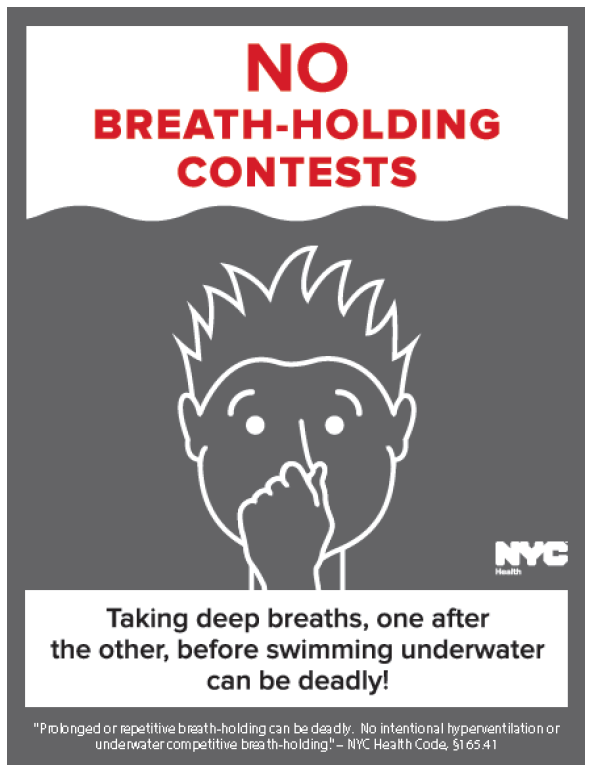
Moreover, the current ban on breath-hold competitions fails to address the root cause of blackout drownings, as all four fatalities in New York's 16 DUBB cases from 1988-2011 involved intentional hyperventilation, a pratice starkly cautioned against in even the most basic freediving training. Beginner freedivers are taught from the very start to avoid such risky behaviors and never hold their breath without direct and qualified supervision. This underscores the critical gap between public perception and the rigorous safety protocols embedded within the freediving community. NYC outlaws breath-hold competition and mandates the posting of poolside posters, intended to warn against dangerous breath-holding. However, one could interpret that if “taking deep breaths, one after another” can be deadly”, perhaps they should take shallow breaths instead - which could exacerbate the risk of blackouts!
We acknowledge the concerns surrounding Dangerous Underwater Breath-Holding Behaviors (DUBBs). However, we urge a distinction between these hazardous practices and the structured environment of competitive freediving. It is important to note that despite thousands of participants globally, in actual freediving competition (which would be illegal in NYC), there have only been two recorded deaths (Audrey Mestre in 2002 and Nicholas Mevoli in 2013 - both were pushing to set records). Trained freedivers follow an extensive list of safety protocols and have great respect and humility when it comes to water safety, making it a relatively safe aquatic pastime.
Public pools play an essential role in access to freediving, because of the restrictions on using fins and snorkels in the waters of NYC Parks. The current atmosphere and fear surrounding breath-hold activities significantly limit the opportunities for New Yorkers to access freediving, pushing enthusiasts towards potentially less safe, unregulated environments or to travel out of state. And though Long Island has made great strides in improving access to the underwater world thanks to organizations like the Long Island Divers Association, it is incredibly difficult for NYC residents to enjoy these dive sites. Unfortunately, the NYC Department of Parks and Recreation has the following regulations concerning pools, boardwalks, and beaches: “Except where permitted by the Commissioner, no person shall bring into or use in any pool under the jurisdiction of the Department, artificial floats, masks, spears, fins, snorkels, air or gas tanks, or other apparatus used for skin or scuba diving. No person shall bring into or use in any other water under the jurisdiction of the Department, artificial floats, spears, fins, snorkels, air or gas tanks, or other apparatus used for scuba diving”. This is a huge shame considering New York is fourth on the list of US States with the most divers and home to one of the oldest and largest dive clubs in the US, the Big Apple Divers (1971)!
Why is Now the Time to Act?
The booming popularity of freediving, highlighted in mainstream media such as Avatar 2 and The Little Mermaid, along with New York City's Waterfront Revitalization plans and upcoming new swimming pool, underscores the urgent need for safe and accessible water engagement. Now more than ever, it is crucial to ensure that individuals can safely enjoy and connect with water. After all, it is well established that being in or around water benefits humans in many ways. As the British poet W.H. Auden wrote, “Thousands have lived without love, not one without water”. This calls for immediate action to improve freediving access, enhance breath-hold safety education, and to rethink the ban on breath-hold competitions.
Call to Action:
- Sign this petition to support the cause for better freediving access and the lifting of the breath-hold competition ban.
- Share this petition to spread awareness about the importance of breath-hold safety and the need for specialized lifeguard training.
- Learn by taking a freediving or breath-hold safety lesson - and share what you learned with others!
- Advocate for a city-supported breath-hold safety campaign targeting lifeguards and members of the public.
- Volunteer for or Donate to Underwater 4 All, Inc., a nonprofit organization dedicated to safe access to underwater activities for everyone.
- Comment below if you have suggestions, stories, or want to express support for this mission.

286
The Issue
Who is Impacted?
The restrictive policies on breath-hold activities in New York's public pools significantly impact our freediving community, including those who see freediving as a more accessible and environmentally responsible way to connect with the underwater world than scuba diving. Divers tend to become stewards of their environment, advocating for the conservation of aquatic ecosystems through sustainable practices like spearfishing and beach cleanups. However, as the operator of a school of underwater recreation (SuperDive), I find it increasingly difficult to secure pool access for training, limiting our ability to educate the public on crucial safety lessons and forcing our customers to travel long distances for limited training opportunities.
What is at Stake?
The lack of public education on breath-hold safety and the scarcity of accessible training locations come at a high price. Lifeguards, often the first responders in aquatic emergencies, are not adequately equipped to handle situations involving dangerous underwater breath-holding behaviors (DUBBs) due to a lack of specialized training in techniques such as "blow tap talk." According to the CDC’s report Fatal and Nonfatal Drowning Outcomes Related to Dangerous Underwater Breath-Holding Behaviors — New York State, 1988–2011, all but one DUBB incident involved a lifeguard on duty and rescue attempt, which suggests the specific risks associated with DUBBs might not be fully understood or effectively managed by pool safety personnel, highlighting the need for specialized training.
Moreover, the current ban on breath-hold competitions fails to address the root cause of blackout drownings, as all four fatalities in New York's 16 DUBB cases from 1988-2011 involved intentional hyperventilation, a pratice starkly cautioned against in even the most basic freediving training. Beginner freedivers are taught from the very start to avoid such risky behaviors and never hold their breath without direct and qualified supervision. This underscores the critical gap between public perception and the rigorous safety protocols embedded within the freediving community. NYC outlaws breath-hold competition and mandates the posting of poolside posters, intended to warn against dangerous breath-holding. However, one could interpret that if “taking deep breaths, one after another” can be deadly”, perhaps they should take shallow breaths instead - which could exacerbate the risk of blackouts!
We acknowledge the concerns surrounding Dangerous Underwater Breath-Holding Behaviors (DUBBs). However, we urge a distinction between these hazardous practices and the structured environment of competitive freediving. It is important to note that despite thousands of participants globally, in actual freediving competition (which would be illegal in NYC), there have only been two recorded deaths (Audrey Mestre in 2002 and Nicholas Mevoli in 2013 - both were pushing to set records). Trained freedivers follow an extensive list of safety protocols and have great respect and humility when it comes to water safety, making it a relatively safe aquatic pastime.
Public pools play an essential role in access to freediving, because of the restrictions on using fins and snorkels in the waters of NYC Parks. The current atmosphere and fear surrounding breath-hold activities significantly limit the opportunities for New Yorkers to access freediving, pushing enthusiasts towards potentially less safe, unregulated environments or to travel out of state. And though Long Island has made great strides in improving access to the underwater world thanks to organizations like the Long Island Divers Association, it is incredibly difficult for NYC residents to enjoy these dive sites. Unfortunately, the NYC Department of Parks and Recreation has the following regulations concerning pools, boardwalks, and beaches: “Except where permitted by the Commissioner, no person shall bring into or use in any pool under the jurisdiction of the Department, artificial floats, masks, spears, fins, snorkels, air or gas tanks, or other apparatus used for skin or scuba diving. No person shall bring into or use in any other water under the jurisdiction of the Department, artificial floats, spears, fins, snorkels, air or gas tanks, or other apparatus used for scuba diving”. This is a huge shame considering New York is fourth on the list of US States with the most divers and home to one of the oldest and largest dive clubs in the US, the Big Apple Divers (1971)!
Why is Now the Time to Act?
The booming popularity of freediving, highlighted in mainstream media such as Avatar 2 and The Little Mermaid, along with New York City's Waterfront Revitalization plans and upcoming new swimming pool, underscores the urgent need for safe and accessible water engagement. Now more than ever, it is crucial to ensure that individuals can safely enjoy and connect with water. After all, it is well established that being in or around water benefits humans in many ways. As the British poet W.H. Auden wrote, “Thousands have lived without love, not one without water”. This calls for immediate action to improve freediving access, enhance breath-hold safety education, and to rethink the ban on breath-hold competitions.
Call to Action:
- Sign this petition to support the cause for better freediving access and the lifting of the breath-hold competition ban.
- Share this petition to spread awareness about the importance of breath-hold safety and the need for specialized lifeguard training.
- Learn by taking a freediving or breath-hold safety lesson - and share what you learned with others!
- Advocate for a city-supported breath-hold safety campaign targeting lifeguards and members of the public.
- Volunteer for or Donate to Underwater 4 All, Inc., a nonprofit organization dedicated to safe access to underwater activities for everyone.
- Comment below if you have suggestions, stories, or want to express support for this mission.
Supporter Voices
Petition Updates
Share this petition
Petition created on February 25, 2024