

Honoring our solar system's peaks.
The Issue
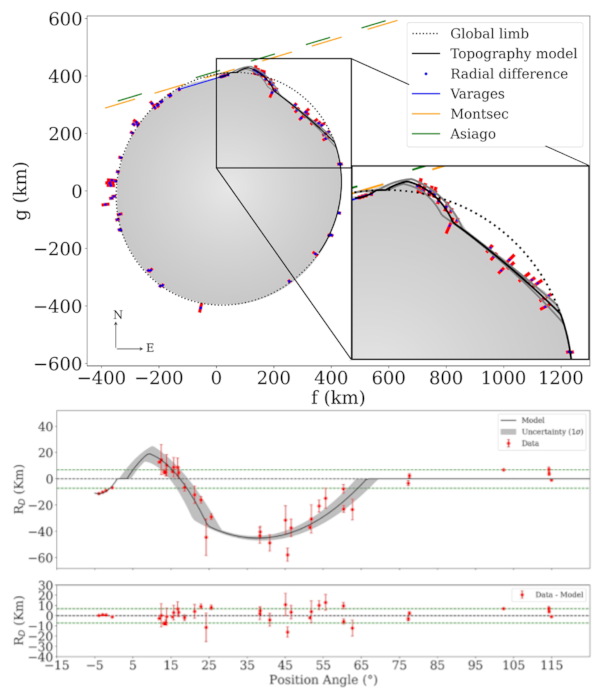
There are three known mountains that could reasonably end up being the tallest points in our entire solar system: Olympus Mons on Mars (21 km ~ 26 km), and two unnamed formations of raised elevation on the cestial bodies of 4 Vesta (20 km ~ 25 km) and 307261 Máni (20 km ~ 29 km). As is indicated by my above sentence, there is nothing for me to call the latter two, nor even any suggestions that I've found, which I believe to be a mild disappointment. One that could very easily be remedied. Any name befitting the unique status and honor of these mountains would be good, but because of the current absence, I will attempt to take charge, and broadly gesture towards finding nomenclature within the Middle Earth of J.R.R. Tolkien. I cannot in recent times recall anything of both significance and goodness being named in honor of one of his imaginations, and many of the mountains or towers supplied by him, I believe, would make for a good inspiration. As my personal proposal, I will suggest Narchost and Carchost, otherwise known as the Towers of the Teeth. There is no deeper meaning or intentions behind this choice; I just think it sounds cool. I also don't have any preference between which one should be named Narchost, nor which one should be named Carchost. And if one were to come along and propose better fitting names, I hope that I would happily concede, regardless of if it is another piece from Tolkien's world, or something from an entirely unrelated origin. Really, I just want these two currently unnamed peaks to have names, as long as they have some intention of awe behind them.
Map & Graph Showing The Central Peak On 4 Vesta's Rheasilvia Crater:
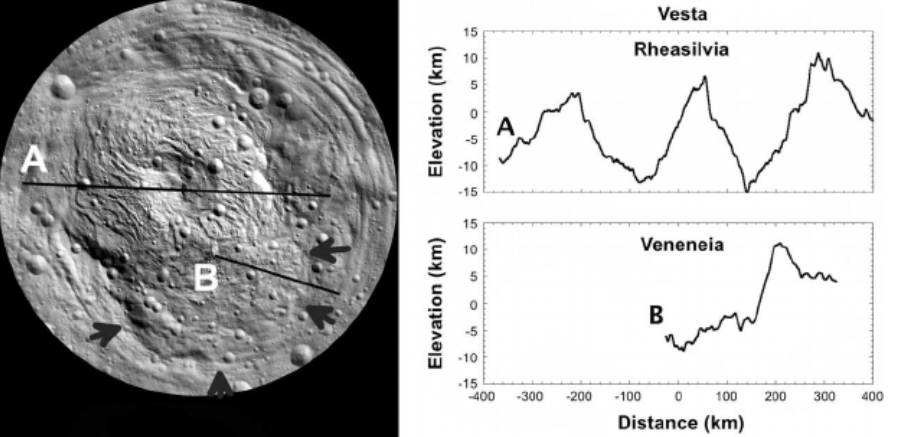
Chart & Graph Showing The Raised Elevation on 307261 Máni:
Furthermore, I would also like to petition for a total ban on landings near the summits of any notable peaks within our solar system. I believe it to be most fitting for these summits to be conquered by methods that are at least attempting to be faithful to the conventional means practiced by mountaineers on Earth — in layman's terms: just hike the mountain, don't cheat. I hope that this will eventually be the case for the already mentioned trio of peaks, and perhaps, if I may be even more hopeful, at least the highest peak on every celestial body in our solar system. If mankind ever reaches a point to where it can explore these distant lands, I think this would best allow for the creation of more interesting stories that our ancestors could participate in, which I hope that their ancestors would eventually cherish.
Notes:
- The peak on 4 Vesta is actually the central peak with a crater known as Rheasilvia; because of this, it wouldn't actually be improper to just refer to it as "Rheasilvia's central peak," and leave it at that, but I would still prefer a more catchy name. The exact nature of the formation on 307261 Máni is less clear, so I can't comment on any of the more clinical terms that could theoretically be applied to it.
- If a fourth peak is ever discovered in our solar system that could for a time contend against the ones on 4 Vesta and 307261 Máni, and there are still no standardized names, I suggest that a new naming trio be formed instead (or quartet, if Olympus Mons is to be grouped with them), and they take on a naming convention which honors the Mountains of Moria. Once again, I have no preference for which mountain gets named which.
- The pictures shown in the title image originate from NASA, which they then released into the public domain; I found them on Wikipedia. The left corresponds to 4 Vesta, and the right corresponds to 307261 Máni.
- The images shown above are from sources 5 and 7 respectively.
Sources:
- Smith D.E, Zuber M.T, Frey H.V, Garvin J, Abshire J.B. (2001). Mars Orbiter Laser Altimeter: Experiment summary after the first year of global mapping of Mars, Table 5: Olympus Mons. Journal of Geophysical Research: Planets, Volume 106, Number E10, Page 23699. [Research Gate]; https://www.researchgate.net/publication/280685745_Mars_Orbiter_Laser_Altimeter_Experiment_summary_after_the_first_year_of_global_mapping_of_Mars
- Comins N.F. (2012). Discovering the Essential Universe, Edition 5, Chapter 5, Section 17, Pages 147-148. W.H. Freeman & Company, Macmillan. [Google]; https://books.google.com/books?id=qK_4mNve1DYC&pg=PA146#v=twopage&q&f=false
- Isherwood R.J, Jozwiak L.M, Jansen J.C, Andrews-Hanna J.C. (2013). The volcanic history of Olympus Mons from paleo-topography and flexural modeling: Introduction. Earth and Planetary Science Letters, Volume 363, Pages 88-96. [Science Direct]; https://www.sciencedirect.com/science/article/abs/pii/S0012821X12007066
- Karimi S, Dombard A.J. (2016). On the possibility of viscoelastic deformation of the large south polar craters and true polar wander on the asteroid Vesta, Introduction: Paragraph 4, Figure 2. Journal of Geophysical Research, Volume 121, Issue 9, Pages 1786-1797. [AGU: Advancing Earth And Space Sciences]; https://agupubs.onlinelibrary.wiley.com/doi/10.1002/2016JE005064
- Schenk P, O'Brien D.P, Marchi S, Gaskell R, Preusker F, Roatsch T, Jaumann R, Buczkowski D, McCord T, McSween H.Y, Williams D, Yingst A, Raymond C, Russell C. (2012). The Geologically Recent Giant Impact Basins at Vesta's South Pole, Page 694 (Column 2), Page 695 (Figure 1). Science, Volume 336. [ResearchGate: sciencemag.org]; https://www.researchgate.net/publication/224951386_The_Geologically_Recent_Giant_Impact_Basins_at_Vesta's_South_Pole
- Vega P.R. (2011). New View of Vesta Mountain from NASA's Dawn Mission. Jet Propulsion Laboratory: California Institute of Technology. [The Internet Archive: WayBack Machine]; https://web.archive.org/web/20111022092700/http://dawn.jpl.nasa.gov/feature_stories/new_view_vesta_mountain.asp
- Rommel F.L, Braga-Ribas F, Ortiz J.L, Sicardy B, Santos-Sanz P, Desmars J, Camargo J.I.B, Vieira-Martins R, Assafin M, Morgado B.E, Boufleur R.C, Benedetti-Rossi G, Gomes-Júnior A.R, Fernández-Valenzuela E, Holler B.J, Souami D, Duffard R, Margoti G, Vara-Lubiano M, Lecacheux J, Plouvier J.L, Morales N, Maury A, Fabrega J, Ceravolo P, Jehin E, Albanese D, Mariey H, Cikota S, Ruždjak D, Cikota A, Szakáts R, Baba Aissa D, Gringahcene Z, Kashuba V, Koshkin N, Zhukov V, Fişek S, Çakir O, Özer S, Schnabel C, Schnabel M, Signoret F, Morrone L, Santana-Ros T, Pereira C.L, Emilio M, Burdanov A.Y, de Wit J, Barkaoui K, Gillon M, Leto G, Frasca A, Catanzaro G, Zanmar Sanchez R, Tagliaferri U, Di Sora M, Isopi G, Krugly Y, Slyusarev I, Chiorny V, Mikuž H, Bacci P, Maestripieri M, Grazia M.D, de la Cueva I, Yuste-Moreno M, Ciabattari F, Kozhukhov O.M, Serra-Ricart M, Alarcon M.R, Licandro J, Masi G, Bacci R, Bosch J.M, Behem R, Prost J.P, Renner S, Conjat M, Bachini M, Succi G, Stoian L, Juravle A, Carosati D, Gowe B, Carrillo J, Zheleznyak A.P, Montigiani N, Foster C.R, Mannucci M, Ruocco N, Cuevas F, Di Marcantonio P, Coretti I, Iafrate G, Baldini V, Collins M, Pál A, Csák B, Fernández-Garcia E, Castro-Tirado A.J, Hudin L, Madiedo J.M, Anghel R.M, Calvo-Fernández J.F, Valvasori A, Guido E, Gherase R.M, Kamoun S, Fafet R, Sánchez-González M, Curelaru L, Vîntdevară C.D, Danescu C.A, Gout J.F, Schmitz C.J, Sota A, Belskaya I, Rodríguez-Marco M, Kilic Y, Frappa E, Klotz A, Lavayssière M, Marques Oliveira J, Popescu M, Mammana L.A, Fernández-Lajús E, Schmidt M, Hopp U, Komžík R, Pribulla T, Tomko D, Husárik M, Erece O, Eryilmaz S, Buzzi L, Gährken B, Nardiello D, Hornoch K, Sonbas E, Er H, Burwitz V, Sybilski P.W, Bykowski W, Müller T.G, Ogloza W, Gonçalves R, Ferreira J.F, Ferreira M, Bento M, Meister S, Bagiran M.N, Tekeş M, Marciniak A, Moravec Z, Delinčák P, Gianni G, Casalnuovo G.B, Boutet M, Sanchez J, Klemt B, Wuensche N, Burzynski W, Borkowski M, Serrau M, Dangl G, Klös O, Weber C, Urbaník M, Rousselot L, Kubánek J, André P, Colazo C, Spagnotto J, Sickafoose A.A, Hueso R., Sánchez-Lavega A, Fisher R.S, Rengstorf A.W, Perelló C, Dascalu M, Altan M, Gazeas K, de Santana T, Sfair R, Winter O.C, Kalkan S, Canales-Moreno O, Trigo-Rodríguez J.M, Tsamis V, Tigani K, Sioulas N, Lekkas G., Bertesteanu D.N, Dumitrescu V, Wilberger A.J, Barnes J.W, Fieber-Beyer S.K, Swaney R.L, Fuentes C, Mendez R.A, Dumitru B.D, Flynn R.L, Wake D.A. (2023). A Large Topographic Feature on the Surface of the Trans-Neptunian Object (307261) 2002 MS4 Measured from Stellar, Section 3: Data Reduction, Analysis, and Results, Subsection 3.2: Topographic Features, Paragraph 6 (Final Paragraph), Figures 5-6. Astronomy & Astrophysics, Volume 678, Article A167. [EDP Sciences]; https://www.aanda.org/articles/aa/full_html/2023/10/aa46892-23/aa46892-23.html

2
The Issue
There are three known mountains that could reasonably end up being the tallest points in our entire solar system: Olympus Mons on Mars (21 km ~ 26 km), and two unnamed formations of raised elevation on the cestial bodies of 4 Vesta (20 km ~ 25 km) and 307261 Máni (20 km ~ 29 km). As is indicated by my above sentence, there is nothing for me to call the latter two, nor even any suggestions that I've found, which I believe to be a mild disappointment. One that could very easily be remedied. Any name befitting the unique status and honor of these mountains would be good, but because of the current absence, I will attempt to take charge, and broadly gesture towards finding nomenclature within the Middle Earth of J.R.R. Tolkien. I cannot in recent times recall anything of both significance and goodness being named in honor of one of his imaginations, and many of the mountains or towers supplied by him, I believe, would make for a good inspiration. As my personal proposal, I will suggest Narchost and Carchost, otherwise known as the Towers of the Teeth. There is no deeper meaning or intentions behind this choice; I just think it sounds cool. I also don't have any preference between which one should be named Narchost, nor which one should be named Carchost. And if one were to come along and propose better fitting names, I hope that I would happily concede, regardless of if it is another piece from Tolkien's world, or something from an entirely unrelated origin. Really, I just want these two currently unnamed peaks to have names, as long as they have some intention of awe behind them.
Map & Graph Showing The Central Peak On 4 Vesta's Rheasilvia Crater:
Chart & Graph Showing The Raised Elevation on 307261 Máni:
Furthermore, I would also like to petition for a total ban on landings near the summits of any notable peaks within our solar system. I believe it to be most fitting for these summits to be conquered by methods that are at least attempting to be faithful to the conventional means practiced by mountaineers on Earth — in layman's terms: just hike the mountain, don't cheat. I hope that this will eventually be the case for the already mentioned trio of peaks, and perhaps, if I may be even more hopeful, at least the highest peak on every celestial body in our solar system. If mankind ever reaches a point to where it can explore these distant lands, I think this would best allow for the creation of more interesting stories that our ancestors could participate in, which I hope that their ancestors would eventually cherish.
Notes:
- The peak on 4 Vesta is actually the central peak with a crater known as Rheasilvia; because of this, it wouldn't actually be improper to just refer to it as "Rheasilvia's central peak," and leave it at that, but I would still prefer a more catchy name. The exact nature of the formation on 307261 Máni is less clear, so I can't comment on any of the more clinical terms that could theoretically be applied to it.
- If a fourth peak is ever discovered in our solar system that could for a time contend against the ones on 4 Vesta and 307261 Máni, and there are still no standardized names, I suggest that a new naming trio be formed instead (or quartet, if Olympus Mons is to be grouped with them), and they take on a naming convention which honors the Mountains of Moria. Once again, I have no preference for which mountain gets named which.
- The pictures shown in the title image originate from NASA, which they then released into the public domain; I found them on Wikipedia. The left corresponds to 4 Vesta, and the right corresponds to 307261 Máni.
- The images shown above are from sources 5 and 7 respectively.
Sources:
- Smith D.E, Zuber M.T, Frey H.V, Garvin J, Abshire J.B. (2001). Mars Orbiter Laser Altimeter: Experiment summary after the first year of global mapping of Mars, Table 5: Olympus Mons. Journal of Geophysical Research: Planets, Volume 106, Number E10, Page 23699. [Research Gate]; https://www.researchgate.net/publication/280685745_Mars_Orbiter_Laser_Altimeter_Experiment_summary_after_the_first_year_of_global_mapping_of_Mars
- Comins N.F. (2012). Discovering the Essential Universe, Edition 5, Chapter 5, Section 17, Pages 147-148. W.H. Freeman & Company, Macmillan. [Google]; https://books.google.com/books?id=qK_4mNve1DYC&pg=PA146#v=twopage&q&f=false
- Isherwood R.J, Jozwiak L.M, Jansen J.C, Andrews-Hanna J.C. (2013). The volcanic history of Olympus Mons from paleo-topography and flexural modeling: Introduction. Earth and Planetary Science Letters, Volume 363, Pages 88-96. [Science Direct]; https://www.sciencedirect.com/science/article/abs/pii/S0012821X12007066
- Karimi S, Dombard A.J. (2016). On the possibility of viscoelastic deformation of the large south polar craters and true polar wander on the asteroid Vesta, Introduction: Paragraph 4, Figure 2. Journal of Geophysical Research, Volume 121, Issue 9, Pages 1786-1797. [AGU: Advancing Earth And Space Sciences]; https://agupubs.onlinelibrary.wiley.com/doi/10.1002/2016JE005064
- Schenk P, O'Brien D.P, Marchi S, Gaskell R, Preusker F, Roatsch T, Jaumann R, Buczkowski D, McCord T, McSween H.Y, Williams D, Yingst A, Raymond C, Russell C. (2012). The Geologically Recent Giant Impact Basins at Vesta's South Pole, Page 694 (Column 2), Page 695 (Figure 1). Science, Volume 336. [ResearchGate: sciencemag.org]; https://www.researchgate.net/publication/224951386_The_Geologically_Recent_Giant_Impact_Basins_at_Vesta's_South_Pole
- Vega P.R. (2011). New View of Vesta Mountain from NASA's Dawn Mission. Jet Propulsion Laboratory: California Institute of Technology. [The Internet Archive: WayBack Machine]; https://web.archive.org/web/20111022092700/http://dawn.jpl.nasa.gov/feature_stories/new_view_vesta_mountain.asp
- Rommel F.L, Braga-Ribas F, Ortiz J.L, Sicardy B, Santos-Sanz P, Desmars J, Camargo J.I.B, Vieira-Martins R, Assafin M, Morgado B.E, Boufleur R.C, Benedetti-Rossi G, Gomes-Júnior A.R, Fernández-Valenzuela E, Holler B.J, Souami D, Duffard R, Margoti G, Vara-Lubiano M, Lecacheux J, Plouvier J.L, Morales N, Maury A, Fabrega J, Ceravolo P, Jehin E, Albanese D, Mariey H, Cikota S, Ruždjak D, Cikota A, Szakáts R, Baba Aissa D, Gringahcene Z, Kashuba V, Koshkin N, Zhukov V, Fişek S, Çakir O, Özer S, Schnabel C, Schnabel M, Signoret F, Morrone L, Santana-Ros T, Pereira C.L, Emilio M, Burdanov A.Y, de Wit J, Barkaoui K, Gillon M, Leto G, Frasca A, Catanzaro G, Zanmar Sanchez R, Tagliaferri U, Di Sora M, Isopi G, Krugly Y, Slyusarev I, Chiorny V, Mikuž H, Bacci P, Maestripieri M, Grazia M.D, de la Cueva I, Yuste-Moreno M, Ciabattari F, Kozhukhov O.M, Serra-Ricart M, Alarcon M.R, Licandro J, Masi G, Bacci R, Bosch J.M, Behem R, Prost J.P, Renner S, Conjat M, Bachini M, Succi G, Stoian L, Juravle A, Carosati D, Gowe B, Carrillo J, Zheleznyak A.P, Montigiani N, Foster C.R, Mannucci M, Ruocco N, Cuevas F, Di Marcantonio P, Coretti I, Iafrate G, Baldini V, Collins M, Pál A, Csák B, Fernández-Garcia E, Castro-Tirado A.J, Hudin L, Madiedo J.M, Anghel R.M, Calvo-Fernández J.F, Valvasori A, Guido E, Gherase R.M, Kamoun S, Fafet R, Sánchez-González M, Curelaru L, Vîntdevară C.D, Danescu C.A, Gout J.F, Schmitz C.J, Sota A, Belskaya I, Rodríguez-Marco M, Kilic Y, Frappa E, Klotz A, Lavayssière M, Marques Oliveira J, Popescu M, Mammana L.A, Fernández-Lajús E, Schmidt M, Hopp U, Komžík R, Pribulla T, Tomko D, Husárik M, Erece O, Eryilmaz S, Buzzi L, Gährken B, Nardiello D, Hornoch K, Sonbas E, Er H, Burwitz V, Sybilski P.W, Bykowski W, Müller T.G, Ogloza W, Gonçalves R, Ferreira J.F, Ferreira M, Bento M, Meister S, Bagiran M.N, Tekeş M, Marciniak A, Moravec Z, Delinčák P, Gianni G, Casalnuovo G.B, Boutet M, Sanchez J, Klemt B, Wuensche N, Burzynski W, Borkowski M, Serrau M, Dangl G, Klös O, Weber C, Urbaník M, Rousselot L, Kubánek J, André P, Colazo C, Spagnotto J, Sickafoose A.A, Hueso R., Sánchez-Lavega A, Fisher R.S, Rengstorf A.W, Perelló C, Dascalu M, Altan M, Gazeas K, de Santana T, Sfair R, Winter O.C, Kalkan S, Canales-Moreno O, Trigo-Rodríguez J.M, Tsamis V, Tigani K, Sioulas N, Lekkas G., Bertesteanu D.N, Dumitrescu V, Wilberger A.J, Barnes J.W, Fieber-Beyer S.K, Swaney R.L, Fuentes C, Mendez R.A, Dumitru B.D, Flynn R.L, Wake D.A. (2023). A Large Topographic Feature on the Surface of the Trans-Neptunian Object (307261) 2002 MS4 Measured from Stellar, Section 3: Data Reduction, Analysis, and Results, Subsection 3.2: Topographic Features, Paragraph 6 (Final Paragraph), Figures 5-6. Astronomy & Astrophysics, Volume 678, Article A167. [EDP Sciences]; https://www.aanda.org/articles/aa/full_html/2023/10/aa46892-23/aa46892-23.html
Petition Updates
Share this petition
Petition created on September 20, 2026