
Honor SOFRED: Rescind the Gibson Rezoning—Protect Frederick County’s Future
The Issue
PETITION TO THE FREDERICK COUNTY BOARD OF SUPERVISORS
Honor SOFRED: Rescind the Gibson Rezoning—Protect Frederick County’s Future
UPDATE — October 30, 2026
We, the undersigned, respectfully call on the Frederick County Board of Supervisors to rescind its October 28, 2026, approval of the Gibson rezoning and place a motion to rescind on its November 12 agenda. Under the Board's rules, the 30-day deadline to make a motion to rescind is November 27, 2026. November 12 is the last regularly scheduled Board meeting before that deadline, with no additional regular meetings scheduled during the remaining 15 days. This makes the November 12 meeting especially urgent.
The approval of approximately 244 acres for M1 industrial (said to be a part of a ~519-608 acre land assemblage) use failed to secure essential protections envisioned in the Southern Frederick Area Plan (SOFRED), left significant industrial uses and truck impacts insufficiently addressed, and offered no firm commitments to the high-quality office and employment campus our community was promised through its planning process. With substantial transportation, environmental, and financial consequences at stake, we ask the Board to reconsider its decision and require a revised proposal with enforceable commitments that fully honor SOFRED's entire vision and, in doing so, uphold the integrity, balance, and harmony of Frederick County's Comprehensive Plan and our community's future as a whole.
Why We Are Requesting Rescission
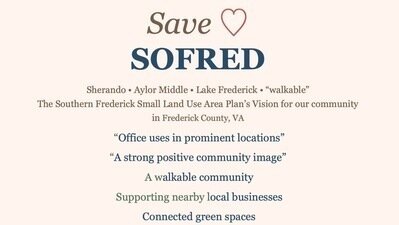
1. The approved rezoning does not adequately secure SOFRED's vision. SOFRED calls for high-quality architecture, office uses in prominent locations, a strong positive community image, walkable employment areas, connected green spaces, and protection from unhealthy noise and light.
An industrial designation on a future land-use map is not a blank check to disregard the written plan. The approved development commitments should secure the community's vision, not merely permit the possibility of achieving it.
2. Incompatible industrial uses remain a serious concern. We have repeatedly requested explicit, enforceable exclusions for freight-dominated warehousing and distribution, truck depots, outdoor storage, industrial-scale energy generation, large battery energy storage facilities, and other high-impact uses.
Calling a zoning district "light industrial" does not guarantee that everything developed within it will have a light footprint.
3. Transportation costs and truck impacts have not been adequately resolved. The applicant's traffic analysis estimated approximately 6,112 additional weekday vehicle trips, but that was from a generic study; our own trip analysis has areas near our industrial parks at 44,700 today. The County already faces hundreds of millions of dollars in identified roadway improvement needs and no clear timelines or guarantees today for meeting those future goals. Additional freight traffic can place long-term burdens on roads, intersections, neighborhoods, taxpayers, and future transportation budgets. These impacts extend far beyond the property boundaries.
4. The economic benefits need stronger commitments. We support well-paying jobs, advanced manufacturing, research, corporate services, and responsible investment. But the rezoning does not adequately guarantee an office-led employment campus or demonstrate the quality of jobs that will ultimately result.
Frederick County's 2026 Cost of Land Use Study estimates net fiscal returns of approximately $866 per 1,000 square feet for warehousing, compared with $3,308 for office and $5,269 for retail. These are modeled estimates, not guaranteed results, but they illustrate why the type of development we approve deserves careful consideration.
5. Environmental and community protections should be secured before approval. The area deserves clear, measurable protections for nearby homes, schools, natural resources, waterways, and wildlife. Noise, light, truck emissions, water demand, and landscape impacts should be evaluated and addressed through enforceable commitments.
6. Last-minute proffer revisions deserved greater public scrutiny. Revised proffers were received on October 28, the very day of the Board's vote. The proffers' legal standing was also in question and confusing. Residents deserve a meaningful opportunity to examine the final commitments governing such a consequential land-use decision.
What We Are Asking the Board to Do
We respectfully request that the Board of Supervisors take the necessary procedural steps to rescind its October 28 approval and allow a substantially improved proposal to return through the appropriate public review process.
That proposal should establish clear permitted uses, meaningful truck and transportation protections, enforceable environmental standards, and a binding development plan that fulfills SOFRED's entire vision.
***Original Petition below is still to be upheld when this comes back in front of the board at a later date!***
Honor SOFRED: Do Not Approve the Gibson Rezoning as Submitted
We, the undersigned residents, neighbors, and stewards of Frederick County, ask the Board of Supervisors to withhold approval of the Gibson rezoning as submitted. Any approval should secure permitted uses, a development plan, and enforceable proffers that carry the Southern Frederick Area Plan—SOFRED—into practice.
We support responsible economic growth, good jobs, and thoughtfully designed places. This property deserves development that brings SOFRED’s vision to life.
Read the Comprehensive Plan and its small area plans together, and you see little islands of life, each with its own harmony and distinctive character. Their employment areas, neighborhoods, village centers, historic places, and natural resources were planned with intention.
A blue color on a future land-use map is not a blank check for every industrial use. The maps must be read alongside the written plans, including language shaped through community input about what belongs where, how different uses should fit together, and how they should transition into surrounding areas.
Each rezoning should honor that language and strengthen the harmony and character envisioned throughout the larger community—not simply follow a color on a map.
For the Route 277 Triangle, SOFRED states: “In specific areas a mix of flexible uses, with office uses in prominent locations is encouraged.” It calls for “high quality architecture and site design” and a “strong positive community image” (p. 29).
We ask that prominent Route 277 frontage be reserved for offices, professional services, and compatible supporting businesses, such as cafés, shops, printing services, and other uses that complement office employment, enhance walkability, and contribute to a strong positive community image. Selected light industrial and advanced manufacturing uses should be appropriately located behind them. Secure this arrangement through a binding development plan and enforceable commitments to high-quality architecture, landscaping, connected green spaces, pedestrian and bicycle access, and protection of natural resources.
SOFRED says, “All areas should be designed to promote/support pedestrian and bike access, making this a walkable community” (p. 33). It also calls for restaurants and community businesses to be “located close to and easily accessible by car or by foot” to employment areas (p. 34). We support places where people can walk to lunch, visit local businesses, and enjoy green spaces—with safe paths and crossings connecting employment areas to the surrounding community as development occurs.
SOFRED’s vision for walkable and bikeable employment areas offers residents opportunities to work, shop, and enjoy community life close to home. An office-led campus could support more of those local connections.
Freight-dominated industrial development has a very different reach. Trucks travel regional routes, bringing traffic from outside the community along I-81, Routes 277 and 522, and connecting roads throughout SOFRED and surrounding areas.
Just as screening a substation does not erase the effects of very large transmission lines extending far beyond it, screening industrial buildings does not contain the truck traffic they generate. That industrial footprint extends far beyond the property, affecting roads, neighborhoods, safety, and quality of life throughout the larger community.
SOFRED calls for “greenways, stream valley parks, and stream buffers around waterways” (p. 37). Gibson’s waterways, wetlands, and woodlands should help shape its development from the beginning. We envision a landmark campus whose architecture complements that natural setting, with connected habitat and thoughtfully placed trails.
Protect Wrights Run and its downstream connections to Opequon Creek, the Potomac River, and the Chesapeake Bay. Preserve this connected watershed and its wildlife habitat, with trails that invite people to enjoy nature while protecting sensitive areas.
The plan also calls for protecting people and wildlife from “unhealthy levels of noise and light” (p. 38). Honor that commitment with shielded lighting, measurable limits on noise, glare, and vibration, and enforceable protections for surrounding homes and natural areas.
To uphold SOFRED’s vision and protect surrounding homes, natural lands, and roadways, we request explicit exclusions for:
• Warehousing and storage as principal uses; freight-dominated wholesale and distribution operations.
• Truck transportation and depots; truck and fleet maintenance; tractor-trailer parking yards; truck, RV, and utility-trailer rental.
• Self-storage; contractor storage yards and other uses dominated by outdoor storage or heavy truck activity.
• Small-arms ammunition manufacturing; industrial laundry and dry-cleaning operations.
• Data centers and high-energy-use facilities as defined by Virginia law.
• Industrial-scale power/energy generation, including gas turbines; large battery energy storage installations; battery manufacturing and recycling.
Review plastics, rubber, and other manufacturing uses individually, and expressly exclude those whose noise, emissions, truck traffic, outdoor storage, or wastewater would be incompatible with the area. Identify and exclude incompatible hazardous-material manufacturing and bulk-storage operations. Any exception for ordinary emergency backup power should be narrowly defined. Secure these restrictions through enforceable proffers before approval.
FOIA-released correspondence from January 2025 describes a proposed 100+ MW gas-turbine power generation facility serving the broader approximately 600-acre Gibson Assemblage (marketed for a hyperscale data center campus or advanced manufacturing facilities). Before approving this rezoning, the County should publicly clarify that proposal’s status and location. The project’s enforceable proffers must explicitly exclude all data centers, including hyperscale campuses; all high-energy-use facilities as defined by Virginia law; and industrial-scale power generation.
The I-81 widening and Exit 317 improvement package is estimated at $253.7 million, in a corridor serving existing industrial parks and substantial freight traffic. Before approving additional truck-intensive uses at Gibson, compare their long-term transportation costs and community benefits with alternatives that fulfill SOFRED’s vision.
Compare warehouse and manufacturing proposals with an office-led mix of professional services, compatible retail, and appropriate agribusiness. Use an updated Cost of Land Use analysis to compare net fiscal returns alongside wages, water demand, and transportation costs. Before approval, demonstrate how the chosen mix will fulfill SOFRED’s call for “office uses in prominent locations” and a “strong positive community image.”
SOFRED envisions the nearby Lake Frederick area as a “gateway feature for Frederick County” (p. 29). Here, at southern Frederick’s connections with Clarke and Warren counties, along routes leading travelers to the Shenandoah Valley and Shenandoah National Park, our community should offer a remarkable greeting. If beloved farmland is to become something new, let it become a legacy: exceptional architecture rooted in our rural heritage, nature woven through its design, and places that enrich daily life. Let visitors recognize what makes this valley special, and residents feel proud to call it home. That is a high standard for rezoning farmland—and a fitting one for land we love so dearly.
Uphold SOFRED’s language, intent, and distinctive vision. This Route 277 Triangle parcel offers an opportunity for good jobs, beautiful architecture, connected green spaces, and community life. Withhold approval until binding commitments demonstrate how the development will fulfill that promise.

516
The Issue
PETITION TO THE FREDERICK COUNTY BOARD OF SUPERVISORS
Honor SOFRED: Rescind the Gibson Rezoning—Protect Frederick County’s Future
UPDATE — October 30, 2026
We, the undersigned, respectfully call on the Frederick County Board of Supervisors to rescind its October 28, 2026, approval of the Gibson rezoning and place a motion to rescind on its November 12 agenda. Under the Board's rules, the 30-day deadline to make a motion to rescind is November 27, 2026. November 12 is the last regularly scheduled Board meeting before that deadline, with no additional regular meetings scheduled during the remaining 15 days. This makes the November 12 meeting especially urgent.
The approval of approximately 244 acres for M1 industrial (said to be a part of a ~519-608 acre land assemblage) use failed to secure essential protections envisioned in the Southern Frederick Area Plan (SOFRED), left significant industrial uses and truck impacts insufficiently addressed, and offered no firm commitments to the high-quality office and employment campus our community was promised through its planning process. With substantial transportation, environmental, and financial consequences at stake, we ask the Board to reconsider its decision and require a revised proposal with enforceable commitments that fully honor SOFRED's entire vision and, in doing so, uphold the integrity, balance, and harmony of Frederick County's Comprehensive Plan and our community's future as a whole.
Why We Are Requesting Rescission
1. The approved rezoning does not adequately secure SOFRED's vision. SOFRED calls for high-quality architecture, office uses in prominent locations, a strong positive community image, walkable employment areas, connected green spaces, and protection from unhealthy noise and light.
An industrial designation on a future land-use map is not a blank check to disregard the written plan. The approved development commitments should secure the community's vision, not merely permit the possibility of achieving it.
2. Incompatible industrial uses remain a serious concern. We have repeatedly requested explicit, enforceable exclusions for freight-dominated warehousing and distribution, truck depots, outdoor storage, industrial-scale energy generation, large battery energy storage facilities, and other high-impact uses.
Calling a zoning district "light industrial" does not guarantee that everything developed within it will have a light footprint.
3. Transportation costs and truck impacts have not been adequately resolved. The applicant's traffic analysis estimated approximately 6,112 additional weekday vehicle trips, but that was from a generic study; our own trip analysis has areas near our industrial parks at 44,700 today. The County already faces hundreds of millions of dollars in identified roadway improvement needs and no clear timelines or guarantees today for meeting those future goals. Additional freight traffic can place long-term burdens on roads, intersections, neighborhoods, taxpayers, and future transportation budgets. These impacts extend far beyond the property boundaries.
4. The economic benefits need stronger commitments. We support well-paying jobs, advanced manufacturing, research, corporate services, and responsible investment. But the rezoning does not adequately guarantee an office-led employment campus or demonstrate the quality of jobs that will ultimately result.
Frederick County's 2026 Cost of Land Use Study estimates net fiscal returns of approximately $866 per 1,000 square feet for warehousing, compared with $3,308 for office and $5,269 for retail. These are modeled estimates, not guaranteed results, but they illustrate why the type of development we approve deserves careful consideration.
5. Environmental and community protections should be secured before approval. The area deserves clear, measurable protections for nearby homes, schools, natural resources, waterways, and wildlife. Noise, light, truck emissions, water demand, and landscape impacts should be evaluated and addressed through enforceable commitments.
6. Last-minute proffer revisions deserved greater public scrutiny. Revised proffers were received on October 28, the very day of the Board's vote. The proffers' legal standing was also in question and confusing. Residents deserve a meaningful opportunity to examine the final commitments governing such a consequential land-use decision.
What We Are Asking the Board to Do
We respectfully request that the Board of Supervisors take the necessary procedural steps to rescind its October 28 approval and allow a substantially improved proposal to return through the appropriate public review process.
That proposal should establish clear permitted uses, meaningful truck and transportation protections, enforceable environmental standards, and a binding development plan that fulfills SOFRED's entire vision.
***Original Petition below is still to be upheld when this comes back in front of the board at a later date!***
Honor SOFRED: Do Not Approve the Gibson Rezoning as Submitted
We, the undersigned residents, neighbors, and stewards of Frederick County, ask the Board of Supervisors to withhold approval of the Gibson rezoning as submitted. Any approval should secure permitted uses, a development plan, and enforceable proffers that carry the Southern Frederick Area Plan—SOFRED—into practice.
We support responsible economic growth, good jobs, and thoughtfully designed places. This property deserves development that brings SOFRED’s vision to life.
Read the Comprehensive Plan and its small area plans together, and you see little islands of life, each with its own harmony and distinctive character. Their employment areas, neighborhoods, village centers, historic places, and natural resources were planned with intention.
A blue color on a future land-use map is not a blank check for every industrial use. The maps must be read alongside the written plans, including language shaped through community input about what belongs where, how different uses should fit together, and how they should transition into surrounding areas.
Each rezoning should honor that language and strengthen the harmony and character envisioned throughout the larger community—not simply follow a color on a map.
For the Route 277 Triangle, SOFRED states: “In specific areas a mix of flexible uses, with office uses in prominent locations is encouraged.” It calls for “high quality architecture and site design” and a “strong positive community image” (p. 29).
We ask that prominent Route 277 frontage be reserved for offices, professional services, and compatible supporting businesses, such as cafés, shops, printing services, and other uses that complement office employment, enhance walkability, and contribute to a strong positive community image. Selected light industrial and advanced manufacturing uses should be appropriately located behind them. Secure this arrangement through a binding development plan and enforceable commitments to high-quality architecture, landscaping, connected green spaces, pedestrian and bicycle access, and protection of natural resources.
SOFRED says, “All areas should be designed to promote/support pedestrian and bike access, making this a walkable community” (p. 33). It also calls for restaurants and community businesses to be “located close to and easily accessible by car or by foot” to employment areas (p. 34). We support places where people can walk to lunch, visit local businesses, and enjoy green spaces—with safe paths and crossings connecting employment areas to the surrounding community as development occurs.
SOFRED’s vision for walkable and bikeable employment areas offers residents opportunities to work, shop, and enjoy community life close to home. An office-led campus could support more of those local connections.
Freight-dominated industrial development has a very different reach. Trucks travel regional routes, bringing traffic from outside the community along I-81, Routes 277 and 522, and connecting roads throughout SOFRED and surrounding areas.
Just as screening a substation does not erase the effects of very large transmission lines extending far beyond it, screening industrial buildings does not contain the truck traffic they generate. That industrial footprint extends far beyond the property, affecting roads, neighborhoods, safety, and quality of life throughout the larger community.
SOFRED calls for “greenways, stream valley parks, and stream buffers around waterways” (p. 37). Gibson’s waterways, wetlands, and woodlands should help shape its development from the beginning. We envision a landmark campus whose architecture complements that natural setting, with connected habitat and thoughtfully placed trails.
Protect Wrights Run and its downstream connections to Opequon Creek, the Potomac River, and the Chesapeake Bay. Preserve this connected watershed and its wildlife habitat, with trails that invite people to enjoy nature while protecting sensitive areas.
The plan also calls for protecting people and wildlife from “unhealthy levels of noise and light” (p. 38). Honor that commitment with shielded lighting, measurable limits on noise, glare, and vibration, and enforceable protections for surrounding homes and natural areas.
To uphold SOFRED’s vision and protect surrounding homes, natural lands, and roadways, we request explicit exclusions for:
• Warehousing and storage as principal uses; freight-dominated wholesale and distribution operations.
• Truck transportation and depots; truck and fleet maintenance; tractor-trailer parking yards; truck, RV, and utility-trailer rental.
• Self-storage; contractor storage yards and other uses dominated by outdoor storage or heavy truck activity.
• Small-arms ammunition manufacturing; industrial laundry and dry-cleaning operations.
• Data centers and high-energy-use facilities as defined by Virginia law.
• Industrial-scale power/energy generation, including gas turbines; large battery energy storage installations; battery manufacturing and recycling.
Review plastics, rubber, and other manufacturing uses individually, and expressly exclude those whose noise, emissions, truck traffic, outdoor storage, or wastewater would be incompatible with the area. Identify and exclude incompatible hazardous-material manufacturing and bulk-storage operations. Any exception for ordinary emergency backup power should be narrowly defined. Secure these restrictions through enforceable proffers before approval.
FOIA-released correspondence from January 2025 describes a proposed 100+ MW gas-turbine power generation facility serving the broader approximately 600-acre Gibson Assemblage (marketed for a hyperscale data center campus or advanced manufacturing facilities). Before approving this rezoning, the County should publicly clarify that proposal’s status and location. The project’s enforceable proffers must explicitly exclude all data centers, including hyperscale campuses; all high-energy-use facilities as defined by Virginia law; and industrial-scale power generation.
The I-81 widening and Exit 317 improvement package is estimated at $253.7 million, in a corridor serving existing industrial parks and substantial freight traffic. Before approving additional truck-intensive uses at Gibson, compare their long-term transportation costs and community benefits with alternatives that fulfill SOFRED’s vision.
Compare warehouse and manufacturing proposals with an office-led mix of professional services, compatible retail, and appropriate agribusiness. Use an updated Cost of Land Use analysis to compare net fiscal returns alongside wages, water demand, and transportation costs. Before approval, demonstrate how the chosen mix will fulfill SOFRED’s call for “office uses in prominent locations” and a “strong positive community image.”
SOFRED envisions the nearby Lake Frederick area as a “gateway feature for Frederick County” (p. 29). Here, at southern Frederick’s connections with Clarke and Warren counties, along routes leading travelers to the Shenandoah Valley and Shenandoah National Park, our community should offer a remarkable greeting. If beloved farmland is to become something new, let it become a legacy: exceptional architecture rooted in our rural heritage, nature woven through its design, and places that enrich daily life. Let visitors recognize what makes this valley special, and residents feel proud to call it home. That is a high standard for rezoning farmland—and a fitting one for land we love so dearly.
Uphold SOFRED’s language, intent, and distinctive vision. This Route 277 Triangle parcel offers an opportunity for good jobs, beautiful architecture, connected green spaces, and community life. Withhold approval until binding commitments demonstrate how the development will fulfill that promise.
The Decision Makers

Supporter Voices
Petition Updates
Share this petition
Petition created on October 26, 2026