

Google is abusing its dominant position and killing our websites: sign the petition
Le problème
My name is Bruno Pozzera and I am the founder of the website Diamants Infos which is one of the largest diamond information and sales websites. I'm a diamond dealer who is passionate about the world of diamonds, and I've been active on the Internet in this field for over 25 years. I'm also a webmaster and over the years I have developed a very good understanding of how search engines work.
The aim of this petition is to inform and alert Internet users and professionals in the Internet industry about the malfunctions of Google’s search engine and algorithm, which are "killing” off quality websites with impunity and general indifference.
Many people use the Google search engine, but very few of them understand its inner workings or what’s going on behind the scenes.
Everyone is impacted by this, irrespective of whether you're a Google search engine user or an Internet professional.
Google regularly updates its algorithm, enabling it to manage the ranking of different websites in its search engine results pages. Depending on the keywords typed in by the user, Google will then display links in the results pages that users can click on to access these websites.
Following a Google algorithm update, a website can lose a huge amount of traffic overnight as a result of a drop in its ranking in Google's search results. And all this without any prior warning or possible recourse. The website finds itself deprived of a significant amount of traffic, and with just one solution to survive: buying Google ads (Google Ads) in order to win back some of its lost traffic. Not all businesses can (or want to) buy Google ads, especially as buying these ads is very expensive and is done via an auction system: the more you pay, the more visibility you get.
Here's an example of how one of my websites lost traffic following a Google update:
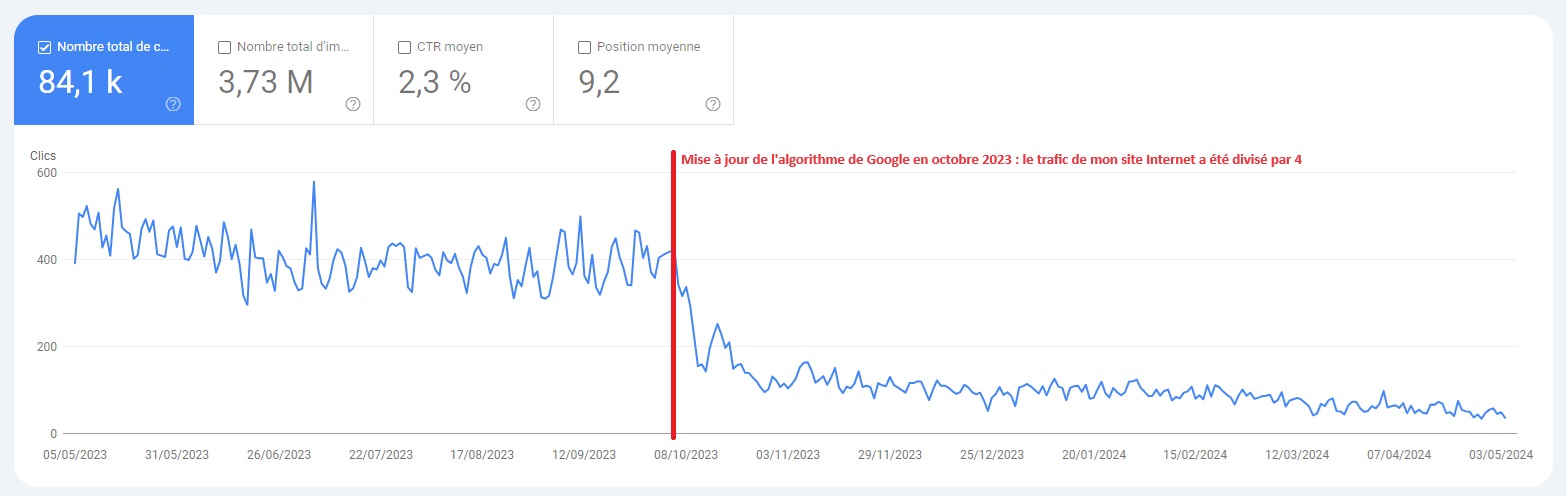
The traffic for my website Diamantes Infos was divided by 4 following the October 2023 updates.
On social networks, other website publishers are also reporting significant drops in website traffic as a result of Google's updates:
https://twitter.com/lr_jordan/status/1775466716652269713
https://twitter.com/JonMiksis/status/1772374109747331548
My Page Impressions Dropped 99% after Google's March Update
Google's core update penalty (October and November) has caused me to lose 80% of my traffic
October Core Update Has Taken Almost 80% Of Search Engine Traffic
Google Is Killing Retro Dodo & Other Independent Sites
Tuta Mail, the world's second largest encrypted email service, lost more than 88% of its traffic on Google in just 30 days: Exclusive: Google rival Tuta complains to EU tech regulators about de-ranking
Google search results, it was better before
For decades, Google has got away with doing whatever they wanted in terms of Internet searches: it has a monopoly, it abuses its dominant position (in terms of the ranking of its own products, the structure of its search results pages and its updates), there is no third-party control (administration, specialist commission, regulator, etc.), Google can undermine free competition between ecommerce businesses with impunity, it has genuine life or death power over our websites, it can wipe out 25 years of editorial work, hard work and professional activity in just 1 update: this is no longer possible, this is no longer acceptable!
This petition is a European citizens' initiative for fairer and more relevant Google search results and updates: everyone is concerned, because by arbitrarily ignoring certain key sites for a specific search, Google is distorting the results of Internet users' searches by prioritising irrelevant results. Everyone loses out: the website because it loses traffic, and the web user because they get inadequate, truncated or unreliable search results.
Key figures
In Europe, e-commerce represents total sales of 900 billion euros.
There are more than 200,000 e-commerce companies in France.
By 2022, 76% of Europe's population will have made online purchases.
Google has a monopoly on Internet search in European countries, with a market share of over 91%. As a result of this monopoly, Google must ensure that it does not distort free competition between European businesses in the e-commerce sector that receive visitors who have clicked on links listed by Google on the results pages of its search engine. Google’s search engine is essential to the economic development of many e-commerce companies and website publishers, so it is vital that they all have the opportunity of receiving visitors from Google.
Definition
SERP (Search Engine Result Page):
The facts
The various updates to Google's algorithm for managing the ranking of natural links in its search engine results are increasingly frequent, opaque and unfair. For many e-commerce companies and website publishers, these updates are a source of anxiety and stress, because they are a form of Russian roulette and sometimes mean the death of their business and their website (and all this happens suddenly, overnight and without any possible recourse).
On the other hand, the positioning of advertising links (sponsored links) first in the SERP, the typography and colour of these advertising links, the structure of the SERPS and the positioning left to natural search engine optimisation links in the SERPS are all subject to discussion and are increasingly harming free competition between e-commerce companies that want to (and can) buy advertising links, and those that cannot (or do not want to) buy advertising links because they have chosen the natural search engine optimisation strategy.
On this page, you'll find all the details, findings, arguments and solutions I propose to resolve these problems.
What are the issues?
The issues are simple: a number of independent publishers' websites have seen a significant deterioration in their performance in the SERPS following the roll-out of Google's latest algorithm updates. This deprives European Internet users of these sources of information, wipes out the editorial work of the publishers of these websites and also harms free competition between e-commerce companies, since some of them are virtually no longer visible in the Google SERPS.
The European Commission is the key to this change
Competition issues are taken very seriously by the European Commission. It has a number of departments that are entirely dedicated to these issues, and which are grouped around the Directorate-General for Competition.
The DMA and DSA are tools created by the European Commission that can be used to force major platforms (mostly American) to change the way they operate when the European Commission considers that they are infringing European competition rules. In other words, the European Commission can force Google to modify its SERPS if it deems it necessary, and Google will have to comply under penalty of fines.
I will be submitting this petition to the European Commission's Directorate-General for Competition and to members of the French government in order to alert them to these issues and ask them to respond favourably to the requests set out below.
What I'm requesting
1) Regarding algorithm updates:
a) I would like Google to clearly indicate in the Google Search Console (GSC) the reasons for a drop in the performance of a website following an update to its algorithm, as soon as this drop in performance exceeds 10%.
b) I would like Google to notify each webmaster via Google Search Console (GSC), at least 1 month before the roll-out of an algorithm update, of any likely future drop in their website's ranking so that the webmaster can take action beforehand and make any necessary corrections to their website.
c) I would like Google to set up technical support for webmasters via the GSC so that they can get precise answers and advice if their website experiences major problems with a drop in performance in the SERPS following an update.
d) I would like all sites that have suffered a performance loss of more than 10% in the last 3 years following an update to be eligible for this technical support.
e) I would like Google to manually improve the ranking of a site that has been downgraded too much in the SERP following an update, provided that the site can demonstrate high quality editorial content and is of real interest to Internet users, which should be confirmed by the opinions of 3 independent experts. A quality website should be visible in the SERP and if Google's algorithm has mistakenly (or unfairly) downgraded it, this is an internal problem resulting from the way Google works, and the website should not suffer the consequences of this problem.
f) I would like Google to display a limited number of elements in the SERP, such as the Featured Snippet, People Also Ask, Local Pack, Knowledge Panel, etc... : I recommend displaying a maximum of 2 elements per request.
2) Regarding the SERP (Search Engine Result Page):
a) Sponsored links should be in a different colour and typography to natural links: they should be easily recognisable at first glance.
b) Use an unambiguous term to define an advertising link: the terms "Ads" and "Sponsored" are not clear enough in the mind of the Internet user to define an advertising link. We recommend that the term "Advertising" be used systematically in search results, as it leaves no room for doubt.
c) Remove all sponsored links that are systematically displayed in the first positions in search results.
d) Mix and display sponsored links with natural links in the same block using a random ranking system (or another system).
e) When an Internet user clicks on a sponsored link, a (pop-up) window appears asking the user for their consent and whether they wish to be redirected to the advertiser's website.
f) I will ask the European Commission to commission a specialist company to carry out an audit of the impact of the presence of sponsored links on the click-through rate of Google's natural link results, and to make this audit public.
3) Regarding editorial work:
Given that the potential benefit (for the site publisher) generated by the placement of a link in one of these 2 elements (" Featured Snippet (Position 0)" andPeople Also Ask") is not guaranteed, and is even controversial, and that there are no reliable and precise statistics to show whether the website publisher gains clicks when Google places a link in one of these 2 elements, I am calling for these 2 elements to be removed from the Google SERP.
Sources
1. Search engine market share in Europe
3. Study on click-through rates depending on Google rankings
4. Impact of the presence of sponsored links on the click-through rate of Google's natural results

165
Le problème
My name is Bruno Pozzera and I am the founder of the website Diamants Infos which is one of the largest diamond information and sales websites. I'm a diamond dealer who is passionate about the world of diamonds, and I've been active on the Internet in this field for over 25 years. I'm also a webmaster and over the years I have developed a very good understanding of how search engines work.
The aim of this petition is to inform and alert Internet users and professionals in the Internet industry about the malfunctions of Google’s search engine and algorithm, which are "killing” off quality websites with impunity and general indifference.
Many people use the Google search engine, but very few of them understand its inner workings or what’s going on behind the scenes.
Everyone is impacted by this, irrespective of whether you're a Google search engine user or an Internet professional.
Google regularly updates its algorithm, enabling it to manage the ranking of different websites in its search engine results pages. Depending on the keywords typed in by the user, Google will then display links in the results pages that users can click on to access these websites.
Following a Google algorithm update, a website can lose a huge amount of traffic overnight as a result of a drop in its ranking in Google's search results. And all this without any prior warning or possible recourse. The website finds itself deprived of a significant amount of traffic, and with just one solution to survive: buying Google ads (Google Ads) in order to win back some of its lost traffic. Not all businesses can (or want to) buy Google ads, especially as buying these ads is very expensive and is done via an auction system: the more you pay, the more visibility you get.
Here's an example of how one of my websites lost traffic following a Google update:
The traffic for my website Diamantes Infos was divided by 4 following the October 2023 updates.
On social networks, other website publishers are also reporting significant drops in website traffic as a result of Google's updates:
https://twitter.com/lr_jordan/status/1775466716652269713
https://twitter.com/JonMiksis/status/1772374109747331548
My Page Impressions Dropped 99% after Google's March Update
Google's core update penalty (October and November) has caused me to lose 80% of my traffic
October Core Update Has Taken Almost 80% Of Search Engine Traffic
Google Is Killing Retro Dodo & Other Independent Sites
Tuta Mail, the world's second largest encrypted email service, lost more than 88% of its traffic on Google in just 30 days: Exclusive: Google rival Tuta complains to EU tech regulators about de-ranking
Google search results, it was better before
For decades, Google has got away with doing whatever they wanted in terms of Internet searches: it has a monopoly, it abuses its dominant position (in terms of the ranking of its own products, the structure of its search results pages and its updates), there is no third-party control (administration, specialist commission, regulator, etc.), Google can undermine free competition between ecommerce businesses with impunity, it has genuine life or death power over our websites, it can wipe out 25 years of editorial work, hard work and professional activity in just 1 update: this is no longer possible, this is no longer acceptable!
This petition is a European citizens' initiative for fairer and more relevant Google search results and updates: everyone is concerned, because by arbitrarily ignoring certain key sites for a specific search, Google is distorting the results of Internet users' searches by prioritising irrelevant results. Everyone loses out: the website because it loses traffic, and the web user because they get inadequate, truncated or unreliable search results.
Key figures
In Europe, e-commerce represents total sales of 900 billion euros.
There are more than 200,000 e-commerce companies in France.
By 2022, 76% of Europe's population will have made online purchases.
Google has a monopoly on Internet search in European countries, with a market share of over 91%. As a result of this monopoly, Google must ensure that it does not distort free competition between European businesses in the e-commerce sector that receive visitors who have clicked on links listed by Google on the results pages of its search engine. Google’s search engine is essential to the economic development of many e-commerce companies and website publishers, so it is vital that they all have the opportunity of receiving visitors from Google.
Definition
SERP (Search Engine Result Page):
The facts
The various updates to Google's algorithm for managing the ranking of natural links in its search engine results are increasingly frequent, opaque and unfair. For many e-commerce companies and website publishers, these updates are a source of anxiety and stress, because they are a form of Russian roulette and sometimes mean the death of their business and their website (and all this happens suddenly, overnight and without any possible recourse).
On the other hand, the positioning of advertising links (sponsored links) first in the SERP, the typography and colour of these advertising links, the structure of the SERPS and the positioning left to natural search engine optimisation links in the SERPS are all subject to discussion and are increasingly harming free competition between e-commerce companies that want to (and can) buy advertising links, and those that cannot (or do not want to) buy advertising links because they have chosen the natural search engine optimisation strategy.
On this page, you'll find all the details, findings, arguments and solutions I propose to resolve these problems.
What are the issues?
The issues are simple: a number of independent publishers' websites have seen a significant deterioration in their performance in the SERPS following the roll-out of Google's latest algorithm updates. This deprives European Internet users of these sources of information, wipes out the editorial work of the publishers of these websites and also harms free competition between e-commerce companies, since some of them are virtually no longer visible in the Google SERPS.
The European Commission is the key to this change
Competition issues are taken very seriously by the European Commission. It has a number of departments that are entirely dedicated to these issues, and which are grouped around the Directorate-General for Competition.
The DMA and DSA are tools created by the European Commission that can be used to force major platforms (mostly American) to change the way they operate when the European Commission considers that they are infringing European competition rules. In other words, the European Commission can force Google to modify its SERPS if it deems it necessary, and Google will have to comply under penalty of fines.
I will be submitting this petition to the European Commission's Directorate-General for Competition and to members of the French government in order to alert them to these issues and ask them to respond favourably to the requests set out below.
What I'm requesting
1) Regarding algorithm updates:
a) I would like Google to clearly indicate in the Google Search Console (GSC) the reasons for a drop in the performance of a website following an update to its algorithm, as soon as this drop in performance exceeds 10%.
b) I would like Google to notify each webmaster via Google Search Console (GSC), at least 1 month before the roll-out of an algorithm update, of any likely future drop in their website's ranking so that the webmaster can take action beforehand and make any necessary corrections to their website.
c) I would like Google to set up technical support for webmasters via the GSC so that they can get precise answers and advice if their website experiences major problems with a drop in performance in the SERPS following an update.
d) I would like all sites that have suffered a performance loss of more than 10% in the last 3 years following an update to be eligible for this technical support.
e) I would like Google to manually improve the ranking of a site that has been downgraded too much in the SERP following an update, provided that the site can demonstrate high quality editorial content and is of real interest to Internet users, which should be confirmed by the opinions of 3 independent experts. A quality website should be visible in the SERP and if Google's algorithm has mistakenly (or unfairly) downgraded it, this is an internal problem resulting from the way Google works, and the website should not suffer the consequences of this problem.
f) I would like Google to display a limited number of elements in the SERP, such as the Featured Snippet, People Also Ask, Local Pack, Knowledge Panel, etc... : I recommend displaying a maximum of 2 elements per request.
2) Regarding the SERP (Search Engine Result Page):
a) Sponsored links should be in a different colour and typography to natural links: they should be easily recognisable at first glance.
b) Use an unambiguous term to define an advertising link: the terms "Ads" and "Sponsored" are not clear enough in the mind of the Internet user to define an advertising link. We recommend that the term "Advertising" be used systematically in search results, as it leaves no room for doubt.
c) Remove all sponsored links that are systematically displayed in the first positions in search results.
d) Mix and display sponsored links with natural links in the same block using a random ranking system (or another system).
e) When an Internet user clicks on a sponsored link, a (pop-up) window appears asking the user for their consent and whether they wish to be redirected to the advertiser's website.
f) I will ask the European Commission to commission a specialist company to carry out an audit of the impact of the presence of sponsored links on the click-through rate of Google's natural link results, and to make this audit public.
3) Regarding editorial work:
Given that the potential benefit (for the site publisher) generated by the placement of a link in one of these 2 elements (" Featured Snippet (Position 0)" andPeople Also Ask") is not guaranteed, and is even controversial, and that there are no reliable and precise statistics to show whether the website publisher gains clicks when Google places a link in one of these 2 elements, I am calling for these 2 elements to be removed from the Google SERP.
Sources
1. Search engine market share in Europe
3. Study on click-through rates depending on Google rankings
4. Impact of the presence of sponsored links on the click-through rate of Google's natural results
Mises à jour sur la pétition
Partager la pétition
Pétition lancée le 13 mai 2024