
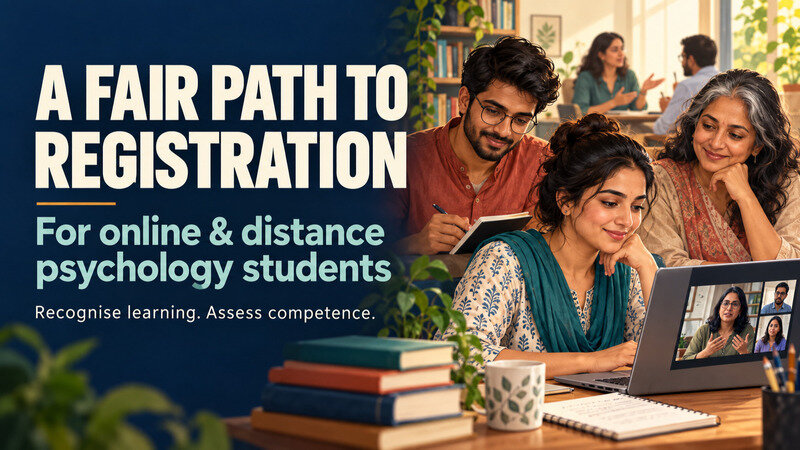
Give Online and Distance Psychology Graduates a Fair Path to Registration
The Issue
Students who enrolled in recognised psychology programmes invested years of study, savings and effort in preparing for their professional futures. They deserve a fair assessment of their education and a practical opportunity to meet the standards required for professional registration.
We call on the National Commission for Allied and Healthcare Professions (NCAHP), the Ministry of Health and Family Welfare, and the University Grants Commission (UGC) to create a fair transition pathway for students and graduates who entered duly recognised online or Open and Distance Learning (ODL) psychology programmes before the July–August 2025 admission session.
The UGC’s notice dated 12 August 2025 prohibited institutions from offering psychology and other programmes covered by the NCAHP Act through online and ODL modes from the July–August 2025 session onwards. The NCAHP Act’s regular-learning requirement and the 2026 registration framework create substantial barriers for earlier online and ODL cohorts seeking professional registration. Students who entered recognised programmes before the admission restriction need a clear answer about how they can qualify.
We recognise that academic recognition and professional registration have different requirements. We also support rigorous professional standards and safeguards for people seeking psychological support. Our request is that the authorities assess the education and supervised experience students have already acquired, explain any gaps, and provide a realistic route to meet the required standards.
Government policy already recognises the value of online learning. Under the UGC’s 2021 SWAYAM framework, institutions may allow up to 40% of the courses offered in a programme in a semester through SWAYAM. This establishes a place for assessed online coursework within university education. Professional standards should therefore explain which competencies require physical attendance and how online theoretical learning will be assessed.
Online and distance programmes can also involve substantial teaching, interaction and assessment. Online learning can include scheduled live classes, faculty discussions, assignments, examinations and monitored participation. The UGC’s online-learning framework provides for assignments, discussion forums and monitoring of learner engagement. A degree’s delivery mode alone cannot describe the quality or extent of a student’s preparation.
Practical training is already part of established ODL psychology curricula. IGNOU’s MA Psychology programme includes laboratory practicals, field internships and research projects. Its internship handbook prescribes at least 240 hours of internship work, carrying eight credits. Where students from online or ODL programmes have completed documented in-person practical work and supervised internships, this preparation deserves assessment and appropriate recognition.
Flexible education also enables participation by working adults, caregivers, people with disabilities and those unable to relocate or afford full-time campus study. The Government’s AISHE 2023–24 report recorded approximately 44 lakh distance-education enrolments, including 21.1 lakh women. These figures cover all subjects and show how widely flexible education is used; they are not a count of affected psychology students.
India needs a competent and accountable mental-health workforce. The National Mental Health Survey 2015–16, cited in the Government’s Economic Survey 2023–24, found mental disorders among 10.6% of adults, with treatment gaps ranging from 70% to 92% across different disorders. Creating accessible opportunities to meet professional standards can contribute to addressing this need.
We ask the authorities to establish explicit transitional protection for students admitted before the July–August 2025 session to psychology programmes recognised or entitled by UGC for their institution, programme, mode and admission session. Protection should follow the admission cohort, including students whose programmes conclude after the restriction began.
Within this transition, applicants’ coursework, practical attendance, internship hours, supervision and assessments should be evaluated against published professional competencies. Verified preparation that meets those standards should receive appropriate credit. Applicants who demonstrate the required preparation should have a legally recognised route to registration, subject to the applicable assessment and other requirements.
Where specific gaps exist, the authorities should provide accredited bridge modules or supervised placements with clear fees, assessment criteria and registration outcomes. Students should not have to repeat education or practical training that already meets the required standards. These opportunities should be affordable, geographically accessible and supported by reasonable accommodations for disability.
The authorities should also publish clear guidance on qualifications, permitted activities, supervision and referral responsibilities for relevant psychology and counselling roles, including educational, workplace and community settings. Any differentiated registration pathway must have a lawful basis and appropriate safeguards for service users.
Finally, we request a joint consultation involving NCAHP, UGC, the relevant ministries, universities, affected students, professional bodies and service users. Where the 2021 Act prevents an appropriate transition arrangement, the Government should initiate the necessary legislative amendment. We ask for a public response within 90 days, followed by an implementation timetable and a process for reviewing individual eligibility decisions.
A fair transition can uphold public safety, recognise education and experience already acquired, and give affected learners a realistic opportunity to qualify.
Please sign this petition to support a transparent, competency-based pathway to professional registration for existing online and distance psychology students and graduates.
Supporting documents:
UGC notice dated 12 August 2025
NCAHP Registration Regulations, 2026
UGC communication on the SWAYAM framework
IGNOU MA Psychology programme and internship handbook
AISHE 2023–24, printed page 59
Government statement on mental health in the Economic Survey 2023–24

647
The Issue
Students who enrolled in recognised psychology programmes invested years of study, savings and effort in preparing for their professional futures. They deserve a fair assessment of their education and a practical opportunity to meet the standards required for professional registration.
We call on the National Commission for Allied and Healthcare Professions (NCAHP), the Ministry of Health and Family Welfare, and the University Grants Commission (UGC) to create a fair transition pathway for students and graduates who entered duly recognised online or Open and Distance Learning (ODL) psychology programmes before the July–August 2025 admission session.
The UGC’s notice dated 12 August 2025 prohibited institutions from offering psychology and other programmes covered by the NCAHP Act through online and ODL modes from the July–August 2025 session onwards. The NCAHP Act’s regular-learning requirement and the 2026 registration framework create substantial barriers for earlier online and ODL cohorts seeking professional registration. Students who entered recognised programmes before the admission restriction need a clear answer about how they can qualify.
We recognise that academic recognition and professional registration have different requirements. We also support rigorous professional standards and safeguards for people seeking psychological support. Our request is that the authorities assess the education and supervised experience students have already acquired, explain any gaps, and provide a realistic route to meet the required standards.
Government policy already recognises the value of online learning. Under the UGC’s 2021 SWAYAM framework, institutions may allow up to 40% of the courses offered in a programme in a semester through SWAYAM. This establishes a place for assessed online coursework within university education. Professional standards should therefore explain which competencies require physical attendance and how online theoretical learning will be assessed.
Online and distance programmes can also involve substantial teaching, interaction and assessment. Online learning can include scheduled live classes, faculty discussions, assignments, examinations and monitored participation. The UGC’s online-learning framework provides for assignments, discussion forums and monitoring of learner engagement. A degree’s delivery mode alone cannot describe the quality or extent of a student’s preparation.
Practical training is already part of established ODL psychology curricula. IGNOU’s MA Psychology programme includes laboratory practicals, field internships and research projects. Its internship handbook prescribes at least 240 hours of internship work, carrying eight credits. Where students from online or ODL programmes have completed documented in-person practical work and supervised internships, this preparation deserves assessment and appropriate recognition.
Flexible education also enables participation by working adults, caregivers, people with disabilities and those unable to relocate or afford full-time campus study. The Government’s AISHE 2023–24 report recorded approximately 44 lakh distance-education enrolments, including 21.1 lakh women. These figures cover all subjects and show how widely flexible education is used; they are not a count of affected psychology students.
India needs a competent and accountable mental-health workforce. The National Mental Health Survey 2015–16, cited in the Government’s Economic Survey 2023–24, found mental disorders among 10.6% of adults, with treatment gaps ranging from 70% to 92% across different disorders. Creating accessible opportunities to meet professional standards can contribute to addressing this need.
We ask the authorities to establish explicit transitional protection for students admitted before the July–August 2025 session to psychology programmes recognised or entitled by UGC for their institution, programme, mode and admission session. Protection should follow the admission cohort, including students whose programmes conclude after the restriction began.
Within this transition, applicants’ coursework, practical attendance, internship hours, supervision and assessments should be evaluated against published professional competencies. Verified preparation that meets those standards should receive appropriate credit. Applicants who demonstrate the required preparation should have a legally recognised route to registration, subject to the applicable assessment and other requirements.
Where specific gaps exist, the authorities should provide accredited bridge modules or supervised placements with clear fees, assessment criteria and registration outcomes. Students should not have to repeat education or practical training that already meets the required standards. These opportunities should be affordable, geographically accessible and supported by reasonable accommodations for disability.
The authorities should also publish clear guidance on qualifications, permitted activities, supervision and referral responsibilities for relevant psychology and counselling roles, including educational, workplace and community settings. Any differentiated registration pathway must have a lawful basis and appropriate safeguards for service users.
Finally, we request a joint consultation involving NCAHP, UGC, the relevant ministries, universities, affected students, professional bodies and service users. Where the 2021 Act prevents an appropriate transition arrangement, the Government should initiate the necessary legislative amendment. We ask for a public response within 90 days, followed by an implementation timetable and a process for reviewing individual eligibility decisions.
A fair transition can uphold public safety, recognise education and experience already acquired, and give affected learners a realistic opportunity to qualify.
Please sign this petition to support a transparent, competency-based pathway to professional registration for existing online and distance psychology students and graduates.
Supporting documents:
UGC notice dated 12 August 2025
NCAHP Registration Regulations, 2026
UGC communication on the SWAYAM framework
IGNOU MA Psychology programme and internship handbook
AISHE 2023–24, printed page 59
Government statement on mental health in the Economic Survey 2023–24
The Decision Makers

Petition Updates
Share this petition
Petition created on 2 October 2026