
Fund a Future for People Living with Epidermolysis Bullosa (EB)
The Issue
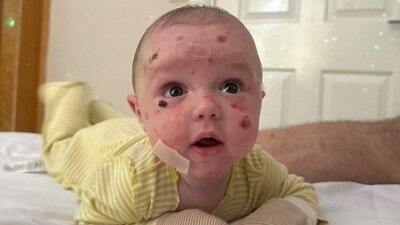
In March 2026, my world forever changed when my son Ralph was born with Junctional Epidermolysis Bullosa (JEB). His skin is so fragile that everyday friction can cause painful blisters and open wounds. Since the moment he was born, our family has had to learn an entirely different way of caring for our baby - how we hold him, dress him, change him and even how we celebrate milestones like rolling over, knowing that normal movement can result in another wound.
EB itself is rare, affecting only a small number of people worldwide. Ralph’s particular form of JEB, caused by COL17A1, is rarer still.
There is currently no cure, and treatment largely focuses on managing wounds, preventing infection and controlling pain. Families across the EB community live with repeated blistering, long dressing changes, hospital appointments, painful procedures and the heartbreaking reality that everyday life itself can cause injury.
When I began this campaign, it was about Ralph. I was a mum desperately searching for something that could give my son a better future. But the more I learned, the more people I met and the more stories I heard, I realised this fight had become so much bigger than our family.
There is an entire community of people with EB who have been fighting quietly for years. They have been overlooked for too long, and we need to be a voice for them.
Despite the enormous impact EB can have, research still relies heavily on charitable funding. DEBRA UK, one of the leading funders of EB research, has repeatedly highlighted the need for greater investment in treatments and research. Promising work is already taking place in areas including gene therapy, RNA-based treatments and regenerative medicine - but researchers need the funding and support to turn scientific breakthroughs into treatments that actually reach patients.
We are asking the UK Government, Department of Health and Social Care, NHS England and UK research funding bodies to:
- Increase dedicated funding for Epidermolysis Bullosa research, including gene, RNA, protein and regenerative therapies, and help promising research move more quickly towards human clinical trials.
- Create clearer pathways for people with rare diseases to access emerging treatments and clinical trials, including international research where appropriate.
- Strengthen EB education across the NHS, particularly within maternity, neonatal, paediatric, emergency and community care, so healthcare professionals understand the warning signs of EB, how to handle fragile skin safely and how to access specialist advice quickly.
- Work directly with EB patients, families, specialist clinicians, charities and researchers when deciding where funding and resources are directed.
The UK has brilliant scientists, clinicians and researchers. Why should we wait for another country to pioneer the treatments our children desperately need and then hope we can buy them, when we could help pioneer them ourselves?
Ralph is the reason I started.
But now I am fighting for every child and adult living with EB, every family changing painful dressings tonight, and every baby still to be born with this condition.
Rare should never mean forgotten.
This campaign began with a UK Parliament petition, which is still live and remains an important route for UK residents to formally show their support. This Change.org petition is the next phase - allowing us to build a wider movement, keep supporters updated, and continue pushing for meaningful action for people living with EB.
🇬🇧 If you’re in the UK, please sign both petitions.
https://petition.parliament.uk/petitions/775393
🌍 If you’re outside the UK, please sign this one to show your support for Ralph and the wider EB community.
Every signature helps us show just how many people want change. 🦋
498
The Issue
In March 2026, my world forever changed when my son Ralph was born with Junctional Epidermolysis Bullosa (JEB). His skin is so fragile that everyday friction can cause painful blisters and open wounds. Since the moment he was born, our family has had to learn an entirely different way of caring for our baby - how we hold him, dress him, change him and even how we celebrate milestones like rolling over, knowing that normal movement can result in another wound.
EB itself is rare, affecting only a small number of people worldwide. Ralph’s particular form of JEB, caused by COL17A1, is rarer still.
There is currently no cure, and treatment largely focuses on managing wounds, preventing infection and controlling pain. Families across the EB community live with repeated blistering, long dressing changes, hospital appointments, painful procedures and the heartbreaking reality that everyday life itself can cause injury.
When I began this campaign, it was about Ralph. I was a mum desperately searching for something that could give my son a better future. But the more I learned, the more people I met and the more stories I heard, I realised this fight had become so much bigger than our family.
There is an entire community of people with EB who have been fighting quietly for years. They have been overlooked for too long, and we need to be a voice for them.
Despite the enormous impact EB can have, research still relies heavily on charitable funding. DEBRA UK, one of the leading funders of EB research, has repeatedly highlighted the need for greater investment in treatments and research. Promising work is already taking place in areas including gene therapy, RNA-based treatments and regenerative medicine - but researchers need the funding and support to turn scientific breakthroughs into treatments that actually reach patients.
We are asking the UK Government, Department of Health and Social Care, NHS England and UK research funding bodies to:
- Increase dedicated funding for Epidermolysis Bullosa research, including gene, RNA, protein and regenerative therapies, and help promising research move more quickly towards human clinical trials.
- Create clearer pathways for people with rare diseases to access emerging treatments and clinical trials, including international research where appropriate.
- Strengthen EB education across the NHS, particularly within maternity, neonatal, paediatric, emergency and community care, so healthcare professionals understand the warning signs of EB, how to handle fragile skin safely and how to access specialist advice quickly.
- Work directly with EB patients, families, specialist clinicians, charities and researchers when deciding where funding and resources are directed.
The UK has brilliant scientists, clinicians and researchers. Why should we wait for another country to pioneer the treatments our children desperately need and then hope we can buy them, when we could help pioneer them ourselves?
Ralph is the reason I started.
But now I am fighting for every child and adult living with EB, every family changing painful dressings tonight, and every baby still to be born with this condition.
Rare should never mean forgotten.
This campaign began with a UK Parliament petition, which is still live and remains an important route for UK residents to formally show their support. This Change.org petition is the next phase - allowing us to build a wider movement, keep supporters updated, and continue pushing for meaningful action for people living with EB.
🇬🇧 If you’re in the UK, please sign both petitions.
https://petition.parliament.uk/petitions/775393
🌍 If you’re outside the UK, please sign this one to show your support for Ralph and the wider EB community.
Every signature helps us show just how many people want change. 🦋
The Decision Makers

Supporter Voices
Petition Updates
Share this petition
Petition created on 10 September 2026