FACTS ON OATHS - LIVE TONIGHT 8PM MTN ON TELEGRAM: FDALethal22

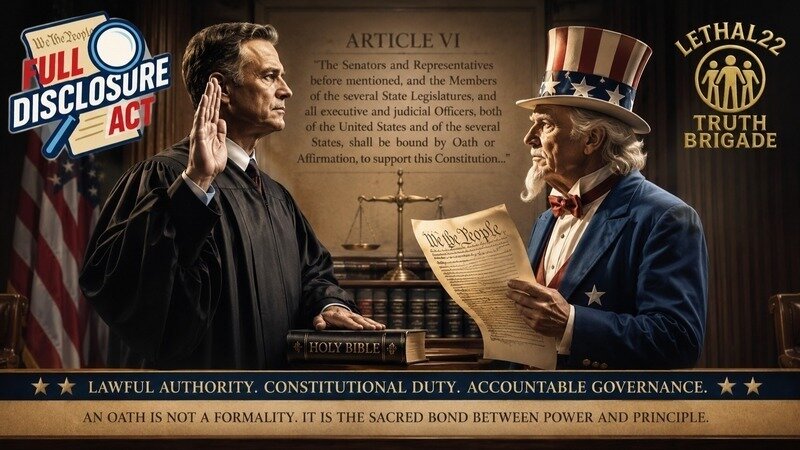
The Oath of Office and the Lawful Exercise of Judicial Authority
Constitutional Qualification, Due Process, and the De Facto Officer Doctrine
The oath of office is often perceived as ceremonial in nature. However, under both federal and state law, the oath serves a substantive constitutional function: it formally binds public officers to the Constitution and the lawful exercise of governmental authority.
The requirement is not merely symbolic. Rather, it reflects the principle that sovereign power derives from law, not from the individual occupying an office.
Questions regarding whether a public officer properly qualified for office may implicate issues of due process, statutory compliance, and the lawful exercise of authority—particularly where such issues are timely raised by a litigant.
I. Constitutional Foundation of the Oath Requirement
The United States Constitution expressly requires public officers to be bound by oath or affirmation. Article VI, Clause 3 provides:
“The Senators and Representatives before mentioned, and the Members of the several State Legislatures, and all executive and judicial Officers, both of the United States and of the several States, shall be bound by Oath or Affirmation, to support this Constitution.”
This provision reflects the Framers’ intent that governmental authority remain subordinate to constitutional limitations. The oath requirement is unique in that it expressly extends to both federal and state officers, reinforcing the supremacy of constitutional governance.
In Marbury v. Madison, the Supreme Court recognized that governmental authority derives from adherence to constitutional and legal prerequisites. While Marbury principally addressed commissions and judicial review, it established the foundational principle that acts inconsistent with constitutional requirements may be legally defective.
The oath requirement therefore functions as part of the constitutional structure through which public officers formally assume the obligations of office.
II. Federal Statutory Requirements
Congress codified the federal oath requirement in 5 U.S.C. § 3331, which requires officers of the United States to swear or affirm that they will “support and defend the Constitution of the United States against all enemies, foreign and domestic.”
Federal law also reflects the importance of integrity in official records. For example, 18 U.S.C. § 1018 imposes penalties relating to knowingly false certifications or official writings. Although not directed specifically at oath filings, the statute reflects Congress’s expectation that official governmental records be maintained accurately and lawfully.
The oath requirement bears a direct relationship to constitutional due process principles. Under the Fourteenth Amendment, individuals may not be deprived of life, liberty, or property without due process of law. Due process includes the right to proceedings conducted before a lawful and impartial tribunal.
In In re Murchison, the Supreme Court stated:
“A fair trial in a fair tribunal is a basic requirement of due process.”
Where substantial questions exist regarding whether an officer properly qualified for office under governing law, litigants may raise legitimate due process concerns regarding the lawful exercise of governmental authority.
III. New York Constitutional and Statutory Requirements
New York law contains detailed requirements concerning the taking and filing of official oaths.
A. New York Constitution
Article XIII, Section 1 of the New York Constitution prescribes the constitutional oath applicable to public officers within the State.
B. Public Officers Law § 10
New York Public Officers Law § 10 requires public officers not only to take the oath of office, but also to file the oath with the appropriate governmental office within the statutory timeframe.
New York law distinguishes between:
1. the act of taking the oath; and
2. the filing and recording of the oath.
The filing requirement serves an evidentiary and public accountability function by creating an official record establishing qualification for office.
C. Public Officers Law § 30
New York Public Officers Law § 30(1)(h) provides that an office may become vacant upon an officer’s refusal or neglect to timely file the required oath or undertaking.
New York courts have recognized that the statute operates automatically under certain circumstances. See, e.g., Matter of Lewis v. Board of Education and Appel v. Halverson, 297 A.D.2d 792 (2002).
At the same time, courts generally distinguish between statutory defects in qualification and wholesale invalidation of governmental acts. Whether a defect renders specific acts void, voidable, or subject to later challenge depends upon the procedural posture of the case, the timing of the objection, and application of related doctrines such as the de facto officer doctrine.
IV. The De Facto Officer Doctrine
Courts have long recognized the de facto officer doctrine to preserve governmental continuity and avoid widespread disruption where an officer’s title may later be challenged.
Under this doctrine, acts performed by an officer acting under color of authority are often treated as valid with respect to the public and third parties, notwithstanding later-discovered defects in appointment or qualification.
The United States Supreme Court addressed the doctrine in Ryder v. United States. Ryder recognized that litigants who timely raise constitutional or statutory objections to an officer’s authority may preserve those challenges for judicial review.
Accordingly, while courts are often reluctant to invalidate governmental actions retroactively, timely challenges concerning constitutional qualification requirements may nevertheless present substantial legal questions warranting judicial examination.
V. Due Process and Judicial Authority
The lawful exercise of judicial authority is fundamental to due process. Courts possess subject matter jurisdiction through constitutional and statutory grant; however, litigants may still challenge whether a particular officer lawfully exercised that authority in conformity with statutory qualification requirements.
Accordingly, courts frequently distinguish between:
• jurisdiction of the court itself; and
• the legal qualification of the individual officer presiding over the matter.
A challenge relating to oath compliance therefore may not necessarily divest the court of subject matter jurisdiction, but may still raise significant questions regarding:
• lawful authority,
• statutory compliance,
• procedural regularity,
• and due process.
These concerns may become particularly important where the objection is raised timely during ongoing proceedings rather than after final judgment.
VI. Application in Foreclosure and Civil Proceedings
In foreclosure and other civil proceedings affecting significant property rights, litigants occasionally raise challenges regarding whether public officials properly qualified for office under applicable constitutional or statutory provisions.
Under New York CPLR 5015(a)(4), a judgment may be challenged for lack of jurisdiction or other substantial procedural defects. Although courts generally apply the de facto officer doctrine cautiously to preserve stability of judgments, timely-raised concerns regarding qualification or authority may still warrant judicial review depending upon the circumstances presented.
Similarly, standing and capacity principles remain central to foreclosure litigation. In Banc of Am. Mtge. Capital Corp. v. Hasan, 138 A.D.3d 903 (2d Dept. 2016), the court emphasized that a party seeking foreclosure must establish lawful standing and authority to proceed.
While courts generally do not equate every technical defect with a jurisdictional failure, the broader constitutional principle remains that governmental and judicial power must be exercised in conformity with governing law.
VII. Conclusion
The oath of office serves an important constitutional and statutory function within American jurisprudence. It reflects the principle that public authority derives not from the individual officeholder, but from lawful compliance with constitutional structure and legal prerequisites.
Both federal and New York law recognize the importance of oath requirements, qualification procedures, and public accountability in the lawful exercise of governmental power.
At the same time, courts have developed doctrines such as the de facto officer doctrine to balance constitutional compliance with institutional stability. As a result, challenges relating to oath compliance are often highly fact-specific and depend upon considerations including:
• timeliness of the objection,
• nature of the alleged defect,
• statutory language,
• and applicable due process concerns.
Ultimately, the constitutional significance of the oath lies in its role as a formal public commitment that governmental power will be exercised lawfully, impartially, and subject to the Constitution itself.
Look forward to chatting with you tonight and every Sunday evening at 8pm MTN TIME on Telegram App: FDALethal22 where we discuss how to expose and eradicate the clandestine criminal cabal that rules our world.
Much Love
Stephen Gladstone
www.Lethal22.com "Truth Threads"