From Olmstead To Homestead
From Olmstead To Homestead
The Issue
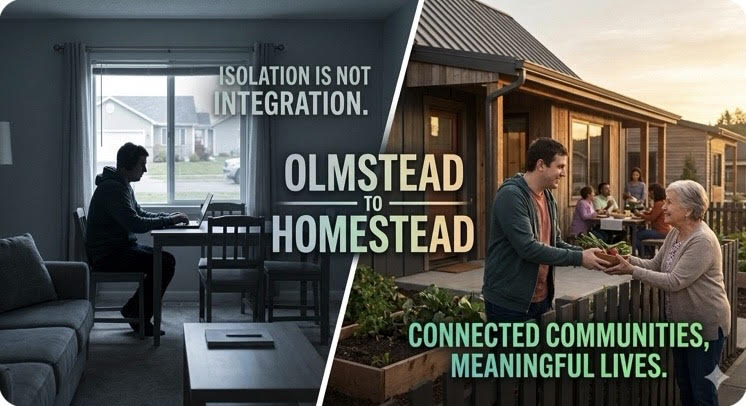
We have come a long way since Olmstead in the 1980s, calling an end to large, neurotypical-run, restrictive institutions that clustered disabled people. They were since moved into the community. Many autistic people now have their legal, medical, residential, educational, and occupational needs met. Paradoxically however, now being separated from each other, many autistic people are still functionally in solitary confinement. Friendship is easier between autistic people. Studies show that autistic people are 10-12x more likely to date other autistic people, and we are only 3% of the population. If a prisoner is intentionally put in solitary confinement, or if an animal is intentionally isolated from its species in solitary confinement, this would be considered cruel and unusual. For autistic people however, this is a reality. Visitation is often a right in parental custodial cases, and prisons have extended family visits. Many of us autists attend support groups, social groups, and social events, and use social networks and dating sites specifically for autistic people - not for family members of autistic people, people open to us, or non-autistic people with other disabilities, but specifically for each other. However, in-person is more effective than online, and the groups are few, seldom, and geographically far. We believe that a permanently settled intentional community of autistic adults will thus be cheaper and more effective long-term than hosting and car-pooling us to each other’s groups and events in different cities; in that it will be more sustainable, self-sufficient, efficient, and stable. To help us agree on one place to settle, and to avoid the devolving back into or appearing like a pre-Olmstead institution, houses should be mortgaged at reduced costs to independent autistic adults. Such an initial project will build momentum for more independent autistic adults to move to houses or apartments there even without such financial help. While financial residential assistance exists, giving such assistance - or even an incentive to those in social need who do not need financial assistance - will help us move near each other. This will be an affirmative furtherance of housing for a unique social need.
Reasons:
• Friendship
• Romance: 73% of autistic adults express a strong interest in dating, yet only 32% have been in a relationship. Autistic adults report more loneliness than neurotypical adults. Relationship satisfaction between two autists is similar to that between two neurotypicals.
• Autistic people can talk to each other about their special interests to start businesses or non-profit causes together.
• Autistic people experience stress from condescension by others who do not understand them.
• More independent autistic neighbors will make socializing easier for their executive functioning - practically no commute, and less activation/transition energy.
• People will also not be stressed with the pressure of having to ask someone to hang out or on a date in the next conversation for fear of less opportunities. By already being proximate, they can relax in a more natural environment.
• They will be less likely to be taken advantage of by others.
• Autistic people can also build a support network to help each other financially, with advice, and otherwise.
• This community will also solve any problems that are more apparent between two autistic people, by moving interactions from online to in-person to remove misunderstandings. Autists who are both experienced with these troubles can develop ways to work together.
• The houses can be specially designed as more conducive (such as with closed front and back porches).
• It will meet sensory needs.
• As a minority, autistic people report more stress due to being misunderstood, discriminated against, and bullied; and the stress causes other medical problems and distracts from other aspects of life, when people can socialize and relate here with less energy.
Eligibility:
• Must be an independent autistic adult who has already been both an American citizen and resident of New York State for at least one year; or a married couple in which at least one spouse is.
• However, one-person mortgages should be prioritized as they will likely be the case, and will demonstrate more of an unmet social need.
• The reason for requiring American citizenship instead of merely permanent residency let alone a visa, is for likelihood of remaining, and legality of owning land.
• Must be formally diagnosed as autistic, to effectively ensure compatibility and prevent people from lying to get reduced mortgages.
• The reason for requiring specifically independent adults is for their compatibility with each other; their willingness, ability, and motivation to move to and stably remain in the community and socialize with each other; to prevent the institutional vibe; and the ability to pay mortgages that will prevent such a vibe.
• It shall be in Erie County, as it is the most populous part of the state with cheap land, and the cheapest populous part of the state. This will make building new proximate houses instead of an apartment edifice easier, while being near an already large population. This will attract autistic adults from the whole state.
• They shall be separate but contiguous lots with homesteads with the one condition of not residing, renting, or owning elsewhere for one decade, and prohibits renting out or resale of the house until then. After the decade, the house is unconditionally theirs after having paid the mortgage.
• This initial program will encourage more residents and non-residents of New York State to move to and begin residency in the area. Deprioritized eligibility might also be given to American citizens who are not already New York State residents, at a greater cost than this but still cheap.
Summary:
People often gas-light us, telling us that we do not need friends or significant others who are also autistic, but the same people who say that are not willing to befriend or date us. We do not ask for a community to pass judgment in telling one another to not socialize with neurotypicals; we are only diagnosing a symptom of an already existing problem, and saying how much more awesome it will be if we can be in our natural habitat with people who are like-minded. Unfortunately, while society portrays not judging people as admirable, the reality is that people often exclude people who are different from them, and social and romantic standards are greater albeit involuntary. Neurotypicals already have the privilege of 97% of people being their same neurotype in daily interactions, without having to wait years between opportunities. All we ask is for that same opportunity, of at least an equal percentage of autistic people. I believe that this will help us with the last forefront of living fulfilling lives.

47
The Issue
We have come a long way since Olmstead in the 1980s, calling an end to large, neurotypical-run, restrictive institutions that clustered disabled people. They were since moved into the community. Many autistic people now have their legal, medical, residential, educational, and occupational needs met. Paradoxically however, now being separated from each other, many autistic people are still functionally in solitary confinement. Friendship is easier between autistic people. Studies show that autistic people are 10-12x more likely to date other autistic people, and we are only 3% of the population. If a prisoner is intentionally put in solitary confinement, or if an animal is intentionally isolated from its species in solitary confinement, this would be considered cruel and unusual. For autistic people however, this is a reality. Visitation is often a right in parental custodial cases, and prisons have extended family visits. Many of us autists attend support groups, social groups, and social events, and use social networks and dating sites specifically for autistic people - not for family members of autistic people, people open to us, or non-autistic people with other disabilities, but specifically for each other. However, in-person is more effective than online, and the groups are few, seldom, and geographically far. We believe that a permanently settled intentional community of autistic adults will thus be cheaper and more effective long-term than hosting and car-pooling us to each other’s groups and events in different cities; in that it will be more sustainable, self-sufficient, efficient, and stable. To help us agree on one place to settle, and to avoid the devolving back into or appearing like a pre-Olmstead institution, houses should be mortgaged at reduced costs to independent autistic adults. Such an initial project will build momentum for more independent autistic adults to move to houses or apartments there even without such financial help. While financial residential assistance exists, giving such assistance - or even an incentive to those in social need who do not need financial assistance - will help us move near each other. This will be an affirmative furtherance of housing for a unique social need.
Reasons:
• Friendship
• Romance: 73% of autistic adults express a strong interest in dating, yet only 32% have been in a relationship. Autistic adults report more loneliness than neurotypical adults. Relationship satisfaction between two autists is similar to that between two neurotypicals.
• Autistic people can talk to each other about their special interests to start businesses or non-profit causes together.
• Autistic people experience stress from condescension by others who do not understand them.
• More independent autistic neighbors will make socializing easier for their executive functioning - practically no commute, and less activation/transition energy.
• People will also not be stressed with the pressure of having to ask someone to hang out or on a date in the next conversation for fear of less opportunities. By already being proximate, they can relax in a more natural environment.
• They will be less likely to be taken advantage of by others.
• Autistic people can also build a support network to help each other financially, with advice, and otherwise.
• This community will also solve any problems that are more apparent between two autistic people, by moving interactions from online to in-person to remove misunderstandings. Autists who are both experienced with these troubles can develop ways to work together.
• The houses can be specially designed as more conducive (such as with closed front and back porches).
• It will meet sensory needs.
• As a minority, autistic people report more stress due to being misunderstood, discriminated against, and bullied; and the stress causes other medical problems and distracts from other aspects of life, when people can socialize and relate here with less energy.
Eligibility:
• Must be an independent autistic adult who has already been both an American citizen and resident of New York State for at least one year; or a married couple in which at least one spouse is.
• However, one-person mortgages should be prioritized as they will likely be the case, and will demonstrate more of an unmet social need.
• The reason for requiring American citizenship instead of merely permanent residency let alone a visa, is for likelihood of remaining, and legality of owning land.
• Must be formally diagnosed as autistic, to effectively ensure compatibility and prevent people from lying to get reduced mortgages.
• The reason for requiring specifically independent adults is for their compatibility with each other; their willingness, ability, and motivation to move to and stably remain in the community and socialize with each other; to prevent the institutional vibe; and the ability to pay mortgages that will prevent such a vibe.
• It shall be in Erie County, as it is the most populous part of the state with cheap land, and the cheapest populous part of the state. This will make building new proximate houses instead of an apartment edifice easier, while being near an already large population. This will attract autistic adults from the whole state.
• They shall be separate but contiguous lots with homesteads with the one condition of not residing, renting, or owning elsewhere for one decade, and prohibits renting out or resale of the house until then. After the decade, the house is unconditionally theirs after having paid the mortgage.
• This initial program will encourage more residents and non-residents of New York State to move to and begin residency in the area. Deprioritized eligibility might also be given to American citizens who are not already New York State residents, at a greater cost than this but still cheap.
Summary:
People often gas-light us, telling us that we do not need friends or significant others who are also autistic, but the same people who say that are not willing to befriend or date us. We do not ask for a community to pass judgment in telling one another to not socialize with neurotypicals; we are only diagnosing a symptom of an already existing problem, and saying how much more awesome it will be if we can be in our natural habitat with people who are like-minded. Unfortunately, while society portrays not judging people as admirable, the reality is that people often exclude people who are different from them, and social and romantic standards are greater albeit involuntary. Neurotypicals already have the privilege of 97% of people being their same neurotype in daily interactions, without having to wait years between opportunities. All we ask is for that same opportunity, of at least an equal percentage of autistic people. I believe that this will help us with the last forefront of living fulfilling lives.
47
The Decision Makers


Petition Updates
Share this petition
Petition created on April 9, 2026