
Fix the SNAP Math: Fund the Diet the USDA Already Priced
The Issue
I’m an Army veteran and a biology student in Ohio. I made a video breaking down the math on SNAP and it hit a nerve. Here’s the full case, with receipts. Every number below comes from the government’s own publications.
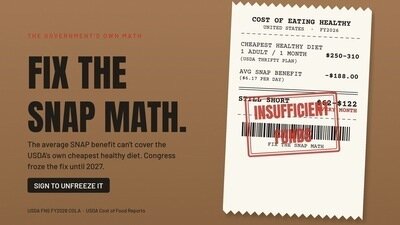
Start with what SNAP actually pays. The average benefit in fiscal year 2026 is about $188 per person per month. That is $6.17 a day. The maximum, which only households with essentially no net income receive, is $298 for one person and $994 for a family of four. Everyone else gets less, because the formula subtracts 30 percent of your net income from the maximum. The program is built on the assumption that you are already spending nearly a third of your own money on food.
Now compare that to what the USDA says food costs. The USDA publishes four food plans every month: Thrifty, Low-Cost, Moderate, and Liberal. All four describe the same nutritious diet at different spending levels. The cheapest one, the Thrifty Food Plan, currently prices a bare-minimum healthy diet at roughly $250 to $310 per adult per month, and the USDA says to add 20 percent for a person living alone. The next tier up, Low-Cost, runs $323 to $371. So the government’s own cheapest healthy diet costs more than the government’s average benefit. That is the entire problem in one sentence.
It gets worse. Congress recently made this gap permanent. The One Big Beautiful Bill Act, signed July 4, 2025, prohibits the USDA from updating the Thrifty Food Plan for anything except inflation. The next reevaluation cannot happen before October 1, 2027, and the law says it “shall not increase the cost of the thrifty food plan.” Read that again. Even if the USDA’s own data proves food costs more than the model assumes, the USDA is legally barred from fixing the number. The 2018 Farm Bill (7 U.S.C. 2012(u)) requires a reevaluation every five years precisely so the model stays honest. The last real one, in 2021, was the first true update since 1975, and it found the model badly out of date. The Congressional Budget Office projects the new inflation-only cap will cut the average benefit by about $15 per person per month by 2034. And in 2024, before the cap even took hold, benefits already failed to cover the cost of a modestly priced meal in 99 percent of U.S. counties, falling about $53 per person per month short.
Meanwhile, the political energy is going to banning soda and candy. Twenty-two states now have USDA waivers restricting what SNAP recipients can buy. My own state, Ohio, starts its sugary drink ban October 1, 2026. I am not here to defend soda as health food. I am here to tell you the ban is backwards. Sweets are cheap because cheap calories are what a six-dollar-a-day budget buys.
The USDA’s own research found that the barrier to healthy eating for SNAP families is affordability, not knowledge. Controlled trials of soda restrictions in 2016 and 2024 found no significant improvement in diet quality. A candy ban does not put produce in a cart. Money does. Courts have already paused at least one state’s ban. If Congress wants people eating the diet the USDA designed, it should fund the diet the USDA designed. Anything else is theater.
And about the viral hearing clips this all started from. What I watched was a member of Congress grilling a program witness about nutrition philosophy when her actual job was getting benefits calculated and delivered to the people who qualify. That is not oversight. That is content farming, and both parties do it. Real oversight would put the USDA’s food plan economists, state administrators, and actual SNAP recipients under oath, put the department’s own published numbers on the record, and ask questions built to get answers instead of clips.
Federal law is blunt about what this program is for. The Food and Nutrition Act, 7 U.S.C. 2011, declares that the policy of Congress is to safeguard the health and well-being of the nation’s population by raising levels of nutrition among low-income households. Congress wrote that purpose down. Congress is now legislating directly against it.
So here is what I am asking Congress to do:
Repeal the OBBBA provision that locks Thrifty Food Plan updates to inflation only, so the October 2027 reevaluation can reflect what food actually costs.
Set SNAP allotments to the real, current cost of a nutritious diet as measured by the USDA’s own monthly Cost of Food reports.
End the purchase-restriction theater. No federal food bans and no new state waivers while benefits cannot cover a full month of groceries. Restriction without adequacy just means less food.
Hold honest, data-first hearings on benefit adequacy before the 2027 reevaluation, with USDA economists, state administrators, and SNAP recipients as the witnesses.
I am not asking for luxury. I am asking Congress to make SNAP do the one thing the law says it exists to do. Sign if you agree, then send this to your representative and your senators.

382
The Issue
I’m an Army veteran and a biology student in Ohio. I made a video breaking down the math on SNAP and it hit a nerve. Here’s the full case, with receipts. Every number below comes from the government’s own publications.
Start with what SNAP actually pays. The average benefit in fiscal year 2026 is about $188 per person per month. That is $6.17 a day. The maximum, which only households with essentially no net income receive, is $298 for one person and $994 for a family of four. Everyone else gets less, because the formula subtracts 30 percent of your net income from the maximum. The program is built on the assumption that you are already spending nearly a third of your own money on food.
Now compare that to what the USDA says food costs. The USDA publishes four food plans every month: Thrifty, Low-Cost, Moderate, and Liberal. All four describe the same nutritious diet at different spending levels. The cheapest one, the Thrifty Food Plan, currently prices a bare-minimum healthy diet at roughly $250 to $310 per adult per month, and the USDA says to add 20 percent for a person living alone. The next tier up, Low-Cost, runs $323 to $371. So the government’s own cheapest healthy diet costs more than the government’s average benefit. That is the entire problem in one sentence.
It gets worse. Congress recently made this gap permanent. The One Big Beautiful Bill Act, signed July 4, 2025, prohibits the USDA from updating the Thrifty Food Plan for anything except inflation. The next reevaluation cannot happen before October 1, 2027, and the law says it “shall not increase the cost of the thrifty food plan.” Read that again. Even if the USDA’s own data proves food costs more than the model assumes, the USDA is legally barred from fixing the number. The 2018 Farm Bill (7 U.S.C. 2012(u)) requires a reevaluation every five years precisely so the model stays honest. The last real one, in 2021, was the first true update since 1975, and it found the model badly out of date. The Congressional Budget Office projects the new inflation-only cap will cut the average benefit by about $15 per person per month by 2034. And in 2024, before the cap even took hold, benefits already failed to cover the cost of a modestly priced meal in 99 percent of U.S. counties, falling about $53 per person per month short.
Meanwhile, the political energy is going to banning soda and candy. Twenty-two states now have USDA waivers restricting what SNAP recipients can buy. My own state, Ohio, starts its sugary drink ban October 1, 2026. I am not here to defend soda as health food. I am here to tell you the ban is backwards. Sweets are cheap because cheap calories are what a six-dollar-a-day budget buys.
The USDA’s own research found that the barrier to healthy eating for SNAP families is affordability, not knowledge. Controlled trials of soda restrictions in 2016 and 2024 found no significant improvement in diet quality. A candy ban does not put produce in a cart. Money does. Courts have already paused at least one state’s ban. If Congress wants people eating the diet the USDA designed, it should fund the diet the USDA designed. Anything else is theater.
And about the viral hearing clips this all started from. What I watched was a member of Congress grilling a program witness about nutrition philosophy when her actual job was getting benefits calculated and delivered to the people who qualify. That is not oversight. That is content farming, and both parties do it. Real oversight would put the USDA’s food plan economists, state administrators, and actual SNAP recipients under oath, put the department’s own published numbers on the record, and ask questions built to get answers instead of clips.
Federal law is blunt about what this program is for. The Food and Nutrition Act, 7 U.S.C. 2011, declares that the policy of Congress is to safeguard the health and well-being of the nation’s population by raising levels of nutrition among low-income households. Congress wrote that purpose down. Congress is now legislating directly against it.
So here is what I am asking Congress to do:
Repeal the OBBBA provision that locks Thrifty Food Plan updates to inflation only, so the October 2027 reevaluation can reflect what food actually costs.
Set SNAP allotments to the real, current cost of a nutritious diet as measured by the USDA’s own monthly Cost of Food reports.
End the purchase-restriction theater. No federal food bans and no new state waivers while benefits cannot cover a full month of groceries. Restriction without adequacy just means less food.
Hold honest, data-first hearings on benefit adequacy before the 2027 reevaluation, with USDA economists, state administrators, and SNAP recipients as the witnesses.
I am not asking for luxury. I am asking Congress to make SNAP do the one thing the law says it exists to do. Sign if you agree, then send this to your representative and your senators.
The Decision Makers


Supporter Voices
Petition Updates
Share this petition
Petition created on July 30, 2026