Find Every Possible Victim: Expand FBI Involvement in the Horsch Investigation
The Issue
To Philadelphia Police Commissioner Kevin Bethel, Philadelphia District Attorney Larry Krasner, the FBI Philadelphia Field Office, the FBI Director, the U.S. Attorney for the Eastern District of Pennsylvania, the U.S. Attorney General, and other appropriate law-enforcement officials:
We, the undersigned, are calling for substantially expanded FBI involvement in the investigation centered on 417 W. Chew Avenue in Philadelphia and Raymond “R.C.” Horsch.
How many women may ultimately be connected to this case?
Right now, there is no clear answer.
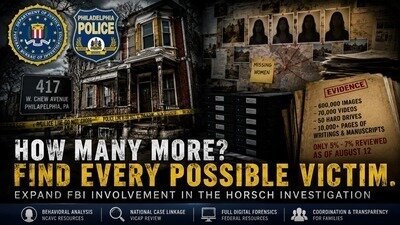
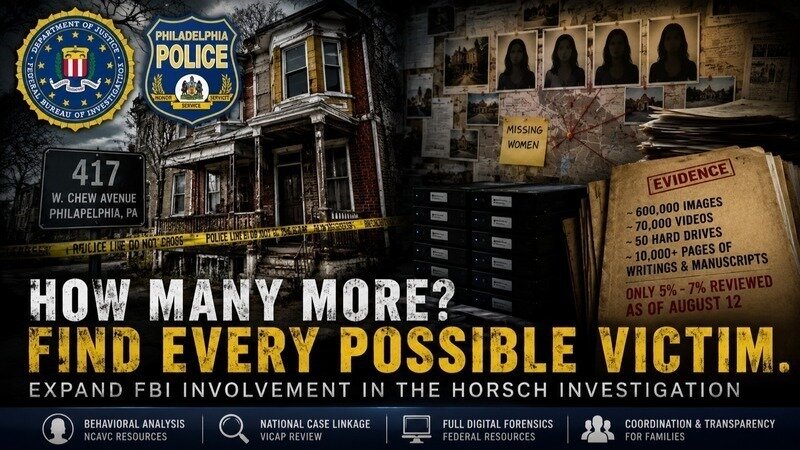
Investigators searching 417 W. Chew Avenue have recovered approximately 600,000 images, 70,000 videos, about 50 hard drives, and more than 10,000 pages of writings, drawings, and manuscripts.
As of August 12, Philadelphia police said they had reviewed only about 5% to 7% of that material.
And what investigators have already found is deeply disturbing.
Philadelphia police say recovered photographs and videos appear to show missing women Gabrielle Amarando and Maribel “Bella” Fresses alive inside the house and later deceased.
Then, on August 28, The Philadelphia Inquirer, citing law-enforcement sources, reported that investigators had recovered another video that appears to show Raymond Horsch strangling a woman to death inside the home.
That report remains part of an active investigation, and many questions are still unanswered.
But one question cannot wait:
Are there more victims?
We believe every reasonable federal resource should be used to find out.
This is not a call to push Philadelphia detectives aside. It is a call to add the FBI’s national tools, specialists, and case-linkage capabilities to an investigation that may reach beyond one house, one city, or the victims already identified.
The FBI Has Resources Built for Cases Like This
This is not a demand based on television’s idea of “FBI profilers.”
We are asking for specific federal resources that already exist to help investigate complex violent crimes and identify connections between cases.
The FBI’s National Center for the Analysis of Violent Crime, or NCAVC, provides behavioral-analysis assistance in serious violent-crime investigations. Its specialists can examine victim patterns, victim selection, offender behavior, relationships between victims and offenders, and similarities between crimes.
The FBI also operates the Violent Criminal Apprehension Program, or ViCAP, which is designed to help law enforcement identify connections among homicides, missing-person cases where foul play is suspected, and unidentified remains.
ViCAP analysts can compare cases across jurisdictions, build timelines and maps, examine victim patterns, identify possible crime series, and help agencies find connections that may otherwise remain hidden.
These are not theoretical tools. They already exist. We are asking officials to use them fully.
We Cannot Afford to Miss Another Connection
There were important connections to 417 W. Chew Avenue before the current investigation began.
Amy McHale disappeared after being at Raymond Horsch’s home in 2016. Police knew about that connection and questioned Raymond.
In 2023, a friend reporting Blair Tonzelli missing told Philadelphia police that Tonzelli had last been seen at 417 W. Chew Avenue.
Then, in May 2025, Philadelphia narcotics officers searched that same house during a drug investigation. According to published reporting, the resulting police report did not mention those missing-person cases.
We do not yet know why those connections were not reflected in that investigation, what information individual officers had, or what legal limits applied to the 2025 search.
This petition is not about assigning blame for what happened in the past.
It is about making sure no connection is missed now.
We Are Asking for Four Specific Actions
1 - Bring in the FBI’s specialized behavioral-analysis resources.
We call on Philadelphia investigators and FBI Philadelphia to request and fully use NCAVC behavioral-analysis assistance focused on suspected serial murder and violent crimes against adults.
These specialists can help investigators study victim patterns, victim selection, offender behavior, relationships between victims and offenders, and similarities or differences between cases.
That work may help investigators identify additional victims, connect cases that were previously investigated separately, and determine where investigators should look next.
2 - Search nationally for other possible victims.
We call for a full retrospective ViCAP case-linkage review.
Every qualifying missing-person and suspected-homicide case connected to the Horsch investigation should be entered into or updated within ViCAP.
But this should be more than a database search.
We are asking ViCAP’s national analysts to use the tools available to them—including case-linkage analysis, timelines, geographic comparisons, victim patterns, and crime-series analysis—to compare Horsch-related cases with relevant unresolved cases in the Philadelphia region and across the country.
The search should not be limited by assumptions about what a victim “should” look like.
Let the evidence determine which victim, behavioral, geographic, and time patterns investigators should examine.
And as investigators learn more from the remaining hard drives, run those comparisons again.
3 - Put enough federal resources on the massive amount of digital evidence.
Hundreds of thousands of photographs and videos still need to be reviewed, organized, authenticated, and analyzed.
Investigators should have all of the federal digital-forensic and victim-identification resources necessary to process that evidence as quickly and carefully as possible.
This is not about disrupting forensic work already underway or creating unnecessary duplication.
It is about making sure lack of staffing, technology, laboratory capacity, or other resources never becomes the reason evidence sits unreviewed.
No family should have to wonder whether the answer to their loved one’s disappearance is sitting unreviewed on a hard drive already in evidence.
4 - Use the federal authority Congress created for serial-killing investigations.
Federal law already provides a path for greater FBI involvement.
Under 28 U.S.C. § 540B, Congress gave the FBI authority to investigate qualifying serial killings even when the underlying crimes would normally fall under state or local law.
The law has specific requirements, including evidence of a qualifying series of killings and a request from the head of an agency with the appropriate investigative or prosecutorial jurisdiction.
We do not claim to know whether investigators currently possess enough evidence to meet that legal standard.
They know more than the public does.
But if the evidence available to law enforcement meets that standard:
Use the law.
We call on Philadelphia Police Commissioner Kevin Bethel, Philadelphia District Attorney Larry Krasner, and any other agency head with qualifying investigative or prosecutorial authority to determine and exercise whatever authority their offices possess and take the steps necessary to request expanded FBI investigation under § 540B.
Federal law requires action from officials with the proper authority. That is why this petition is directed not only to the FBI, but also to the Philadelphia officials who may have the ability to formally request greater federal involvement.
If These FBI Resources Are Already Involved, Keep Them There
We know the FBI is already assisting with parts of this investigation, and we understand that law enforcement cannot publicly disclose every specialist, resource, or investigative strategy being used.
If NCAVC, ViCAP, federal digital-forensic teams, or other resources requested in this petition are already involved, we welcome it.
Keep them involved.
Expand their role where needed.
And give them the resources necessary to determine the full scope of what happened at 417 W. Chew Avenue.
Somewhere, Another Family May Still Be Waiting
There may be another missing woman somewhere in those hundreds of thousands of photographs and videos.
There may be a case sitting in a police file in Philadelphia, elsewhere in Pennsylvania, New Jersey, or another part of the country that nobody has connected to Raymond Horsch yet.
There may be another family that has spent years—or decades—wondering what happened to someone they love.
And the evidence that finally gives them an answer may already have been recovered.
We cannot wait until the other 90-plus percent of this evidence is reviewed before making sure every available resource is in place.
We owe it to every woman who may have been harmed.
We owe it to every missing person whose case could be connected.
And we owe it to every family still waiting for answers.
Bring the FBI’s specialized resources fully into this investigation.
Compare these cases nationally.
Find every possible victim.
Give every family the best possible chance at answers.
Please sign this petition calling for substantially expanded FBI involvement in the Horsch investigation.

373
The Issue
To Philadelphia Police Commissioner Kevin Bethel, Philadelphia District Attorney Larry Krasner, the FBI Philadelphia Field Office, the FBI Director, the U.S. Attorney for the Eastern District of Pennsylvania, the U.S. Attorney General, and other appropriate law-enforcement officials:
We, the undersigned, are calling for substantially expanded FBI involvement in the investigation centered on 417 W. Chew Avenue in Philadelphia and Raymond “R.C.” Horsch.
How many women may ultimately be connected to this case?
Right now, there is no clear answer.
Investigators searching 417 W. Chew Avenue have recovered approximately 600,000 images, 70,000 videos, about 50 hard drives, and more than 10,000 pages of writings, drawings, and manuscripts.
As of August 12, Philadelphia police said they had reviewed only about 5% to 7% of that material.
And what investigators have already found is deeply disturbing.
Philadelphia police say recovered photographs and videos appear to show missing women Gabrielle Amarando and Maribel “Bella” Fresses alive inside the house and later deceased.
Then, on August 28, The Philadelphia Inquirer, citing law-enforcement sources, reported that investigators had recovered another video that appears to show Raymond Horsch strangling a woman to death inside the home.
That report remains part of an active investigation, and many questions are still unanswered.
But one question cannot wait:
Are there more victims?
We believe every reasonable federal resource should be used to find out.
This is not a call to push Philadelphia detectives aside. It is a call to add the FBI’s national tools, specialists, and case-linkage capabilities to an investigation that may reach beyond one house, one city, or the victims already identified.
The FBI Has Resources Built for Cases Like This
This is not a demand based on television’s idea of “FBI profilers.”
We are asking for specific federal resources that already exist to help investigate complex violent crimes and identify connections between cases.
The FBI’s National Center for the Analysis of Violent Crime, or NCAVC, provides behavioral-analysis assistance in serious violent-crime investigations. Its specialists can examine victim patterns, victim selection, offender behavior, relationships between victims and offenders, and similarities between crimes.
The FBI also operates the Violent Criminal Apprehension Program, or ViCAP, which is designed to help law enforcement identify connections among homicides, missing-person cases where foul play is suspected, and unidentified remains.
ViCAP analysts can compare cases across jurisdictions, build timelines and maps, examine victim patterns, identify possible crime series, and help agencies find connections that may otherwise remain hidden.
These are not theoretical tools. They already exist. We are asking officials to use them fully.
We Cannot Afford to Miss Another Connection
There were important connections to 417 W. Chew Avenue before the current investigation began.
Amy McHale disappeared after being at Raymond Horsch’s home in 2016. Police knew about that connection and questioned Raymond.
In 2023, a friend reporting Blair Tonzelli missing told Philadelphia police that Tonzelli had last been seen at 417 W. Chew Avenue.
Then, in May 2025, Philadelphia narcotics officers searched that same house during a drug investigation. According to published reporting, the resulting police report did not mention those missing-person cases.
We do not yet know why those connections were not reflected in that investigation, what information individual officers had, or what legal limits applied to the 2025 search.
This petition is not about assigning blame for what happened in the past.
It is about making sure no connection is missed now.
We Are Asking for Four Specific Actions
1 - Bring in the FBI’s specialized behavioral-analysis resources.
We call on Philadelphia investigators and FBI Philadelphia to request and fully use NCAVC behavioral-analysis assistance focused on suspected serial murder and violent crimes against adults.
These specialists can help investigators study victim patterns, victim selection, offender behavior, relationships between victims and offenders, and similarities or differences between cases.
That work may help investigators identify additional victims, connect cases that were previously investigated separately, and determine where investigators should look next.
2 - Search nationally for other possible victims.
We call for a full retrospective ViCAP case-linkage review.
Every qualifying missing-person and suspected-homicide case connected to the Horsch investigation should be entered into or updated within ViCAP.
But this should be more than a database search.
We are asking ViCAP’s national analysts to use the tools available to them—including case-linkage analysis, timelines, geographic comparisons, victim patterns, and crime-series analysis—to compare Horsch-related cases with relevant unresolved cases in the Philadelphia region and across the country.
The search should not be limited by assumptions about what a victim “should” look like.
Let the evidence determine which victim, behavioral, geographic, and time patterns investigators should examine.
And as investigators learn more from the remaining hard drives, run those comparisons again.
3 - Put enough federal resources on the massive amount of digital evidence.
Hundreds of thousands of photographs and videos still need to be reviewed, organized, authenticated, and analyzed.
Investigators should have all of the federal digital-forensic and victim-identification resources necessary to process that evidence as quickly and carefully as possible.
This is not about disrupting forensic work already underway or creating unnecessary duplication.
It is about making sure lack of staffing, technology, laboratory capacity, or other resources never becomes the reason evidence sits unreviewed.
No family should have to wonder whether the answer to their loved one’s disappearance is sitting unreviewed on a hard drive already in evidence.
4 - Use the federal authority Congress created for serial-killing investigations.
Federal law already provides a path for greater FBI involvement.
Under 28 U.S.C. § 540B, Congress gave the FBI authority to investigate qualifying serial killings even when the underlying crimes would normally fall under state or local law.
The law has specific requirements, including evidence of a qualifying series of killings and a request from the head of an agency with the appropriate investigative or prosecutorial jurisdiction.
We do not claim to know whether investigators currently possess enough evidence to meet that legal standard.
They know more than the public does.
But if the evidence available to law enforcement meets that standard:
Use the law.
We call on Philadelphia Police Commissioner Kevin Bethel, Philadelphia District Attorney Larry Krasner, and any other agency head with qualifying investigative or prosecutorial authority to determine and exercise whatever authority their offices possess and take the steps necessary to request expanded FBI investigation under § 540B.
Federal law requires action from officials with the proper authority. That is why this petition is directed not only to the FBI, but also to the Philadelphia officials who may have the ability to formally request greater federal involvement.
If These FBI Resources Are Already Involved, Keep Them There
We know the FBI is already assisting with parts of this investigation, and we understand that law enforcement cannot publicly disclose every specialist, resource, or investigative strategy being used.
If NCAVC, ViCAP, federal digital-forensic teams, or other resources requested in this petition are already involved, we welcome it.
Keep them involved.
Expand their role where needed.
And give them the resources necessary to determine the full scope of what happened at 417 W. Chew Avenue.
Somewhere, Another Family May Still Be Waiting
There may be another missing woman somewhere in those hundreds of thousands of photographs and videos.
There may be a case sitting in a police file in Philadelphia, elsewhere in Pennsylvania, New Jersey, or another part of the country that nobody has connected to Raymond Horsch yet.
There may be another family that has spent years—or decades—wondering what happened to someone they love.
And the evidence that finally gives them an answer may already have been recovered.
We cannot wait until the other 90-plus percent of this evidence is reviewed before making sure every available resource is in place.
We owe it to every woman who may have been harmed.
We owe it to every missing person whose case could be connected.
And we owe it to every family still waiting for answers.
Bring the FBI’s specialized resources fully into this investigation.
Compare these cases nationally.
Find every possible victim.
Give every family the best possible chance at answers.
Please sign this petition calling for substantially expanded FBI involvement in the Horsch investigation.
The Decision Makers


Supporter Voices
Petition Updates
Share this petition
Petition created on September 1, 2026