Environmental dissent is not anti-development — it is constitutional accountability
समस्या
To
Hon’ble Chief Justice of India
Supreme Court of India
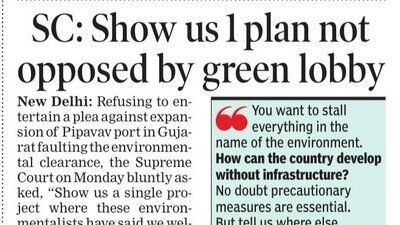
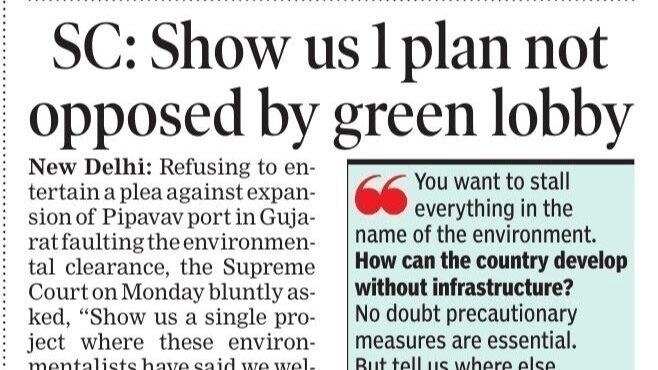
We write as citizens deeply concerned by the observations made during the hearing on the Pipavav Port expansion matter on 11-05-2026, particularly the remark asking:
“Show us one project where these environmentalists have said we welcome this.”
With utmost respect to the institution of the Supreme Court and your office, we believe such observations risk undermining decades of constitutional jurisprudence painstakingly built by this very Court — jurisprudence that recognised environmental protection as an integral part of development itself and an integral part of right to life under Article 21.
When environmental concerns are described through the language of a “green lobby,” the implication is troubling. It suggests that ecological scrutiny is merely ideological obstruction rather than democratic participation and constitutional vigilance. Yet history shows that environmental litigation in India did not arise to “stall development”; it arose because unplanned industrialization, mining and construction activities devastated rivers, forests, coastlines, public health, and livelihoods while regulatory institutions failed to protect citizens.
Citizens approach Court in the fervent hope that justice will be done to them and to nature. They also approach Courts in furtherance of their fundamental duty under Article 51 (A) (g) of the Constitution which obligates every citizen to protect and conserve the environment. It is indeed unfortunate to be labelled as ‘green lobby’ for being good citizens.
It was the Supreme Court itself that evolved doctrines such as sustainable development, the precautionary principle, intergenerational equity, species best interest standards, ecocentric principle and the public trust doctrine,. These principles were not crafted to paralyse infrastructure. They were crafted precisely because infrastructure without accountability often produces irreversible destruction.
The framing of environmentalists as habitual obstructionists also creates a dangerous imbalance. Industrial and corporate interests routinely lobby for dilution of safeguards, expedited clearances, weakened impact assessments, and post-facto approvals. Yet they are rarely described pejoratively. By contrast, citizens, scientists, fisherfolk, tribal communities, and conservation groups raising concerns about mangroves, marine ecology, biodiversity, displacement, or pollution are collectively reduced to a “green lobby.”
This asymmetry is neither fair nor constitutionally sound.
In the Pipavav Case, which was heard, the Project Itself could not expand based on the Environmental Clearance granted in 2012 because of unfavourable macro economic conditions. In the last 14 years, as per the submissions of the project proponent before the MOEF&CC only one component of the project was compeltd: first aid room. The project was ‘stalled’ not on environmental grounds or by environmentalist, but because of unfavourable market situation. It is unfortunate that the blame has been put on the entire environmentalist community.
The Pipavav matter itself reportedly involves concerns relating to marine mammals, Olive Ridley turtles, avian species, mangroves, and fragile coastal ecosystems. These are not frivolous objections manufactured to obstruct economic growth. They concern irreversible ecological consequences and the survival of communities dependent on coastal ecology for livelihood and sustenance.
To question such concerns is legitimate. To caricature them is dangerous.
Development versus environment is a false binary that India can no longer afford. The real constitutional question is not whether infrastructure should be built, but whether it can be built lawfully, transparently, scientifically, and sustainably. Environmental litigation has often strengthened projects by compelling better safeguards, rehabilitation mechanisms, scientific scrutiny, and compliance standards. Without judicial intervention in the past, India would likely have suffered far greater ecological collapse and social displacement in the name of progress.
We are also compelled to ask: when did demanding accountability become anti-development?
For many vulnerable communities, courts remain the only forum capable of balancing overwhelming state and corporate power. Fisherfolk facing coastal erosion, villagers resisting toxic contamination, forest dwellers confronting displacement, and citizens breathing polluted air do not possess lobbying power, financial influence, or institutional access. Their constitutional remedy lies in approaching the judiciary. If environmental petitioners begin to be viewed with suspicion merely because they challenge powerful projects, the scales of justice risk tilting irreversibly toward executive and corporate interests.
We wish to put certain facts before you. Of all the Projects granted Forest and Environmental Clearance every year, less than 1 percent are challenged before the Courts including the NGT. Courts, including the NGT, very rarely, ever In an investigation done by the Indian Express, 4 out of every 5 appeals challenging environmental clearance are dismissed by the NGT
[https://indianexpress.com/article/express-exclusive/2020-25-in-4-of-5-appeals-green-watchdog-ngt-rules-in-favour-of-developers-to-clear-projects-10552569/ As the investigation shows, most decisions are in favour of developers.
It is a fact that only a miniscule number of projects in the country are questioned. Also in most instances, it is not environmentalist but affected people who question them. It is pertinent to point out that the projects are not challenged: it is the gross illegality in the approval process and the undermining of the Rule of law that is questioned.
Judicial language carries immense weight. Observations from the highest constitutional court shape administrative culture, influence tribunals, affect public discourse, and determine whether dissent is respected or delegitimised. At a time when environmental safeguards are already being steadily diluted through weakened assessments, expedited clearances, and shrinking public consultation, remarks portraying ecological concerns as impediments to national development send a deeply troubling signal.
India certainly needs development. But development cannot mean the normalisation of ecological sacrifice zones where constitutional protections become secondary to economic speed. A nation cannot build long-term prosperity upon collapsing ecosystems, disappearing coastlines, poisoned groundwater, and communities stripped of livelihood and dignity.
The judiciary has historically stood as the conscience keeper of the Republic precisely because it resisted the temptation to reduce constitutional questions into administrative convenience. The Supreme Court earned moral authority not by echoing the language of expediency, but by defending rights when they were politically inconvenient.
We therefore urge this Hon’ble Court to continue viewing environmental scrutiny not as anti-development resistance, but as an essential democratic safeguard within a constitutional republic. Ecological dissent is not the enemy of progress. In many cases, it is the last defence against irreversible damage carried out in the name of progress.
India does not need a judiciary that blindly halts projects. Nor does it need one that reflexively distrusts environmental concerns. It needs a Court capable of holding together two constitutional truths at once: infrastructure matters, and ecology is not expendable.
We urge you at the head of the Indian Judiciary to keep the above concerns into account while making any observation. Each and every word uttered by the Supreme Court carries immense weight and has cascading effect not only in the judiciary but the public at large. It greatly demoralises citizens who are working against all odds to make India a better place to live.
Respectfully,
Concerned Citizens of India

994
समस्या
To
Hon’ble Chief Justice of India
Supreme Court of India
We write as citizens deeply concerned by the observations made during the hearing on the Pipavav Port expansion matter on 11-05-2026, particularly the remark asking:
“Show us one project where these environmentalists have said we welcome this.”
With utmost respect to the institution of the Supreme Court and your office, we believe such observations risk undermining decades of constitutional jurisprudence painstakingly built by this very Court — jurisprudence that recognised environmental protection as an integral part of development itself and an integral part of right to life under Article 21.
When environmental concerns are described through the language of a “green lobby,” the implication is troubling. It suggests that ecological scrutiny is merely ideological obstruction rather than democratic participation and constitutional vigilance. Yet history shows that environmental litigation in India did not arise to “stall development”; it arose because unplanned industrialization, mining and construction activities devastated rivers, forests, coastlines, public health, and livelihoods while regulatory institutions failed to protect citizens.
Citizens approach Court in the fervent hope that justice will be done to them and to nature. They also approach Courts in furtherance of their fundamental duty under Article 51 (A) (g) of the Constitution which obligates every citizen to protect and conserve the environment. It is indeed unfortunate to be labelled as ‘green lobby’ for being good citizens.
It was the Supreme Court itself that evolved doctrines such as sustainable development, the precautionary principle, intergenerational equity, species best interest standards, ecocentric principle and the public trust doctrine,. These principles were not crafted to paralyse infrastructure. They were crafted precisely because infrastructure without accountability often produces irreversible destruction.
The framing of environmentalists as habitual obstructionists also creates a dangerous imbalance. Industrial and corporate interests routinely lobby for dilution of safeguards, expedited clearances, weakened impact assessments, and post-facto approvals. Yet they are rarely described pejoratively. By contrast, citizens, scientists, fisherfolk, tribal communities, and conservation groups raising concerns about mangroves, marine ecology, biodiversity, displacement, or pollution are collectively reduced to a “green lobby.”
This asymmetry is neither fair nor constitutionally sound.
In the Pipavav Case, which was heard, the Project Itself could not expand based on the Environmental Clearance granted in 2012 because of unfavourable macro economic conditions. In the last 14 years, as per the submissions of the project proponent before the MOEF&CC only one component of the project was compeltd: first aid room. The project was ‘stalled’ not on environmental grounds or by environmentalist, but because of unfavourable market situation. It is unfortunate that the blame has been put on the entire environmentalist community.
The Pipavav matter itself reportedly involves concerns relating to marine mammals, Olive Ridley turtles, avian species, mangroves, and fragile coastal ecosystems. These are not frivolous objections manufactured to obstruct economic growth. They concern irreversible ecological consequences and the survival of communities dependent on coastal ecology for livelihood and sustenance.
To question such concerns is legitimate. To caricature them is dangerous.
Development versus environment is a false binary that India can no longer afford. The real constitutional question is not whether infrastructure should be built, but whether it can be built lawfully, transparently, scientifically, and sustainably. Environmental litigation has often strengthened projects by compelling better safeguards, rehabilitation mechanisms, scientific scrutiny, and compliance standards. Without judicial intervention in the past, India would likely have suffered far greater ecological collapse and social displacement in the name of progress.
We are also compelled to ask: when did demanding accountability become anti-development?
For many vulnerable communities, courts remain the only forum capable of balancing overwhelming state and corporate power. Fisherfolk facing coastal erosion, villagers resisting toxic contamination, forest dwellers confronting displacement, and citizens breathing polluted air do not possess lobbying power, financial influence, or institutional access. Their constitutional remedy lies in approaching the judiciary. If environmental petitioners begin to be viewed with suspicion merely because they challenge powerful projects, the scales of justice risk tilting irreversibly toward executive and corporate interests.
We wish to put certain facts before you. Of all the Projects granted Forest and Environmental Clearance every year, less than 1 percent are challenged before the Courts including the NGT. Courts, including the NGT, very rarely, ever In an investigation done by the Indian Express, 4 out of every 5 appeals challenging environmental clearance are dismissed by the NGT
[https://indianexpress.com/article/express-exclusive/2020-25-in-4-of-5-appeals-green-watchdog-ngt-rules-in-favour-of-developers-to-clear-projects-10552569/ As the investigation shows, most decisions are in favour of developers.
It is a fact that only a miniscule number of projects in the country are questioned. Also in most instances, it is not environmentalist but affected people who question them. It is pertinent to point out that the projects are not challenged: it is the gross illegality in the approval process and the undermining of the Rule of law that is questioned.
Judicial language carries immense weight. Observations from the highest constitutional court shape administrative culture, influence tribunals, affect public discourse, and determine whether dissent is respected or delegitimised. At a time when environmental safeguards are already being steadily diluted through weakened assessments, expedited clearances, and shrinking public consultation, remarks portraying ecological concerns as impediments to national development send a deeply troubling signal.
India certainly needs development. But development cannot mean the normalisation of ecological sacrifice zones where constitutional protections become secondary to economic speed. A nation cannot build long-term prosperity upon collapsing ecosystems, disappearing coastlines, poisoned groundwater, and communities stripped of livelihood and dignity.
The judiciary has historically stood as the conscience keeper of the Republic precisely because it resisted the temptation to reduce constitutional questions into administrative convenience. The Supreme Court earned moral authority not by echoing the language of expediency, but by defending rights when they were politically inconvenient.
We therefore urge this Hon’ble Court to continue viewing environmental scrutiny not as anti-development resistance, but as an essential democratic safeguard within a constitutional republic. Ecological dissent is not the enemy of progress. In many cases, it is the last defence against irreversible damage carried out in the name of progress.
India does not need a judiciary that blindly halts projects. Nor does it need one that reflexively distrusts environmental concerns. It needs a Court capable of holding together two constitutional truths at once: infrastructure matters, and ecology is not expendable.
We urge you at the head of the Indian Judiciary to keep the above concerns into account while making any observation. Each and every word uttered by the Supreme Court carries immense weight and has cascading effect not only in the judiciary but the public at large. It greatly demoralises citizens who are working against all odds to make India a better place to live.
Respectfully,
Concerned Citizens of India
फैसला लेने वाले

पेटीशन अपडेट
पेटीशन को शेयर करें
12 मई 2026 पर पेटीशन बनाई गई