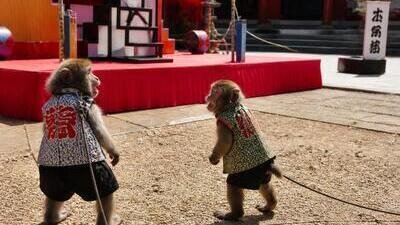

End Monkey Performances at Shitennōji Temple 四天王寺における猿回し公演の中止を求めます
The Issue
We call upon Shitennōji Temple to demonstrate leadership in animal welfare by ending all live monkey performances on its grounds and adopting a permanent policy that prohibits permitting, hosting, or supporting these performances.
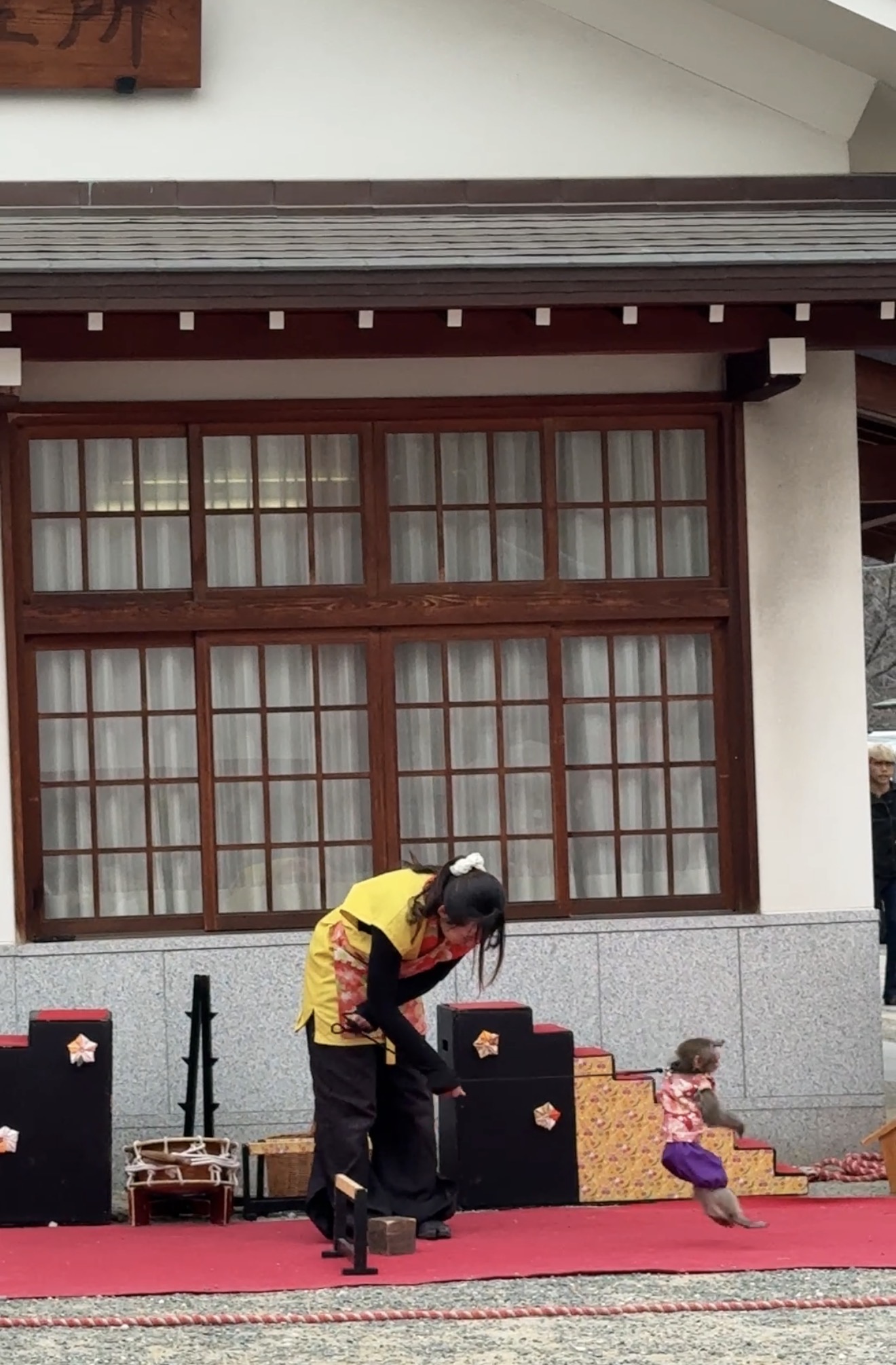
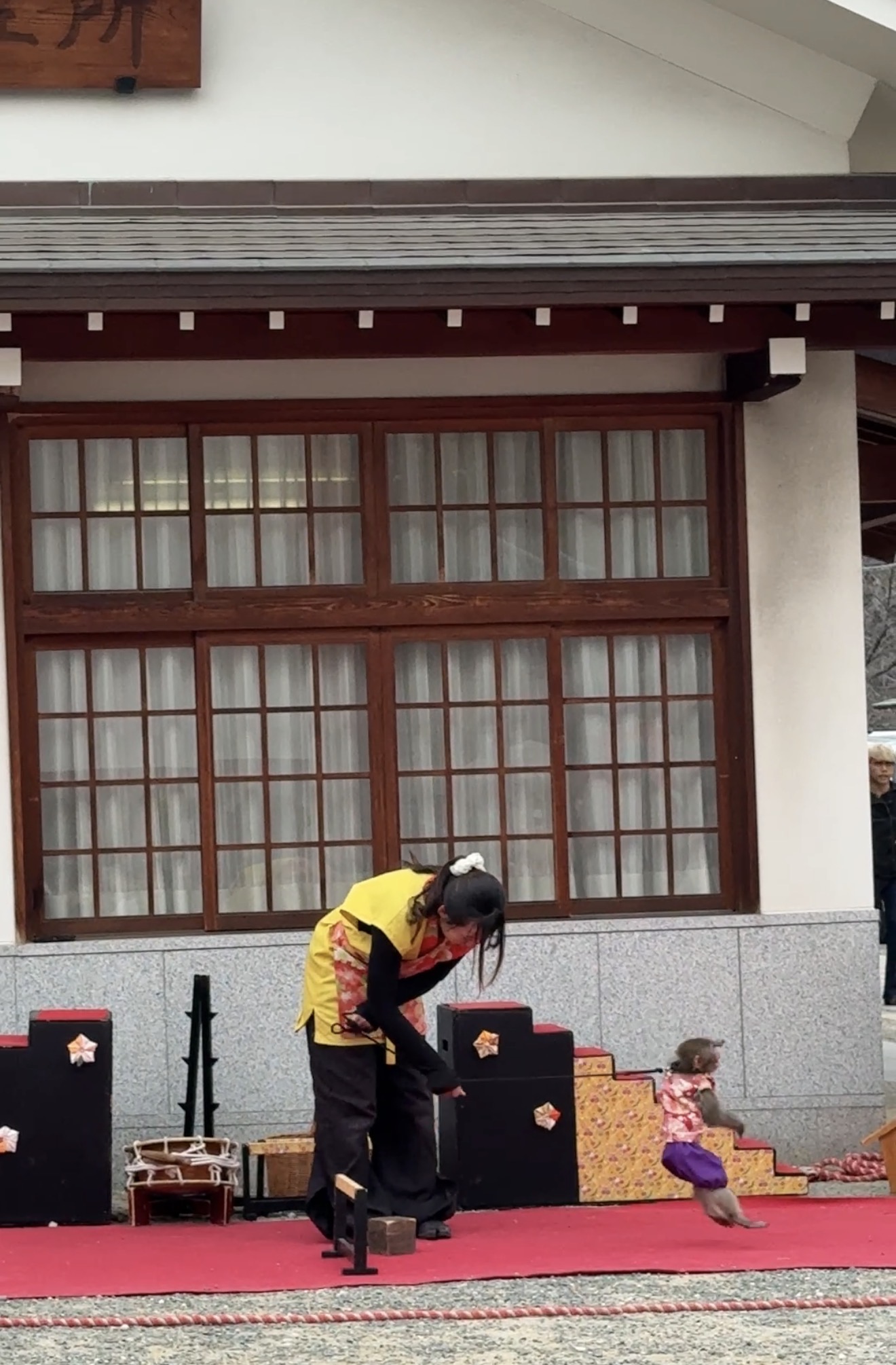
On March 22, 2026, at approximately 3:43PM, we personally observed a live sarumawashi performance on Shitennōji grounds at Scripture Transcription/Seal Office. The performance involved a monkey wearing a full costume while a handler pulled a leash attached around its neck, and the body language that appeared tense and uneasy. We documented the event through photograph and video. The footage documents the use of costume, neck restraint, repeated upright movement and restricted freedom of movement.[1]
Why monkey performances are incompatible with primate welfare
Japanese macaques are intelligent, highly social wild animals. Sarumawashi performances often feature monkeys wearing costumes or diapers, walking upright, using stilts, jumping over obstacles and performing other human-like tricks. The Macaque Coalition warns that prolonged unnatural postures and movements may harm monkeys' muscles and joints. It also identifies repeated transportation, crowds, close public contact and disease transmission as additional welfare concerns.[2]
Public reporting shows that training practices are not uniform. Some trainers describe using positive reinforcement and affection. However, animal-welfare experts interviewed by National Geographic reported that harsh discipline and physical abuse also occur within the industry. The same investigation documented training beginning with very young macaques and found that orphaned monkeys from wildlife-control programs sometimes enter entertainment groups.[3]
These concerns are recognized within Japan
At a December 2025 meeting of Japan’s Central Environment Council Animal Welfare Subcommittee, veterinarian Dr. Machiya (町屋 奈) raised concerns about outdoor animal exhibitions and sarumawashi performances taking place during extreme summer heat. She identified extreme summer heat as a significant welfare concern for animals used in outdoor performances, including sarumawashi.[4][5]
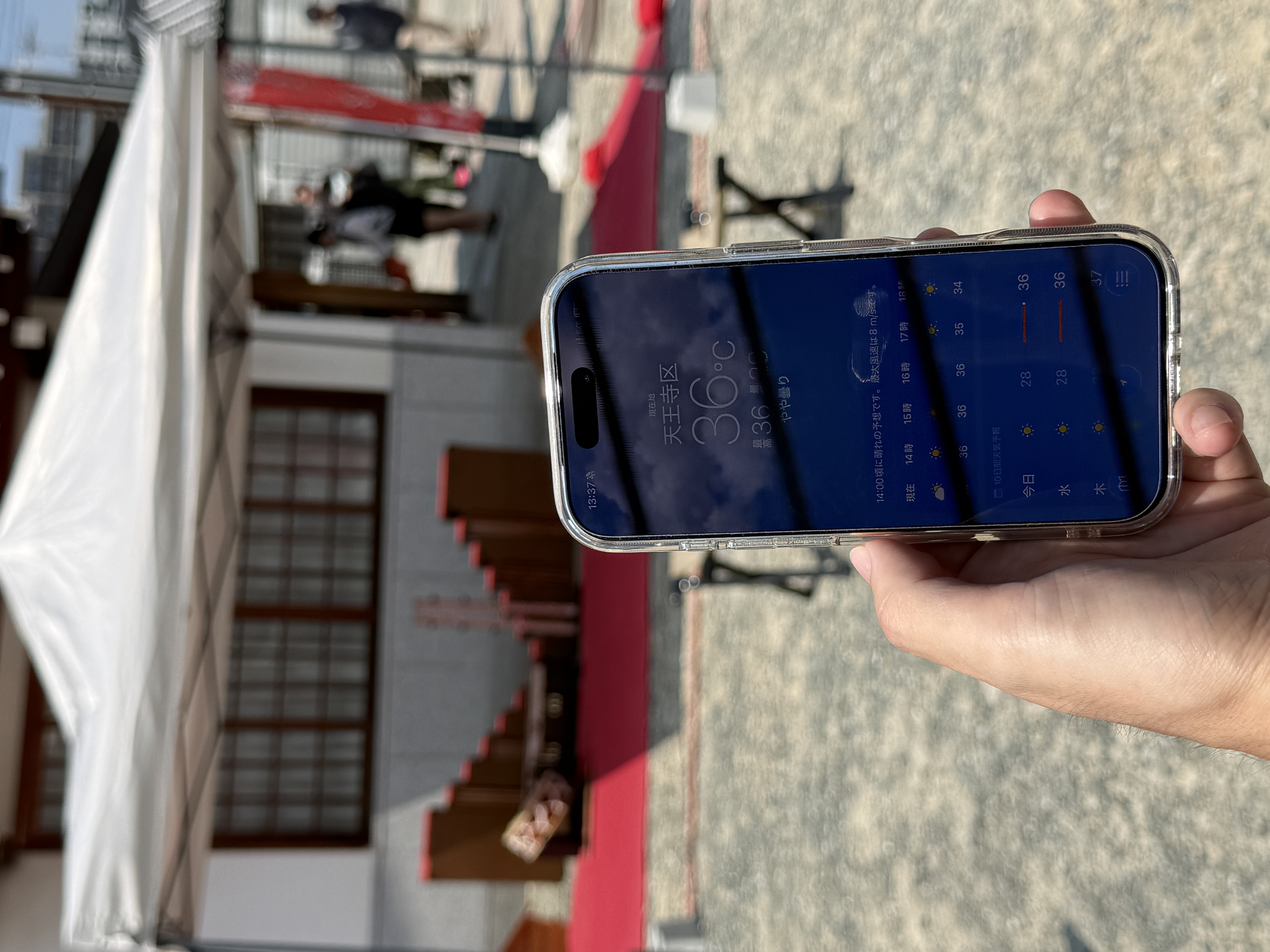
On July 21, 2026, at approximately 2:00PM, we personally observed a live sarumawashi performance on Shitennōji grounds at Scripture Transcription/Seal Office (納経所) during extreme heat. The temperature was approximately 36°C, with 52% humidity, according to the Japan Meteorological Agency. During an apparent break, the monkey remained tethered by a lead clipped at the back of its neck and wore purple costume trousers. It sat in a hunched posture with its head lowered directly in front of a small portable fan while one handler held the tether and another used a handheld fan. We documented the performance and weather conditions through photographs and video.[6] The footage shows handlers attempting to manage the effects of extreme heat after bringing the monkey to the outdoor performance site, rather than avoiding the exposure by suspending the activity.
Additionally, earlier Environment Ministry expert materials listed reported welfare problems associated with sarumawashi, including grabbing monkeys by the arms, shouting, hitting, and pulling collars when an animal failed to perform.[7]
Monkey performances also affect how people understand wild animals. Peer-reviewed research examining visual portrayals of nonhuman primates found that showing primates in human-like settings and in contact with people made viewers more likely to consider them suitable pets and more likely to believe their wild populations were not endangered.[8] Presenting macaques in clothing and making them imitate humans risks teaching audiences, especially children, that wild primates are compliant entertainers rather than complex animals with their own social and behavioral needs.
Respecting history does not require continuing the practice
Sarumawashi has a long history in Japan. Monkeys were traditionally associated with protection, good fortune and mediation between humans and the divine. We recognize that cultural history and do not seek to insult the people who preserved or participated in it.
But acknowledging a tradition is not the same as requiring its continuation in its present form. Traditions can evolve as society’s understanding of animals evolves. Sarumawashi’s history can be preserved through human performance, storytelling, exhibitions, archival materials, and education without requiring living macaques to perform.
For a temple associated with compassion and respect for life, ending monkey performances would not erase Japanese culture. It would demonstrate that those values remain living principles.
We respectfully ask Shitennōji Temple to end all live monkey performances on its grounds and adopt a permanent policy prohibiting their return. This would preserve the temple’s cultural and spiritual significance while recognizing the complex welfare needs of the animals involved.
Sources
Macaque Coalition: Use as Performers and Entertainers (https://www.macaquecoalition.com/use-as-performers-entertainers
National Geographic: Circus-like Performances by Snow Monkeys in Japan (https://www.nationalgeographic.com/magazine/article/japan-snow-monkeys-circus-like-performances-contradict-long-revered-status-feature
Central Environment Council Animal Welfare Subcommittee, December 2025 transcript (https://www.env.go.jp/council/14animal/65_2_00002.html
Japan University of Veterinary and Life Sciences: Machiya’s veterinary credentials (https://www.nvlu.ac.jp/news/20240920-01.html/
Photographs or video documenting the monkey performance at Shitennōji, DATE](INSERT LINK)
Environment Ministry expert material on commercial animal-care standards (https://www.env.go.jp/nature/dobutsu/aigo/2_data/tekisei/h29_15/mat04.pdf
Leighty et al.: Impact of Visual Context on Public Perceptions of Non-Human Primate Performers (https://doi.org/10.1371/journal.pone.0118487
私たちは四天王寺に対し、境内における生きたサルを用いたすべての公演を中止し、今後これらの公演を許可、受け入れ、または支援しない恒久的な方針を採用するよう求めます。
2026年3月22日午後3時、私たちは四天王寺境内の納経所において、猿回しの実演を直接目撃しました。サルは全身に衣装を着せられ、演者が首に取り付けられたリードを引いていました。また、サルは緊張や不安をうかがわせるような身体の動きを示していました。私たちは、この状況を写真および動画で記録しました。映像には、衣装の着用、首への拘束、繰り返される直立移動、移動の自由が制限されている状況が記録されています。[1]
猿回しが霊長類の福祉と両立しない理由
ニホンザルは知能が高く、非常に社会性の強い野生動物です。猿回しでは、サルに衣装やおむつを着用させ、直立歩行、竹馬、障害物を飛び越える動作など、人間を模倣した芸を行わせることがあります。Macaque Coalitionは、長時間にわたる不自然な姿勢や動作が、サルの筋肉や関節を傷める可能性があると警告しています。また、繰り返される移動、大勢の観客、一般の人々との近距離での接触、感染症の伝播についても、福祉上の懸念として挙げています。[2]
報道によれば、サルの訓練方法はさまざまです。餌や褒め言葉などのご褒美を与えて行動を促す方法を用いる調教師もいます。一方で、『ナショナル ジオグラフィック』の取材を受けた動物福祉の専門家は、この業界では厳しい懲罰や身体的虐待も行われていると報告しています。同調査では、非常に幼いニホンザルに対する訓練や、野生動物の被害管理事業によって親を失ったサルが興行団体に入る事例も記録されています。[3]
日本国内でも、猿回しに関する動物福祉上の懸念が指摘されています
2025年12月に開催された中央環境審議会動物愛護部会において、獣医師の町屋奈氏は、猛暑の中で屋外の動物展示や猿回しが行われていることに懸念を示しました。町屋氏は、夏季の猛暑が、猿回しを屋外公演に使われる動物にとって重大な福祉上の問題であると指摘しています。[4][5]
2026年7月21日午後2時頃、私たちは四天王寺境内の納経所において、猛暑の中で行われていた猿回しを直接目撃しました。気象庁のデータによれば、当時の気温は約36℃でした。休憩中と思われる時間にも、サルは首の後ろに留められたリードにつながれたままで、紫色の衣装用ズボンを着用していました。サルは小型の携帯扇風機の正面で、頭を下げ、背中を丸めた姿勢で座っていました。一人の演者がリードを持ち、もう一人が手持ちの扇子でサルをあおいでいました。私たちは、公演と気象条件を写真および動画で記録しました。[6]
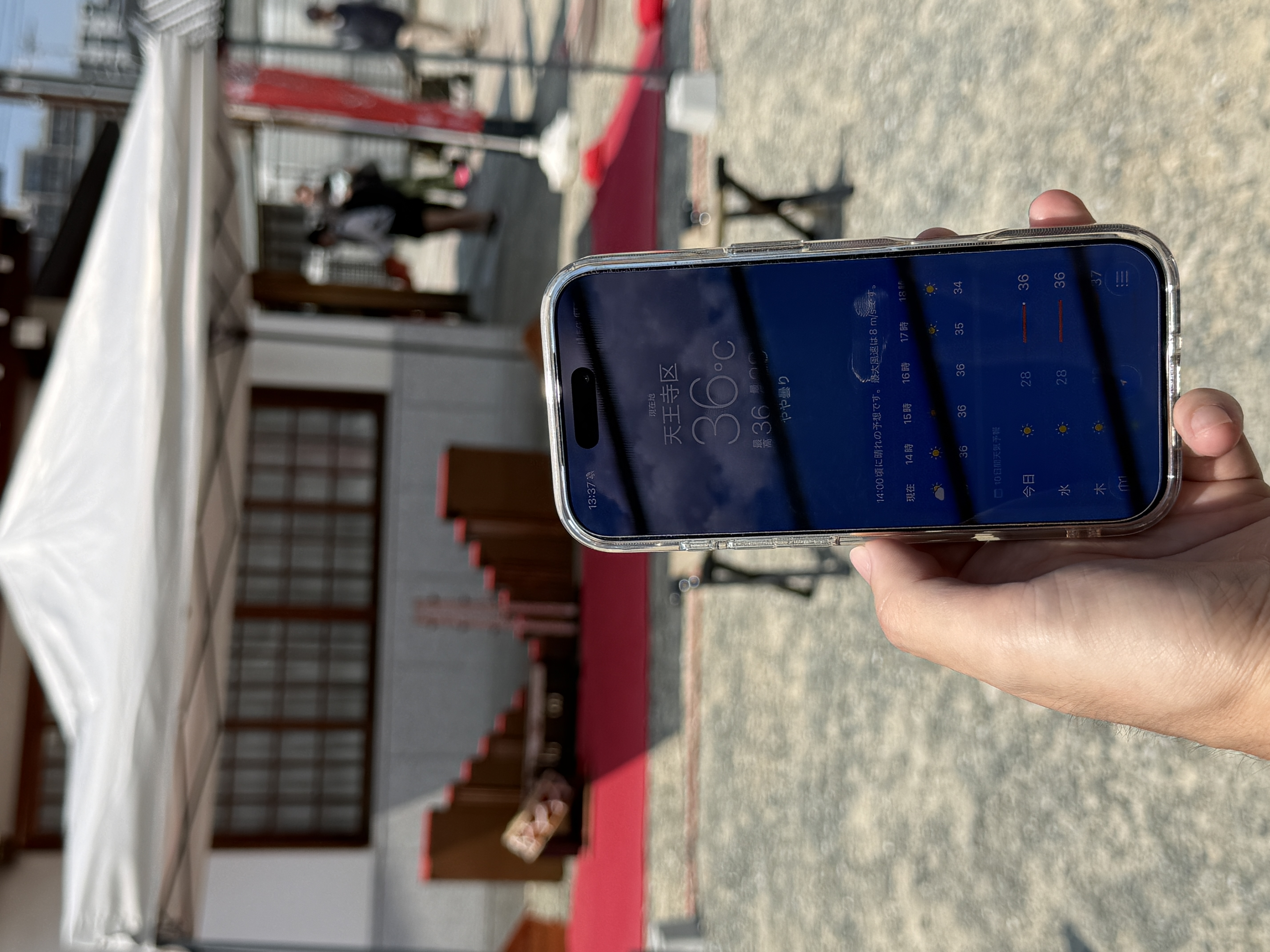
この映像が示しているのは、公演を中止して暑熱への曝露そのものを避けるのではなく、サルを屋外の公演場所へ連れてきた後に、その影響を緩和しようとする対応です。さらに、環境省の以前の専門家資料では、サルが芸をできなかった際に、腕をつかむ、大声で怒鳴る、たたく、首輪を引っ張るといった、猿回しに関連する福祉上の問題事例が挙げられています。[7]
猿回しは、人々が野生動物をどのように理解するかにも影響します。人以外の霊長類がどのように視覚的に表現されるかを調べた査読付き研究では、霊長類を人間のような環境に置き、人間と接触させて見せることで、見る人がその動物をペットに適していると考えやすくなり、野生個体群が絶滅の危機にないと考えやすくなることが示されています。[8]
ニホンザルに衣装を着せ、人間を模倣した芸を行わせることは、特に子どもたちに対し、野生の霊長類を、固有の社会的・行動的要求を持つ複雑な動物ではなく、人間に従う娯楽のための存在として認識させるおそれがあります。
猿回しは、日本において長い歴史を持っています。サルは伝統的に、守護、幸運、そして人間と神々を仲介する存在と結びつけられてきました。私たちはこの文化的歴史を認識しており、それを保存してきた方々や関わってきた方々を侮辱する意図はありません。
しかし、伝統の存在を認めることと、それを現在の形のまま継続しなければならないとすることは同じではありません。社会の動物に対する理解が深まるにつれて、伝統も変化することができます。猿回しの歴史は、生きたニホンザルに芸をさせることなく、人間による実演、語り、展示、アーカイブ資料、教育などを通じて保存することができます。
慈悲と生命の尊重に結びつく寺院が猿回しを終了することは、日本文化を消し去ることではありません。それは、そうした価値観が現在も生きた理念であることを示すものです。
以上の理由から、私たちは四天王寺に対し、境内での生きたサルを用いた公演を終了し、その再開を認めない恒久的な方針を採用していただくよう求めます。
出典
1 四天王寺での猿回しを記録した写真および動画、日付 (INSERT LINK)
2 Macaque Coalition:娯楽・公演に利用されるマカク (https://www.macaquecoalition.com/use-as-performers-entertainers
3 ナショナル ジオグラフィック:日本で行われるニホンザルのサーカスのような公演 (https://www.nationalgeographic.com/magazine/article/japan-snow-monkeys-circus-like-performances-contradict-long-revered-status-feature
4 中央環境審議会動物愛護部会、2025年12月議事録 (https://www.env.go.jp/council/14animal/65_2_00002.html
5 日本獣医生命科学大学:町屋奈氏の獣医師としての経歴 (https://www.nvlu.ac.jp/news/20240920-01.html/
6 四天王寺での猿回しを記録した写真または動画、日付 (INSERT LINK)
7 環境省:動物取扱業における飼養管理基準に関する専門家資料 (https://www.env.go.jp/nature/dobutsu/aigo/2_data/tekisei/h29_15/mat04.pdf
8 Leightyほか:視覚的文脈が人以外の霊長類演者に対する一般の認識に及ぼす影響 (https://doi.org/10.1371/journal.pone.0118487

651
The Issue
We call upon Shitennōji Temple to demonstrate leadership in animal welfare by ending all live monkey performances on its grounds and adopting a permanent policy that prohibits permitting, hosting, or supporting these performances.
On March 22, 2026, at approximately 3:43PM, we personally observed a live sarumawashi performance on Shitennōji grounds at Scripture Transcription/Seal Office. The performance involved a monkey wearing a full costume while a handler pulled a leash attached around its neck, and the body language that appeared tense and uneasy. We documented the event through photograph and video. The footage documents the use of costume, neck restraint, repeated upright movement and restricted freedom of movement.[1]
Why monkey performances are incompatible with primate welfare
Japanese macaques are intelligent, highly social wild animals. Sarumawashi performances often feature monkeys wearing costumes or diapers, walking upright, using stilts, jumping over obstacles and performing other human-like tricks. The Macaque Coalition warns that prolonged unnatural postures and movements may harm monkeys' muscles and joints. It also identifies repeated transportation, crowds, close public contact and disease transmission as additional welfare concerns.[2]
Public reporting shows that training practices are not uniform. Some trainers describe using positive reinforcement and affection. However, animal-welfare experts interviewed by National Geographic reported that harsh discipline and physical abuse also occur within the industry. The same investigation documented training beginning with very young macaques and found that orphaned monkeys from wildlife-control programs sometimes enter entertainment groups.[3]
These concerns are recognized within Japan
At a December 2025 meeting of Japan’s Central Environment Council Animal Welfare Subcommittee, veterinarian Dr. Machiya (町屋 奈) raised concerns about outdoor animal exhibitions and sarumawashi performances taking place during extreme summer heat. She identified extreme summer heat as a significant welfare concern for animals used in outdoor performances, including sarumawashi.[4][5]
On July 21, 2026, at approximately 2:00PM, we personally observed a live sarumawashi performance on Shitennōji grounds at Scripture Transcription/Seal Office (納経所) during extreme heat. The temperature was approximately 36°C, with 52% humidity, according to the Japan Meteorological Agency. During an apparent break, the monkey remained tethered by a lead clipped at the back of its neck and wore purple costume trousers. It sat in a hunched posture with its head lowered directly in front of a small portable fan while one handler held the tether and another used a handheld fan. We documented the performance and weather conditions through photographs and video.[6] The footage shows handlers attempting to manage the effects of extreme heat after bringing the monkey to the outdoor performance site, rather than avoiding the exposure by suspending the activity.
Additionally, earlier Environment Ministry expert materials listed reported welfare problems associated with sarumawashi, including grabbing monkeys by the arms, shouting, hitting, and pulling collars when an animal failed to perform.[7]
Monkey performances also affect how people understand wild animals. Peer-reviewed research examining visual portrayals of nonhuman primates found that showing primates in human-like settings and in contact with people made viewers more likely to consider them suitable pets and more likely to believe their wild populations were not endangered.[8] Presenting macaques in clothing and making them imitate humans risks teaching audiences, especially children, that wild primates are compliant entertainers rather than complex animals with their own social and behavioral needs.
Respecting history does not require continuing the practice
Sarumawashi has a long history in Japan. Monkeys were traditionally associated with protection, good fortune and mediation between humans and the divine. We recognize that cultural history and do not seek to insult the people who preserved or participated in it.
But acknowledging a tradition is not the same as requiring its continuation in its present form. Traditions can evolve as society’s understanding of animals evolves. Sarumawashi’s history can be preserved through human performance, storytelling, exhibitions, archival materials, and education without requiring living macaques to perform.
For a temple associated with compassion and respect for life, ending monkey performances would not erase Japanese culture. It would demonstrate that those values remain living principles.
We respectfully ask Shitennōji Temple to end all live monkey performances on its grounds and adopt a permanent policy prohibiting their return. This would preserve the temple’s cultural and spiritual significance while recognizing the complex welfare needs of the animals involved.
Sources
Macaque Coalition: Use as Performers and Entertainers (https://www.macaquecoalition.com/use-as-performers-entertainers
National Geographic: Circus-like Performances by Snow Monkeys in Japan (https://www.nationalgeographic.com/magazine/article/japan-snow-monkeys-circus-like-performances-contradict-long-revered-status-feature
Central Environment Council Animal Welfare Subcommittee, December 2025 transcript (https://www.env.go.jp/council/14animal/65_2_00002.html
Japan University of Veterinary and Life Sciences: Machiya’s veterinary credentials (https://www.nvlu.ac.jp/news/20240920-01.html/
Photographs or video documenting the monkey performance at Shitennōji, DATE](INSERT LINK)
Environment Ministry expert material on commercial animal-care standards (https://www.env.go.jp/nature/dobutsu/aigo/2_data/tekisei/h29_15/mat04.pdf
Leighty et al.: Impact of Visual Context on Public Perceptions of Non-Human Primate Performers (https://doi.org/10.1371/journal.pone.0118487
私たちは四天王寺に対し、境内における生きたサルを用いたすべての公演を中止し、今後これらの公演を許可、受け入れ、または支援しない恒久的な方針を採用するよう求めます。
2026年3月22日午後3時、私たちは四天王寺境内の納経所において、猿回しの実演を直接目撃しました。サルは全身に衣装を着せられ、演者が首に取り付けられたリードを引いていました。また、サルは緊張や不安をうかがわせるような身体の動きを示していました。私たちは、この状況を写真および動画で記録しました。映像には、衣装の着用、首への拘束、繰り返される直立移動、移動の自由が制限されている状況が記録されています。[1]
猿回しが霊長類の福祉と両立しない理由
ニホンザルは知能が高く、非常に社会性の強い野生動物です。猿回しでは、サルに衣装やおむつを着用させ、直立歩行、竹馬、障害物を飛び越える動作など、人間を模倣した芸を行わせることがあります。Macaque Coalitionは、長時間にわたる不自然な姿勢や動作が、サルの筋肉や関節を傷める可能性があると警告しています。また、繰り返される移動、大勢の観客、一般の人々との近距離での接触、感染症の伝播についても、福祉上の懸念として挙げています。[2]
報道によれば、サルの訓練方法はさまざまです。餌や褒め言葉などのご褒美を与えて行動を促す方法を用いる調教師もいます。一方で、『ナショナル ジオグラフィック』の取材を受けた動物福祉の専門家は、この業界では厳しい懲罰や身体的虐待も行われていると報告しています。同調査では、非常に幼いニホンザルに対する訓練や、野生動物の被害管理事業によって親を失ったサルが興行団体に入る事例も記録されています。[3]
日本国内でも、猿回しに関する動物福祉上の懸念が指摘されています
2025年12月に開催された中央環境審議会動物愛護部会において、獣医師の町屋奈氏は、猛暑の中で屋外の動物展示や猿回しが行われていることに懸念を示しました。町屋氏は、夏季の猛暑が、猿回しを屋外公演に使われる動物にとって重大な福祉上の問題であると指摘しています。[4][5]
2026年7月21日午後2時頃、私たちは四天王寺境内の納経所において、猛暑の中で行われていた猿回しを直接目撃しました。気象庁のデータによれば、当時の気温は約36℃でした。休憩中と思われる時間にも、サルは首の後ろに留められたリードにつながれたままで、紫色の衣装用ズボンを着用していました。サルは小型の携帯扇風機の正面で、頭を下げ、背中を丸めた姿勢で座っていました。一人の演者がリードを持ち、もう一人が手持ちの扇子でサルをあおいでいました。私たちは、公演と気象条件を写真および動画で記録しました。[6]
この映像が示しているのは、公演を中止して暑熱への曝露そのものを避けるのではなく、サルを屋外の公演場所へ連れてきた後に、その影響を緩和しようとする対応です。さらに、環境省の以前の専門家資料では、サルが芸をできなかった際に、腕をつかむ、大声で怒鳴る、たたく、首輪を引っ張るといった、猿回しに関連する福祉上の問題事例が挙げられています。[7]
猿回しは、人々が野生動物をどのように理解するかにも影響します。人以外の霊長類がどのように視覚的に表現されるかを調べた査読付き研究では、霊長類を人間のような環境に置き、人間と接触させて見せることで、見る人がその動物をペットに適していると考えやすくなり、野生個体群が絶滅の危機にないと考えやすくなることが示されています。[8]
ニホンザルに衣装を着せ、人間を模倣した芸を行わせることは、特に子どもたちに対し、野生の霊長類を、固有の社会的・行動的要求を持つ複雑な動物ではなく、人間に従う娯楽のための存在として認識させるおそれがあります。
猿回しは、日本において長い歴史を持っています。サルは伝統的に、守護、幸運、そして人間と神々を仲介する存在と結びつけられてきました。私たちはこの文化的歴史を認識しており、それを保存してきた方々や関わってきた方々を侮辱する意図はありません。
しかし、伝統の存在を認めることと、それを現在の形のまま継続しなければならないとすることは同じではありません。社会の動物に対する理解が深まるにつれて、伝統も変化することができます。猿回しの歴史は、生きたニホンザルに芸をさせることなく、人間による実演、語り、展示、アーカイブ資料、教育などを通じて保存することができます。
慈悲と生命の尊重に結びつく寺院が猿回しを終了することは、日本文化を消し去ることではありません。それは、そうした価値観が現在も生きた理念であることを示すものです。
以上の理由から、私たちは四天王寺に対し、境内での生きたサルを用いた公演を終了し、その再開を認めない恒久的な方針を採用していただくよう求めます。
出典
1 四天王寺での猿回しを記録した写真および動画、日付 (INSERT LINK)
2 Macaque Coalition:娯楽・公演に利用されるマカク (https://www.macaquecoalition.com/use-as-performers-entertainers
3 ナショナル ジオグラフィック:日本で行われるニホンザルのサーカスのような公演 (https://www.nationalgeographic.com/magazine/article/japan-snow-monkeys-circus-like-performances-contradict-long-revered-status-feature
4 中央環境審議会動物愛護部会、2025年12月議事録 (https://www.env.go.jp/council/14animal/65_2_00002.html
5 日本獣医生命科学大学:町屋奈氏の獣医師としての経歴 (https://www.nvlu.ac.jp/news/20240920-01.html/
6 四天王寺での猿回しを記録した写真または動画、日付 (INSERT LINK)
7 環境省:動物取扱業における飼養管理基準に関する専門家資料 (https://www.env.go.jp/nature/dobutsu/aigo/2_data/tekisei/h29_15/mat04.pdf
8 Leightyほか:視覚的文脈が人以外の霊長類演者に対する一般の認識に及ぼす影響 (https://doi.org/10.1371/journal.pone.0118487
Supporter Voices
Petition Updates
Share this petition
Petition created on July 23, 2026