
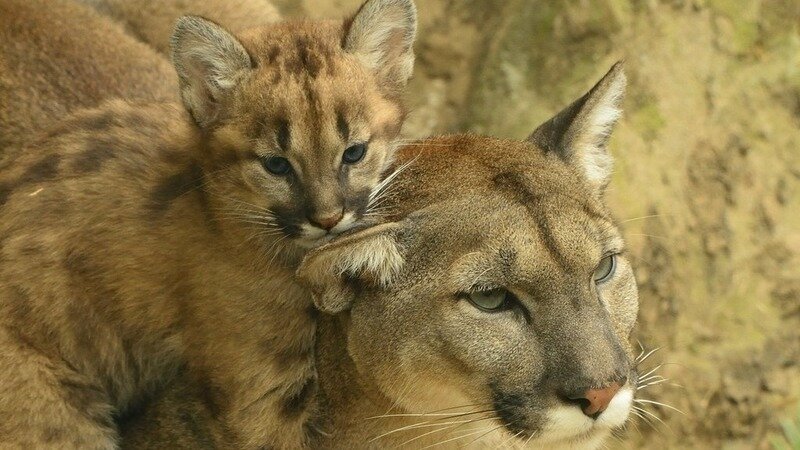
End Hunting of Cougars in Oregon
The Issue
A major problem with hunting cougars is that the hunters often look to kill the largest of the species for the sake of the trophy. The largest cougars are the mature lions of the species. These cougars are experienced and efficient hunters. Decreasing the population of skilled mature lions allows less experienced juvenile cougars to move into territories occupied by humans and pets. Because the juveniles are less skilled in the hunt, they may become desperate and prey on pets or attack a human. Territory clashes between mothers and a new lion in the area can also lead to a mother lion's death, which can result in the death of kittens, or kittens growing up into cougars that do not know how to identify and hunt prey.
Studies have also shown that the cougars that are likely to be involved in conflicts with pets and livestock are cats that were orphaned as kittens and lack the societal hierarchy of the cougar families. Many of these orphaned kittens became so because a hunter killed their mother, and they were left to fend for themselves without the requisite nurturing and hunting skills modeled by life with their mother.
Additionally, there are not as many cougars in the state as one would be led to believe. The population count reported by the Oregon Department of Fish and Wildlife is skewed because the count includes kittens. Cougar kittens have an approximated 55% mortality rate in the first year of life in Oregon. Thus, the population count is inaccurate and the need to reduce the population through hunting does not exist.
It is time for us to shift our belief from viewing cougars as threats to our safety to appreciating them as essential contributors to our environment. We must end hunting of cougars in Oregon and instead focus on coexisting with these magnificent animals.
Hunting as management tool? Research Article
The Elephant in the Room: What can we learn from California regarding the use of sport hunting of pumas (Puma concolor) as a management tool? Research article

321
The Issue
A major problem with hunting cougars is that the hunters often look to kill the largest of the species for the sake of the trophy. The largest cougars are the mature lions of the species. These cougars are experienced and efficient hunters. Decreasing the population of skilled mature lions allows less experienced juvenile cougars to move into territories occupied by humans and pets. Because the juveniles are less skilled in the hunt, they may become desperate and prey on pets or attack a human. Territory clashes between mothers and a new lion in the area can also lead to a mother lion's death, which can result in the death of kittens, or kittens growing up into cougars that do not know how to identify and hunt prey.
Studies have also shown that the cougars that are likely to be involved in conflicts with pets and livestock are cats that were orphaned as kittens and lack the societal hierarchy of the cougar families. Many of these orphaned kittens became so because a hunter killed their mother, and they were left to fend for themselves without the requisite nurturing and hunting skills modeled by life with their mother.
Additionally, there are not as many cougars in the state as one would be led to believe. The population count reported by the Oregon Department of Fish and Wildlife is skewed because the count includes kittens. Cougar kittens have an approximated 55% mortality rate in the first year of life in Oregon. Thus, the population count is inaccurate and the need to reduce the population through hunting does not exist.
It is time for us to shift our belief from viewing cougars as threats to our safety to appreciating them as essential contributors to our environment. We must end hunting of cougars in Oregon and instead focus on coexisting with these magnificent animals.
Hunting as management tool? Research Article
The Elephant in the Room: What can we learn from California regarding the use of sport hunting of pumas (Puma concolor) as a management tool? Research article
Supporter Voices
Petition Updates
Share this petition
Petition created on December 21, 2023