"Nixon's Ulterior Motives Behind the War on Drugs: Hidden Agendas & Long Shadows of Drug War"

Dear Supporters,
Thank you for standing with us in seeking justice for communities disproportionately affected by the War on Drugs. As we move forward with our cause, it's essential to understand the historical context of our fight.
The journey of drug regulation in the US dates back to the 1800s. Drugs, both medicinal and recreational, have been a part of the American fabric since its inception. From the Sears and Roebuck catalog offering cocaine syringes in the 1890s to the initial regulations like the Smoking Opium Exclusion Act in 1909 and the Harrison Act in 1914, we've had a complex relationship with substances. The 1937 "Marijuana Tax Act" was one of the initial steps towards the rigorous regulation we witness today.
Fast forward to 1970, President Nixon launched the Controlled Substances Act and not long after declared drug abuse as "public enemy number one," marking the official commencement of the "War on Drugs." With this came an increased budget and a strengthened force targeting drug use and trafficking, namely the DEA.
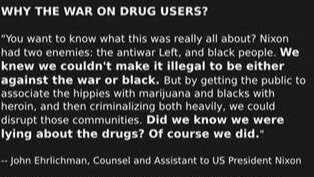
While on the surface, it seemed like an initiative to protect society, however, revelations by insiders like John Ehrlichman President Nixon's Domestic Policy Chief suggest ulterior motives, primarily targeting anti-war activists and black communities. The intention was to destabilize these groups, tarnishing their image, thereby consolidating political power. In the interview, conducted by journalist Dan Baum and published in Harper magazine, Ehrlichman explained that the Nixon campaign had two enemies: “the antiwar left and black people.”
Ehrlichman was quoted as saying: “We knew we couldn’t make it illegal to be either against the war or black, but by getting the public to associate the 'hippies with marijuana' and 'blacks with heroin', and then criminalizing both heavily, we could disrupt those communities. We could arrest their leaders, raid their homes, break up their meetings, and vilify them night after night on the evening news. Did we know we were lying about the drugs? Of course, we did.”
The subsequent years, especially the 1970s, were marked by a slight relaxation in the War on Drugs, with President Carter advocating for the decriminalization of marijuana. However, the damage to targeted communities was already deep-rooted.
We bring forth these historical facts not only as a testament to the systemic challenges we face but to remind everyone of the long-standing injustices certain communities have endured. We stand committed to seeking reparations and ensuring a more inclusive, understanding, and compassionate future. Your continued support is invaluable.
With gratitude and resolve