

Don't weaken Massachusetts hunting laws
The Issue
We are deeply concerned about the proposed changes by the Division of Fisheries & Wildlife to weaken Massachusetts hunting regulations. Hunting is a cherished tradition for many in the Commonwealth, however, these proposed changes pose new public safety risks that outweigh any potential benefits.
As explained in detail below, the proposed changes would increase the likelihood of hunting accidents resulting in injury or death. Hunting safety is paramount, and weakening regulations that have long safeguarded both hunters and the public is a step backward. According to the International Hunter Education Association, hunting is safer than ever due to stringent regulations, and weakening them undermines years of progress in safety training and protocol.
Moreover, these changes would likely lead to a rise in trespassing and violations of private property rights. Massachusetts has a rich history of respecting individual and community rights, and these changes threaten to erode that respect. Trespassing is not only a legal issue but also a matter of trust within the community. Landowners should feel secure in their homes without the fear of uninvited hunters violating their property.
The changes do not present any measurable public benefit. The current regulations have been effective in balancing the sport of hunting with public safety, and altering them now seems unnecessary and unjustified.
In addition to signing this petition, please also submit your own personal written public comment to the Division of Fisheries & Wildlife before 5:00pm on February 6. Signing the petition is good, but submitting a comment as well is even better.
Sunday hunting. The prohibition on Sunday hunting should be retained. While deer season is a limited period of the year, hunting of some kind is allowed across 73% of the calendar, or 264 days (of which deer hunting seasons span 137 days, or 38% of the year). Only May 24–August 31 is free of any hunting. During the nearly three-quarters of the year when hunting is allowed, it is not unreasonable to set aside 1 of every 7 days to allow non-hunters (who comprise 99.2% of the Massachusetts population)[1] to safely access forests and other open space recreational areas—including their own property—without risk of harm or fear of being accidentally shot. 37 days out of that portion of the year still leaves a total 227 hunting days across the calendar, which is 62%, or a nearly two-thirds majority, of the year. We would also note that the Division of Fisheries & Wildlife's statement that “Massachusetts is one of only two states in the country with an outright ban on Sunday hunting” elides the fact that 11 states have some forms of restriction on Sunday hunting.
Crossbow hunting. The prohibition on crossbow hunting except for hunters with accessibility limitations should be retained. Crossbows have a range of up to 1500 feet, equivalent to a hunting rifle, and can fire a bolt at up to 400 feet per second or more. This far exceeds the fire power and lethality of modern compound bows, which fire arrows up to 300 feet per second. It is even more lethal than some firearms. Despite being a comparable public safety hazard to some firearms, however, because of their ease of use and the lack of regulations on their purchase or ownership, crossbows are more likely to be used by untrained or under-trained hunters. Unlike firearms, crossbows can be easily acquired, with no background checks, so this change would almost certainly lead to an increase in unregulated weapons in the Commonwealth. In addition, crossbow hunting has an average wound rate of nearly 20%, making it one of the more inefficient, and inhumane, of hunting methods.[2]
Setback limits. Setback limits for the discharge of weapons should not be changed. Decreasing these protections puts more of our homes, and the people in them, in the crosshairs for a hunting accident and exposes more of our private property to trespass, either deliberate or inadvertent. Weapon discharge setback limits were first adopted into MGL in 1967 (Massachusetts Acts of 1967, Ch. 802, §1). At that time, the effective range for a standard hunting rifle was 450–750 feet and for a bow was up to 100 feet. Today’s standard hunting rifles have ranges of 600–1500 feet (a 100% increase over 1967) and bows can reach 300 feet (a 200% increase). While it is true that modern weapons have better accuracy than those in use when the setbacks were first established, they are thus also capable of killing at greater distances. If anything, then, we should be contemplating increasing the distance at which weapons can be discharged near our homes and families.
The press release announcing these proposed changes cites the need to control deer population as one reason to adopt these measures. Clear scientific evidence, however, has demonstrated that recreational hunting does not reduce deer population in a sustainable way.[3] Indeed, studies have long shown that recreational hunting has the opposite effect: following hunting seasons, the lack of competition for resources among the survivors results in a higher birth rate in the spring.[4] The very fact deer populations are higher than is sustainable is because of the history of over-hunting other animals in Massachusetts, including mountain lion and wolf. Relying on increased hunting to solve a problem caused by over-hunting is ill-conceived.
In trying to justify these contemplated changes, the press release also notes that some other states have hunting laws that are in various ways laxer than those in Massachusetts. As we teach our children, though, just because your friend makes a poor choice does not mean you should make that choice. Rather than weakening our laws to resemble what other states are doing, Massachusetts should serve as a role model for hunting safety. As with other forms of firearm safety, we should be a leader, not a follower, setting an example to which other states can look.
Comparing the rate of hunting injuries and fatalities across the northeast, Massachusetts is by far the safest state in the region:
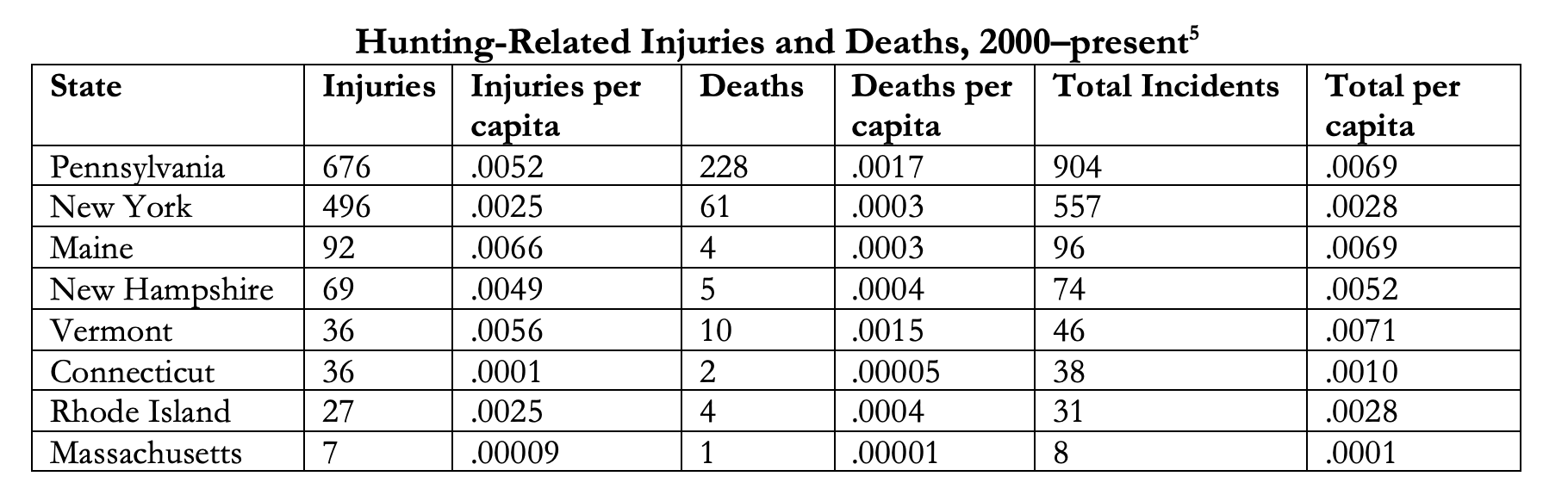
Why would we seek to emulate regulations used by states that have a demonstrably worse hunting safety record than our own? It should be noted, also, that some states have some hunting laws that are stricter than what we have in Massachusetts. Why should our role models necessarily be laws that offer fewer protections rather than stronger ones?
We are calling on the Division of Fisheries & Wildlife to reconsider these changes and on our elected officials to oppose them should they be presented to the Legislature. Hunting regulations should be strengthened, with a focus on conservation and safety, rather than weakened.
Please join us in opposing these changes to protect our communities, uphold our values, and maintain the safety standards that keep hunting a respected and safe sport in Massachusetts. Sign this petition to make your voice heard and help us prevent these detrimental changes to our hunting regulations. Your signature can help preserve the balance between tradition and safety and keep our forests safe for us all.
------------------------------------------------------------------------------
[1] There are approximately 60,000 hunters in Massachusetts, out of a total population of 7.14 million people, meaning licensed hunters make up just 0.8% of Massachusetts residents.
[2] Bob Humphrey, “Do crossbows wound more or less deer?” Bowhunter (2025), online.
[3] S. D. Cote et al, “Ecological impacts of deer overabundance,” Review of Ecology, Evolution, and Systematics 35 (2004): 113–47. M. A. Simard et al, “Is hunting an effective tool to control overabundant deer? A test using an experimental approach,” Journal of Wildlife Management 77 (2013): 254–69. A. J. Bengsen et al. “Can recreational hunting contribute to pest mammal control on public land in Australia?” Mammal Review 46 (2016): 297–310. B. Blossey et al “An indicator approach to capture impacts of white-tailed deer and other ungulates in the presence of multiple associated stressors,” AoB Plants 9 (2017), online. B. Blossey et al “Red oak seedlings as indicators of deer browse pressure: Gauging the outcome of different white-tailed deer management approaches,” Ecology and Evolution 9 (2019): 13085–13103.
[4] Louis Verme, “Reproductive patterns of white-tailed deer related to nutritional plane,” Journal of Wildlife Management 33 (1969): 881–87. Andreas Richter and Ronald Labisky, “Reproductive dynamics among disjunct white-tailed deer herds in Florida,” Journal of Wildlife Management 49 (1985): 964–71. W. J. McShea et al, The Science of Overabundance: Deer Ecology and Population Management (Washington DC: Smithsonian Institution Pres, 1997). Gary White and Richard Bartmann, “Effect of density reduction on overwinter survival of free-ranging mule deer fawns,” Journal of Wildlife Management 62 (1998): 214–25. Julie Blanchong et al, “Genetic diversity and population structure in urban white-tailed deer,” Wildlife Management 77 (2013); 855–62. T. S. Readyhough, “Unveiling drivers of fecundity in an urban white-tailed deer population over 20 years of active management,” Urban Ecosystems 28 (2024), online. Lindsay Thomas, “How often do whitetails give birth to triplet and quadruplet fawns, or more?” NDA (2024), online.
[5] Data from the International Hunter Education Association (https://incidents.ihea-usa.org

378
The Issue
We are deeply concerned about the proposed changes by the Division of Fisheries & Wildlife to weaken Massachusetts hunting regulations. Hunting is a cherished tradition for many in the Commonwealth, however, these proposed changes pose new public safety risks that outweigh any potential benefits.
As explained in detail below, the proposed changes would increase the likelihood of hunting accidents resulting in injury or death. Hunting safety is paramount, and weakening regulations that have long safeguarded both hunters and the public is a step backward. According to the International Hunter Education Association, hunting is safer than ever due to stringent regulations, and weakening them undermines years of progress in safety training and protocol.
Moreover, these changes would likely lead to a rise in trespassing and violations of private property rights. Massachusetts has a rich history of respecting individual and community rights, and these changes threaten to erode that respect. Trespassing is not only a legal issue but also a matter of trust within the community. Landowners should feel secure in their homes without the fear of uninvited hunters violating their property.
The changes do not present any measurable public benefit. The current regulations have been effective in balancing the sport of hunting with public safety, and altering them now seems unnecessary and unjustified.
In addition to signing this petition, please also submit your own personal written public comment to the Division of Fisheries & Wildlife before 5:00pm on February 6. Signing the petition is good, but submitting a comment as well is even better.
Sunday hunting. The prohibition on Sunday hunting should be retained. While deer season is a limited period of the year, hunting of some kind is allowed across 73% of the calendar, or 264 days (of which deer hunting seasons span 137 days, or 38% of the year). Only May 24–August 31 is free of any hunting. During the nearly three-quarters of the year when hunting is allowed, it is not unreasonable to set aside 1 of every 7 days to allow non-hunters (who comprise 99.2% of the Massachusetts population)[1] to safely access forests and other open space recreational areas—including their own property—without risk of harm or fear of being accidentally shot. 37 days out of that portion of the year still leaves a total 227 hunting days across the calendar, which is 62%, or a nearly two-thirds majority, of the year. We would also note that the Division of Fisheries & Wildlife's statement that “Massachusetts is one of only two states in the country with an outright ban on Sunday hunting” elides the fact that 11 states have some forms of restriction on Sunday hunting.
Crossbow hunting. The prohibition on crossbow hunting except for hunters with accessibility limitations should be retained. Crossbows have a range of up to 1500 feet, equivalent to a hunting rifle, and can fire a bolt at up to 400 feet per second or more. This far exceeds the fire power and lethality of modern compound bows, which fire arrows up to 300 feet per second. It is even more lethal than some firearms. Despite being a comparable public safety hazard to some firearms, however, because of their ease of use and the lack of regulations on their purchase or ownership, crossbows are more likely to be used by untrained or under-trained hunters. Unlike firearms, crossbows can be easily acquired, with no background checks, so this change would almost certainly lead to an increase in unregulated weapons in the Commonwealth. In addition, crossbow hunting has an average wound rate of nearly 20%, making it one of the more inefficient, and inhumane, of hunting methods.[2]
Setback limits. Setback limits for the discharge of weapons should not be changed. Decreasing these protections puts more of our homes, and the people in them, in the crosshairs for a hunting accident and exposes more of our private property to trespass, either deliberate or inadvertent. Weapon discharge setback limits were first adopted into MGL in 1967 (Massachusetts Acts of 1967, Ch. 802, §1). At that time, the effective range for a standard hunting rifle was 450–750 feet and for a bow was up to 100 feet. Today’s standard hunting rifles have ranges of 600–1500 feet (a 100% increase over 1967) and bows can reach 300 feet (a 200% increase). While it is true that modern weapons have better accuracy than those in use when the setbacks were first established, they are thus also capable of killing at greater distances. If anything, then, we should be contemplating increasing the distance at which weapons can be discharged near our homes and families.
The press release announcing these proposed changes cites the need to control deer population as one reason to adopt these measures. Clear scientific evidence, however, has demonstrated that recreational hunting does not reduce deer population in a sustainable way.[3] Indeed, studies have long shown that recreational hunting has the opposite effect: following hunting seasons, the lack of competition for resources among the survivors results in a higher birth rate in the spring.[4] The very fact deer populations are higher than is sustainable is because of the history of over-hunting other animals in Massachusetts, including mountain lion and wolf. Relying on increased hunting to solve a problem caused by over-hunting is ill-conceived.
In trying to justify these contemplated changes, the press release also notes that some other states have hunting laws that are in various ways laxer than those in Massachusetts. As we teach our children, though, just because your friend makes a poor choice does not mean you should make that choice. Rather than weakening our laws to resemble what other states are doing, Massachusetts should serve as a role model for hunting safety. As with other forms of firearm safety, we should be a leader, not a follower, setting an example to which other states can look.
Comparing the rate of hunting injuries and fatalities across the northeast, Massachusetts is by far the safest state in the region:
Why would we seek to emulate regulations used by states that have a demonstrably worse hunting safety record than our own? It should be noted, also, that some states have some hunting laws that are stricter than what we have in Massachusetts. Why should our role models necessarily be laws that offer fewer protections rather than stronger ones?
We are calling on the Division of Fisheries & Wildlife to reconsider these changes and on our elected officials to oppose them should they be presented to the Legislature. Hunting regulations should be strengthened, with a focus on conservation and safety, rather than weakened.
Please join us in opposing these changes to protect our communities, uphold our values, and maintain the safety standards that keep hunting a respected and safe sport in Massachusetts. Sign this petition to make your voice heard and help us prevent these detrimental changes to our hunting regulations. Your signature can help preserve the balance between tradition and safety and keep our forests safe for us all.
------------------------------------------------------------------------------
[1] There are approximately 60,000 hunters in Massachusetts, out of a total population of 7.14 million people, meaning licensed hunters make up just 0.8% of Massachusetts residents.
[2] Bob Humphrey, “Do crossbows wound more or less deer?” Bowhunter (2025), online.
[3] S. D. Cote et al, “Ecological impacts of deer overabundance,” Review of Ecology, Evolution, and Systematics 35 (2004): 113–47. M. A. Simard et al, “Is hunting an effective tool to control overabundant deer? A test using an experimental approach,” Journal of Wildlife Management 77 (2013): 254–69. A. J. Bengsen et al. “Can recreational hunting contribute to pest mammal control on public land in Australia?” Mammal Review 46 (2016): 297–310. B. Blossey et al “An indicator approach to capture impacts of white-tailed deer and other ungulates in the presence of multiple associated stressors,” AoB Plants 9 (2017), online. B. Blossey et al “Red oak seedlings as indicators of deer browse pressure: Gauging the outcome of different white-tailed deer management approaches,” Ecology and Evolution 9 (2019): 13085–13103.
[4] Louis Verme, “Reproductive patterns of white-tailed deer related to nutritional plane,” Journal of Wildlife Management 33 (1969): 881–87. Andreas Richter and Ronald Labisky, “Reproductive dynamics among disjunct white-tailed deer herds in Florida,” Journal of Wildlife Management 49 (1985): 964–71. W. J. McShea et al, The Science of Overabundance: Deer Ecology and Population Management (Washington DC: Smithsonian Institution Pres, 1997). Gary White and Richard Bartmann, “Effect of density reduction on overwinter survival of free-ranging mule deer fawns,” Journal of Wildlife Management 62 (1998): 214–25. Julie Blanchong et al, “Genetic diversity and population structure in urban white-tailed deer,” Wildlife Management 77 (2013); 855–62. T. S. Readyhough, “Unveiling drivers of fecundity in an urban white-tailed deer population over 20 years of active management,” Urban Ecosystems 28 (2024), online. Lindsay Thomas, “How often do whitetails give birth to triplet and quadruplet fawns, or more?” NDA (2024), online.
[5] Data from the International Hunter Education Association (https://incidents.ihea-usa.org
The Decision Makers


Supporter Voices
Petition Updates
Share this petition
Petition created on January 26, 2026