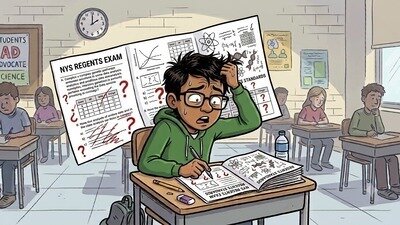

Demand NYSED & Board of Regents Address New Science Curricula & Exams
Recent signers:
Noah and 19 others have signed recently.
The Issue
Overview
- There are a number of deep concerns that both educators and students have regarding the rollout of the new science curricula and New York State Regents examinations. Hardworking educators and their students are fully committing to the new standards, yet they are being left feeling discouraged by a fundamentally broken system.
- As educators, our responsibility is to make the difficult and confusing both understandable and doable for our students. However, the current state of these assessments—marked by oddly worded, excessively long reading sections filled with impertinent information, and direct mismatches between the provided curricula and state tests—does not reflect academic rigor. Instead, these are clear signs of a severe lack of cohesion between state curricula, assessments, and reference tables.
- If an assessment requires an artificially large score curve just to be equitable for students, it is a clear sign of poor exam design on the part of the state, not a lack of effort in classroom instruction or student capability. To ensure clarity and fairness, we are bringing the main systemic flaws to light.
The Core Issues
- Flawed Exam Vetting and Blatant Errors - Questions on the new assessments are frequently riddled with typos, worded in a highly confusing manner, and substitute standard scientific vocabulary for atypical language. Worse, multiple questions have featured incorrect translations or have contained absolutely no possible correct response choice. These recurring mistakes are leading science educators across New York to question whether these high-stakes assessments are actually being vetted by qualified experts in their respective content areas.
- Severe Curricular and Laboratory Disconnect - The provided state curricula do not align with the actual content featured on the new assessments. This has left students and teachers entirely confused as to why they were directed to follow these new frameworks rather than the original Regents curriculum, which connected far more logically to the assessments. Most notably, the vast majority of the topics contained within the state-mandated laboratory activities were completely absent from the actual Regents exams, rendering hours of intensive lab dedication moot.
- Confusing Formatting and Structural Layouts - Both the Regents examinations and the state-mandated laboratory activities are physically formatted in a way that actively hinders student performance. Students are forced to constantly flip back and forth to previous pages to analyze texts, operational steps, and complex diagrams or graphs to answer questions presented on an entirely separate page.
- Inconsistent Metrics and Stripped Reference Tools - Units of measurement that were completely excluded from the provided curricula and official reference tables have suddenly appeared on operational Regents exams (such as M/s and ng/L). Conversely, core equations and units that were explicitly taught in the curricula and provided on the reference tables (such as ppm and mol/L) were completely missing from assessment questions. Furthermore, for Earth & Space Science, Chemistry, and Physics, the previous 2011 iterations of the reference tables provided vastly more useful and supportive information for students than the newly issued versions.
- Punitive "Multi-Jeopardy" Grading Structures - An unfamiliar and punitive layout has been introduced where multiple questions utilize "triple or quadruple jeopardy" formatting. This structure requires a student to execute three to four distinct scientific and computational steps flawlessly just to be awarded a single point. For non-Advanced Placement (AP) level assessments, these layout mechanisms function as unfair and punitive grading structures for our general student population, a large number of whom are English Language Learners and students with special educational needs.
Our Request for Changes
- Students, their parents/guardians, and teachers urgently need the New York State Education Department (NYSED) and the New York State Board of Regents to make the new science curricula, assessments, mandated laboratory activities, and reference tables fully coherent going forward. We demand an immediate independent audit of current exam formats, structural layout corrections, and a transparent review process involving currently active educators, certified in the respective subject areas to restore equity and standard academic fairness to these high stakes exams.
Take Action Now!
- For Students & Parents: Voice your direct concerns to the state by contacting emscassessinfo@nysed.gov , commissioner@nysed.gov , or RegentsOffice@nysed.gov
- For Educators: Submit formal engineering feedback regarding your specific subject exam directly via the official NYSED portal: https://www.nysed.gov/state-assessment/teacher-feedback-state-assessments
- Please sign and share this petition to stand up for academic clarity, professional vetting, and student equity in New York State!

214
Let’s get to 500 signatures!
Recent signers:
Noah and 19 others have signed recently.
The Issue
Overview
- There are a number of deep concerns that both educators and students have regarding the rollout of the new science curricula and New York State Regents examinations. Hardworking educators and their students are fully committing to the new standards, yet they are being left feeling discouraged by a fundamentally broken system.
- As educators, our responsibility is to make the difficult and confusing both understandable and doable for our students. However, the current state of these assessments—marked by oddly worded, excessively long reading sections filled with impertinent information, and direct mismatches between the provided curricula and state tests—does not reflect academic rigor. Instead, these are clear signs of a severe lack of cohesion between state curricula, assessments, and reference tables.
- If an assessment requires an artificially large score curve just to be equitable for students, it is a clear sign of poor exam design on the part of the state, not a lack of effort in classroom instruction or student capability. To ensure clarity and fairness, we are bringing the main systemic flaws to light.
The Core Issues
- Flawed Exam Vetting and Blatant Errors - Questions on the new assessments are frequently riddled with typos, worded in a highly confusing manner, and substitute standard scientific vocabulary for atypical language. Worse, multiple questions have featured incorrect translations or have contained absolutely no possible correct response choice. These recurring mistakes are leading science educators across New York to question whether these high-stakes assessments are actually being vetted by qualified experts in their respective content areas.
- Severe Curricular and Laboratory Disconnect - The provided state curricula do not align with the actual content featured on the new assessments. This has left students and teachers entirely confused as to why they were directed to follow these new frameworks rather than the original Regents curriculum, which connected far more logically to the assessments. Most notably, the vast majority of the topics contained within the state-mandated laboratory activities were completely absent from the actual Regents exams, rendering hours of intensive lab dedication moot.
- Confusing Formatting and Structural Layouts - Both the Regents examinations and the state-mandated laboratory activities are physically formatted in a way that actively hinders student performance. Students are forced to constantly flip back and forth to previous pages to analyze texts, operational steps, and complex diagrams or graphs to answer questions presented on an entirely separate page.
- Inconsistent Metrics and Stripped Reference Tools - Units of measurement that were completely excluded from the provided curricula and official reference tables have suddenly appeared on operational Regents exams (such as M/s and ng/L). Conversely, core equations and units that were explicitly taught in the curricula and provided on the reference tables (such as ppm and mol/L) were completely missing from assessment questions. Furthermore, for Earth & Space Science, Chemistry, and Physics, the previous 2011 iterations of the reference tables provided vastly more useful and supportive information for students than the newly issued versions.
- Punitive "Multi-Jeopardy" Grading Structures - An unfamiliar and punitive layout has been introduced where multiple questions utilize "triple or quadruple jeopardy" formatting. This structure requires a student to execute three to four distinct scientific and computational steps flawlessly just to be awarded a single point. For non-Advanced Placement (AP) level assessments, these layout mechanisms function as unfair and punitive grading structures for our general student population, a large number of whom are English Language Learners and students with special educational needs.
Our Request for Changes
- Students, their parents/guardians, and teachers urgently need the New York State Education Department (NYSED) and the New York State Board of Regents to make the new science curricula, assessments, mandated laboratory activities, and reference tables fully coherent going forward. We demand an immediate independent audit of current exam formats, structural layout corrections, and a transparent review process involving currently active educators, certified in the respective subject areas to restore equity and standard academic fairness to these high stakes exams.
Take Action Now!
- For Students & Parents: Voice your direct concerns to the state by contacting emscassessinfo@nysed.gov , commissioner@nysed.gov , or RegentsOffice@nysed.gov
- For Educators: Submit formal engineering feedback regarding your specific subject exam directly via the official NYSED portal: https://www.nysed.gov/state-assessment/teacher-feedback-state-assessments
- Please sign and share this petition to stand up for academic clarity, professional vetting, and student equity in New York State!
187 people signed this week
Supporter Voices
Petition Updates
Share this petition
Petition created on June 25, 2026