

Demand Justice for Samuel Gichuhi
The Issue
What happened to Samuel Gichuhi is not a private tragedy. It is a public warning.
It shows what can happen when disability, race, housing power, medical vulnerability, and institutional authority converge against one human being at the same time.
Samuel "Sam" Gichuhi is a Black male brain injury survivor who entered brain surgery in 2022 to remove a tumor — and came out catastrophically injured after his middle cerebral artery was accidentally ruptured on the operating table, causing both a hemorrhagic and ischemic stroke. This was not a vague complication. It was a life-altering injury with consequences that changed every aspect of his life.
Sam survived — but with paralysis and a traumatic brain injury.
And still, he fought.
His mind remained intact. His speech remained intact. His ability to think, communicate, advocate for himself, and interact with others remained intact. Like many brain injury survivors, he experiences slowed processing, spatial impairment, and trauma-related anxiety responses. These are recognized neurological consequences — not criminal behavior, incompetence, or justification for stripping a person of dignity or rights.
He remained in active treatment and rehabilitation through July 2023.
With the support of family, doctors, therapists, and rehabilitation teams, Sam was rebuilding his life. His family renovated a family home to make it wheelchair accessible and medically appropriate for his survival and recovery.
He was not abandoned.
He was recovering.
Then the system intervened — and everything changed.
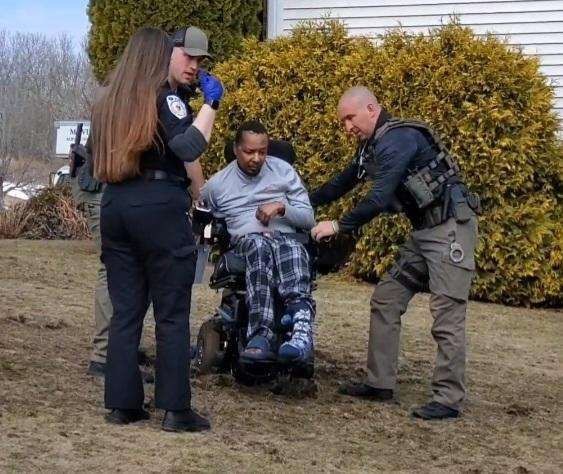
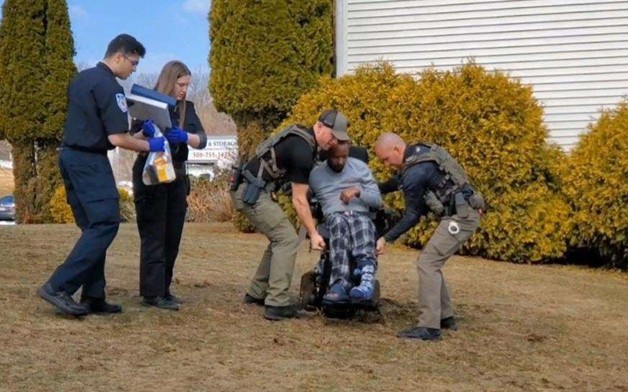
Above: Sam being mishandled by sheriffs during the forced unhousing that left him medically homeless and disrupted his care.
The family home where Sam lived and recovered is a roughly $1.3 million property with a $350,000 home equity loan. A vulture capitalist, operating through a shell company and with the assistance of a specific housing court judge and clerk magistrate, targeted the property and branded Sam a "squatter" — a label that was used verbally and loudly against him to erase his legitimacy and humanity.
Sam was dragged into housing court and subjected to an abusive summary process that culminated in his eviction — even though the issues at hand were ownership disputes, not landlord-tenant matters. Summary process eviction procedures are designed for tenant removals, not property ownership conflicts. Yet the court moved the process forward anyway with all the reported abuses. Instead of recognizing a catastrophically disabled Black man and a family providing medically necessary care, institutions entrusted with protecting vulnerable people chose procedural expediency over humanity — stripping a Black brain injury survivor of his medically necessary home through a fast-track eviction mechanism never intended for such cases.
What followed, according to the family, was not a lawful eviction, but a sustained campaign of intimidation, harassment, dispossession, and institutional abuse supported by documentary evidence, including public video footage and records surrounding the eviction process.
The family reports more than ten incidents involving threats, harassment, and aggressive enforcement actions designed to force them out. Video evidence of one such incident has been made public.
On the final morning of one such harassment, law enforcement arrived early at the home. Sam's primary family advocate and caregiver was suddenly removed from the scene under emergency mental health procedures, leaving a severely disabled man without the person most familiar with his medical, mobility, and communication needs.
What happened next raises serious and urgent concerns.
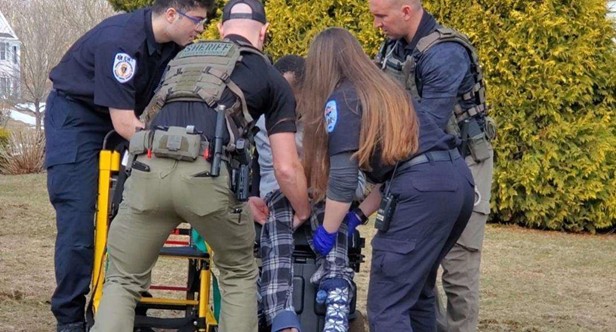
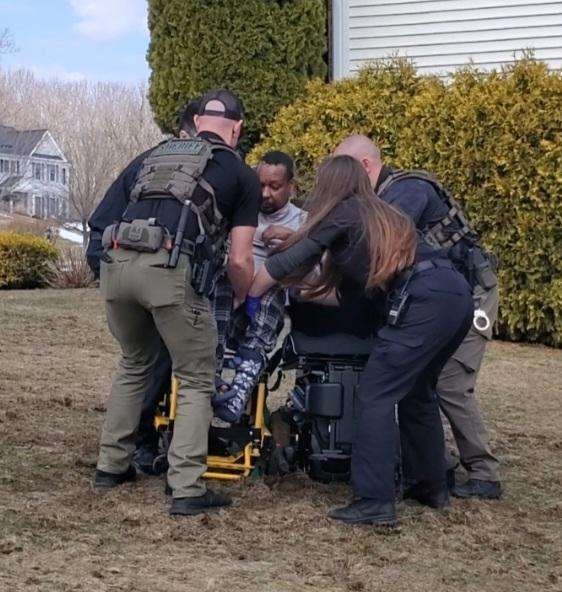
Above: Sam being transported by ambulance despite no clear medical emergency requiring hospitalization.
Sam, a wheelchair-bound brain injury survivor requiring specialized handling and medical support equipment, was forcibly removed from his home without appropriate medical safeguards. He was transported to a hospital by ambulance despite no clear emergency medical basis requiring hospitalization and, according to the family, abandoned in ER corridors for days without proper admission, food, support, or continuity of care.
His medically adapted home — essential to his survival — was gone.
His treatment continuity — disrupted.
His stability — shattered.
For days, Sam remained in degrading conditions until outside agencies and public pressure forced intervention. Only then was he moved into an actual room.
But by then, another horrifying reality had become clear: a disabled man who had successfully been living in the community, supported by family and rehabilitation systems, was now medically homeless and at risk of institutionalization against his will.
A man with intact cognition and a voice.
A man whose home had already been adapted for disability access.
A man urgently needing continuity of cancer-related treatment and radiation care. Now displaced.
Destabilized.
At risk of losing autonomy.
Sam, his 98-year-old mother, and the rest of his family strongly opposed his institutionalization. But to silence their objections and confine him to the annals of statistics, the hospital where he had been abandoned — with the backing of powerful individuals seeking to unhouse him completely and potentially hasten his demise — went to probate court in the same jurisdiction where all the other abuses had occurred.
They lied to the judge.
The hospital claimed Sam was an incapacitated man who had suffered a cardioembolic stroke, had Alzheimer's and dementia, and was abandoned by his family. They sought temporary guardianship to institutionalize him without giving the family any ability to protest.
Then, to make their petition seem urgent and serious, the hospital's attorney added a final, devastating lie: they stereotyped Sam as a dangerous Black man who had tried to kill a hospital staff member with a knife.
Think about what they were asking the court to believe.
Sam is paralyzed on one side. He is wheelchair bound. He cannot reach someone who simply takes one step backward. Yet the hospital presented this disabled man — who cannot walk, cannot use half his body, and requires assistance for basic tasks — as a violent criminal threat capable of stabbing hospital staff.
The court bought the narrative and granted the hospital temporary guardianship.
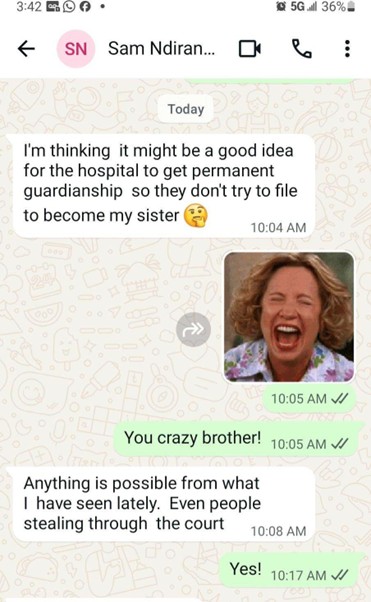
Sam — the same man a hospital claimed was so incapacitated he needed to be confined in a nursing home and stripped of his autonomy — still maintains his sharp wit and sense of humor. He sent this message to a family member:
Meanwhile, critical radiation treatment at Massachusetts General Hospital was disrupted because Sam had effectively been rendered medically homeless.
The family and community believe this case reflects a broader pattern of systemic harm, including:
Institutional Abuse Carried Out Under Color of Authority
- Weaponization of housing courts against vulnerable families and communities of color
- Misuse of sheriff and police power against disabled, medically vulnerable, and marginalized people
- Use of hospitals as dumping grounds for medically displaced individuals after forced removals and evictions
- Misuse of ambulance and medical transport systems to facilitate displacement and institutional control rather than genuine medical care
- Weaponization of emergency mental health procedures and jail against caregivers, advocates, and family members who resist abuse
- Systemic disregard for disability rights, civil rights, and human dignity when vulnerable people stand in the path of money, power, or institutional convenience
- Coordinated institutional conduct that strips disabled, vulnerable and medically fragile people of housing, medical stability, safety, autonomy, and dignity
- Criminalization and intimidation of caregivers and community members who advocate for vulnerable loved ones
- Public institutions protecting power structures, financial interests, and one another instead of protecting human beings
- Delayed intervention by oversight agencies until outside public pressure, community outrage, or media attention forces action
- A growing pattern in which vulnerable people of color are treated not as citizens deserving protection, but as obstacles to be removed, displaced, institutionalized, or silenced
This case demands public scrutiny.
A black man who survived an accidental during catastrophic brain injury should not be pushed toward homelessness, institutionalization, or neglect by the very systems meant to protect him.
Disabled people should not lose medically necessary housing because powerful institutions decide they are undeserving and inconvenient.
Communities of color should not have to fear the weaponization of courts, law enforcement, hospitals, and mental health systems against vulnerable loved ones.
We call for:
- An independent investigation into the unlawful eviction process and law enforcement conduct
- A review of the medical handling and hospital response
- Immediate safeguards protecting medically vulnerable individuals during housing removals
- Accountability for any misuse of authority or violations of civil rights
- Protection of medically vulnerable individuals' rights to housing, dignity, and continuity of care
- Oversight reforms preventing the misuse of courts, emergency mental health procedures, and medical systems against vulnerable communities
This is bigger than one family.
It is about whether our systems will be weaponized against the most vulnerable people in society — or used to protect them.
Because when every institution that is supposed to protect a vulnerable human being instead turns its power against them, silence becomes dangerous.
Sign this petition to demand oversight, accountability, and protection for vulnerable disabled individuals and communities of color before this happens again.
ADDITIONAL WAYS TO STAND WITH SAM
Justice for Sam cannot happen on outrage alone — it requires resources, protection, and immediate action.
This petition is therefore tied to a public fundraiser to help secure two urgent necessities:
- A qualified civil rights attorney capable of investigating and challenging what continues to happen to Sam
- Sam needs at least two months of housing within five miles of Massachusetts General Hospital so he can receive daily, 30-minute outpatient brain-radiation treatments for a minimum of 30 consecutive days. The radiation must be delivered in very small, precisely targeted doses because of the tumor's dangerous location, and the treatment protocol does not allow inpatient admission; MGH has ordered that Sam cannot be subjected to long drives to and from the hospital and must remain within at most five miles of the hospital.
Sam is a Black brain injury survivor fighting not only for justice, dignity, and accountability —but for his life, his health, his stability, and his survival against systems that have targeted him because of both his race and his disability.
For anyone who wishes to verify the facts before contributing, Sam is willing to authorize access to relevant records, information, and supporting documentation necessary to confirm what happened and help save his life.
If this story moved you, please do more than sign.
Stand with Sam.
Help protect vulnerable disabled individuals and communities of color.
Help secure the treatment and legal support needed before more irreversible harm is done.

164
The Issue
What happened to Samuel Gichuhi is not a private tragedy. It is a public warning.
It shows what can happen when disability, race, housing power, medical vulnerability, and institutional authority converge against one human being at the same time.
Samuel "Sam" Gichuhi is a Black male brain injury survivor who entered brain surgery in 2022 to remove a tumor — and came out catastrophically injured after his middle cerebral artery was accidentally ruptured on the operating table, causing both a hemorrhagic and ischemic stroke. This was not a vague complication. It was a life-altering injury with consequences that changed every aspect of his life.
Sam survived — but with paralysis and a traumatic brain injury.
And still, he fought.
His mind remained intact. His speech remained intact. His ability to think, communicate, advocate for himself, and interact with others remained intact. Like many brain injury survivors, he experiences slowed processing, spatial impairment, and trauma-related anxiety responses. These are recognized neurological consequences — not criminal behavior, incompetence, or justification for stripping a person of dignity or rights.
He remained in active treatment and rehabilitation through July 2023.
With the support of family, doctors, therapists, and rehabilitation teams, Sam was rebuilding his life. His family renovated a family home to make it wheelchair accessible and medically appropriate for his survival and recovery.
He was not abandoned.
He was recovering.
Then the system intervened — and everything changed.
Above: Sam being mishandled by sheriffs during the forced unhousing that left him medically homeless and disrupted his care.
The family home where Sam lived and recovered is a roughly $1.3 million property with a $350,000 home equity loan. A vulture capitalist, operating through a shell company and with the assistance of a specific housing court judge and clerk magistrate, targeted the property and branded Sam a "squatter" — a label that was used verbally and loudly against him to erase his legitimacy and humanity.
Sam was dragged into housing court and subjected to an abusive summary process that culminated in his eviction — even though the issues at hand were ownership disputes, not landlord-tenant matters. Summary process eviction procedures are designed for tenant removals, not property ownership conflicts. Yet the court moved the process forward anyway with all the reported abuses. Instead of recognizing a catastrophically disabled Black man and a family providing medically necessary care, institutions entrusted with protecting vulnerable people chose procedural expediency over humanity — stripping a Black brain injury survivor of his medically necessary home through a fast-track eviction mechanism never intended for such cases.
What followed, according to the family, was not a lawful eviction, but a sustained campaign of intimidation, harassment, dispossession, and institutional abuse supported by documentary evidence, including public video footage and records surrounding the eviction process.
The family reports more than ten incidents involving threats, harassment, and aggressive enforcement actions designed to force them out. Video evidence of one such incident has been made public.
On the final morning of one such harassment, law enforcement arrived early at the home. Sam's primary family advocate and caregiver was suddenly removed from the scene under emergency mental health procedures, leaving a severely disabled man without the person most familiar with his medical, mobility, and communication needs.
What happened next raises serious and urgent concerns.
Above: Sam being transported by ambulance despite no clear medical emergency requiring hospitalization.
Sam, a wheelchair-bound brain injury survivor requiring specialized handling and medical support equipment, was forcibly removed from his home without appropriate medical safeguards. He was transported to a hospital by ambulance despite no clear emergency medical basis requiring hospitalization and, according to the family, abandoned in ER corridors for days without proper admission, food, support, or continuity of care.
His medically adapted home — essential to his survival — was gone.
His treatment continuity — disrupted.
His stability — shattered.
For days, Sam remained in degrading conditions until outside agencies and public pressure forced intervention. Only then was he moved into an actual room.
But by then, another horrifying reality had become clear: a disabled man who had successfully been living in the community, supported by family and rehabilitation systems, was now medically homeless and at risk of institutionalization against his will.
A man with intact cognition and a voice.
A man whose home had already been adapted for disability access.
A man urgently needing continuity of cancer-related treatment and radiation care. Now displaced.
Destabilized.
At risk of losing autonomy.
Sam, his 98-year-old mother, and the rest of his family strongly opposed his institutionalization. But to silence their objections and confine him to the annals of statistics, the hospital where he had been abandoned — with the backing of powerful individuals seeking to unhouse him completely and potentially hasten his demise — went to probate court in the same jurisdiction where all the other abuses had occurred.
They lied to the judge.
The hospital claimed Sam was an incapacitated man who had suffered a cardioembolic stroke, had Alzheimer's and dementia, and was abandoned by his family. They sought temporary guardianship to institutionalize him without giving the family any ability to protest.
Then, to make their petition seem urgent and serious, the hospital's attorney added a final, devastating lie: they stereotyped Sam as a dangerous Black man who had tried to kill a hospital staff member with a knife.
Think about what they were asking the court to believe.
Sam is paralyzed on one side. He is wheelchair bound. He cannot reach someone who simply takes one step backward. Yet the hospital presented this disabled man — who cannot walk, cannot use half his body, and requires assistance for basic tasks — as a violent criminal threat capable of stabbing hospital staff.
The court bought the narrative and granted the hospital temporary guardianship.
Sam — the same man a hospital claimed was so incapacitated he needed to be confined in a nursing home and stripped of his autonomy — still maintains his sharp wit and sense of humor. He sent this message to a family member:
Meanwhile, critical radiation treatment at Massachusetts General Hospital was disrupted because Sam had effectively been rendered medically homeless.
The family and community believe this case reflects a broader pattern of systemic harm, including:
Institutional Abuse Carried Out Under Color of Authority
- Weaponization of housing courts against vulnerable families and communities of color
- Misuse of sheriff and police power against disabled, medically vulnerable, and marginalized people
- Use of hospitals as dumping grounds for medically displaced individuals after forced removals and evictions
- Misuse of ambulance and medical transport systems to facilitate displacement and institutional control rather than genuine medical care
- Weaponization of emergency mental health procedures and jail against caregivers, advocates, and family members who resist abuse
- Systemic disregard for disability rights, civil rights, and human dignity when vulnerable people stand in the path of money, power, or institutional convenience
- Coordinated institutional conduct that strips disabled, vulnerable and medically fragile people of housing, medical stability, safety, autonomy, and dignity
- Criminalization and intimidation of caregivers and community members who advocate for vulnerable loved ones
- Public institutions protecting power structures, financial interests, and one another instead of protecting human beings
- Delayed intervention by oversight agencies until outside public pressure, community outrage, or media attention forces action
- A growing pattern in which vulnerable people of color are treated not as citizens deserving protection, but as obstacles to be removed, displaced, institutionalized, or silenced
This case demands public scrutiny.
A black man who survived an accidental during catastrophic brain injury should not be pushed toward homelessness, institutionalization, or neglect by the very systems meant to protect him.
Disabled people should not lose medically necessary housing because powerful institutions decide they are undeserving and inconvenient.
Communities of color should not have to fear the weaponization of courts, law enforcement, hospitals, and mental health systems against vulnerable loved ones.
We call for:
- An independent investigation into the unlawful eviction process and law enforcement conduct
- A review of the medical handling and hospital response
- Immediate safeguards protecting medically vulnerable individuals during housing removals
- Accountability for any misuse of authority or violations of civil rights
- Protection of medically vulnerable individuals' rights to housing, dignity, and continuity of care
- Oversight reforms preventing the misuse of courts, emergency mental health procedures, and medical systems against vulnerable communities
This is bigger than one family.
It is about whether our systems will be weaponized against the most vulnerable people in society — or used to protect them.
Because when every institution that is supposed to protect a vulnerable human being instead turns its power against them, silence becomes dangerous.
Sign this petition to demand oversight, accountability, and protection for vulnerable disabled individuals and communities of color before this happens again.
ADDITIONAL WAYS TO STAND WITH SAM
Justice for Sam cannot happen on outrage alone — it requires resources, protection, and immediate action.
This petition is therefore tied to a public fundraiser to help secure two urgent necessities:
- A qualified civil rights attorney capable of investigating and challenging what continues to happen to Sam
- Sam needs at least two months of housing within five miles of Massachusetts General Hospital so he can receive daily, 30-minute outpatient brain-radiation treatments for a minimum of 30 consecutive days. The radiation must be delivered in very small, precisely targeted doses because of the tumor's dangerous location, and the treatment protocol does not allow inpatient admission; MGH has ordered that Sam cannot be subjected to long drives to and from the hospital and must remain within at most five miles of the hospital.
Sam is a Black brain injury survivor fighting not only for justice, dignity, and accountability —but for his life, his health, his stability, and his survival against systems that have targeted him because of both his race and his disability.
For anyone who wishes to verify the facts before contributing, Sam is willing to authorize access to relevant records, information, and supporting documentation necessary to confirm what happened and help save his life.
If this story moved you, please do more than sign.
Stand with Sam.
Help protect vulnerable disabled individuals and communities of color.
Help secure the treatment and legal support needed before more irreversible harm is done.
The Decision Makers


Petition Updates
Share this petition
Petition created on May 24, 2026