
Live Updates: Trump Lashes Out After Conviction in Misleading Speech
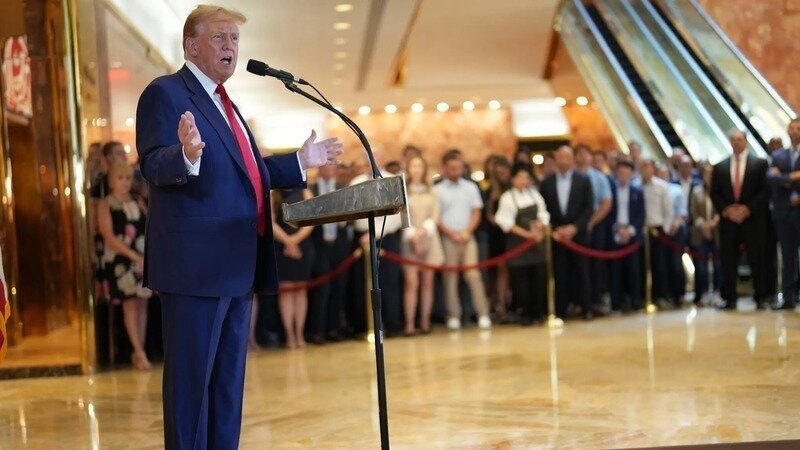
Donald J. Trump, the first U.S. president to become a felon, excoriated prosecutors and the judge in his criminal case and ran through a litany of false statements as he spoke to reporters and a small crowd of vetted supporters at Trump Tower in Midtown Manhattan.
Here’s what to know after Donald Trump’s conviction.
As America began to absorb on Friday the conviction of Donald J. Trump, a first for a U.S. president, he criticized the criminal case and attacked the judge who oversaw his trial.
Mr. Trump, in a rambling and misleading 33-minute speech, derided the trial as “rigged” and made numerous false statements about what had taken place in court. His remarks came after he was found guilty on Thursday of all 34 felony counts of falsifying records to cover up a sex scandal that threatened to derail his 2016 presidential campaign.
Mr. Trump, who said he would appeal the verdict, continued to attack people who testified against him in the seven-week trial, specifically his former fixer, Michael D. Cohen, the star witness for the prosecution. He also admitted that he had gotten “very upset” with his lawyers.
He called the judge, Juan M. Merchan, the “devil.”
Mr. Trump delivered the comments inside Trump Tower in Manhattan, a gilded venue on Fifth Avenue far more photogenic than the drab courtroom hallway where he had been delivering remarks since his criminal trial began in April.
The case stemmed from a scheme to influence the outcome of the 2016 election by silencing a porn star’s account of a sexual liaison with him a decade earlier. Stormy Daniels’s story of a one-night encounter — which she recounted under oath and which the former president has always denied — led Mr. Trump to conceal the $130,000 hush-money payment she received just before Election Day.
Mr. Trump faked the records to hide reimbursements to Mr. Cohen, who had made the payment to Ms. Daniels. Prosecutors said their efforts were part of a plot to hide negative stories about Mr. Trump from the American public in the days and months before voters cast their ballots in 2016.
Mr. Trump’s sentencing is set for July 11. He faces probation or up to four years in prison.
Here is what else to know:
At Trump Tower on Friday, Mr. Trump reprised his usual campaign attacks on immigrants and made numerous false representations about U.S. border policies under President Biden. He falsely claimed that American children couldn’t play Little League Baseball games anymore because undocumented immigrants were setting up too many tents.
Mr. Trump sat largely expressionless in court on Thursday as he was convicted by a jury of 12 New Yorkers, who deliberated over two days to reach a decision in a case rife with descriptions of secret deals, tabloid scandal and an Oval Office pact. Here’s how the scheme worked.
The guilty verdict has given President Biden’s campaign a fresh way to frame the 2024 election: a stark choice between someone who is a felon and someone who is not. The verdict is likely to focus attention on Mr. Trump in a way that Mr. Biden’s supporters have long hoped it would. Even if Mr. Biden does not directly affix the title “felon” to his rival, scores of his allies are planning to do so in their communications about Mr. Trump through the end of the campaign.
Though Mr. Trump has promised to appeal, he will be enmeshed in the gears of the criminal justice system long before any such appeal is heard. A pre-sentence report, made by probation officers, will make recommendations based on his criminal record — he had none before this case — as well as his personal history and the crime itself.
Mr. Trump can still run for president. The Constitution sets very few eligibility requirements. Presidents must be at least 35 years old, be “natural born” citizens and have lived in the United States for at least 14 years. There are no limitations based on character or criminal record. While some states prohibit felons from running for state and local office, these laws do not apply to federal offices. If elected, Mr. Trump could not pardon himself because presidential pardon power does not extend to state cases.
Alvin L. Bragg, the Manhattan district attorney, risked his reputation by indicting Mr. Trump in a case that some prominent Democrats said wasn’t strong enough to have brought against a former president. Instead, Mr. Bragg cemented his place in history as the first prosecutor to convict a former president. In a news conference Thursday, Mr. Bragg thanked the jury, calling its service the “cornerstone of our judicial system.” He reiterated that his office performed the sort of white-collar prosecution that is central to its role. “I did my job, and we did our job,” Mr. Bragg said.