

Demand Better Financial Management and Community Focus in UNA's 2024-25 Budget
Demand Better Financial Management and Community Focus in UNA's 2024-25 Budget
The Issue
Note:
- If you are not a UBC resident, please refrain from signing, as this petition is exclusively for UBC residents. When providing your reasons for signing the petition, please include at least the specific University Neighbourhood where you reside. Options include Wesbrook, Hawthorn, Hampton, East Campus, Chancellor, Central Building, among others (please specify if it's a different area). This information is crucial for us to better understand and represent the varied perspectives and concerns across our community.
- The Change.org website may prompt voters to donate. Please ignore this message and do NOT donate(不用捐款), as the free access limit should be sufficient to achieve the spread and appeal of this petition. You are welcome to share and encourage more residents to participate in signing!
- For anyone interested in reading the translated version of the letter in Simplified Chinese or another language, you can follow the provided link. The tool allows you to switch languages using the toolbar at the top of the result page. Here's the link for convenience: 中文及其他语言翻译请点击 Google Translate - UNA 2024-25 Budget Letter.
Dear UNA Board Members,
This letter, co-signed by a dozen UBC residents and council members, reflects our collective concerns regarding the UNA 2024-25 budget. Our joint efforts underscore the seriousness with which we view the following issues.
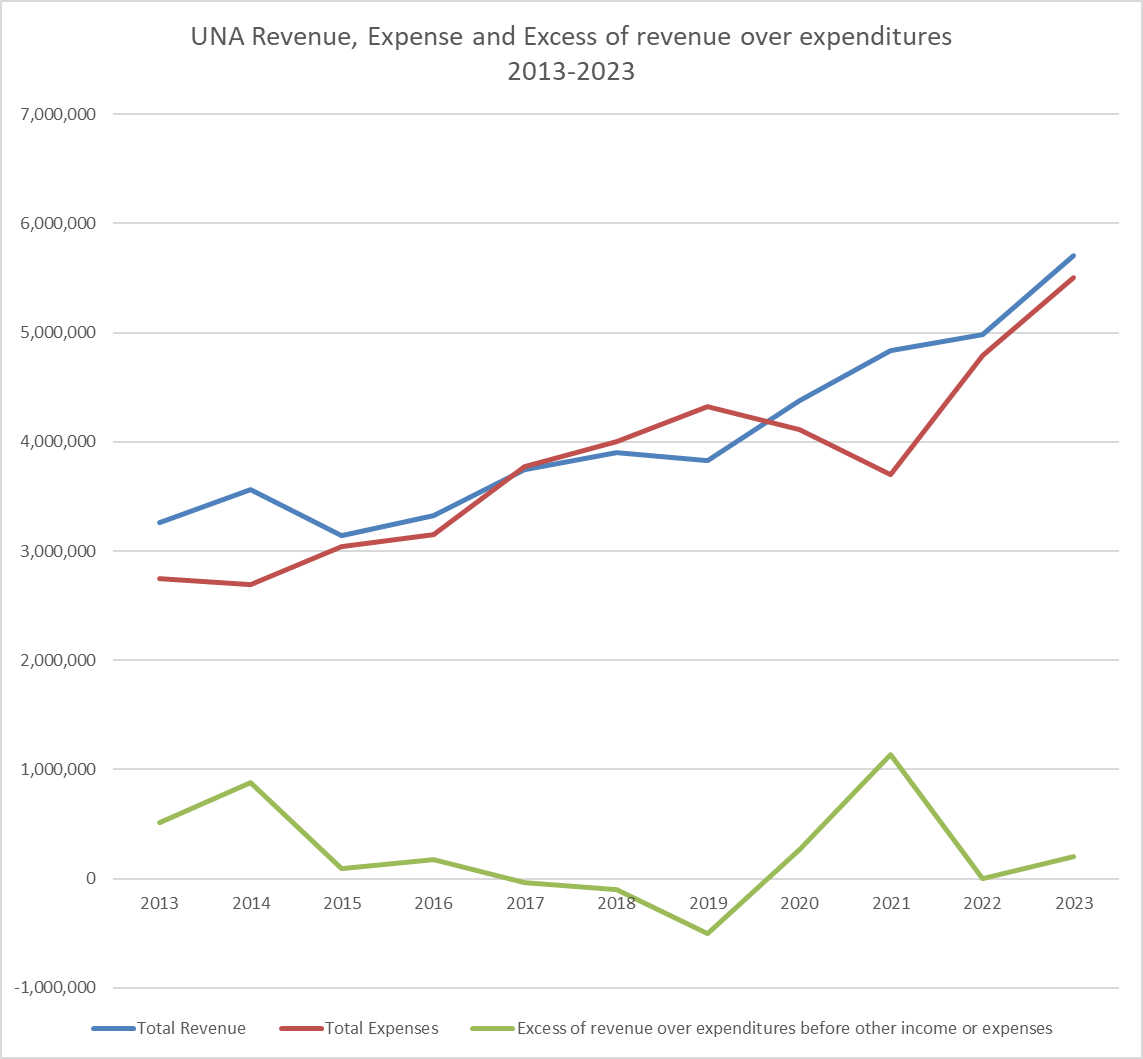
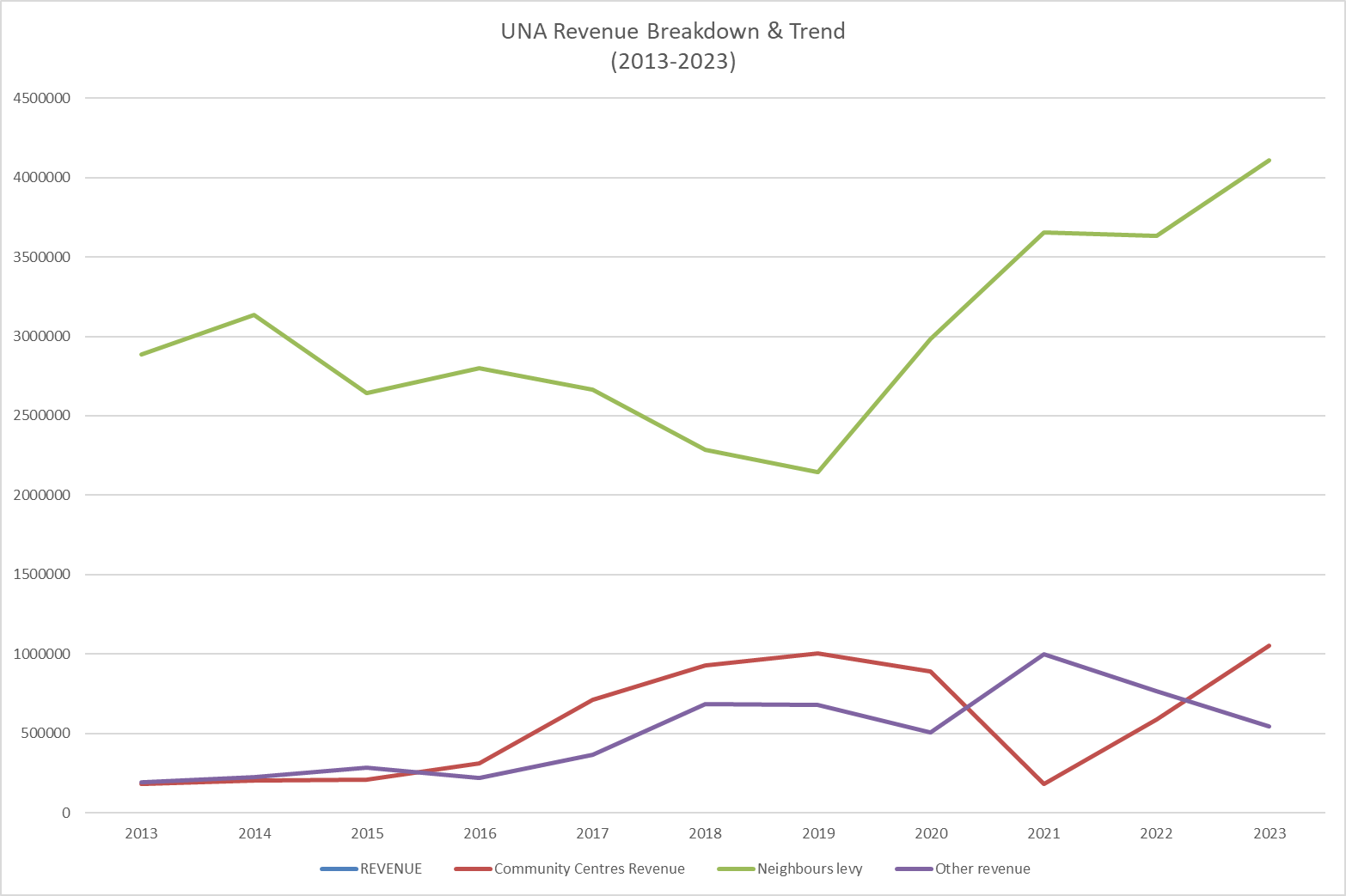
The 2nd drafted budget estimates a 12% increase in the Neighbours Levy, bringing UNA's total revenue to a substantial $8.1M in 2024-25. (I fully understand that the rise or drop of the service levy fee is not under UNA's control. However, this is not where my concerns lie.) Yet, there's a plan to spend it all under a 'zero surplus' strategy, as in previous years.
Since last October, I have raised concerns and provided feedback regarding UNA's operational efficiency and financial issues at the 2023.10.17 board meeting (see my enclosed previous presentation), followed by numerous emails and multiple face-to-face communications with the UNA board. Unfortunately, these efforts have not led to any substantive progress. The new budget does not critically review past issues and continues the previous budgeting approach. This is why we are co-signing this letter, to make our concerns and suggestions heard.
Firstly, I'd like to emphasize the following general principles for making a UNA budget:
1. Resident-Focused Budgeting: The budget should primarily reflect the real needs of UNA residents, rather than being driven solely by internal requests or the availability of funds, especially since most of the budget comprises levy fees.
2. Honest and Thorough Review: A solid budget cannot be established without an honest and thorough review of the previous year's operational performance and expense efficiency, incorporating both hard and soft measures.
3. UNA Board Responsibility: The Board should be responsible for the quality and accuracy of the overall UNA budget by thoroughly reviewing it and representing all residents, especially those who voted for the board members.
Secondly, I’d like to express my ongoing high-level concerns regarding the 2024-25 budget, which persist despite previous discussions and presentations:
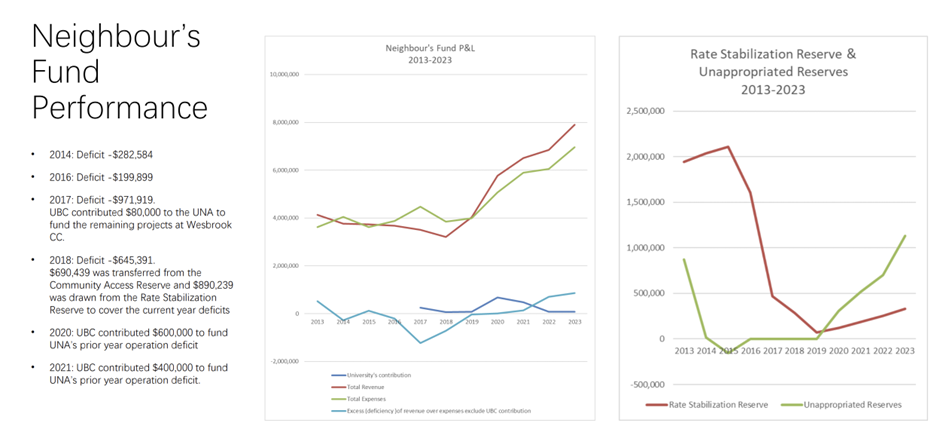
1. Insufficient Savings for Rainy Days: With this “spend it all” or “zero surplus budget strategy”, the UNA Neighbour’s Fund has shown huge deficits in 6 out of the past 10 years from 2014 to 2023. In 2020 and 2021, UNA required financial aid from UBC. The Rate Stabilization Reserve's significant drops, as indicated in my previous presentation, show that a mere 1% annual reserve contribution is inadequate. Canada is facing high inflation and entering an economic recession now, with residents controlling personal and household expenses. However, I do not see expense control and savings reflected in the budget. Shouldn't this be a key strategy in budgeting?
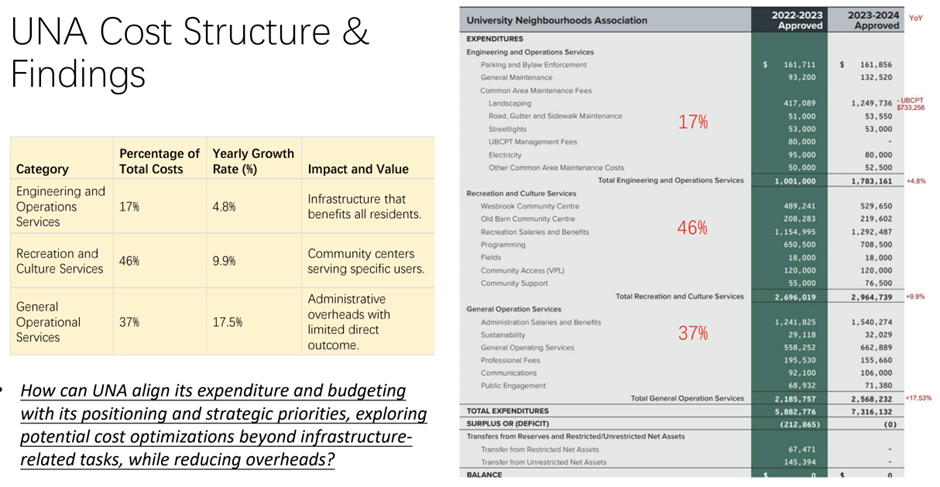
2. Excessive Administrative Overheads (35% of total 2024/25 Budget): The budget allocations for wages and salaries, office expenses per headcount, professional consulting fees, and IT services for a small organization like UNA seem excessively high, especially when compared to conservative spending on public infrastructure and impactful projects for residents. The rise in expenses, especially when a large part of our revenue is granted and not within our direct control, leads to unforeseen variations in our surplus or deficit figures. Remember, both UBC levy rate and property assessment value could drop, as they have in the past.
3. Lack of Specific, Overall Annual Strategic Objectives: The budget lacks concrete and clear overall annual strategic goals, beyond the abstract five points of the UNA Strategic Plan. What new, significant initiatives are there to improve the community and enhance operational efficiency? The budget feels like a purely financial document, focused on maintaining public infrastructure and keeping community centers operational, without a broader vision for tangible improvements and innovations in the community.
4. Lack of a detailed headcount or staffing budget: It is imperative that the annual budget distinctly includes a comprehensive headcount or staffing budget, detailing the number of full-time and part-time employees and noting any year-over-year changes. This transparency is key to assessing financial allocations for human resources and aligning them with UNA's operational needs and strategic goals. The clear presentation of this data is crucial for operational efficiency, stakeholder accountability, and informed decision-making.
Thirdly, I want to point out some particular issues with the UNA budget for 2024-2025 as below. Please be aware that since the first and second draft do not have revision descriptions that show what has been changed (I would recommend UNA to include this in the future to make review/consultation more efficient), and only the board meeting package has the detailed budget line item descriptions, I mostly use the amount from the meeting package but my comments should still apply:
1. Community Center Income Expectations: Why have the income expectations for both community centers (excluding programming) been lowered for 2024-25, including the recently renovated and refitted Old Barn? WCC dropped from $383,000 in 2023 to $327,000 and OBCC from $140,000 in 2023 to $125,425.
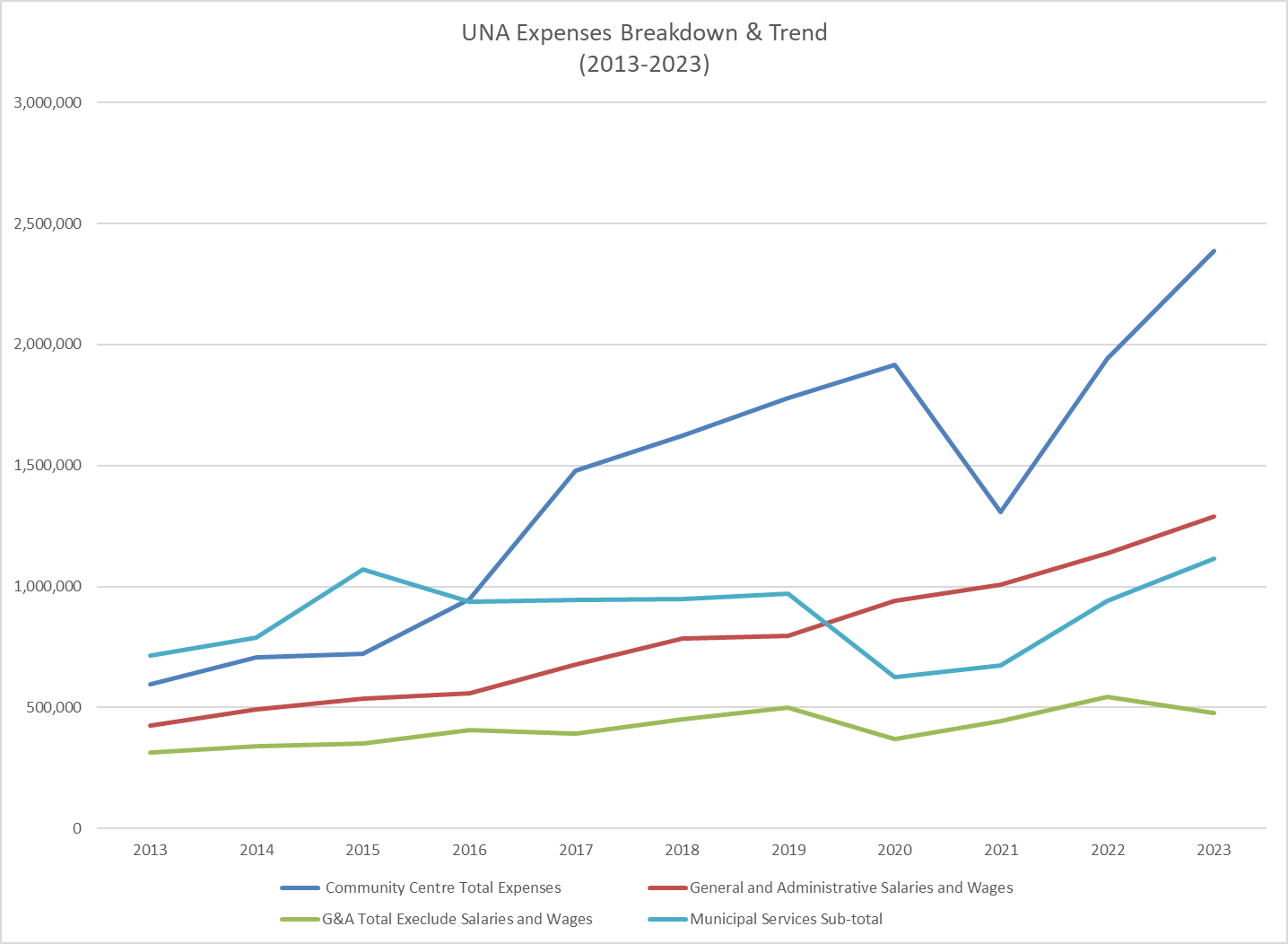
2. Substantial Increases in Salaries and Benefits: UNA has seen considerable increases in salaries and benefits expenses, surpassing UBC's 2024 COLA of 3.08% by a wide margin. Specific details on UNA's COLA and group RRSP contributions are needed for clarity. Despite acknowledging our staff's hard work, the 62% increase in General and Administrative Salaries and Wages from 2019 to 2023, amidst reduced operations due to the pandemic, calls for a reassessment of salary scales, particularly as revenue from community centers is only just recovering.
3. Professional Consulting Fee and IT Services: Query about the justification of a $60,000 expense for salary review and professional consulting fees for a small organization like UNA. A detailed breakdown of conference travel, training costs, and specifics of the $79,200 annual IT services expenditure is required.
4. High Communication Expenses with Poor Results: Questioning the cost-effectiveness of spending $27,950 + $22,050 on simple static content website maintenance with limited traffic. $5,400 expenditure for newspaper template improvement and the effectiveness of this investment. Request for a performance assessment of the newspaper website and newsletter. Why not use leading modern software-as-a-service tools like Wix.com($36/month) and Mailchimp.com($27/month) at only a fraction of the expense? Given that both the website and newspaper currently have low traffic and engagement, resources should be redirected towards driving visits, increasing engagement, and producing higher quality, relevant content.
5. AGM & Election for 2024/25: Inquiry about the rationale behind the $25,000 increase, possibly for online election software. How many votes did we get in past election campaigns? Do we really need to spend $25,000 on this?
6. $32,130 for URL Shortener Subscription, Social Media Ads, Newsletter Email Service Subscription, Customer Service, and Software Subscription: This allocation appears unusually high. Detailed clarification is required on how these funds are distributed, particularly with respect to social media ads. Typically, subscription fees for a small organization like UNA should be modest, for instance, just a few tens of dollars per account per month. A focus on community-based online/offline engagement might provide more value than broad social media promotions. Conducting an analysis of the ROI from previous advertising campaigns is crucial to assess their effectiveness and justify these expenses.
Please note, as an outsider and not a finance expert, I believe the issues raised are only part of the potential problems in the budget. I urge UNA to consider these points and re-examine the budget in light of our earlier discussions, making necessary adjustments before public consultation. I am open to corrections and welcome any supporting evidence to refine my understanding.
Our co-signatories include members of various strata councils in the UBC neighborhood, all of whom share a deep investment in the financial health and operational efficiency of UNA. We urge the board to take our concerns into consideration, recognizing the broader community's vested interest in these matters.
Sincerely,
Brad Chen, and all co-signatories
P.S. For a detailed analysis and historical perspective, please refer to my presentation "Enhancing UNA Operational Efficiency" available in the UNA's Facebook Group. Click Here to download the PDF file.

402
The Issue
Note:
- If you are not a UBC resident, please refrain from signing, as this petition is exclusively for UBC residents. When providing your reasons for signing the petition, please include at least the specific University Neighbourhood where you reside. Options include Wesbrook, Hawthorn, Hampton, East Campus, Chancellor, Central Building, among others (please specify if it's a different area). This information is crucial for us to better understand and represent the varied perspectives and concerns across our community.
- The Change.org website may prompt voters to donate. Please ignore this message and do NOT donate(不用捐款), as the free access limit should be sufficient to achieve the spread and appeal of this petition. You are welcome to share and encourage more residents to participate in signing!
- For anyone interested in reading the translated version of the letter in Simplified Chinese or another language, you can follow the provided link. The tool allows you to switch languages using the toolbar at the top of the result page. Here's the link for convenience: 中文及其他语言翻译请点击 Google Translate - UNA 2024-25 Budget Letter.
Dear UNA Board Members,
This letter, co-signed by a dozen UBC residents and council members, reflects our collective concerns regarding the UNA 2024-25 budget. Our joint efforts underscore the seriousness with which we view the following issues.
The 2nd drafted budget estimates a 12% increase in the Neighbours Levy, bringing UNA's total revenue to a substantial $8.1M in 2024-25. (I fully understand that the rise or drop of the service levy fee is not under UNA's control. However, this is not where my concerns lie.) Yet, there's a plan to spend it all under a 'zero surplus' strategy, as in previous years.
Since last October, I have raised concerns and provided feedback regarding UNA's operational efficiency and financial issues at the 2023.10.17 board meeting (see my enclosed previous presentation), followed by numerous emails and multiple face-to-face communications with the UNA board. Unfortunately, these efforts have not led to any substantive progress. The new budget does not critically review past issues and continues the previous budgeting approach. This is why we are co-signing this letter, to make our concerns and suggestions heard.
Firstly, I'd like to emphasize the following general principles for making a UNA budget:
1. Resident-Focused Budgeting: The budget should primarily reflect the real needs of UNA residents, rather than being driven solely by internal requests or the availability of funds, especially since most of the budget comprises levy fees.
2. Honest and Thorough Review: A solid budget cannot be established without an honest and thorough review of the previous year's operational performance and expense efficiency, incorporating both hard and soft measures.
3. UNA Board Responsibility: The Board should be responsible for the quality and accuracy of the overall UNA budget by thoroughly reviewing it and representing all residents, especially those who voted for the board members.
Secondly, I’d like to express my ongoing high-level concerns regarding the 2024-25 budget, which persist despite previous discussions and presentations:
1. Insufficient Savings for Rainy Days: With this “spend it all” or “zero surplus budget strategy”, the UNA Neighbour’s Fund has shown huge deficits in 6 out of the past 10 years from 2014 to 2023. In 2020 and 2021, UNA required financial aid from UBC. The Rate Stabilization Reserve's significant drops, as indicated in my previous presentation, show that a mere 1% annual reserve contribution is inadequate. Canada is facing high inflation and entering an economic recession now, with residents controlling personal and household expenses. However, I do not see expense control and savings reflected in the budget. Shouldn't this be a key strategy in budgeting?
2. Excessive Administrative Overheads (35% of total 2024/25 Budget): The budget allocations for wages and salaries, office expenses per headcount, professional consulting fees, and IT services for a small organization like UNA seem excessively high, especially when compared to conservative spending on public infrastructure and impactful projects for residents. The rise in expenses, especially when a large part of our revenue is granted and not within our direct control, leads to unforeseen variations in our surplus or deficit figures. Remember, both UBC levy rate and property assessment value could drop, as they have in the past.
3. Lack of Specific, Overall Annual Strategic Objectives: The budget lacks concrete and clear overall annual strategic goals, beyond the abstract five points of the UNA Strategic Plan. What new, significant initiatives are there to improve the community and enhance operational efficiency? The budget feels like a purely financial document, focused on maintaining public infrastructure and keeping community centers operational, without a broader vision for tangible improvements and innovations in the community.
4. Lack of a detailed headcount or staffing budget: It is imperative that the annual budget distinctly includes a comprehensive headcount or staffing budget, detailing the number of full-time and part-time employees and noting any year-over-year changes. This transparency is key to assessing financial allocations for human resources and aligning them with UNA's operational needs and strategic goals. The clear presentation of this data is crucial for operational efficiency, stakeholder accountability, and informed decision-making.
Thirdly, I want to point out some particular issues with the UNA budget for 2024-2025 as below. Please be aware that since the first and second draft do not have revision descriptions that show what has been changed (I would recommend UNA to include this in the future to make review/consultation more efficient), and only the board meeting package has the detailed budget line item descriptions, I mostly use the amount from the meeting package but my comments should still apply:
1. Community Center Income Expectations: Why have the income expectations for both community centers (excluding programming) been lowered for 2024-25, including the recently renovated and refitted Old Barn? WCC dropped from $383,000 in 2023 to $327,000 and OBCC from $140,000 in 2023 to $125,425.
2. Substantial Increases in Salaries and Benefits: UNA has seen considerable increases in salaries and benefits expenses, surpassing UBC's 2024 COLA of 3.08% by a wide margin. Specific details on UNA's COLA and group RRSP contributions are needed for clarity. Despite acknowledging our staff's hard work, the 62% increase in General and Administrative Salaries and Wages from 2019 to 2023, amidst reduced operations due to the pandemic, calls for a reassessment of salary scales, particularly as revenue from community centers is only just recovering.
3. Professional Consulting Fee and IT Services: Query about the justification of a $60,000 expense for salary review and professional consulting fees for a small organization like UNA. A detailed breakdown of conference travel, training costs, and specifics of the $79,200 annual IT services expenditure is required.
4. High Communication Expenses with Poor Results: Questioning the cost-effectiveness of spending $27,950 + $22,050 on simple static content website maintenance with limited traffic. $5,400 expenditure for newspaper template improvement and the effectiveness of this investment. Request for a performance assessment of the newspaper website and newsletter. Why not use leading modern software-as-a-service tools like Wix.com($36/month) and Mailchimp.com($27/month) at only a fraction of the expense? Given that both the website and newspaper currently have low traffic and engagement, resources should be redirected towards driving visits, increasing engagement, and producing higher quality, relevant content.
5. AGM & Election for 2024/25: Inquiry about the rationale behind the $25,000 increase, possibly for online election software. How many votes did we get in past election campaigns? Do we really need to spend $25,000 on this?
6. $32,130 for URL Shortener Subscription, Social Media Ads, Newsletter Email Service Subscription, Customer Service, and Software Subscription: This allocation appears unusually high. Detailed clarification is required on how these funds are distributed, particularly with respect to social media ads. Typically, subscription fees for a small organization like UNA should be modest, for instance, just a few tens of dollars per account per month. A focus on community-based online/offline engagement might provide more value than broad social media promotions. Conducting an analysis of the ROI from previous advertising campaigns is crucial to assess their effectiveness and justify these expenses.
Please note, as an outsider and not a finance expert, I believe the issues raised are only part of the potential problems in the budget. I urge UNA to consider these points and re-examine the budget in light of our earlier discussions, making necessary adjustments before public consultation. I am open to corrections and welcome any supporting evidence to refine my understanding.
Our co-signatories include members of various strata councils in the UBC neighborhood, all of whom share a deep investment in the financial health and operational efficiency of UNA. We urge the board to take our concerns into consideration, recognizing the broader community's vested interest in these matters.
Sincerely,
Brad Chen, and all co-signatories
P.S. For a detailed analysis and historical perspective, please refer to my presentation "Enhancing UNA Operational Efficiency" available in the UNA's Facebook Group. Click Here to download the PDF file.
402
The Decision Makers

Petition Updates
Share this petition
Petition created on January 25, 2024