
Deb Haaland: Return the $87,200 and Commit to No AI Data Centers
The Issue
New Mexico cannot regulate its way out of the fundamental problem posed by massive AI infrastructure: corporations are demanding extraordinary amounts of water, electricity, land and public resources so some of the wealthiest companies in the world can expand an industry built around extraction.
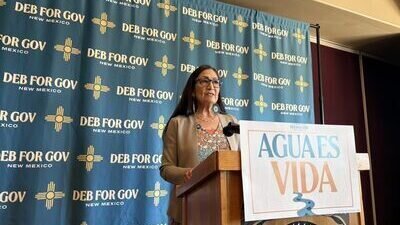
On September 17th, Deb Haaland announced that, if elected governor, she would impose a moratorium on new large-scale data centers while pursuing additional requirements around water, electricity, labor, environmental protections and community benefits.
But one enormous question remains: What happens to Project Jupiter?
Project Jupiter is already under construction in Doña Ana County. Oracle reported this month that construction was approximately 26% complete, even while major permitting proceedings had been paused by the New Mexico Supreme Court.
At the same time, Haaland's campaign has accepted at least $87,200 from Oracle and individuals whose identifying information matches senior leadership at Oracle and Clayco, companies involved in Project Jupiter.
That money includes:
Oracle America Inc. - $12,400. Oracle is directly involved in Project Jupiter.
Clayton Magouyrk - $12,400. The donor information matches Oracle co-CEO Clay Magouyrk.
Michael Sicilia - $12,400. The donor information matches Oracle co-CEO Mike Sicilia.
Robert G. Clark - $10,000;
Anthony Johnson - $10,000;
Ryan McGuire - $10,000;
Justin Lienemann - $10,000;
Shawn Clark - $10,000.
Searchlight New Mexico reported that the identifying details for these five donors match senior executives at Clayco, the construction company working with Oracle and STACK Infrastructure on Project Jupiter.
That is $87,200 connected directly or through individuals identified by reporting as matching leadership of companies participating in Project Jupiter.
Oracle has separately disclosed spending $3.44 million promoting Project Jupiter during the fight over the project's development and permitting.
New Mexicans should not have to wonder whether corporations seeking access to our water, electricity and public institutions are simultaneously purchasing access to the people who will regulate them.
We are calling on Deb Haaland to do the following:
1. Return the $87,200. Return Oracle's corporate contribution and the contributions from the Oracle and Clayco-linked executives identified above, and publicly disclose the returned contributions.
2. Refuse future money from the AI and data-center industry. Commit to rejecting corporate contributions and contributions from senior executives, lobbyists and developers whose companies are seeking approval, subsidies or contracts for hyperscale data centers or major AI infrastructure in New Mexico.
3. Tell New Mexicans exactly where Project Jupiter stands. A moratorium on new data centers leaves an obvious question about projects already being built. Publicly state whether Project Jupiter would be subject to the administration's proposed moratorium and what lawful state actions the administration would take regarding its outstanding permits, subsidies and regulatory approvals. Project Jupiter is already under construction, so this distinction is material.
4. No grandfather clause for unfinished mega-projects. Any statewide data-center policy should address proposed, permitted, expanding and partially constructed projects rather than creating a loophole simply because construction began before a new administration took office.
5. No public subsidies for AI extraction. Oppose state tax breaks, public financing, infrastructure subsidies and other economic-development incentives for hyperscale AI data centers. Companies worth hundreds of billions of dollars should bear the full cost of the infrastructure their projects require.
6. Protect New Mexico's water. Establish enforceable limits on industrial water consumption, require public disclosure of actual and projected water use, prohibit arrangements that conceal water consumption behind contractors or utilities, and prevent AI infrastructure from receiving preferential access to scarce public water supplies.
7. Protect ratepayers. Data centers should pay the full cost of new generation, transmission, substations and other grid infrastructure required to serve them. Residential customers should not subsidize extraordinary electricity demand created by private AI companies.
8. No fossil-fuel buildout for AI. Do not allow the AI boom to become justification for new gas plants, gas-powered fuel cells or other fossil infrastructure whose primary purpose is supplying data centers.
9. Put environmental information in public view. Require project-level disclosure of electricity consumption, water consumption, backup generation, air emissions, greenhouse-gas emissions, land use and projected infrastructure requirements before state approvals are issued.
10. Protect workers and communities from automated decision-making. Establish strict limits on state use of AI for policing, surveillance, immigration enforcement, benefits eligibility, employment decisions and other systems capable of making or materially influencing decisions about people's rights and livelihoods.
11. No secret AI contracts. Create a public registry of state and local government AI contracts, including the vendor, price, purpose, data being accessed, environmental footprint and any automated decision-making involved.
12. Guarantee Tribal sovereignty and meaningful community authority. Projects affecting Tribal nations, Indigenous communities, water, cultural resources or sacred landscapes must include meaningful government-to-government consultation and protections consistent with Tribal sovereignty—not consultation after major decisions have already been made.
13. Make corporations responsible for cleanup. Require substantial decommissioning bonds so communities are not left paying for abandoned data centers, contaminated industrial sites or obsolete energy infrastructure
14. Put human needs ahead of computational demand. New Mexico's water and energy policy should prioritize households, existing communities, food systems and essential public services before extraordinary new resource demands from hyperscale AI infrastructure.
15. Put a statewide AI data center ban into law, not just an executive order.
An executive-order moratorium is not a substitute for legislation. Executive orders can direct state agencies and implement existing law, but they cannot create a new statewide law and can be changed or rescinded by a future governor. We demand that Deb Haaland make a statewide statutory ban on AI data centers a priority of her first legislative session, publicly call for its passage, and use every lawful power of the governor’s office to get it enacted.
Community-benefit agreements can redistribute a fraction of a project's revenue. They do not, by themselves, answer the larger questions of how much water and electricity should be dedicated to AI infrastructure, who bears the environmental costs, who pays for the infrastructure, and whether these projects should be built at this scale in the first place.
Returning the money is a concrete first step.
If Deb Haaland intends to confront the political and environmental power of the AI industry as governor, the public can reasonably ask her campaign to separate itself financially from the corporations and executives whose projects her administration could be responsible for regulating.
Return the $87,200. Make clear where you stand on Project Jupiter. And put forward an AI policy platform that treats New Mexico's water, energy, land and people as more important than the expansion plans of some of the richest corporations on Earth.

412
The Issue
New Mexico cannot regulate its way out of the fundamental problem posed by massive AI infrastructure: corporations are demanding extraordinary amounts of water, electricity, land and public resources so some of the wealthiest companies in the world can expand an industry built around extraction.
On September 17th, Deb Haaland announced that, if elected governor, she would impose a moratorium on new large-scale data centers while pursuing additional requirements around water, electricity, labor, environmental protections and community benefits.
But one enormous question remains: What happens to Project Jupiter?
Project Jupiter is already under construction in Doña Ana County. Oracle reported this month that construction was approximately 26% complete, even while major permitting proceedings had been paused by the New Mexico Supreme Court.
At the same time, Haaland's campaign has accepted at least $87,200 from Oracle and individuals whose identifying information matches senior leadership at Oracle and Clayco, companies involved in Project Jupiter.
That money includes:
Oracle America Inc. - $12,400. Oracle is directly involved in Project Jupiter.
Clayton Magouyrk - $12,400. The donor information matches Oracle co-CEO Clay Magouyrk.
Michael Sicilia - $12,400. The donor information matches Oracle co-CEO Mike Sicilia.
Robert G. Clark - $10,000;
Anthony Johnson - $10,000;
Ryan McGuire - $10,000;
Justin Lienemann - $10,000;
Shawn Clark - $10,000.
Searchlight New Mexico reported that the identifying details for these five donors match senior executives at Clayco, the construction company working with Oracle and STACK Infrastructure on Project Jupiter.
That is $87,200 connected directly or through individuals identified by reporting as matching leadership of companies participating in Project Jupiter.
Oracle has separately disclosed spending $3.44 million promoting Project Jupiter during the fight over the project's development and permitting.
New Mexicans should not have to wonder whether corporations seeking access to our water, electricity and public institutions are simultaneously purchasing access to the people who will regulate them.
We are calling on Deb Haaland to do the following:
1. Return the $87,200. Return Oracle's corporate contribution and the contributions from the Oracle and Clayco-linked executives identified above, and publicly disclose the returned contributions.
2. Refuse future money from the AI and data-center industry. Commit to rejecting corporate contributions and contributions from senior executives, lobbyists and developers whose companies are seeking approval, subsidies or contracts for hyperscale data centers or major AI infrastructure in New Mexico.
3. Tell New Mexicans exactly where Project Jupiter stands. A moratorium on new data centers leaves an obvious question about projects already being built. Publicly state whether Project Jupiter would be subject to the administration's proposed moratorium and what lawful state actions the administration would take regarding its outstanding permits, subsidies and regulatory approvals. Project Jupiter is already under construction, so this distinction is material.
4. No grandfather clause for unfinished mega-projects. Any statewide data-center policy should address proposed, permitted, expanding and partially constructed projects rather than creating a loophole simply because construction began before a new administration took office.
5. No public subsidies for AI extraction. Oppose state tax breaks, public financing, infrastructure subsidies and other economic-development incentives for hyperscale AI data centers. Companies worth hundreds of billions of dollars should bear the full cost of the infrastructure their projects require.
6. Protect New Mexico's water. Establish enforceable limits on industrial water consumption, require public disclosure of actual and projected water use, prohibit arrangements that conceal water consumption behind contractors or utilities, and prevent AI infrastructure from receiving preferential access to scarce public water supplies.
7. Protect ratepayers. Data centers should pay the full cost of new generation, transmission, substations and other grid infrastructure required to serve them. Residential customers should not subsidize extraordinary electricity demand created by private AI companies.
8. No fossil-fuel buildout for AI. Do not allow the AI boom to become justification for new gas plants, gas-powered fuel cells or other fossil infrastructure whose primary purpose is supplying data centers.
9. Put environmental information in public view. Require project-level disclosure of electricity consumption, water consumption, backup generation, air emissions, greenhouse-gas emissions, land use and projected infrastructure requirements before state approvals are issued.
10. Protect workers and communities from automated decision-making. Establish strict limits on state use of AI for policing, surveillance, immigration enforcement, benefits eligibility, employment decisions and other systems capable of making or materially influencing decisions about people's rights and livelihoods.
11. No secret AI contracts. Create a public registry of state and local government AI contracts, including the vendor, price, purpose, data being accessed, environmental footprint and any automated decision-making involved.
12. Guarantee Tribal sovereignty and meaningful community authority. Projects affecting Tribal nations, Indigenous communities, water, cultural resources or sacred landscapes must include meaningful government-to-government consultation and protections consistent with Tribal sovereignty—not consultation after major decisions have already been made.
13. Make corporations responsible for cleanup. Require substantial decommissioning bonds so communities are not left paying for abandoned data centers, contaminated industrial sites or obsolete energy infrastructure
14. Put human needs ahead of computational demand. New Mexico's water and energy policy should prioritize households, existing communities, food systems and essential public services before extraordinary new resource demands from hyperscale AI infrastructure.
15. Put a statewide AI data center ban into law, not just an executive order.
An executive-order moratorium is not a substitute for legislation. Executive orders can direct state agencies and implement existing law, but they cannot create a new statewide law and can be changed or rescinded by a future governor. We demand that Deb Haaland make a statewide statutory ban on AI data centers a priority of her first legislative session, publicly call for its passage, and use every lawful power of the governor’s office to get it enacted.
Community-benefit agreements can redistribute a fraction of a project's revenue. They do not, by themselves, answer the larger questions of how much water and electricity should be dedicated to AI infrastructure, who bears the environmental costs, who pays for the infrastructure, and whether these projects should be built at this scale in the first place.
Returning the money is a concrete first step.
If Deb Haaland intends to confront the political and environmental power of the AI industry as governor, the public can reasonably ask her campaign to separate itself financially from the corporations and executives whose projects her administration could be responsible for regulating.
Return the $87,200. Make clear where you stand on Project Jupiter. And put forward an AI policy platform that treats New Mexico's water, energy, land and people as more important than the expansion plans of some of the richest corporations on Earth.
The Decision Makers

Supporter Voices
Petition Updates
Share this petition
Petition created on September 18, 2026