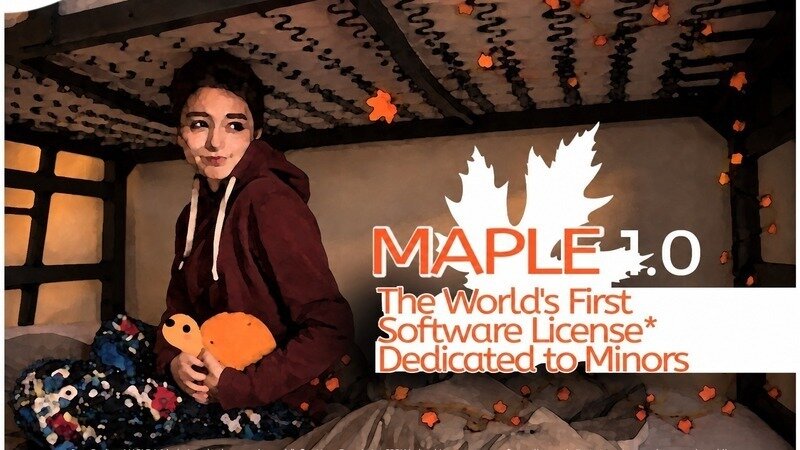
Create the World's First Semi-Open-Source License for Minors' Intellectual Property
The Issue
Introducing Legal Capacity Continuity (LCC) for Minors’ Intellectual Property in Open Source Science
OpenRockets is a New York City based nonprofit corporation with more than sixty volunteers
across fourteen countries. It began under the fiscal sponsorship of the Hack Foundation in the
United States. OpenRockets was built around four ideas that still guide the organization today,
Change, Diversity, Value of Time, and Freedom. One of its two main goals is to protect the
intellectual property of minors and prevent young people from losing access to the work they
give to the world, regardless of the magnitude of that work. The organization also builds
infrastructure for nonprofits run by minors and teenagers and works on systems for preserving
and publishing student work.
We are now creating OpenRockets MAPLE 1.0, or in other words, the Minor Authors’ Public
License for Expression. Wait a minute, Expression? Yes. It is a public open source software
license designed around a rule that existing licensing systems have never had to express clearly.
In this age of Information, when the intellectual property owner is too young to satisfy the legal
requirements an institution expects, the law may require another person to stand beside the
minor. It should not require the record to put that person in the author’s place.
Jakob is fourteen and lives in NJ. For three months, he worked on a software program that
identifies motion artifacts in MRI scans, the distortion that appears when a patient accidentally
moves inside the machine. He worked on it after school. He used public datasets. Several trials
failed. The system was remarkably accurate at the end and he wanted to publish it somewhere.
Jakob finds out about GitHub through Alex, his best friend, who has been using it since last
year. GitHub is the largest developer community, with more than 180 million developers. Jakob
publishes the source code there under the project name “NoiseCentropy.”
Four months later, a research group working at a university hospital wanted to use it in a study.
They wrote to him directly over email. They admired Jakob’s work, thanked him for his interest
in giving the software to them for free under an open source license, and asked whether they
could have permission. It was the best thing that had happened to him. Their legal office sent
the agreement. It was short and it was normal. Near the end, there was a line for Jakob to sign,
and above it a note explaining that the relevant party must be a person with the capacity to sign
an agreement. Jakob was fourteen. Beneath that line was a second line for a parent or guardian.
His mother signed it. Everybody supported Jakob. The hospital was complying with the
university’s intellectual property policy, the university was complying with state and national
law, and his mother signed to help him.
The study was published the following year on a course content archive, and the software was
used in it. In the open source legal record attached to the work, the person recorded as having
granted permission was his mother. Nothing was stolen from Jakob. Nothing was taken. That
form simply did not contain a field that could preserve his place in the transaction. Jakob’s
name is still there in GitHub commit messages and in the discussion threads with the hospital
undergraduates group. But his name is not on the instrument, which is the record institutions
read first, automatic archives preserved, lawyers may consult in twenty years, and search
engines may record when no stronger external confirmation about Jakob exists. Jakob’s commit
history is also a fragile record because it depends on the continued existence of the repository
and the systems around it. Fragility is part of this problem, but it is not the only part. Jakob is
not invisible because he is unable to create his own intellectual property. The question arises
because ownership of the right and legal capacity to participate in a transaction involving that
right are not the same. The software belongs to Jakob. The uncertainty belongs to the
transaction. The form collides those two things into one.
GitHub does not restrict account creation to adults. It opens participation from age thirteen, and
it provides tools such as the GitHub Student Developer Pack to help students create even more.
One system tells young people to create. The other assumes that a person arriving with
intellectual property that needs to be licensed is already an adult. HackerOne openly states that
under eighteen users must be handled through a parent or legal guardian and that "additional
conditions may apply" when they arrive at software contracts. Apple requires an individual in its
Developer Program to be of legal age to enter into contracts with Apple. In an era where
enormous amounts of information can be gathered, reorganized and produced at low cost with
tools like Artificial Intelligence programs, work such as NoiseCentropy still represents weeks of
human thought, failure, testing and repetition. That should make us think more seriously about
the legal value attached to the work minors create. We should not alter their place in that work
when their ideas are only beginning to rise. We should support them as the world evolves.
Keeping aside how extraordinary Jakob’s work is compared with his age, read the argument
again. A thirteen year old may learn, create, build, fail, research, repeat and publish. An adult
may give an institution legal permission through a known and predictable process. Between
those ages, the code does not become less real. The copyright does not disappear. What is
missing from the roots of open source is a standardized and legally accepted way for an
institution to accept a minor’s own license grant without substituting an adult into that process.
This becomes even more important when access is difficult. Think about another Jakob
somewhere rural or in a developing country. He has no computer at home. His parents use old
2010 Motorolas with slow connections. He has ninety minutes a day in his school's computer lab
period, and everything he has ever built was built inside those ninety minutes. The email from
the hospital reaches him on a school machine, and so does the document, and at that point, a
process that trillion dollar companies try to avoid by making their workplaces better happens.
Friction. Unyielding and soul crushing friction, because the signature it requires is not his. A
legal guardian or parent has to be located, and that person has to be reachable, willing, and able
to come to the school. No one refused him anything. There is no rule against pursuing it. Again,
this is called friction rather than a barrier, and friction is the more durable of the two because
often, nobody is accountable and is difficult to remove. This is not even close to uncommon.
Consider how many students are standing at that exact point. In the United States, there are 1.54
million students experiencing homelessness in 2024, a rise of 28.5 percent in two years, and a
significant part of them are living without a single guardian, meaning there is no parent or
guardian in their lives. Federal data places more than 320,000 more children in foster care.
Globally, UNICEF and the International Telecommunication Union put the number of children
and teens under 17 with no internet connection at home at 1300 million, yes, in billions. UNHCR
counted 117.8 million forcibly displaced by caregivers at the end of 2025, in conditions that
frequently include no guardian, no address, and no functioning registry of either.
They are all equal, brilliant human beings with an exceptional gift in their mind. Being human is
already exceptional. We should not try to see the Jakob who at least got his parents’ signature as
the only Jakob this system has to serve, compared with our friends in those unfortunate
situations. A professional developer now manually performs a microscopic fraction of the work
and the AI systems around them do the rest automatically. This one step, the step that
determines whether a child’s work carries their own name, can still require an adult to be
physically present, have their own email address/ phone/ identity documents (where
applicable), and be able to participate in contracts.
We know these are deep rooted and multilayered economic concerns that go beyond our
capacity. That is why we do not want to categorize kids based on their geography. OpenRockets
MAPLE will be 100 percent available worldwide, without restrictions, and potentially on
platforms such as GitHub, GitLab, Internet Archive, CERN and more. The next Jakob should be
able to select it the moment he creates the project repository from the official license dropdown.
Open source licensing was not built around this problem. The Apache License 2.0 grants broad
and enduring copyright permissions. Version 3 of the GNU General Public License does the
same through a different architecture, stating that all rights it grants "are irrevocable provided
the stated conditions are met." The Linux Foundation's Developer Certificate of Origin, which a
large part of the industry requires before a contribution is accepted, asks the contributor to
certify that "the contribution was created in whole or in part by me and I have the right to
submit it under the open source license indicated in the file."
Those instruments solved enormous problems and they solved them well. We use them every
day. But all of them arrive at the same underlying proposition, which is that the person giving
the permission holds the right and the authority to give it, and for almost everybody that
proposition is binary. Yes or no. A minor is the single case that carries a third condition. First, I
hold the right. Second, I am giving the permission. Third, my age may affect the process very
differently than others. Those three points above are true at the same moment. This is what
makes the problem we try to solve so unique and complex. No ordinary open source license has
included that third conditional policy.
So far we have identified Creative Commons as the only organization to even include a small
documented piece for minors. Its own guidance states that "We are unaware of any attempt by a
licensor to exercise the disaffirmation right with respect to a CC license applied to a work by a
minor." So the young author holds a protection that has never once been used, and the
institution on the other side of the table faces an uncertainty with no precedent to compare it
against. And an institution holding a transaction it cannot clearly process does what institutions
always do. They present an agreement to the parent or a legal guardian. And it is how Jakob's
mother became the named licensor of her son’s work. And is the same way how bureaucracy and
the lack of focus toward the Intellectual Property of Minors dictate the future of thousands of
other Jakobs from all walks of life, on the Earth, in an unfortunate way.
It also inevitably collides with two separate issues. Who owns the work and is granting the
permission? Whose participation makes the transaction legally reliable? Nothing requires those
to be the same person, and almost every form now in use is written as though they always are.
The MAPLE licensing framework was designed because of all of those reasons. That instrument
is MAPLE 1.0, the Minor Authors Public License for Expression, which is being built to become
the world's first and only open source software license dedicated to minor authors that is
indexable on the Linux Foundation's SPDX License List and open to the public. Both of those
points matter a lot.
OpenRockets MAPLE is an open source license and is not restricted to minors. We do not need
to create an unnecessary division among humanity as adults and minors. We all are humans and
minors are equally important as the age of majority. We are building the license on top of the
foundations of already existing licenses that make license specific custom policies for reuse,
copy, derivation, commercial and noncommercial use and more, which are the same terms they
would get from any license they already trust, such as the MIT Expat License. What
differentiates OpenRockets MAPLE significantly is the first inclusion of the theory of capacity
continuity into the license. Jakob holds the copyright, so Jakob is the licensor, and that does not
become legally hidden because a separate party had to be involved for the transaction or use.
The line that used to read Jakob's mother now reads Jakob. Jakob has stopped disappearing
from his work.
This principle is the same with time. A license granted at sixteen should not have to be replaced
when the minor turns eighteen. MAPLE keeps the original developer as the licensor and allows
legal changes, such as later using the project in a legally binding agreement, can be added to the
same record. The history stays intact instead of being rewritten. Fortunately, thanks to the Git
version control system already available on GitHub, GitLab and almost all platforms, Git can
show the timeline of verified code changes. MAPLE is designed to show who had the legal
authority to license it and how that authority, and the license itself updated over time.
OpenRockets MAPLE is defining a new view of Open Science. It is not only that. MAPLE is
intended to give minors total freedom over their intellectual property and the right to stand
behind the creative work they give to this world.
Freedom is one of the four principles OpenRockets was built around. At OpenRockets, we
believe children begin creating, reorganizing and using information long before adulthood. The
child examining an ant is doing it. The child dismantling a toy car is doing it. The teenager
publishing software is doing it. The student creating a research journal is doing it. The teenager
operating a nonprofit is doing it. Children should have the freedom and legal capability to hold
their intellectual property, enforce rights to it, and make great things happen.
As an organization, OpenRockets will continue to grow, thrive, and work hard to protect the gift
of being human and give value to it, from day one of the mind of a giant. There is no better time
to do better things.
Teenagers? Learn more about our vision, mission, volunteer positions and more at
OpenRockets.com/en

31
The Issue
Introducing Legal Capacity Continuity (LCC) for Minors’ Intellectual Property in Open Source Science
OpenRockets is a New York City based nonprofit corporation with more than sixty volunteers
across fourteen countries. It began under the fiscal sponsorship of the Hack Foundation in the
United States. OpenRockets was built around four ideas that still guide the organization today,
Change, Diversity, Value of Time, and Freedom. One of its two main goals is to protect the
intellectual property of minors and prevent young people from losing access to the work they
give to the world, regardless of the magnitude of that work. The organization also builds
infrastructure for nonprofits run by minors and teenagers and works on systems for preserving
and publishing student work.
We are now creating OpenRockets MAPLE 1.0, or in other words, the Minor Authors’ Public
License for Expression. Wait a minute, Expression? Yes. It is a public open source software
license designed around a rule that existing licensing systems have never had to express clearly.
In this age of Information, when the intellectual property owner is too young to satisfy the legal
requirements an institution expects, the law may require another person to stand beside the
minor. It should not require the record to put that person in the author’s place.
Jakob is fourteen and lives in NJ. For three months, he worked on a software program that
identifies motion artifacts in MRI scans, the distortion that appears when a patient accidentally
moves inside the machine. He worked on it after school. He used public datasets. Several trials
failed. The system was remarkably accurate at the end and he wanted to publish it somewhere.
Jakob finds out about GitHub through Alex, his best friend, who has been using it since last
year. GitHub is the largest developer community, with more than 180 million developers. Jakob
publishes the source code there under the project name “NoiseCentropy.”
Four months later, a research group working at a university hospital wanted to use it in a study.
They wrote to him directly over email. They admired Jakob’s work, thanked him for his interest
in giving the software to them for free under an open source license, and asked whether they
could have permission. It was the best thing that had happened to him. Their legal office sent
the agreement. It was short and it was normal. Near the end, there was a line for Jakob to sign,
and above it a note explaining that the relevant party must be a person with the capacity to sign
an agreement. Jakob was fourteen. Beneath that line was a second line for a parent or guardian.
His mother signed it. Everybody supported Jakob. The hospital was complying with the
university’s intellectual property policy, the university was complying with state and national
law, and his mother signed to help him.
The study was published the following year on a course content archive, and the software was
used in it. In the open source legal record attached to the work, the person recorded as having
granted permission was his mother. Nothing was stolen from Jakob. Nothing was taken. That
form simply did not contain a field that could preserve his place in the transaction. Jakob’s
name is still there in GitHub commit messages and in the discussion threads with the hospital
undergraduates group. But his name is not on the instrument, which is the record institutions
read first, automatic archives preserved, lawyers may consult in twenty years, and search
engines may record when no stronger external confirmation about Jakob exists. Jakob’s commit
history is also a fragile record because it depends on the continued existence of the repository
and the systems around it. Fragility is part of this problem, but it is not the only part. Jakob is
not invisible because he is unable to create his own intellectual property. The question arises
because ownership of the right and legal capacity to participate in a transaction involving that
right are not the same. The software belongs to Jakob. The uncertainty belongs to the
transaction. The form collides those two things into one.
GitHub does not restrict account creation to adults. It opens participation from age thirteen, and
it provides tools such as the GitHub Student Developer Pack to help students create even more.
One system tells young people to create. The other assumes that a person arriving with
intellectual property that needs to be licensed is already an adult. HackerOne openly states that
under eighteen users must be handled through a parent or legal guardian and that "additional
conditions may apply" when they arrive at software contracts. Apple requires an individual in its
Developer Program to be of legal age to enter into contracts with Apple. In an era where
enormous amounts of information can be gathered, reorganized and produced at low cost with
tools like Artificial Intelligence programs, work such as NoiseCentropy still represents weeks of
human thought, failure, testing and repetition. That should make us think more seriously about
the legal value attached to the work minors create. We should not alter their place in that work
when their ideas are only beginning to rise. We should support them as the world evolves.
Keeping aside how extraordinary Jakob’s work is compared with his age, read the argument
again. A thirteen year old may learn, create, build, fail, research, repeat and publish. An adult
may give an institution legal permission through a known and predictable process. Between
those ages, the code does not become less real. The copyright does not disappear. What is
missing from the roots of open source is a standardized and legally accepted way for an
institution to accept a minor’s own license grant without substituting an adult into that process.
This becomes even more important when access is difficult. Think about another Jakob
somewhere rural or in a developing country. He has no computer at home. His parents use old
2010 Motorolas with slow connections. He has ninety minutes a day in his school's computer lab
period, and everything he has ever built was built inside those ninety minutes. The email from
the hospital reaches him on a school machine, and so does the document, and at that point, a
process that trillion dollar companies try to avoid by making their workplaces better happens.
Friction. Unyielding and soul crushing friction, because the signature it requires is not his. A
legal guardian or parent has to be located, and that person has to be reachable, willing, and able
to come to the school. No one refused him anything. There is no rule against pursuing it. Again,
this is called friction rather than a barrier, and friction is the more durable of the two because
often, nobody is accountable and is difficult to remove. This is not even close to uncommon.
Consider how many students are standing at that exact point. In the United States, there are 1.54
million students experiencing homelessness in 2024, a rise of 28.5 percent in two years, and a
significant part of them are living without a single guardian, meaning there is no parent or
guardian in their lives. Federal data places more than 320,000 more children in foster care.
Globally, UNICEF and the International Telecommunication Union put the number of children
and teens under 17 with no internet connection at home at 1300 million, yes, in billions. UNHCR
counted 117.8 million forcibly displaced by caregivers at the end of 2025, in conditions that
frequently include no guardian, no address, and no functioning registry of either.
They are all equal, brilliant human beings with an exceptional gift in their mind. Being human is
already exceptional. We should not try to see the Jakob who at least got his parents’ signature as
the only Jakob this system has to serve, compared with our friends in those unfortunate
situations. A professional developer now manually performs a microscopic fraction of the work
and the AI systems around them do the rest automatically. This one step, the step that
determines whether a child’s work carries their own name, can still require an adult to be
physically present, have their own email address/ phone/ identity documents (where
applicable), and be able to participate in contracts.
We know these are deep rooted and multilayered economic concerns that go beyond our
capacity. That is why we do not want to categorize kids based on their geography. OpenRockets
MAPLE will be 100 percent available worldwide, without restrictions, and potentially on
platforms such as GitHub, GitLab, Internet Archive, CERN and more. The next Jakob should be
able to select it the moment he creates the project repository from the official license dropdown.
Open source licensing was not built around this problem. The Apache License 2.0 grants broad
and enduring copyright permissions. Version 3 of the GNU General Public License does the
same through a different architecture, stating that all rights it grants "are irrevocable provided
the stated conditions are met." The Linux Foundation's Developer Certificate of Origin, which a
large part of the industry requires before a contribution is accepted, asks the contributor to
certify that "the contribution was created in whole or in part by me and I have the right to
submit it under the open source license indicated in the file."
Those instruments solved enormous problems and they solved them well. We use them every
day. But all of them arrive at the same underlying proposition, which is that the person giving
the permission holds the right and the authority to give it, and for almost everybody that
proposition is binary. Yes or no. A minor is the single case that carries a third condition. First, I
hold the right. Second, I am giving the permission. Third, my age may affect the process very
differently than others. Those three points above are true at the same moment. This is what
makes the problem we try to solve so unique and complex. No ordinary open source license has
included that third conditional policy.
So far we have identified Creative Commons as the only organization to even include a small
documented piece for minors. Its own guidance states that "We are unaware of any attempt by a
licensor to exercise the disaffirmation right with respect to a CC license applied to a work by a
minor." So the young author holds a protection that has never once been used, and the
institution on the other side of the table faces an uncertainty with no precedent to compare it
against. And an institution holding a transaction it cannot clearly process does what institutions
always do. They present an agreement to the parent or a legal guardian. And it is how Jakob's
mother became the named licensor of her son’s work. And is the same way how bureaucracy and
the lack of focus toward the Intellectual Property of Minors dictate the future of thousands of
other Jakobs from all walks of life, on the Earth, in an unfortunate way.
It also inevitably collides with two separate issues. Who owns the work and is granting the
permission? Whose participation makes the transaction legally reliable? Nothing requires those
to be the same person, and almost every form now in use is written as though they always are.
The MAPLE licensing framework was designed because of all of those reasons. That instrument
is MAPLE 1.0, the Minor Authors Public License for Expression, which is being built to become
the world's first and only open source software license dedicated to minor authors that is
indexable on the Linux Foundation's SPDX License List and open to the public. Both of those
points matter a lot.
OpenRockets MAPLE is an open source license and is not restricted to minors. We do not need
to create an unnecessary division among humanity as adults and minors. We all are humans and
minors are equally important as the age of majority. We are building the license on top of the
foundations of already existing licenses that make license specific custom policies for reuse,
copy, derivation, commercial and noncommercial use and more, which are the same terms they
would get from any license they already trust, such as the MIT Expat License. What
differentiates OpenRockets MAPLE significantly is the first inclusion of the theory of capacity
continuity into the license. Jakob holds the copyright, so Jakob is the licensor, and that does not
become legally hidden because a separate party had to be involved for the transaction or use.
The line that used to read Jakob's mother now reads Jakob. Jakob has stopped disappearing
from his work.
This principle is the same with time. A license granted at sixteen should not have to be replaced
when the minor turns eighteen. MAPLE keeps the original developer as the licensor and allows
legal changes, such as later using the project in a legally binding agreement, can be added to the
same record. The history stays intact instead of being rewritten. Fortunately, thanks to the Git
version control system already available on GitHub, GitLab and almost all platforms, Git can
show the timeline of verified code changes. MAPLE is designed to show who had the legal
authority to license it and how that authority, and the license itself updated over time.
OpenRockets MAPLE is defining a new view of Open Science. It is not only that. MAPLE is
intended to give minors total freedom over their intellectual property and the right to stand
behind the creative work they give to this world.
Freedom is one of the four principles OpenRockets was built around. At OpenRockets, we
believe children begin creating, reorganizing and using information long before adulthood. The
child examining an ant is doing it. The child dismantling a toy car is doing it. The teenager
publishing software is doing it. The student creating a research journal is doing it. The teenager
operating a nonprofit is doing it. Children should have the freedom and legal capability to hold
their intellectual property, enforce rights to it, and make great things happen.
As an organization, OpenRockets will continue to grow, thrive, and work hard to protect the gift
of being human and give value to it, from day one of the mind of a giant. There is no better time
to do better things.
Teenagers? Learn more about our vision, mission, volunteer positions and more at
OpenRockets.com/en
The Decision Makers

Supporter Voices
Petition Updates
Share this petition
Petition created on 5 September 2026