

Conserve the Woodlands N1 Forest as a protected biodiversity site
The Issue
Dear President Tharman,
We write this plea with very heavy hearts and hope that it does not fall on deaf ears like many of the pleas against the destruction of our beloved forests. All our forests are important, and we are seeking to conserve an especially important one, the site at Woodlands Neighbourhood 1, in order to preserve the high biodiversity it contains. The map below shows the location of the forest.
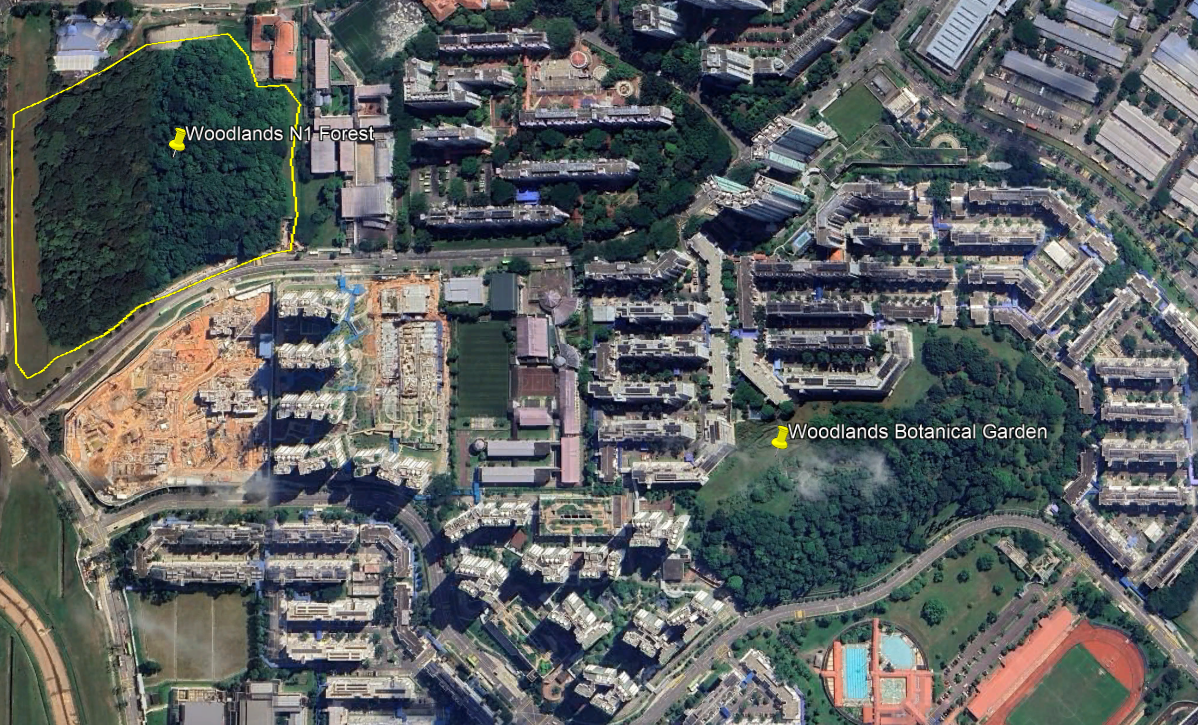
The recent Straits Times article ‘Forests being cleared for upcoming Sembawang, Woodlands HDB projects contain endangered wildlife’ updated on 3rd Dec raised alarm bells for many of us on the ground as there has been no end to our forest clearing in the last few years including our Dover forest and Kranji woodland.
We are disheartened that Singapore’s natural heritage, which makes us unique and is far richer than many countries far larger than ours, is being destroyed at such a pace and with such apparent disregard for the value it holds. The case of the Woodlands N1 forest is especially important for its unusual density of significant species – destroying it will destroy a linchpin of natural habitat across the north of Singapore.
Who and Why?
Our team belongs to the Woodlands Botanical Garden (WBG), a small garden situated in Marsiling and just one bus stop away from this magnificent forest patch which is also home to one of the most iconic butterflies in the world, the Common Birdwing (Troides helena cerberus).
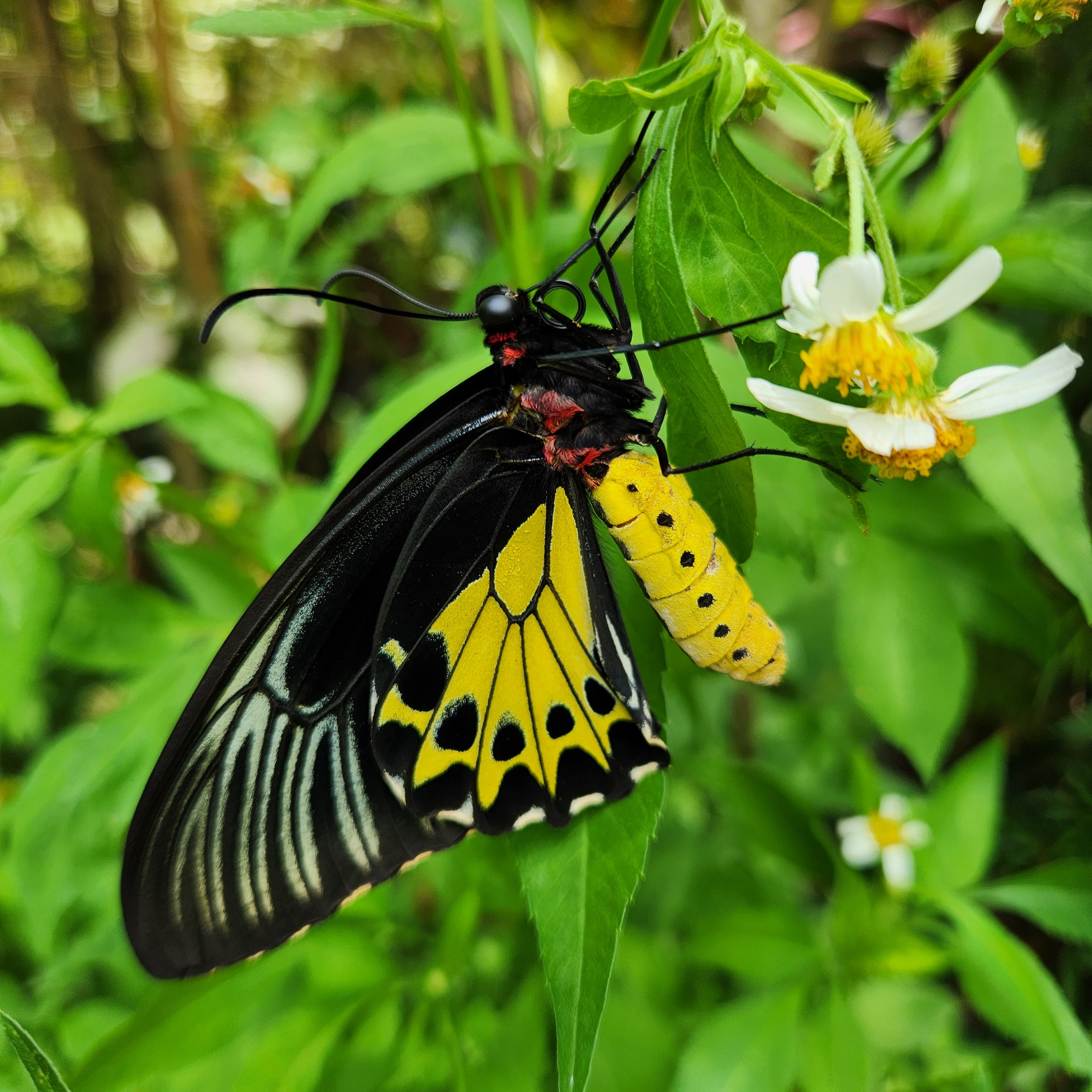
The Common Birdwing is not only Singapore’s largest butterfly, but also the only internationally protected butterfly here, because its beauty makes it vulnerable to poaching.
The butterfly was first sighted at WBG in 2022, presumably having flown from the Woodlands N1 forest, and our garden has fought hard since then to cherish and nurture this species that has been listed as ‘vulnerable’ in our Singapore Red Data Book.
One of the reasons for the vulnerability of the Common Birdwing is that its caterpillar only feeds on one host plant, the Dutchman’s Pipe (Aristolochia acuminata). A survey by the Lee Kong Chian Natural History Museum found that the A. acuminata plants grew in abundance within the Woodlands N1 forest, meaning that the survival of this species in this part of Singapore relies heavily on this forest.
As a community garden, we have tried our level best to provide habitat for the Common Birdwing. In March this year, we even launched a citizen project under our own funding to try to save the Common Birdwing by getting the community to germinate its host plant, which can then be planted in the garden.
This project not only received a fantastic response with so many people wanting to play a part in protecting nature, but the response was so overwhelming that we had to happily close the project in October as we had received so many plants. For the time being, we have been able to support a small population of the Common Birdwing in WBG.
Yet, even with our ongoing efforts, the fact remains that the Woodlands N1 forest is key to the survival of the Common Birdwing. It is from the abundant host plants in there that the population is firmly established, and if the forest is destroyed, then those remaining in WBG will also live a precarious existence. We strongly believe that if we are going to recognise a species as vulnerable and in need of protection, then we must take concrete action to offer this protection.
A Haven of Biodiversity
The Common Birdwing is just one of the species highlighted in the EIA for Woodlands N1 that shows its astounding biodiversity. Not every forest is the same when it comes to the density of species contained within the area, and the density in this small forested area is immense, even compared to other, well-known forests in SIngapore. This is primarily due to lack of any human activity and interference in its immediate vicinity.
The forests in Woodlands are also very important transit points for migratory birds coming from the north and is also a potential stop for the natural spread of species down from Malaysia due to our very close proximity. Massive, ongoing development in the north has already destroyed large patches of forest that have existed in Woodlands for eons, making the protection of every remaining forested area much more critical.
A comparison of the statistics in Table 1 makes our case, comparing Woodlands N1 to Dover forest, Turf City, and the other prospective site at Sembawang Neighbourhoods 4 and 5.
Table 1. Comparison between the various forest patches in terms of area, flora and fauna species
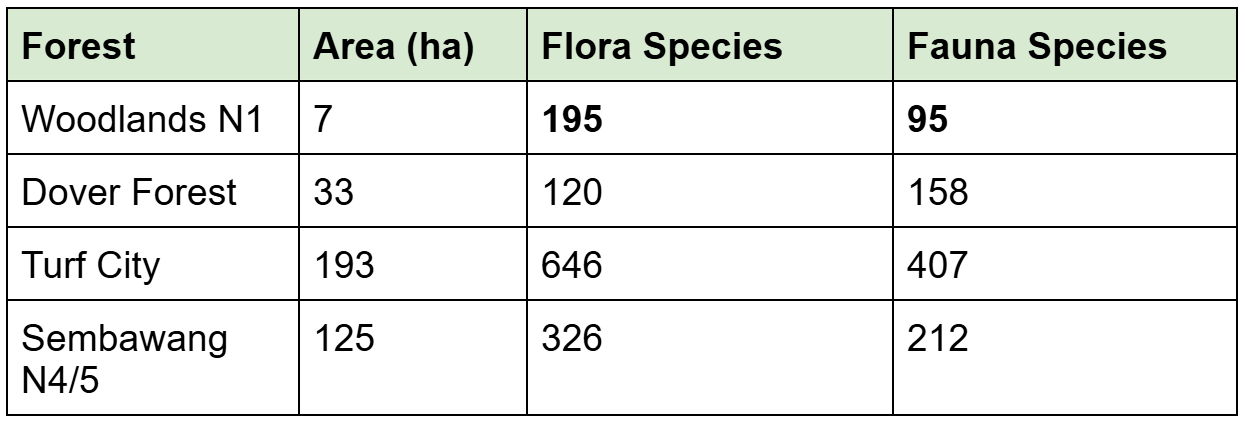
As the table above shows, the Woodlands N1 forest hosts incomparable diversity to the other forests even though it is absolutely tiny compared to them – less than a quarter of the area of Dover Forest. We can show this incredible difference even more clearly by looking at species density – how many species of flora and fauna per hectare are being hosted. This is shown in Table 2 below.
Table 2. Comparison between the various forest patches in terms of area, flora and fauna density
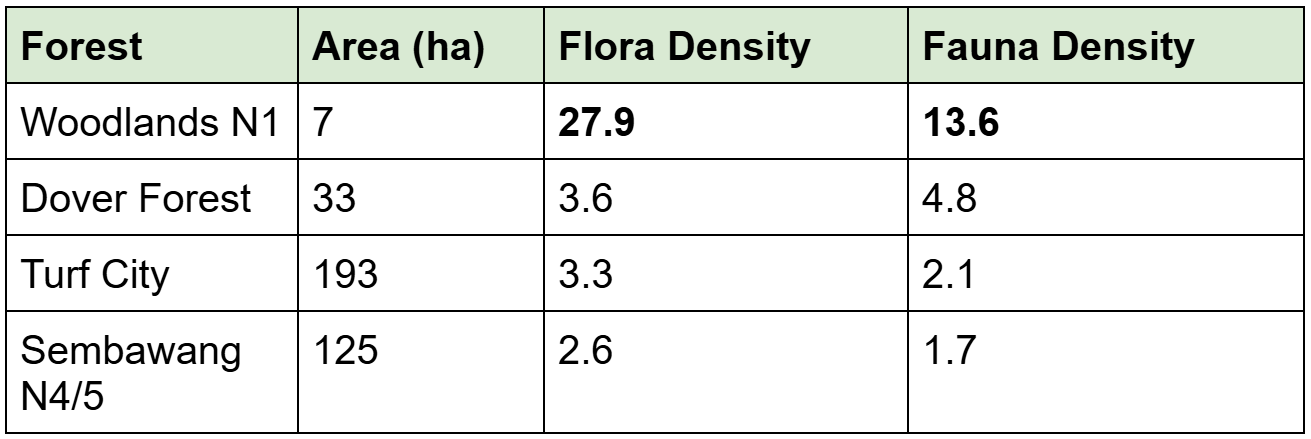
The Woodlands N1 forest contains nearly ten times the flora species density of any of the other forests, and up to six times the fauna species density. This, along with it only being a small area is why we firmly believe it should be conserved in its entirety and be protected.
Compared to the relatively small value that such a small plot of forest would yield if it was destroyed and built on, it would have immeasurably greater value in hosting Singapore’s wildlife if it was preserved. If Singapore is to be serious about balancing the needs of urban development and nature, Woodlands N1 is precisely the kind of forest we should be preserving - one that contains the greatest diversity, in the most compact space.
Running Out of Time
HDB has asked for public feedback by the 10th of December which does not give us much time to fight our case. This is part of a pattern where minimal feedback time leads to the destruction of spaces that are of great ecological value.
For instance, an environmental impact assessment (EIA) was not conducted for the Kranji woodland where we erroneously lost about 4.5 hectares of forest due to oversight that can never be recovered. This lack of an EIA sadly also means that we can never truly know what we might have lost. Another appalling example is the taking over of Turf City for developments that will destroy so many more hectares of incredibly beautiful and treasured forest.
In light of this, we are glad that EIAs were performed for Sembawang N4 and 5 and Woodlands N1 forest patches. They have revealed how important these patches are for conserving our biodiversity and have highlighted certain species that are of particular concern. However, since the sites were already slated for development, the EIAs might just prove to be empty documents if they are not acted upon.
Therefore, we beseech that the EIA for Woodlands N1 be acted upon so as to achieve its main goal – namely, to mitigate the negative impact to our valuable and fragile biodiversity.
It was mentioned in the article that there are already plans for 8,000 BTO and 2,000 private homes in the Sembawang N4 area while there are no specific plans for the Sembawang N5 and Woodlands N1 sectors yet. We are aware that time is running out, but we must still attempt to fight our case all the way through – to conserve the Woodlands N1 forest will show how serious we are about being a City in Nature, and a city-state that takes our natural habitats and heritage seriously.
On behalf of not only our team at WBG but also for everyone on the ground who has a heart for Mother Nature and Mother Earth, we ask that you please consider our plea and keep this biodiversity paradise from being destroyed.
As Singaporeans who are proud of the natural inheritance that makes us unique, as people who love the nature that surrounds us and are serious about building a city that coexists with nature, we sincerely and humbly ask of you to consider our plea to protect the Woodlands N1 forest patch.

3,817
The Issue
Dear President Tharman,
We write this plea with very heavy hearts and hope that it does not fall on deaf ears like many of the pleas against the destruction of our beloved forests. All our forests are important, and we are seeking to conserve an especially important one, the site at Woodlands Neighbourhood 1, in order to preserve the high biodiversity it contains. The map below shows the location of the forest.
The recent Straits Times article ‘Forests being cleared for upcoming Sembawang, Woodlands HDB projects contain endangered wildlife’ updated on 3rd Dec raised alarm bells for many of us on the ground as there has been no end to our forest clearing in the last few years including our Dover forest and Kranji woodland.
We are disheartened that Singapore’s natural heritage, which makes us unique and is far richer than many countries far larger than ours, is being destroyed at such a pace and with such apparent disregard for the value it holds. The case of the Woodlands N1 forest is especially important for its unusual density of significant species – destroying it will destroy a linchpin of natural habitat across the north of Singapore.
Who and Why?
Our team belongs to the Woodlands Botanical Garden (WBG), a small garden situated in Marsiling and just one bus stop away from this magnificent forest patch which is also home to one of the most iconic butterflies in the world, the Common Birdwing (Troides helena cerberus).
The Common Birdwing is not only Singapore’s largest butterfly, but also the only internationally protected butterfly here, because its beauty makes it vulnerable to poaching.
The butterfly was first sighted at WBG in 2022, presumably having flown from the Woodlands N1 forest, and our garden has fought hard since then to cherish and nurture this species that has been listed as ‘vulnerable’ in our Singapore Red Data Book.
One of the reasons for the vulnerability of the Common Birdwing is that its caterpillar only feeds on one host plant, the Dutchman’s Pipe (Aristolochia acuminata). A survey by the Lee Kong Chian Natural History Museum found that the A. acuminata plants grew in abundance within the Woodlands N1 forest, meaning that the survival of this species in this part of Singapore relies heavily on this forest.
As a community garden, we have tried our level best to provide habitat for the Common Birdwing. In March this year, we even launched a citizen project under our own funding to try to save the Common Birdwing by getting the community to germinate its host plant, which can then be planted in the garden.
This project not only received a fantastic response with so many people wanting to play a part in protecting nature, but the response was so overwhelming that we had to happily close the project in October as we had received so many plants. For the time being, we have been able to support a small population of the Common Birdwing in WBG.
Yet, even with our ongoing efforts, the fact remains that the Woodlands N1 forest is key to the survival of the Common Birdwing. It is from the abundant host plants in there that the population is firmly established, and if the forest is destroyed, then those remaining in WBG will also live a precarious existence. We strongly believe that if we are going to recognise a species as vulnerable and in need of protection, then we must take concrete action to offer this protection.
A Haven of Biodiversity
The Common Birdwing is just one of the species highlighted in the EIA for Woodlands N1 that shows its astounding biodiversity. Not every forest is the same when it comes to the density of species contained within the area, and the density in this small forested area is immense, even compared to other, well-known forests in SIngapore. This is primarily due to lack of any human activity and interference in its immediate vicinity.
The forests in Woodlands are also very important transit points for migratory birds coming from the north and is also a potential stop for the natural spread of species down from Malaysia due to our very close proximity. Massive, ongoing development in the north has already destroyed large patches of forest that have existed in Woodlands for eons, making the protection of every remaining forested area much more critical.
A comparison of the statistics in Table 1 makes our case, comparing Woodlands N1 to Dover forest, Turf City, and the other prospective site at Sembawang Neighbourhoods 4 and 5.
Table 1. Comparison between the various forest patches in terms of area, flora and fauna species
As the table above shows, the Woodlands N1 forest hosts incomparable diversity to the other forests even though it is absolutely tiny compared to them – less than a quarter of the area of Dover Forest. We can show this incredible difference even more clearly by looking at species density – how many species of flora and fauna per hectare are being hosted. This is shown in Table 2 below.
Table 2. Comparison between the various forest patches in terms of area, flora and fauna density
The Woodlands N1 forest contains nearly ten times the flora species density of any of the other forests, and up to six times the fauna species density. This, along with it only being a small area is why we firmly believe it should be conserved in its entirety and be protected.
Compared to the relatively small value that such a small plot of forest would yield if it was destroyed and built on, it would have immeasurably greater value in hosting Singapore’s wildlife if it was preserved. If Singapore is to be serious about balancing the needs of urban development and nature, Woodlands N1 is precisely the kind of forest we should be preserving - one that contains the greatest diversity, in the most compact space.
Running Out of Time
HDB has asked for public feedback by the 10th of December which does not give us much time to fight our case. This is part of a pattern where minimal feedback time leads to the destruction of spaces that are of great ecological value.
For instance, an environmental impact assessment (EIA) was not conducted for the Kranji woodland where we erroneously lost about 4.5 hectares of forest due to oversight that can never be recovered. This lack of an EIA sadly also means that we can never truly know what we might have lost. Another appalling example is the taking over of Turf City for developments that will destroy so many more hectares of incredibly beautiful and treasured forest.
In light of this, we are glad that EIAs were performed for Sembawang N4 and 5 and Woodlands N1 forest patches. They have revealed how important these patches are for conserving our biodiversity and have highlighted certain species that are of particular concern. However, since the sites were already slated for development, the EIAs might just prove to be empty documents if they are not acted upon.
Therefore, we beseech that the EIA for Woodlands N1 be acted upon so as to achieve its main goal – namely, to mitigate the negative impact to our valuable and fragile biodiversity.
It was mentioned in the article that there are already plans for 8,000 BTO and 2,000 private homes in the Sembawang N4 area while there are no specific plans for the Sembawang N5 and Woodlands N1 sectors yet. We are aware that time is running out, but we must still attempt to fight our case all the way through – to conserve the Woodlands N1 forest will show how serious we are about being a City in Nature, and a city-state that takes our natural habitats and heritage seriously.
On behalf of not only our team at WBG but also for everyone on the ground who has a heart for Mother Nature and Mother Earth, we ask that you please consider our plea and keep this biodiversity paradise from being destroyed.
As Singaporeans who are proud of the natural inheritance that makes us unique, as people who love the nature that surrounds us and are serious about building a city that coexists with nature, we sincerely and humbly ask of you to consider our plea to protect the Woodlands N1 forest patch.
Supporter Voices
Petition Updates
Share this petition
Petition created on 3 December 2024