Bench update Aug 27th

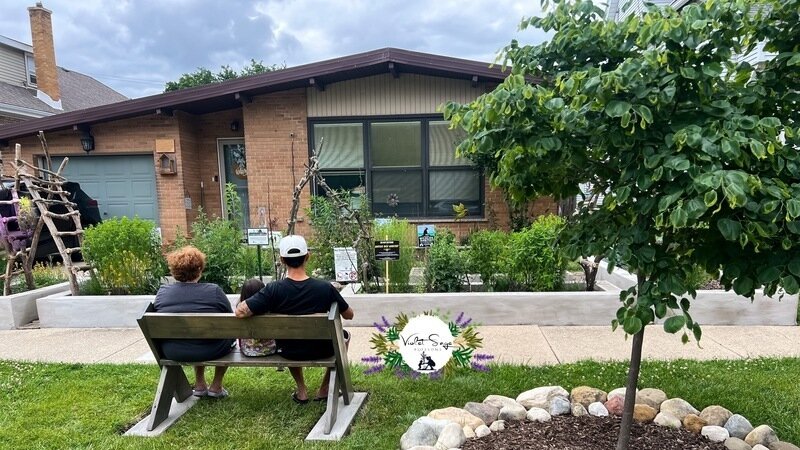
Hi all, we’ve reached 88 signatures on this petition in less then two days—thank you so much for your support!
Bench updates…
I met with Nichols Walny (Director of Community Development and Zoning) and Rudy Repa, AICP (Senior Planner, Village of Franklin Park
Dept. of Community Development & Zoning)
Tuesday at 3:45PM. Both have informed me that they are not in charge of writing ordinances and it was brought to their attention that this ordinance in Franklin park exists but it was written in 1984/1985.
• 7-6-2. - Private placement prohibited.
It shall be unlawful for any person to place, or cause to be placed, any bench within the right-of-way of any public street or roadway within the village. This prohibition shall apply to all benches, including those displaying advertising matter, but shall not apply where the placement is with the prior written direction or authorization of the corporate authorities of the village.
(Ord. 8485 MC 26, § 1)
Now it states clearly that someone can acquire written consent, which they were doing when they had me apply for the permit. They’ve done it for businesses in the community, but again, someone is telling them no because of one complaint by a dog walker who has an issue with being told their grown adult son wasn’t cleaning up after their dog and was littering in our neighborhood.
So I’m advised now to go to the village board to ask permission. Next meeting is Tuesday September 8th, at 7pm. Located at the Police Station
9541 Belmont Avenue
Franklin Park, US-IL, 60131
I am told to use public comment to go in front of the board about my bench and will only be allowed 2mins.
I would love to have others who have used the bench, seen the bench and my garden come and also give their public comment for 2 mins.
Local government exists to serve the public, which requires a strong commitment to hearing and addressing resident feedback. The majority overwhelmingly is voting ‘yes' to praise the bench. Because only one person voted 'no,' leadership should listen to the majority and act accordingly."
Now, when you look around our town at the benches we have, are they located somewhere quiet—somewhere facing directly into a garden space? Or are they facing busy streets, looking at bars, liquor stores, and apartment buildings?
Well-placed benches create welcoming, accessible, and inclusive environments for everyone. By serving as essential resting spots, they help seniors and individuals with mobility challenges navigate public spaces, provide convenient seating for families, and encourage all visitors to safely enjoy and linger in the community.
Why Strategic Placement Matters
Universal Access: Benches provide frequent resting intervals, reducing fatigue for those walking or pushing strollers.
Social Connection: Grouped or facing benches encourage community interaction and provide a quiet space to observe surroundings.
Safety & Wayfinding: Strategically located benches help guide pedestrian flow and offer defined, safe boundaries in heavy-traffic areas.
Research from the Project for Public Spaces (PPS) focuses on placemaking—a collaborative process that capitalizes on a local community’s assets, inspiration, and potential to create public spaces that promote health, happiness, and well-being.
Core Research & Findings
The State of Public Space: Surveys conducted by PPS indicate that public spaces act as critical "multi-solvers" capable of addressing public health, social isolation, and local economic needs, though many professionals report that ongoing disinvestment and broken funding systems threaten these vital civic structures.
William H. Whyte’s Observational Foundation: Rooted in the pioneering urban research of William H. Whyte in the 1960s and 70s, PPS research highlights that successful, sociable spaces depend on human scale, seating options, food, sun/shade choices, and activity clustering (triangulation).
Lighter, Quicker, Cheaper (LQC): PPS advocates for low-cost, short-term interventions—such as temporary seating, pop-up markets, or localized greenery—as living laboratories that empower communities and test ideas before committing to long-term capital investments.
Social and Economic Impacts: Their collaborative frameworks show that active public spaces foster community attachment, support small-scale local economies, and bridge social divides by encouraging casual, low-key interactions among diverse groups of people.
Please help us keep the momentum going by sharing? Posting to Facebook groups, Instagram stories or sending it directly via text or email all make a big difference.
Thanks for being part of this!