Petition updateTell the City we want Oak Street Bicycle and Pedestrian ImprovementsLast Day to Write Your Letter of Support

Drew BryckUnited States
Apr 7, 2017
Hi Guys,
I Encourage you to write a personal note to the email list from the last post on the last day of public comment.
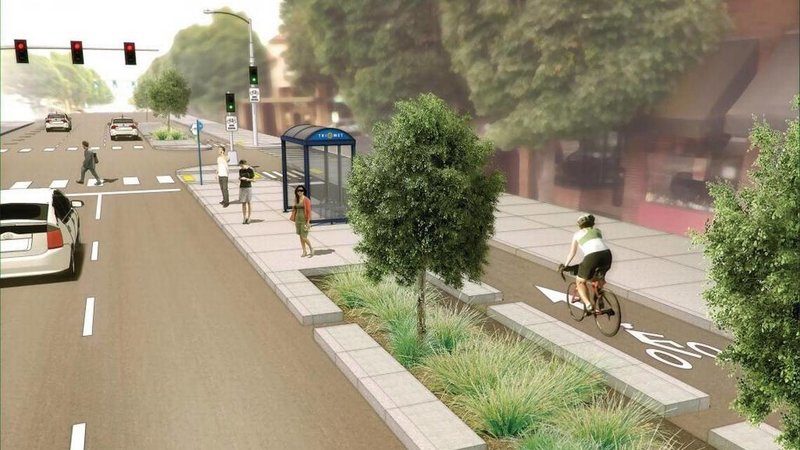
Remember they city was planning on adding their standard bike lanes to the street. So we are writing in support of buffered/protected bike lanes. The chicanes are an element that was not on their plan so mention those. They are also hesitant about adding street trees so you should mention that walkable streets are only as good as the shade that is provided on them.
Just an FYI, the city HAS been good to work with. This is not adversarial. We just need to build support to get them outside their comfort zone for building standard streets.
I have done some research and put together a list of citations you could use if you are planning on writing an email. Citing the city's own plans is a powerful way to encourage them to implement the words they write. Let's help the city get a complete street demonstration area and maybe it will gradually become easier for them to consider these actions for other streets in the future. The first one is the hardest!
Urban tree planting – the benefits outweigh the costs to Phoenix. Cities across the globe are seeing rising temperatures, in part, as a result of the Urban Heat Island (UHI) e ect. 1 This phenomenon is largely due to urban infrastructure like roads, buildings, and sidewalks re-emitting heat at night that they absorbed throughout the day. Now, more than ever, we need to start bringing Nature’s valuable, cooling powerhouse into our cities – trees are back!
https://www.phoenix.gov/parkssite/Documents/Infographic%20-%20Urban%20Forestry%20-%20Benefits%20vs%20Costs.pdf
For the City of Phoenix, the primary focus of street design will no longer be solely on the speed and efficiency of automobile travel, but on the safety and comfort of all users of the public right-of-way (ROW). Phoenicians have been slowly making the shift towards a more multi-modal way of living, meaning that more and more people are beginning to incorporate some level of active transportation into their lives via walking or bicycling in order to reap the benefits of a healthy lifestyle, connect with the community, and improve overall quality of life.
https://www.phoenix.gov/streets/whats-new/complete-streets
(G) The City shall design streets with a strong sense of place using landscaping, streetscape amenities, public art, signage, and other amenities to reflect the community and neighborhood.
https://www.phoenix.gov/streetssite/Documents/100667.pdf
Encourage centers to provide a pedestrian environment with plazas, common open space, shaded walkways, separation of pedestrian and vehicular traffic, bicycle parking, and vehicle parking in architecturally disguised structures or underground where feasible. Promote development in compact cores, centers and corridors that are connected by roads and transit, and are designed to encourage walking and bicycling. Pg 62
Investment in trees and shade is one of the best things Phoenix can do to improve the city’s overall health, prosperity and environment. By integrating trees and shade into the built environment, issues such as storm water management and the urban heat island can be addressed. Integrate trees and shade into the design of new development and redevelopment projects throughout Phoenix. Study and explore options to increase shade canopy, by developing street design standards to increase the number of trees planted along all public streets and minimize or mitigate the impacts of expansive paving.Pg. 140
https://www.phoenix.gov/pddsite/Documents/PlanPhx%20Draft%20General%20Plan%20Update.pdf
Space for buffered bicycle lanes can be created by reallocating existing roadway space, e.g., by narrowing other travel lanes, removing travel lanes, and/or reconfiguring parking lanes. Pg 83.
https://www.phoenix.gov/streetssite/Documents/2014bikePHX_DraftFinalReport_web.pdf
What are we doing now?
Phoenix is achieving these goals by providing safe, clean, efficient, sustainable, multi-modal surface transportation systems consistent with Complete Streets policies to support mobility needs of present and future residents, businesses, and visitors within the city of Phoenix.
https://www.phoenix.gov/sustainability/transportation
Shade: Minimum 75% of the sidewalk should be shaded (can be structural or landscaping). The standards are already part of the Interim Transit Oriented Overlay Districts.
https://www.phoenix.gov/pddsite/Documents/pdd_pz_pdf_00406.pdf
Bicycle Infrastructure
The Council-adopted Bicycle Master Plan included a prioritized bicycle project list for phased implementation to ensure the City has a complete and connected bicycle facility network. Transportation 2050 funding will ensure the Bicycle Master Plan and its projects will be funded. New bicycle lanes will be installed as part of stand-alone projects in the Bicycle Master Plan, and also as overlay and pavement maintenance activities are executed.
https://www.phoenix.gov/T2050/Elements
Arizona State University and the forestry team have worked together to illustrate the importance of Urban Tree Planting and to share their findings that both the financial, environmental, and social benefits of planting the right trees in the urban environment will greatly outweigh the cost of the tree planting and maintenance.
https://www.phoenix.gov/parks/parks/urban-forest
The City of Phoenix’s Cool Urban Spaces Report (2014) investigated the impact of the Phoenix Cool Roofs and Tree and Shade Master Plan initiatives on the city. The study evaluated how these heat mitigation efforts affect microclimates and human thermal comfort in the Phoenix metropolitan area. These findings are especially relevant as rapid and extensive urbanization has led to an urban heat island (UHI) effect that has increased steadily at approximately 0.9°F per decade… This indicates that the combination of increased tree canopy cover and cool roofs does lower temperatures as well as reduce the demand for air conditioning, thereby reducing anthropogenic heat.
https://www.phoenix.gov/parkssite/MediaAssets/NOAA_PHX_UrbanSpaces_HighRes_Rep.pdf
Christopher Boone, dean of Arizona State University’s School of Sustainability, said “walkability” is increasingly becoming a focus in cities across the country. He cited New York City, San Francisco and Portland as examples of successful walkable regions. Real-estate sites like Zillow include a “walk score” for neighborhoods, showing the demand for pedestrian-friendly development.
“It’s something that people are putting value on,” Boone said. “People want to live in walkable neighborhoods, and it’s also becoming increasingly important for the next generation of Millennials who don’t see the need to own a car. They would rather live in a dense, walkable neighborhood than in homogeneous suburbs.”
http://azbigmedia.com/azre-magazine/downtown-phoenix-development-shows-need-walkable-streets
Copy link
WhatsApp
Facebook
Nextdoor
Email
X