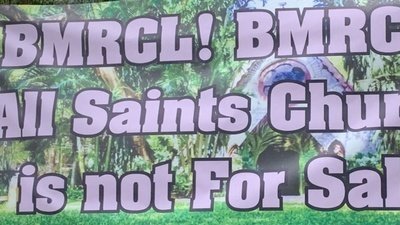
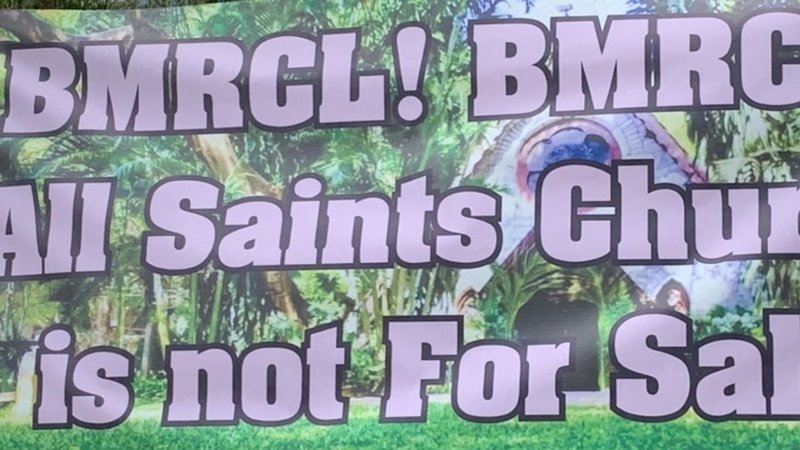
Urgent appeal to Save Historic Heritage All Saints Church from Bangalore Metro Station
The Issue
To:
Shri. Basavaraj Bommai
Chief Minister of Karnataka
24th November 2021
Respected Sir,
We are shocked to learn that the Karnataka Industrial Area Development Board (KIADB) proposes to permanently acquire 883 sq. m. of the biodiversity rich, verdant and tranquil sacred grove of All Saints Church campus in the middle of Bangalore for the construction of a Metro station by Bangalore Metro Rail Corporation Ltd.
The undersigned fervently appeal to you to immediately intervene and protect this amazing garden and historic church from certain ruin and destruction. Such a decision will also send a global message that the Government of Karnataka builds public utilities like Namma Metro by safeguarding sacred spaces, and without destroying living heritage and very few biodiversity rich spaces that still remain in the metropolis.
We say this because we sincerely believe Namma Metro is a public utility that ought to be built lawfully and following the best standards for improving the quality of life of all residents in this sprawling metropolis. We believe the Metro, when built with sensitivity required of such mega projects, can secure a better Bengaluru. A key to this is to ensure public involvement in decision making is integral to how the system is shaped, and public aspirations are respected.
The Government of India and Government of Karnataka secured financing to the extent of Euro 500 million R-6 Line of Phase II of the project from the European Investment Bank (EIB). This loan was taken on grounds the project will be built and operationalised in strict compliance with law, and following applicable techno-economic, planning, environmental and financing standards. In the financial contract, BMRCL commits to implementing the project in accordance with the approved Detailed Project Report (DPR), the land use plan of Bengaluru and in conformance with applicable law and Court directives. Equally importantly, BMRCL committed to respecting protection of irreplaceable living heritage and biodiversity of the city - on equal terms with advancement of public transport objectives.
Over the past two years, the congregation of All Saints Church, and various other groups and individuals, have been drawing attention every day to the fact that BMRCL proposes to build the ‘Vellara Junction’ station inside All Saints Church’s verdant campus. It has been repeatedly highlighted that the station construction would result in desecrating and destroying the sacred grove which has been the place for thousands of Christian fellowships and Eucharistic celebrations, where weddings and births have been celebrated, and where families and friends have grieved on the departure of their near and dear ones.
This sacred grove has also been a place where children from the Church run Special School and elders from the Old Age Home which is located next to the church, spend quality time. This is a site of extraordinary biodiversity with studies revealing over 100 species of trees, some over 150 years old, forming an intricate and complex micro-ecosystem. This space supports at least 25 species of birds, and forms a critical link to their movements. The All Saints Church sacred grove thus is as critical an urban ecosystem as are spaces like Cubbon Park and Lalbagh.
The proposal to locate the station within the church campus is violative of the designated land use of the space. As per the Comprehensive Development Plan, the space must always be used for a church and church related activities. Every land use plan detailed by Bangalore Development Authority since 1985. In the Draft Revised Master Plan 2031, the church has been designated as a Heritage zone. Moreover, the conditions under which the Ministry of Defence allowed the church to come up within the military cantonment 150 years ago, is that the land shall always only be used for the church and no other purpose.
According to the Indian National Trust for Art and Cultural Heritage (INTACH), “the church is significant for being designed by the celebrated architect Robert Fellowes Chisholm, one of the pioneers of the so-called Indo-Saracenic style. To the best of our knowledge, All Saints’ Church is the only building designed by Chisholm in Bengaluru.” INTACH further states: “The garden provides the setting for and hence enhances the character of the heritage building. It is also an essential part of the religious and social life of the church members. Several functions of the congregation are conducted here. It is also often resorted to by members for its peace and solitude. This grove is one of the important biodiversity hotspots in the city, important for both its trees and the rich birdlife that it supports, and is therefore of great significance to Bengaluru.” They go on to say that “the truss system in the church is an unusual one. …. (and) to our knowledge, the only building in Bengaluru with this truss form.”
Such land use values have been upheld by the Karnataka High Court in its final ruling in Environment Support Group v. BMRCL (WP 13241/2010), and explicitly warning individual officials of BMRCL or any infrastructure development agency against deviating from approved land use plans. This value has also been upheld time and again by the Supreme Court, most recently in Bangalore Mysore Infrastructure Corridor Area Planning Authority v. Nandi Infrastructure Corridor Enterprise Limited. Even the approved DPR of Namma Metro indicates the station cannot be located within the church campus at all - it has to be on across the road.
There are alternatives to the current proposal and they enhance the Metro system’s viability far more than were the station inside the church. For instance, if the Vellara Junction station were located at Hotel Vellara, to the north of Richmond Road, it would vastly improve the utility of the metro system and be equidistant from Langford Road and M. G. Road stations - a requirement for metro stations as per the DPR. The private properties would substantially gain commercially from increased Floor Area Ratio (FAR) and also Transfer of Development Rights (TDR) schemes; there would be massive increase in footfalls - what with over 6000 students more willing to use the Metro daily, which they are unlikely to if they have to cross the busy Richmond Road to access the station; which would substantially reduce private vehicle use, and thus bring down peak hour congestion and consequent air and noise pollution; would absolutely not block traffic flows which is certain to occur at the now proposed location in the church; and would turn the southern extent of Brigade Road region vibrant again.
There is another important consideration that has been overlooked in the proposed decision to locate the station inside All Saints Church. The proposed station box is merely 15-20 metres from the church. It is well known that several stable buildings have developed structural weakness, been flooded, even collapsed, due to Metro construction, when they were as far away as 50 to 200 metres away. Clearly with heavy soil excavation, blasting operations and tunneling, the chances of the fragile church standing remain very slim.
As you are aware, all these concerns over the decision to acquire All Saints Church land and also viable alternatives have been brought to public attention by All Saints Congregation and Environment Support Group in various ways. It has also been the basis of a complaint filed to the EIB Complaint Mechanism. According to the EIB Statement of Environmental and Social Principles and Standards, BMRCL is required to work with great sensitivity when the project impacts local eco-socially important landscapes, cultural heritage and the built environment. The Governments of India and Karnataka have also agreed in the loan agreement confirming they will have BMRCL build Namma Metro “consistent with the National Urban Transport Policy 2006 and Bengaluru Revised City Masterplan to 2031”. But the decision to locate the station in All Saints Church exposes all these commitments as merely ritualistic.
We believe if you visit the Church campus yourself, you will be convinced of the viability of the alternatives proposed, and how this will vastly improve the utility and financial viability of the Metro system. You will also be able to value the tranquil beauty of the sacred grove - a rarity in the city - and how critical it is to protect this heritage church for posterity.
Taking into consideration all of the above, we urge you, with all sincerity and in fervent hope, that you will take the historically wise and legally right decision and direct KIADB to withdraw the emergency land acquisition notice over All Saints Church. We urge you to direct BMRCL to review the alternative of locating the station at Vellara Junction. Such a decision will enhance your image as a protector of Bengaluru’s syncretic tradition and a leader who listens to people’s will and aspirations.

Petition Closed
The Issue
To:
Shri. Basavaraj Bommai
Chief Minister of Karnataka
24th November 2021
Respected Sir,
We are shocked to learn that the Karnataka Industrial Area Development Board (KIADB) proposes to permanently acquire 883 sq. m. of the biodiversity rich, verdant and tranquil sacred grove of All Saints Church campus in the middle of Bangalore for the construction of a Metro station by Bangalore Metro Rail Corporation Ltd.
The undersigned fervently appeal to you to immediately intervene and protect this amazing garden and historic church from certain ruin and destruction. Such a decision will also send a global message that the Government of Karnataka builds public utilities like Namma Metro by safeguarding sacred spaces, and without destroying living heritage and very few biodiversity rich spaces that still remain in the metropolis.
We say this because we sincerely believe Namma Metro is a public utility that ought to be built lawfully and following the best standards for improving the quality of life of all residents in this sprawling metropolis. We believe the Metro, when built with sensitivity required of such mega projects, can secure a better Bengaluru. A key to this is to ensure public involvement in decision making is integral to how the system is shaped, and public aspirations are respected.
The Government of India and Government of Karnataka secured financing to the extent of Euro 500 million R-6 Line of Phase II of the project from the European Investment Bank (EIB). This loan was taken on grounds the project will be built and operationalised in strict compliance with law, and following applicable techno-economic, planning, environmental and financing standards. In the financial contract, BMRCL commits to implementing the project in accordance with the approved Detailed Project Report (DPR), the land use plan of Bengaluru and in conformance with applicable law and Court directives. Equally importantly, BMRCL committed to respecting protection of irreplaceable living heritage and biodiversity of the city - on equal terms with advancement of public transport objectives.
Over the past two years, the congregation of All Saints Church, and various other groups and individuals, have been drawing attention every day to the fact that BMRCL proposes to build the ‘Vellara Junction’ station inside All Saints Church’s verdant campus. It has been repeatedly highlighted that the station construction would result in desecrating and destroying the sacred grove which has been the place for thousands of Christian fellowships and Eucharistic celebrations, where weddings and births have been celebrated, and where families and friends have grieved on the departure of their near and dear ones.
This sacred grove has also been a place where children from the Church run Special School and elders from the Old Age Home which is located next to the church, spend quality time. This is a site of extraordinary biodiversity with studies revealing over 100 species of trees, some over 150 years old, forming an intricate and complex micro-ecosystem. This space supports at least 25 species of birds, and forms a critical link to their movements. The All Saints Church sacred grove thus is as critical an urban ecosystem as are spaces like Cubbon Park and Lalbagh.
The proposal to locate the station within the church campus is violative of the designated land use of the space. As per the Comprehensive Development Plan, the space must always be used for a church and church related activities. Every land use plan detailed by Bangalore Development Authority since 1985. In the Draft Revised Master Plan 2031, the church has been designated as a Heritage zone. Moreover, the conditions under which the Ministry of Defence allowed the church to come up within the military cantonment 150 years ago, is that the land shall always only be used for the church and no other purpose.
According to the Indian National Trust for Art and Cultural Heritage (INTACH), “the church is significant for being designed by the celebrated architect Robert Fellowes Chisholm, one of the pioneers of the so-called Indo-Saracenic style. To the best of our knowledge, All Saints’ Church is the only building designed by Chisholm in Bengaluru.” INTACH further states: “The garden provides the setting for and hence enhances the character of the heritage building. It is also an essential part of the religious and social life of the church members. Several functions of the congregation are conducted here. It is also often resorted to by members for its peace and solitude. This grove is one of the important biodiversity hotspots in the city, important for both its trees and the rich birdlife that it supports, and is therefore of great significance to Bengaluru.” They go on to say that “the truss system in the church is an unusual one. …. (and) to our knowledge, the only building in Bengaluru with this truss form.”
Such land use values have been upheld by the Karnataka High Court in its final ruling in Environment Support Group v. BMRCL (WP 13241/2010), and explicitly warning individual officials of BMRCL or any infrastructure development agency against deviating from approved land use plans. This value has also been upheld time and again by the Supreme Court, most recently in Bangalore Mysore Infrastructure Corridor Area Planning Authority v. Nandi Infrastructure Corridor Enterprise Limited. Even the approved DPR of Namma Metro indicates the station cannot be located within the church campus at all - it has to be on across the road.
There are alternatives to the current proposal and they enhance the Metro system’s viability far more than were the station inside the church. For instance, if the Vellara Junction station were located at Hotel Vellara, to the north of Richmond Road, it would vastly improve the utility of the metro system and be equidistant from Langford Road and M. G. Road stations - a requirement for metro stations as per the DPR. The private properties would substantially gain commercially from increased Floor Area Ratio (FAR) and also Transfer of Development Rights (TDR) schemes; there would be massive increase in footfalls - what with over 6000 students more willing to use the Metro daily, which they are unlikely to if they have to cross the busy Richmond Road to access the station; which would substantially reduce private vehicle use, and thus bring down peak hour congestion and consequent air and noise pollution; would absolutely not block traffic flows which is certain to occur at the now proposed location in the church; and would turn the southern extent of Brigade Road region vibrant again.
There is another important consideration that has been overlooked in the proposed decision to locate the station inside All Saints Church. The proposed station box is merely 15-20 metres from the church. It is well known that several stable buildings have developed structural weakness, been flooded, even collapsed, due to Metro construction, when they were as far away as 50 to 200 metres away. Clearly with heavy soil excavation, blasting operations and tunneling, the chances of the fragile church standing remain very slim.
As you are aware, all these concerns over the decision to acquire All Saints Church land and also viable alternatives have been brought to public attention by All Saints Congregation and Environment Support Group in various ways. It has also been the basis of a complaint filed to the EIB Complaint Mechanism. According to the EIB Statement of Environmental and Social Principles and Standards, BMRCL is required to work with great sensitivity when the project impacts local eco-socially important landscapes, cultural heritage and the built environment. The Governments of India and Karnataka have also agreed in the loan agreement confirming they will have BMRCL build Namma Metro “consistent with the National Urban Transport Policy 2006 and Bengaluru Revised City Masterplan to 2031”. But the decision to locate the station in All Saints Church exposes all these commitments as merely ritualistic.
We believe if you visit the Church campus yourself, you will be convinced of the viability of the alternatives proposed, and how this will vastly improve the utility and financial viability of the Metro system. You will also be able to value the tranquil beauty of the sacred grove - a rarity in the city - and how critical it is to protect this heritage church for posterity.
Taking into consideration all of the above, we urge you, with all sincerity and in fervent hope, that you will take the historically wise and legally right decision and direct KIADB to withdraw the emergency land acquisition notice over All Saints Church. We urge you to direct BMRCL to review the alternative of locating the station at Vellara Junction. Such a decision will enhance your image as a protector of Bengaluru’s syncretic tradition and a leader who listens to people’s will and aspirations.
The Decision Makers

Petition Updates
Share this petition
Petition created on 24 November 2021