

Character Education, Not Indoctrination: Teach Children HOW to Think, Not WHAT to Think
The Issue
On October 16, 2025, two days after a fourteen-year-old boy stabbed a sixteen-year-old girl to death in a Petaling Jaya classroom, and less than two weeks after four teenage boys gang-raped a fifteen-year-old girl in a Melaka school—filming the assault and sharing it online—Education Minister Fadhlina Sidek stood in Parliament.
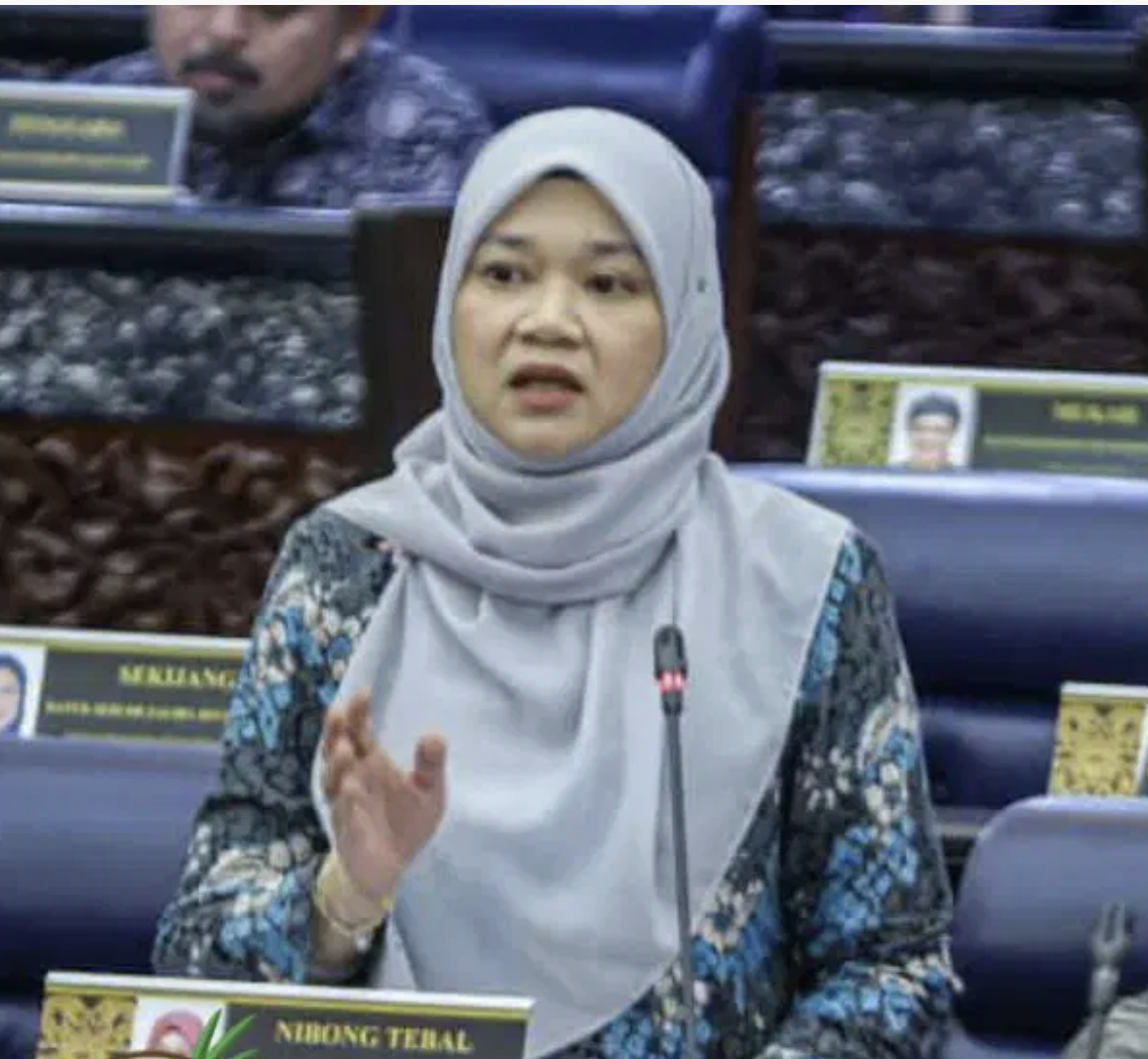
In responding to a question from YB Temerloh about how she would enhance students' morality and sense of identity in schools, she announced a solution to Malaysia's education crisis:
A new subject called Character Education, to be implemented starting in 2026.
The timing was not coincidental.
The pattern was familiar.
When schools fail catastrophically, when children are raped or murdered within institutional walls, when the nation recoils in horror—the Ministry of Education announces a curriculum fix along hastily introduced reform measures taken in reaction to the news.
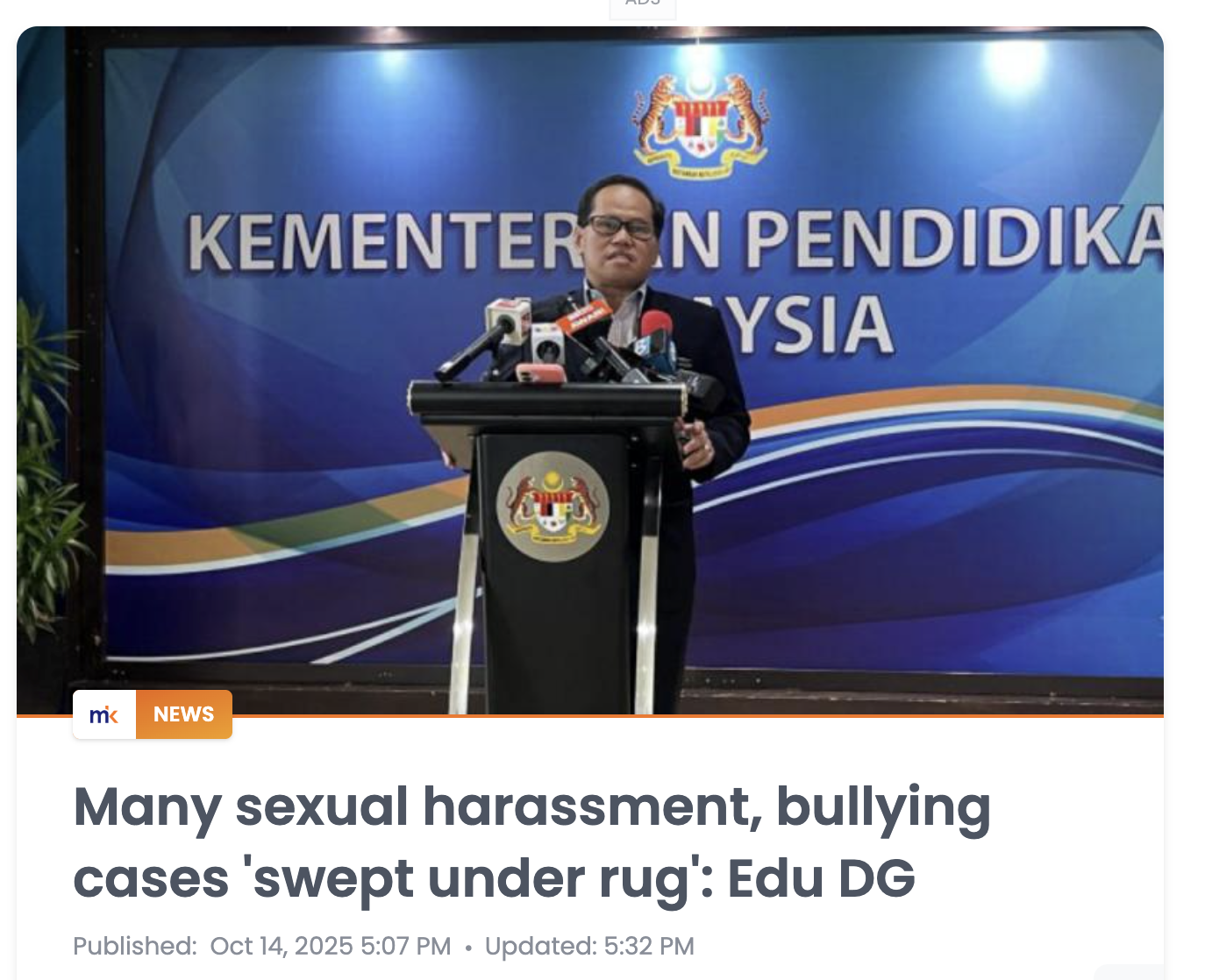
Parents do not receive accountability for administrators who covered up years of warning signs - only clarifications to indicate that her Education Director General had been 'misunderstood' when he talked about how sexual harassment and bullying cases were being swept under the rug.
And so here we are.
A new subject. Another examined course.
More content for teachers to deliver, more material for students to absorb despite the existence of subjects such as Pendidikan Moral, Pendidikan Islam, and Pendidikan Sivik to produce "students who are not only academically capable, but also kind, resilient, and grounded in strong moral values.", to be rolled out in preschools beginning from 2026 after an effort initiated in 2023 for which surveys were conducted and 61000 respondents were consulted...
Yet mysteriously, the public and parents know next to nothing about that curriculum in any depth despite two years of this engagement process.
What We Demand
Before detailing why this matters, here is what must happen immediately:
1. HALT THE 2026 ROLLOUT of Pendidikan Karakter until genuine consultation—not a survey, not a press conference, but actual dialogue with parents, teachers, students, and diverse community stakeholders—has occurred.
2. PUBLISH THE CURRICULUM in full.
What will be taught? Who designed it? What "character" and whose "values" are we talking about?
Are there any biases that exist in the curriculum? How will it be implemented?
No implementation without transparency, as we must ensure that students are educated, not indoctrinated, and a lack of a published curriculum raises the possibility that the curriculum will entail a science taken in the direction of presenting assertions as if they are facts or realities, even if they are contentious.
3. LEARN FROM FAILURE by conducting an independent review of why Pendidikan Moral, after forty-two years as a mandatory subject, has produced generations of students who can recite definitions of eighteen moral values but has not created a generation that can resist moral decay despite years of investment into this subject and countless hours that could have been better spent otherwise, while assessing why it is that Pendidikan Islam and Pendidikan Sivik have not been sufficient to achieve the stated goals of the Ministry of Education.
4. PROTECT AGAINST INDOCTRINATION by establishing clear criteria: Character education must teach ethical reasoning and critical thinking—how to evaluate moral questions—not impose political positions on contested issues, definitely not religious solidarity disguised as humanitarian values, not "correct" answers to complex questions.
5. GUARANTEE PARENTAL RIGHTS to review all materials, participate in curriculum design, and opt out of content that conflicts with family values without academic penalty to their children.
6. PRIORITIZE SYSTEMS OVER SUBJECTS by fixing what is actually broken—school safety infrastructure, child protection protocols, teacher training and workload, mental health support—before adding another examined course to an already collapsing system.
These are not radical demands.
They are basic expectations of competent governance. If the Ministry believes character education is genuinely about education and not about political expedience, it should welcome this scrutiny. Transparency is not the enemy of good policy. It is the prerequisite.
Why This Matters Now
The Ministry claims character education emerged from "engagement with stakeholders and a nationwide survey with over 61,000 respondents."
This sounds impressive until you realize what it means: data collection, not consultation. Somewhere, someone analyzed survey responses and decided what Malaysian children should learn about morality.
There is no published methodology. No disclosure of how questions were framed.
No indication that those 61,000 people were asked, "Should we create another examined subject?"
Indeed, there should be no reason for why parents should be objecting if the consultation and surveying were comprehensive and representative of the parents and students of Malaysia - which it is not.
The Ministry's track record on rushed curriculum decisions is not encouraging.
Consider the Palestine Solidarity Week of October 2023—launched without parliamentary debate, without parental consultation, ostensibly to teach "humanitarian values and harmony."
Within days, videos emerged of teachers in balaclavas brandishing toy rifles, leading students in chants, turning classrooms into theaters of political performance.
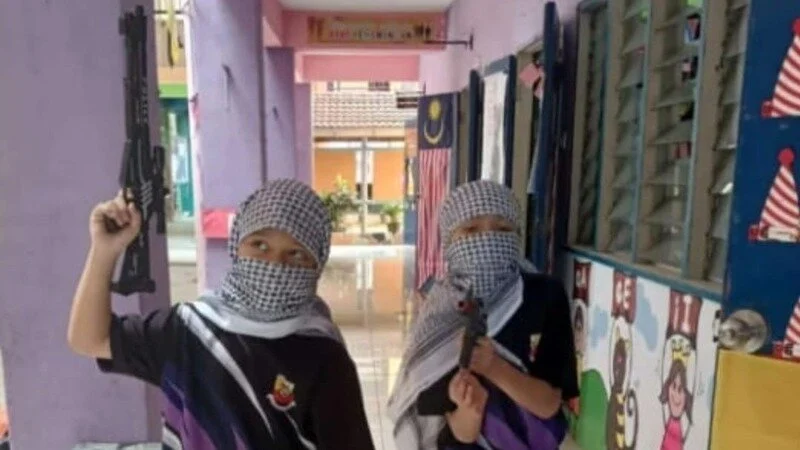
When seventeen civil society organizations and twelve government coalition lawmakers raised concerns, the Education Minister wept in Parliament and told critics to stop "messing with" her schools.
That was not accountability. That was deflection.
Two years later, a singer who suffered detention by Israeli forces stood before the Prime Minister at a solidarity rally and proposed making Palestine a permanent part of the school curriculum—explicitly framing it as Islamic solidarity ("saudara sesama Islam").
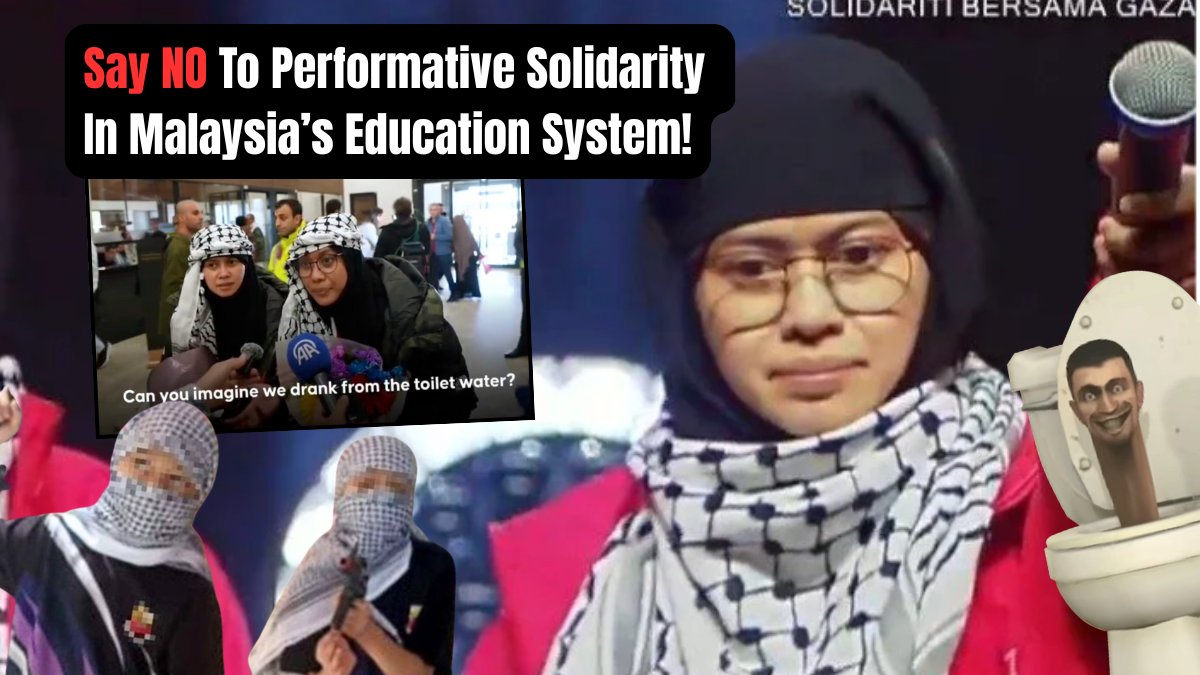
The crowd roared. The PM nodded.
And now, conveniently, character education is being rushed into implementation, with no clarity about what political or religious content might be embedded within it.
Pattern recognition is not paranoia. It is due diligence.
The Failure We Must Not Repeat
Character education is not inherently problematic or wrong in and of itself. However, so as it takes a village to raise a child, it takes an ecosystem to build each child's character.
Character is developed not only in the classroom; it is developed also in the homes of children, by emulation of their role models whether online or offline, whether close by or in the leaders whom they admire in our society.
Moreover, in the classroom context, Malaysia already has character education. It is called Pendidikan Moral and Pendidikan Islam, for Muslim students; Civics is taught, but clearly, none of the learning seems to have mattered.
For non-Muslim students, Moral has been mandatory since 1983.
The syllabus requires memorization of eighteen moral values—responsibility, honesty, tolerance, and so forth—each with Ministry-approved definitions that must be reproduced exactly on examinations.
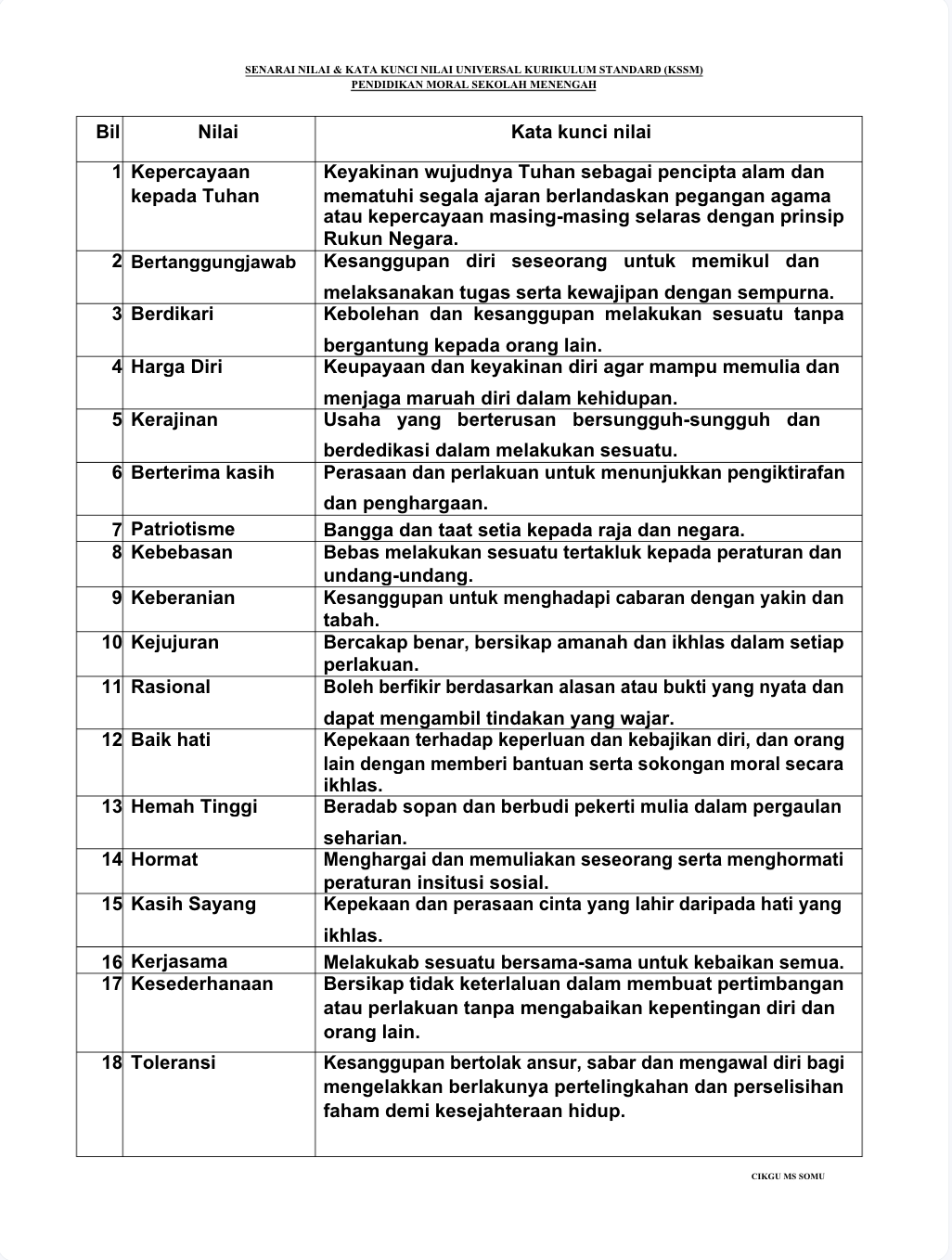
Misspell a word, rephrase a definition without changing its meaning, and no marks are awarded. Teachers focus on exam technique: identifying keywords in scenarios and matching them to the corresponding value.
The consequence?
Students learn the mechanics of appearing moral without engaging with actual ethical reasoning, memorize everything, and then just forget shortly after the exams after having been hyper-focused on details and never on integrating the values they learned into their lives.
After forty-two years of this curriculum, we have achieved what, exactly? The subject exists not to develop character but to fulfill a bureaucratic requirement, to occupy a timeslot, to produce a grade that universities do not value and that employers do not review.
And what of its religious counterpart Pendidikan Islam, institutionalized in schools?
Pendidikan Moral sought to create citizens who could navigate ethical complexity in a multi-religious society, who understood that different communities hold different values while recognizing shared principles of human dignity and mutual respect, and PI aims for the same – but has it completely stopped students from engaging in crimes? Should it have?
If it hasn't, and that isn't the goal, then we must ask:
What really is the goal of these subjects?
Are they not subjects that are supposed to produce students who are not only academically capable, but also kind, resilient, and grounded in strong moral values?
If they weren't, then why continue them in institutionalized form when their informal counterparts in family homes and the company of others would have been sufficient, and with no discernible result that can be statistically established?
Neither subject failed because its goals were wrong, but because they were implemented through an educational system that measures everything by examination results and teaches students that what matters is the grade, not the substance; the definition memorized, not the principle understood; the correct answer on paper, not the ethical choice in life.
Meanwhile, Civics education has fared no better.
Launched with fanfare, it devolved into another rote-learning exercise, teaching students to memorize the Rukun Negara rather than to think critically about citizenship, rights, and responsibilities.
And now, the Ministry proposes to add a fourth subject—Character Education—apparently believing that what failed twice will succeed on the third attempt, if only we rebrand it and implement it more quickly.
This is not education. This is institutional denial masquerading as policy reform.
Before adding another examined subject, before burdening teachers with another curriculum to deliver, before subjecting students to another values course that will be reduced to memorization and exam technique, the Ministry must answer a simple question:
What will make Character Education different from Pendidikan Moral, Pendidikan Islam, and Civics?
Not in name. Not in timing. Not in who teaches it or which students take it. But in substance. In pedagogy. In whether it actually develops character or merely tests the ability to simulate it on exams.
If the answer is "nothing will be different"—if character education becomes another subject where students memorize values they will forget after the exam, another assessment that rewards regurgitation over reasoning, another bureaucratic requirement that exists to satisfy policymakers rather than serve students—then we are not solving the problem. We are repeating it.
As such, we will have wasted resources, exhausted teachers further, and accomplished nothing except the appearance of doing something in the search of a legacy for YB Fadhlina that is better than black shoes, jalur gemilang badges, or singing "We love you PMX!" at a ministry event.
Teachers Cannot Carry What Is Broken
Malaysian teachers manage overcrowded classrooms, navigate outdated infrastructure, coordinate extracurricular activities mandated by administrators, complete endless bureaucratic reporting, and somehow find time to actually teach.
Now it proposes to add character education—a philosophically complex, pedagogically demanding subject requiring teachers to facilitate discussions about ethics, identity, and values across a multi-religious, multi-ethnic classroom—without addressing whether teachers want this, whether they are trained for it, whether they have capacity for it, without accounting to the public how it will do it and upon the basis of what values.
Schools are for education, not indoctrination. They are for teaching students HOW to think, not WHAT to think.
Teaching ethics well is harder than teaching mathematics. Ethical questions have no single correct answer. They require navigating disagreement, modeling intellectual humility, creating space for students to reason through complexity. This cannot be done by teachers who are overworked, under-supported, and handed a curriculum designed by bureaucrats responding to political pressure rather than pedagogical need.
If you genuinely want character education to succeed, you must first fix the conditions that make good teaching possible.
You must reduce teacher workload. You must provide real training. You must give teachers professional autonomy to adapt curriculum to their students' needs rather than dictating scripts to follow. You must trust educators as professionals, not conscript them as government messaging apparatus.
Anything less is setting teachers up to fail—and blaming them when they do.
What Character Education Could Be
We are not opposed to character education. We are opposed to bad character education implemented badly.
Done right, character education would teach students to:
- Recognize ethical dilemmas and analyze them from multiple perspectives
- Understand the difference between facts and values, between what is true and what is good
- Practice empathy without abandoning critical thinking
- Navigate disagreement constructively
- Apply ethical reasoning to real situations they will face
Done right, it would be integrated into existing subjects and school culture rather than isolated in a separate examined course.
It would be modeled by teachers in how they treat students, not delivered through textbooks. It would respect Malaysia's diversity by acknowledging that different communities hold different values, and that pluralism requires negotiating shared principles rather than imposing one group's "character" on everyone else's children.
Done right, it would address the actual problems in Malaysian schools: the culture of silence around abuse, the bullying that schools minimize to protect their reputations, the lack of training in recognizing warning signs of violence, the absence of systems to protect vulnerable children.
But done wrong—done quickly, done politically, done without consultation or accountability—it becomes another failed experiment conducted on our children, another burden placed on our teachers, another evasion of the systemic reforms our education system desperately needs.
The Choice Before Us
Malaysia is at a crossroads.
We can allow the Ministry to rush forward with character education as currently planned—opaque in design, unclear in content, unvetted in pedagogy, implemented by fiat.
Or we can demand better.
Better means consultation that is genuine, not performative.
Better means transparency about what will be taught and why.
Better means learning from past failures rather than repeating them with different labels. Better means fixing systems before adding subjects.
Better means teaching children how to think ethically rather than what political or religious positions to hold.
This petition demands better.
Not because we oppose character education writ large, but because we insist it be education rather than indoctrination.
Not because we distrust teachers, but because we refuse to burden them with poorly designed mandates.
Not because we want less attention to values, but because we want approaches that actually work.
Our children's education is too important to sacrifice on the altar of political expediency.
Our teachers deserve policies developed with their input and expertise.
Our communities deserve a voice in what values are taught to their children.
And our nation deserves an education system that produces citizens capable of ethical reasoning, not subjects who have memorized correct answers to questions that have none.
Sign this petition if you believe Malaysian children should learn how to think, not what to think.
Sign if you believe consultation means dialogue, not data collection.
Sign if you believe transparency is not optional.
Sign if you believe teachers are professionals, not political instruments.
Sign if you believe our children deserve better than rushed reactions to preventable crises.
Schools should educate, not indoctrinate, and students should learn HOW to think, not WHAT to think.
Character education must be educational, not political.
The time to demand this is now—before implementation becomes fait accompli, before another generation of students receives another failed curriculum, before we lose another opportunity to build the education system Malaysia's children actually need.
Upon signing this petition, please consider sharing it widely with your friends and with anyone who disagrees with the status quo of the implementation of this curriculum.
Thank you!

132
The Issue
On October 16, 2025, two days after a fourteen-year-old boy stabbed a sixteen-year-old girl to death in a Petaling Jaya classroom, and less than two weeks after four teenage boys gang-raped a fifteen-year-old girl in a Melaka school—filming the assault and sharing it online—Education Minister Fadhlina Sidek stood in Parliament.
In responding to a question from YB Temerloh about how she would enhance students' morality and sense of identity in schools, she announced a solution to Malaysia's education crisis:
A new subject called Character Education, to be implemented starting in 2026.
The timing was not coincidental.
The pattern was familiar.
When schools fail catastrophically, when children are raped or murdered within institutional walls, when the nation recoils in horror—the Ministry of Education announces a curriculum fix along hastily introduced reform measures taken in reaction to the news.
Parents do not receive accountability for administrators who covered up years of warning signs - only clarifications to indicate that her Education Director General had been 'misunderstood' when he talked about how sexual harassment and bullying cases were being swept under the rug.
And so here we are.
A new subject. Another examined course.
More content for teachers to deliver, more material for students to absorb despite the existence of subjects such as Pendidikan Moral, Pendidikan Islam, and Pendidikan Sivik to produce "students who are not only academically capable, but also kind, resilient, and grounded in strong moral values.", to be rolled out in preschools beginning from 2026 after an effort initiated in 2023 for which surveys were conducted and 61000 respondents were consulted...
Yet mysteriously, the public and parents know next to nothing about that curriculum in any depth despite two years of this engagement process.
What We Demand
Before detailing why this matters, here is what must happen immediately:
1. HALT THE 2026 ROLLOUT of Pendidikan Karakter until genuine consultation—not a survey, not a press conference, but actual dialogue with parents, teachers, students, and diverse community stakeholders—has occurred.
2. PUBLISH THE CURRICULUM in full.
What will be taught? Who designed it? What "character" and whose "values" are we talking about?
Are there any biases that exist in the curriculum? How will it be implemented?
No implementation without transparency, as we must ensure that students are educated, not indoctrinated, and a lack of a published curriculum raises the possibility that the curriculum will entail a science taken in the direction of presenting assertions as if they are facts or realities, even if they are contentious.
3. LEARN FROM FAILURE by conducting an independent review of why Pendidikan Moral, after forty-two years as a mandatory subject, has produced generations of students who can recite definitions of eighteen moral values but has not created a generation that can resist moral decay despite years of investment into this subject and countless hours that could have been better spent otherwise, while assessing why it is that Pendidikan Islam and Pendidikan Sivik have not been sufficient to achieve the stated goals of the Ministry of Education.
4. PROTECT AGAINST INDOCTRINATION by establishing clear criteria: Character education must teach ethical reasoning and critical thinking—how to evaluate moral questions—not impose political positions on contested issues, definitely not religious solidarity disguised as humanitarian values, not "correct" answers to complex questions.
5. GUARANTEE PARENTAL RIGHTS to review all materials, participate in curriculum design, and opt out of content that conflicts with family values without academic penalty to their children.
6. PRIORITIZE SYSTEMS OVER SUBJECTS by fixing what is actually broken—school safety infrastructure, child protection protocols, teacher training and workload, mental health support—before adding another examined course to an already collapsing system.
These are not radical demands.
They are basic expectations of competent governance. If the Ministry believes character education is genuinely about education and not about political expedience, it should welcome this scrutiny. Transparency is not the enemy of good policy. It is the prerequisite.
Why This Matters Now
The Ministry claims character education emerged from "engagement with stakeholders and a nationwide survey with over 61,000 respondents."
This sounds impressive until you realize what it means: data collection, not consultation. Somewhere, someone analyzed survey responses and decided what Malaysian children should learn about morality.
There is no published methodology. No disclosure of how questions were framed.
No indication that those 61,000 people were asked, "Should we create another examined subject?"
Indeed, there should be no reason for why parents should be objecting if the consultation and surveying were comprehensive and representative of the parents and students of Malaysia - which it is not.
The Ministry's track record on rushed curriculum decisions is not encouraging.
Consider the Palestine Solidarity Week of October 2023—launched without parliamentary debate, without parental consultation, ostensibly to teach "humanitarian values and harmony."
Within days, videos emerged of teachers in balaclavas brandishing toy rifles, leading students in chants, turning classrooms into theaters of political performance.
When seventeen civil society organizations and twelve government coalition lawmakers raised concerns, the Education Minister wept in Parliament and told critics to stop "messing with" her schools.
That was not accountability. That was deflection.
Two years later, a singer who suffered detention by Israeli forces stood before the Prime Minister at a solidarity rally and proposed making Palestine a permanent part of the school curriculum—explicitly framing it as Islamic solidarity ("saudara sesama Islam").
The crowd roared. The PM nodded.
And now, conveniently, character education is being rushed into implementation, with no clarity about what political or religious content might be embedded within it.
Pattern recognition is not paranoia. It is due diligence.
The Failure We Must Not Repeat
Character education is not inherently problematic or wrong in and of itself. However, so as it takes a village to raise a child, it takes an ecosystem to build each child's character.
Character is developed not only in the classroom; it is developed also in the homes of children, by emulation of their role models whether online or offline, whether close by or in the leaders whom they admire in our society.
Moreover, in the classroom context, Malaysia already has character education. It is called Pendidikan Moral and Pendidikan Islam, for Muslim students; Civics is taught, but clearly, none of the learning seems to have mattered.
For non-Muslim students, Moral has been mandatory since 1983.
The syllabus requires memorization of eighteen moral values—responsibility, honesty, tolerance, and so forth—each with Ministry-approved definitions that must be reproduced exactly on examinations.
Misspell a word, rephrase a definition without changing its meaning, and no marks are awarded. Teachers focus on exam technique: identifying keywords in scenarios and matching them to the corresponding value.
The consequence?
Students learn the mechanics of appearing moral without engaging with actual ethical reasoning, memorize everything, and then just forget shortly after the exams after having been hyper-focused on details and never on integrating the values they learned into their lives.
After forty-two years of this curriculum, we have achieved what, exactly? The subject exists not to develop character but to fulfill a bureaucratic requirement, to occupy a timeslot, to produce a grade that universities do not value and that employers do not review.
And what of its religious counterpart Pendidikan Islam, institutionalized in schools?
Pendidikan Moral sought to create citizens who could navigate ethical complexity in a multi-religious society, who understood that different communities hold different values while recognizing shared principles of human dignity and mutual respect, and PI aims for the same – but has it completely stopped students from engaging in crimes? Should it have?
If it hasn't, and that isn't the goal, then we must ask:
What really is the goal of these subjects?
Are they not subjects that are supposed to produce students who are not only academically capable, but also kind, resilient, and grounded in strong moral values?
If they weren't, then why continue them in institutionalized form when their informal counterparts in family homes and the company of others would have been sufficient, and with no discernible result that can be statistically established?
Neither subject failed because its goals were wrong, but because they were implemented through an educational system that measures everything by examination results and teaches students that what matters is the grade, not the substance; the definition memorized, not the principle understood; the correct answer on paper, not the ethical choice in life.
Meanwhile, Civics education has fared no better.
Launched with fanfare, it devolved into another rote-learning exercise, teaching students to memorize the Rukun Negara rather than to think critically about citizenship, rights, and responsibilities.
And now, the Ministry proposes to add a fourth subject—Character Education—apparently believing that what failed twice will succeed on the third attempt, if only we rebrand it and implement it more quickly.
This is not education. This is institutional denial masquerading as policy reform.
Before adding another examined subject, before burdening teachers with another curriculum to deliver, before subjecting students to another values course that will be reduced to memorization and exam technique, the Ministry must answer a simple question:
What will make Character Education different from Pendidikan Moral, Pendidikan Islam, and Civics?
Not in name. Not in timing. Not in who teaches it or which students take it. But in substance. In pedagogy. In whether it actually develops character or merely tests the ability to simulate it on exams.
If the answer is "nothing will be different"—if character education becomes another subject where students memorize values they will forget after the exam, another assessment that rewards regurgitation over reasoning, another bureaucratic requirement that exists to satisfy policymakers rather than serve students—then we are not solving the problem. We are repeating it.
As such, we will have wasted resources, exhausted teachers further, and accomplished nothing except the appearance of doing something in the search of a legacy for YB Fadhlina that is better than black shoes, jalur gemilang badges, or singing "We love you PMX!" at a ministry event.
Teachers Cannot Carry What Is Broken
Malaysian teachers manage overcrowded classrooms, navigate outdated infrastructure, coordinate extracurricular activities mandated by administrators, complete endless bureaucratic reporting, and somehow find time to actually teach.
Now it proposes to add character education—a philosophically complex, pedagogically demanding subject requiring teachers to facilitate discussions about ethics, identity, and values across a multi-religious, multi-ethnic classroom—without addressing whether teachers want this, whether they are trained for it, whether they have capacity for it, without accounting to the public how it will do it and upon the basis of what values.
Schools are for education, not indoctrination. They are for teaching students HOW to think, not WHAT to think.
Teaching ethics well is harder than teaching mathematics. Ethical questions have no single correct answer. They require navigating disagreement, modeling intellectual humility, creating space for students to reason through complexity. This cannot be done by teachers who are overworked, under-supported, and handed a curriculum designed by bureaucrats responding to political pressure rather than pedagogical need.
If you genuinely want character education to succeed, you must first fix the conditions that make good teaching possible.
You must reduce teacher workload. You must provide real training. You must give teachers professional autonomy to adapt curriculum to their students' needs rather than dictating scripts to follow. You must trust educators as professionals, not conscript them as government messaging apparatus.
Anything less is setting teachers up to fail—and blaming them when they do.
What Character Education Could Be
We are not opposed to character education. We are opposed to bad character education implemented badly.
Done right, character education would teach students to:
- Recognize ethical dilemmas and analyze them from multiple perspectives
- Understand the difference between facts and values, between what is true and what is good
- Practice empathy without abandoning critical thinking
- Navigate disagreement constructively
- Apply ethical reasoning to real situations they will face
Done right, it would be integrated into existing subjects and school culture rather than isolated in a separate examined course.
It would be modeled by teachers in how they treat students, not delivered through textbooks. It would respect Malaysia's diversity by acknowledging that different communities hold different values, and that pluralism requires negotiating shared principles rather than imposing one group's "character" on everyone else's children.
Done right, it would address the actual problems in Malaysian schools: the culture of silence around abuse, the bullying that schools minimize to protect their reputations, the lack of training in recognizing warning signs of violence, the absence of systems to protect vulnerable children.
But done wrong—done quickly, done politically, done without consultation or accountability—it becomes another failed experiment conducted on our children, another burden placed on our teachers, another evasion of the systemic reforms our education system desperately needs.
The Choice Before Us
Malaysia is at a crossroads.
We can allow the Ministry to rush forward with character education as currently planned—opaque in design, unclear in content, unvetted in pedagogy, implemented by fiat.
Or we can demand better.
Better means consultation that is genuine, not performative.
Better means transparency about what will be taught and why.
Better means learning from past failures rather than repeating them with different labels. Better means fixing systems before adding subjects.
Better means teaching children how to think ethically rather than what political or religious positions to hold.
This petition demands better.
Not because we oppose character education writ large, but because we insist it be education rather than indoctrination.
Not because we distrust teachers, but because we refuse to burden them with poorly designed mandates.
Not because we want less attention to values, but because we want approaches that actually work.
Our children's education is too important to sacrifice on the altar of political expediency.
Our teachers deserve policies developed with their input and expertise.
Our communities deserve a voice in what values are taught to their children.
And our nation deserves an education system that produces citizens capable of ethical reasoning, not subjects who have memorized correct answers to questions that have none.
Sign this petition if you believe Malaysian children should learn how to think, not what to think.
Sign if you believe consultation means dialogue, not data collection.
Sign if you believe transparency is not optional.
Sign if you believe teachers are professionals, not political instruments.
Sign if you believe our children deserve better than rushed reactions to preventable crises.
Schools should educate, not indoctrinate, and students should learn HOW to think, not WHAT to think.
Character education must be educational, not political.
The time to demand this is now—before implementation becomes fait accompli, before another generation of students receives another failed curriculum, before we lose another opportunity to build the education system Malaysia's children actually need.
Upon signing this petition, please consider sharing it widely with your friends and with anyone who disagrees with the status quo of the implementation of this curriculum.
Thank you!
The Decision Makers

Supporter Voices
Petition Updates
Share this petition
Petition created on 16 October 2025