Challenge Condescension, Not Gender: A Call for More Inclusive Language
The Issue
Petition for More Inclusive Language: Addressing Condescending Communication Regardless of Gender
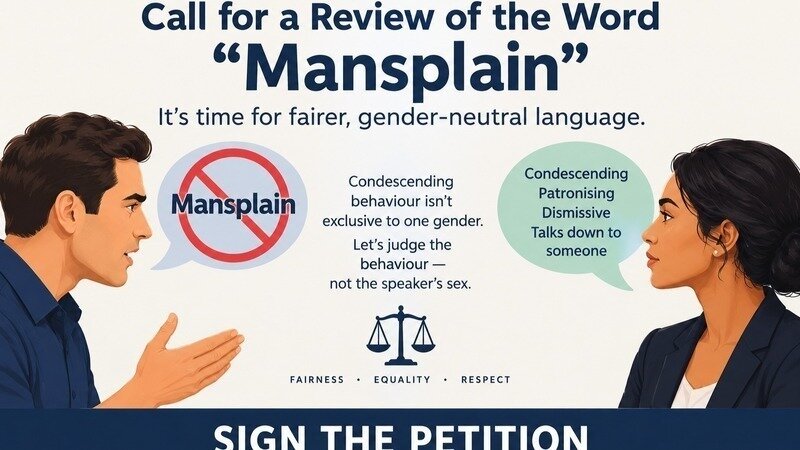
We should challenge condescension, not reinforce gender stereotypes.
I am calling for a broader conversation about the widespread use of the term “mansplaining” and whether gender-specific language is always the most constructive way to describe condescending or patronising communication.
Having personally experienced belittling and condescending behaviour from individuals of different genders, I believe this issue deserves a more inclusive approach. Patronising communication is not exclusive to men. People of any gender can be dismissive, unnecessarily authoritative, over-explanatory, or disrespectful towards others.
The problem is condescension itself, not the gender of the person displaying it.
Language should reflect the complexity of human behaviour
Although the term “mansplaining” was popularised to describe a particular pattern in which a man explains something to someone, often a woman, in a condescending manner or despite their existing knowledge, its widespread use can sometimes encourage overly broad generalisations about men's communication.
There is an important distinction between identifying a genuine gender-related pattern of behaviour and implying that patronising communication is predominantly, or inherently, a male characteristic. Recognising that some people experience gender-based condescension does not require us to overlook the fact that similar behaviour occurs across all genders.
Our language should be precise enough to distinguish between these experiences without inadvertently reinforcing stereotypes about the way men and women communicate.
A more universal approach to respectful communication
Words influence how we interpret other people's intentions and behaviour. When we rely too heavily on gender-specific labels, we risk focusing on the identity of the person speaking rather than the actual conduct that needs to be addressed.
Terms such as condescension, patronising communication, unsolicited over-explaining, and disrespectful dialogue can describe the behaviour directly, regardless of who engages in it.
This approach does not deny that sexism exists or that gender can influence communication. Instead, it encourages us to assess each interaction fairly, consider its context, and hold everyone to the same standard of mutual respect.
What this petition calls for
I urge linguistic experts, educators, social commentators, media organisations, and public communicators to encourage a more thoughtful and inclusive discussion about the use of the term “mansplaining.”
Specifically, I call for:
Greater precision in language: Encouraging descriptions that identify the actual behaviour rather than making unnecessary assumptions based on gender.
Consistent standards of accountability: Recognising and challenging condescending communication regardless of the gender of the person responsible.
Balanced public discussion: Acknowledging gender-related patterns where evidence supports them while avoiding generalisations about entire groups.
A culture of mutual respect: Promoting communication in which people are listened to, treated as individuals, and not unnecessarily belittled or dismissed.
Let us challenge the behaviour, not stereotype the individual.
The goal should not be to silence discussions about sexism or dismiss the experiences of people who have encountered gender-based condescension. Rather, it should be to ensure that our language remains accurate, fair, and inclusive.
We can acknowledge that certain behaviours may occur in particular social or gendered contexts while recognising that no gender has a monopoly on arrogance, condescension, or disrespect.
Respectful communication should be a universal expectation, not a gender-specific standard.
I invite everyone who believes in fairness, consistency, and mutual respect to support a more inclusive approach to discussing condescending behaviour. By choosing language that focuses on actions rather than assumptions, we can encourage more constructive conversations, challenge harmful stereotypes, and foster an environment in which everyone is held to the same standard of respect.
Please support this petition if you believe that condescension should be challenged wherever it occurs, whoever displays it, and that our language should bring people towards mutual understanding rather than unnecessary division.

24
The Issue
Petition for More Inclusive Language: Addressing Condescending Communication Regardless of Gender
We should challenge condescension, not reinforce gender stereotypes.
I am calling for a broader conversation about the widespread use of the term “mansplaining” and whether gender-specific language is always the most constructive way to describe condescending or patronising communication.
Having personally experienced belittling and condescending behaviour from individuals of different genders, I believe this issue deserves a more inclusive approach. Patronising communication is not exclusive to men. People of any gender can be dismissive, unnecessarily authoritative, over-explanatory, or disrespectful towards others.
The problem is condescension itself, not the gender of the person displaying it.
Language should reflect the complexity of human behaviour
Although the term “mansplaining” was popularised to describe a particular pattern in which a man explains something to someone, often a woman, in a condescending manner or despite their existing knowledge, its widespread use can sometimes encourage overly broad generalisations about men's communication.
There is an important distinction between identifying a genuine gender-related pattern of behaviour and implying that patronising communication is predominantly, or inherently, a male characteristic. Recognising that some people experience gender-based condescension does not require us to overlook the fact that similar behaviour occurs across all genders.
Our language should be precise enough to distinguish between these experiences without inadvertently reinforcing stereotypes about the way men and women communicate.
A more universal approach to respectful communication
Words influence how we interpret other people's intentions and behaviour. When we rely too heavily on gender-specific labels, we risk focusing on the identity of the person speaking rather than the actual conduct that needs to be addressed.
Terms such as condescension, patronising communication, unsolicited over-explaining, and disrespectful dialogue can describe the behaviour directly, regardless of who engages in it.
This approach does not deny that sexism exists or that gender can influence communication. Instead, it encourages us to assess each interaction fairly, consider its context, and hold everyone to the same standard of mutual respect.
What this petition calls for
I urge linguistic experts, educators, social commentators, media organisations, and public communicators to encourage a more thoughtful and inclusive discussion about the use of the term “mansplaining.”
Specifically, I call for:
Greater precision in language: Encouraging descriptions that identify the actual behaviour rather than making unnecessary assumptions based on gender.
Consistent standards of accountability: Recognising and challenging condescending communication regardless of the gender of the person responsible.
Balanced public discussion: Acknowledging gender-related patterns where evidence supports them while avoiding generalisations about entire groups.
A culture of mutual respect: Promoting communication in which people are listened to, treated as individuals, and not unnecessarily belittled or dismissed.
Let us challenge the behaviour, not stereotype the individual.
The goal should not be to silence discussions about sexism or dismiss the experiences of people who have encountered gender-based condescension. Rather, it should be to ensure that our language remains accurate, fair, and inclusive.
We can acknowledge that certain behaviours may occur in particular social or gendered contexts while recognising that no gender has a monopoly on arrogance, condescension, or disrespect.
Respectful communication should be a universal expectation, not a gender-specific standard.
I invite everyone who believes in fairness, consistency, and mutual respect to support a more inclusive approach to discussing condescending behaviour. By choosing language that focuses on actions rather than assumptions, we can encourage more constructive conversations, challenge harmful stereotypes, and foster an environment in which everyone is held to the same standard of respect.
Please support this petition if you believe that condescension should be challenged wherever it occurs, whoever displays it, and that our language should bring people towards mutual understanding rather than unnecessary division.
Petition Updates
Share this petition
Petition created on 19 October 2026