Cancel Salina and Saline County's Flock Safety Surveillance Contract
The Issue
Addressed to: The Salina City Commission, the Salina Police Department, the Saline County Commission, and the Saline County Sheriff's Office.
What we are asking
We, the residents of Salina and Saline County, call on our elected and appointed officials to:
- Terminate the City of Salina's contract with Flock Safety at the earliest opportunity the agreement permits.
- Decommission every fixed and stationary automated license plate reader (ALPR) operated by any agency within Saline County, including any separate deployment run by the Sheriff's Office.
- Delete all vehicle location data already collected and stored through these systems, and stop sharing it with any outside agency.
- Publicly disclose every data-sharing agreement now in effect: which outside agencies (state, federal, or private) have queried Salina's ALPR data, how often, and for what stated purpose.
- Adopt a binding policy that no new ALPR contract may be signed without a full public hearing and, ideally, a public vote.
Why this matters
In 2022, Salina installed 22 fixed license plate readers and 2 portable units under a contract with Flock Safety. That agreement expired in April 2026 and was renewed at a higher price (roughly $198,000 for the fixed cameras and $21,000 for the portable ones over three years), even after many residents stood before the commission and asked them not to. This petition exists because that decision does not reflect the will of the people it affects.
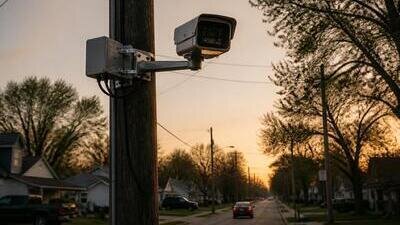
These are not ordinary traffic cameras. A Flock reader photographs every vehicle that passes, not just suspects, and logs the plate number, the exact time, and the exact location. Its software builds what the company calls a "vehicle fingerprint," cataloging a car's make, model, color, and even bumper stickers, so that a person can be tracked even without their plate number. Every one of these records feeds a searchable archive and a networked national database spanning thousands of agencies. In practice, this turns the ordinary act of driving to work, to church, to a clinic, to a protest, or to a friend's home into a permanent, government-held record of where you have been.
This is a Fourth Amendment problem, not a hypothetical one
We know the standard reply: there is no expectation of privacy on a public road, so a camera photographing a plate is fair game. That answer misses what has actually changed.
A single officer noticing a single car on a single street is one thing. A countywide grid of cameras that logs the movements of every resident, every day, and stores it for weeks in a searchable archive is something entirely different in kind. The U.S. Supreme Court recognized exactly this distinction in Carpenter v. United States (2018), holding that assembling a comprehensive record of a person's movements over time is a "search" that requires a warrant, precisely because the whole reveals far more than any single moment ever could. Civil liberties organizations across the spectrum, from the ACLU and the Electronic Frontier Foundation to the libertarian Cato Institute and the Institute for Justice, are now making this same argument in federal court against Flock's dragnet model.
The point is simple. Cameras have no rights. The people they watch do. A tool built to track everyone, all the time, with no warrant and no individualized suspicion, is a general search of the kind the Fourth Amendment was written to forbid. Convenience for investigators does not suspend that principle.
The abuse is not theoretical, and it is happening in Kansas
Supporters ask us to trust that this data will only be used properly. The record does not earn that trust, and the clearest examples are in our own state:
Sedgwick, Kansas: a police chief used the Flock system to stalk a former partner, an abuse that led to disciplinary action and exposed how little stands between an officer and the private movements of anyone they choose to track.Lenexa, Kansas: police used license plate data to open an investigation into a resident who had written a column critical of the department and posted memes near city hall. This is the surveillance apparatus turned against protected speech, exactly the chilling effect that mass tracking makes possible.
Nationally, the concerns are the same and larger. A class action filed in California alleges Flock allowed out-of-state and federal agencies to search one department's database more than 1.6 million times in seven months, in violation of state privacy law. As federal immigration enforcement has intensified, communities across the country have realized that local camera data can be pulled into a federal dragnet with no local control and no notice to residents. Salina's data lives in the same national system.
Salina is not alone, and cancellation works
Cities and towns everywhere are pulling back. More than 80 Flock contracts have been terminated across 28 states in recent years, and at least 30 localities have canceled or deactivated their cameras since the start of 2025 alone. Nearby Weston, Missouri canceled its Flock contract just five months after signing, and paid nothing. Cancellation is not radical. It is what a growing number of communities are choosing once they understand what they actually bought.
The public safety case does not hold up to the cost
We are told these cameras solve crimes. Some investigative value is real, and we do not dismiss it. But the question is not whether a surveillance dragnet is ever useful. Almost any expansion of government surveillance power is useful to someone. The question is whether continuous, warrantless tracking of every resident is a price a free community should pay for it, and whether the roughly $220,000 committed over three years buys enough public safety to justify handing our collective movements to a private company and its national network. We say it does not. Traditional, targeted investigation, backed by warrants and probable cause, protected this county for generations and can do so still.
Our position
Public safety and constitutional liberty are not opposites, and we refuse to trade one away for a false promise of the other. We are not anti-police. We are pro-Fourth Amendment. We are asking our leaders to end a program that treats every resident as a suspect to be logged, and to restore the simple expectation that the government does not track law-abiding people without cause.
Sign this petition to tell the City of Salina and Saline County: cancel the Flock contract, take down the cameras, delete the data, and give us back our privacy.
Sources for verification
Salina contract history and renewal, Salina Post (June 2026): https://salinapost.com/posts/d902070a-cc14-4b63-ac30-a19ef2b8ee3f
Original 2022 authorization, KSAL: https://www.ksal.com/salina-to-install-multiple-cameras/
Kansas and Missouri resident resistance (Sedgwick, Lenexa, Weston), KCUR: https://www.kcur.org/news/2026-06-29/automated-license-plate-readers-alpr-kansas-city-lenexa-weston-police
Contracts canceled nationwide and immigration-data concerns, NPR: https://www.npr.org/2026/02/17/nx-s1-5612825/flock-contracts-canceled-immigration-survillance-concerns
Backlash and 82 terminated contracts, GovTech: https://www.govtech.com/spotlight/why-flock-safety-finds-itself-in-a-surveillance-backlash
California class action over out-of-state data sharing, KTVU: https://www.ktvu.com/news/class-action-lawsuit-alleges-flock-license-plate-readers-violate-ca-law-privacy-residents
Fourth Amendment litigation and the aggregation argument, The Autowire: https://theautowire.com/2026/07/06/the-supreme-court-just-handed-flocks-license-plate-cameras-a-legal-time-bomb/

332
The Issue
Addressed to: The Salina City Commission, the Salina Police Department, the Saline County Commission, and the Saline County Sheriff's Office.
What we are asking
We, the residents of Salina and Saline County, call on our elected and appointed officials to:
- Terminate the City of Salina's contract with Flock Safety at the earliest opportunity the agreement permits.
- Decommission every fixed and stationary automated license plate reader (ALPR) operated by any agency within Saline County, including any separate deployment run by the Sheriff's Office.
- Delete all vehicle location data already collected and stored through these systems, and stop sharing it with any outside agency.
- Publicly disclose every data-sharing agreement now in effect: which outside agencies (state, federal, or private) have queried Salina's ALPR data, how often, and for what stated purpose.
- Adopt a binding policy that no new ALPR contract may be signed without a full public hearing and, ideally, a public vote.
Why this matters
In 2022, Salina installed 22 fixed license plate readers and 2 portable units under a contract with Flock Safety. That agreement expired in April 2026 and was renewed at a higher price (roughly $198,000 for the fixed cameras and $21,000 for the portable ones over three years), even after many residents stood before the commission and asked them not to. This petition exists because that decision does not reflect the will of the people it affects.
These are not ordinary traffic cameras. A Flock reader photographs every vehicle that passes, not just suspects, and logs the plate number, the exact time, and the exact location. Its software builds what the company calls a "vehicle fingerprint," cataloging a car's make, model, color, and even bumper stickers, so that a person can be tracked even without their plate number. Every one of these records feeds a searchable archive and a networked national database spanning thousands of agencies. In practice, this turns the ordinary act of driving to work, to church, to a clinic, to a protest, or to a friend's home into a permanent, government-held record of where you have been.
This is a Fourth Amendment problem, not a hypothetical one
We know the standard reply: there is no expectation of privacy on a public road, so a camera photographing a plate is fair game. That answer misses what has actually changed.
A single officer noticing a single car on a single street is one thing. A countywide grid of cameras that logs the movements of every resident, every day, and stores it for weeks in a searchable archive is something entirely different in kind. The U.S. Supreme Court recognized exactly this distinction in Carpenter v. United States (2018), holding that assembling a comprehensive record of a person's movements over time is a "search" that requires a warrant, precisely because the whole reveals far more than any single moment ever could. Civil liberties organizations across the spectrum, from the ACLU and the Electronic Frontier Foundation to the libertarian Cato Institute and the Institute for Justice, are now making this same argument in federal court against Flock's dragnet model.
The point is simple. Cameras have no rights. The people they watch do. A tool built to track everyone, all the time, with no warrant and no individualized suspicion, is a general search of the kind the Fourth Amendment was written to forbid. Convenience for investigators does not suspend that principle.
The abuse is not theoretical, and it is happening in Kansas
Supporters ask us to trust that this data will only be used properly. The record does not earn that trust, and the clearest examples are in our own state:
Sedgwick, Kansas: a police chief used the Flock system to stalk a former partner, an abuse that led to disciplinary action and exposed how little stands between an officer and the private movements of anyone they choose to track.Lenexa, Kansas: police used license plate data to open an investigation into a resident who had written a column critical of the department and posted memes near city hall. This is the surveillance apparatus turned against protected speech, exactly the chilling effect that mass tracking makes possible.
Nationally, the concerns are the same and larger. A class action filed in California alleges Flock allowed out-of-state and federal agencies to search one department's database more than 1.6 million times in seven months, in violation of state privacy law. As federal immigration enforcement has intensified, communities across the country have realized that local camera data can be pulled into a federal dragnet with no local control and no notice to residents. Salina's data lives in the same national system.
Salina is not alone, and cancellation works
Cities and towns everywhere are pulling back. More than 80 Flock contracts have been terminated across 28 states in recent years, and at least 30 localities have canceled or deactivated their cameras since the start of 2025 alone. Nearby Weston, Missouri canceled its Flock contract just five months after signing, and paid nothing. Cancellation is not radical. It is what a growing number of communities are choosing once they understand what they actually bought.
The public safety case does not hold up to the cost
We are told these cameras solve crimes. Some investigative value is real, and we do not dismiss it. But the question is not whether a surveillance dragnet is ever useful. Almost any expansion of government surveillance power is useful to someone. The question is whether continuous, warrantless tracking of every resident is a price a free community should pay for it, and whether the roughly $220,000 committed over three years buys enough public safety to justify handing our collective movements to a private company and its national network. We say it does not. Traditional, targeted investigation, backed by warrants and probable cause, protected this county for generations and can do so still.
Our position
Public safety and constitutional liberty are not opposites, and we refuse to trade one away for a false promise of the other. We are not anti-police. We are pro-Fourth Amendment. We are asking our leaders to end a program that treats every resident as a suspect to be logged, and to restore the simple expectation that the government does not track law-abiding people without cause.
Sign this petition to tell the City of Salina and Saline County: cancel the Flock contract, take down the cameras, delete the data, and give us back our privacy.
Sources for verification
Salina contract history and renewal, Salina Post (June 2026): https://salinapost.com/posts/d902070a-cc14-4b63-ac30-a19ef2b8ee3f
Original 2022 authorization, KSAL: https://www.ksal.com/salina-to-install-multiple-cameras/
Kansas and Missouri resident resistance (Sedgwick, Lenexa, Weston), KCUR: https://www.kcur.org/news/2026-06-29/automated-license-plate-readers-alpr-kansas-city-lenexa-weston-police
Contracts canceled nationwide and immigration-data concerns, NPR: https://www.npr.org/2026/02/17/nx-s1-5612825/flock-contracts-canceled-immigration-survillance-concerns
Backlash and 82 terminated contracts, GovTech: https://www.govtech.com/spotlight/why-flock-safety-finds-itself-in-a-surveillance-backlash
California class action over out-of-state data sharing, KTVU: https://www.ktvu.com/news/class-action-lawsuit-alleges-flock-license-plate-readers-violate-ca-law-privacy-residents
Fourth Amendment litigation and the aggregation argument, The Autowire: https://theautowire.com/2026/07/06/the-supreme-court-just-handed-flocks-license-plate-cameras-a-legal-time-bomb/
The Decision Makers


Supporter Voices
Petition Updates
Share this petition
Petition created on July 16, 2026